John Martin (1789-1854) understood something modern societies forget:
collapse is not an accident.
The Fall of Babylon; Cyrus the Great defeating the Babylonian army (1831). Mezzotint, depicting the Ziggurat in the background under a dark and stormy sky, with crowds in distress.
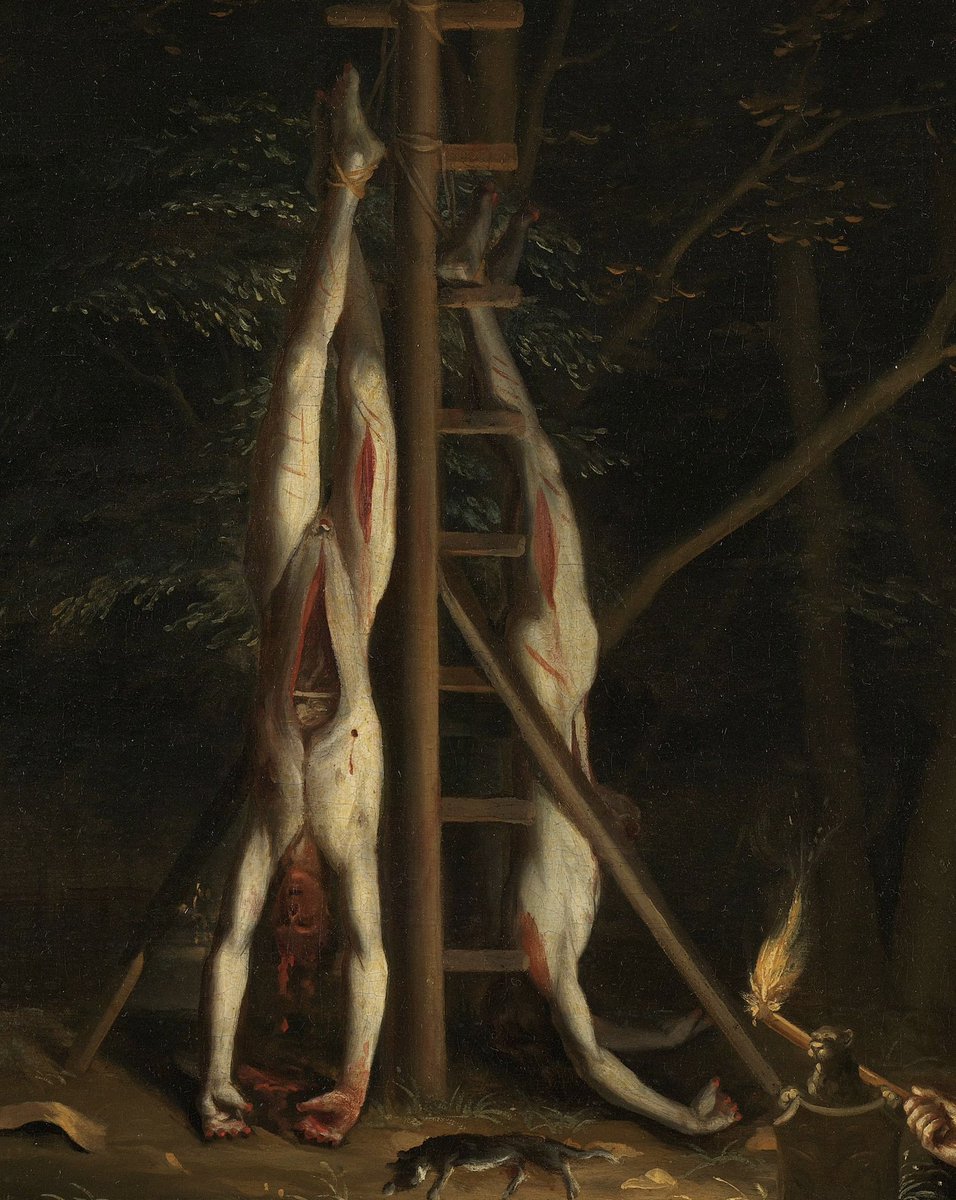
The Corpses of the De Witt Brothers (c. 1672–75)
By
Attributed to Jan de Baen (1633–1702)
The Corpses of the De Witt Brothers, is an oil on canvas painting created by Dutch Golden Age artist Jan de Baen, likely between 1672 and 1675. Currently housed in the Rijksmuseum in Amsterdam, the artwork depicts the dead and mutilated bodies of brothers Johan and Cornelis de Witt, suspended upside down at the Groene Zoodje, the site of their execution located in front of the Gevangenpoort in The Hague.
The two De Witt brothers were prominent figures in Dutch politics and staunch opponents of the House of Orange. They had dominated the political landscape for years but left the nation vulnerable to invasion during the infamous Rampjaar in 1672, when Louis XIV of France launched an attack. On August 20, 1672, a furious mob—supporters of the newly appointed stadtholder William of Orange, who would later become William III of England—lynched the brothers after a series of political events led to their downfall. Following Johan’s forced resignation as Grand Pensionary of Holland on August 4, 1672, Cornelis was accused of treason and sentenced to exile. The brothers were ultimately murdered by an enraged local militia and mob outside the Gevangenispoort.
This painting has been a notable piece in the national history collection since it was purchased by Alexander Gogel in 1802 for nearly 1,000 guilders. It has been continuously displayed, often in rooms dedicated to anatomical themes due to its graphic content. Originally acquired for the National Kunst Galerie in The Hague, the painting faced initial skepticism regarding its attribution and presentation, with Cornelis Sebille Roos recommending that it be covered with a curtain. It was later reattributed to Jan de Baen shortly after its purchase.
Fléau! (1901)
By
Henri Camille Danger (1857-1937)
“Fleau! (Scourge!)” by Henri-Camille Danger is a captivating masterpiece that resides in the prestigious collection of Musee d’Orsay, Paris. This thought-provoking oil on canvas print showcases Danger’s exceptional talent for combining mythology, symbolism, and fine art imagery. The painting immediately draws the viewer’s attention with its striking composition and powerful subject matter.
At its center stands a towering giant, a colossal figure that dominates the canvas, emanating a sense of overwhelming power and dread. This giant, with a menacing countenance and piercing gaze, strides purposefully amidst the carnage and despair that surrounds him. His imposing presence is accentuated by the lifeless bodies strewn at his feet, a grim testament to the havoc he has wrought upon the world.
The dead bodies, rendered with haunting realism, lie in twisted contortions, their faces frozen in expressions of agony and despair. Danger’s masterful brushwork captures every detail – the pallor of death, the gnarled limbs, the vacant stares – evoking a visceral response from the viewer. Each body tells a story of lives cut short, of dreams extinguished, of futures stolen away by the scourge that the giant represents.
Through this mesmerizing piece, Danger invites us to reflect upon the fragility of human existence and our vulnerability to unforeseen catastrophes. The artist masterfully intertwines elements from Greek mythology with contemporary themes to create a timeless narrative that resonates with viewers across generations. The rich symbolism present in ‘Fleau! (Scourge!)’ encourages contemplation about societal issues such as disease outbreaks or political unrest.
Scene from A Midsummer Night’s Dream: Titania and Bottom” (1851)
By
Edwin Landseer (1802–1873)
Edwin Landseer’s Scene from A Midsummer Night’s Dream: Titania and Bottom is an enchanting oil-on-canvas painting that captures a moment from the third act of William Shakespeare’s A Midsummer Night’s Dream. The work, commissioned by engineer Isambard Kingdom Brunel for his London dining room, was part of a series of Shakespearean-themed paintings.
The scene centers on Titania, Queen of the Fairies, who, under the influence of a love potion, lovingly embraces Nick Bottom, who has been transformed with the head of a donkey. The enchanted pair are surrounded by other fairy folk, rabbits, and a lush array of flowers, lending the scene a magical, whimsical atmosphere. Landseer, known primarily for his animal paintings, skillfully incorporates animals into this dreamlike setting, which may have inspired his choice of subject.
First exhibited at the Royal Academy’s summer exhibition in 1851, the painting quickly became a popular success, praised by Queen Victoria and admired by Lewis Carroll, who particularly appreciated the white rabbit depicted—a possible inspiration for Alice’s Adventures in Wonderland.
Measuring 82.0 × 133.0 cm (32.3 × 52.4 in), the painting has passed through numerous notable collections before being acquired by the National Gallery of Victoria, Melbourne, in 1932, where it resides today. Landseer’s intricate brushwork and attention to both animal and human figures make this work a singular contribution to the art inspired by Shakespeare.
Murder in the House (1890)
By
Jakub Schikaneder (1855–1924)
“Murder in the House” (1890), painted by Jakub Schikaneder (1855–1924), is a large, haunting depiction of a gruesome crime scene, possibly in the Jewish quarter of Prague. This oil on canvas measures 203 x 321 cm and is part of the Collection of 19th Century Art and Classical Modernism at the National Gallery.
In the composition, a man gestures towards a lifeless body, eerily pointing back at it. The corpse, its head twisted in its own blood puddle and wrist cast awkwardly backward, lies in a gruesome pose in a courtyard of a dilapidated urban area, which adds to the somber and tragic atmosphere. Surrounding the scene is a crowd of diverse reactions reflecting the aftermath of the shock. Most of them, like the maid with clasped hands and the older man leaning forward, appear contemplative and inquisitive rather than horrified, capturing a moment beyond the initial hysteria.
Interestingly, the majority of the ten characters in the painting seem more focused on the older couple at the front than the lifeless body. The small child, positioned beside the older man near the door, appears particularly fascinated, her gaze firmly fixed on the grim scene. Schikaneder excels in portraying the characters’ emotions and expressions, from the man’s exasperation to the maid’s diplomatic reserve. Their reactions form a coherent and believable ensemble within the context of the horror.
Schikaneder’s work is notable for its narrative strength and vivid sense of realism, often exploring themes of tragedy and the harsh realities of life. This painting delves into the complex range of human emotions and reactions in the face of such a tragedy, making it a profound and intricate work that beckons viewers to explore its details and mysteries.
The Course of Empire: Consummation (1863)
By
Thomas Cole (1801–1848)
“The Consummation of Empire” is the third painting in Thomas Cole’s series “The Course of Empire,” completed in 1836. This oil on canvas piece measures 51 inches in height and 76 inches in width, and it is part of the collection at the New-York Historical Society. The series as a whole illustrates the rise and fall of a fictional civilization, reflecting on the transient nature of empires.
In this central scene, the perspective has shifted to the opposite shore of a river valley where the once-rudimentary village has evolved into a resplendent city. This bustling metropolis, reminiscent of the height of ancient Rome, features a wealth of neoclassical architecture with temples, colonnades, and massive domes. A grand harbor, marked by two imposing pharoi at the entrance, hosts ships with lateen sails.
The painting vibrantly captures a day of public rejoicing and imperial triumph. A scarlet-robed ruler or general is seen in a majestic procession, crossing a bridge with a diverse retinue of soldiers, indicative of the empire’s vast reach. The conqueror, portrayed in a chariot drawn by an elephant, passes under a triumphal arch, surrounded by captives and a procession of guards and senators. The air is filled with the scent of incense, and the waters teem with decorated vessels.
Details are meticulously depicted: senators carry golden treasures, and girls strew flowers around the conqueror. High above, golden trophies catch the sunlight, while festoons and silver censers add to the festive atmosphere. On one side, a large group of white-robed priests surrounds a temple, with smoke rising from sacrificial altars. A statue of Minerva, symbolizing victory, presides over the scene.
In the foreground, an imperial figure watches the procession, surrounded by children and guards. Two boys play at her feet, one sinking a toy boat, symbolizing the unnoticed seeds of the empire’s eventual decline amidst the grandeur and festivity.
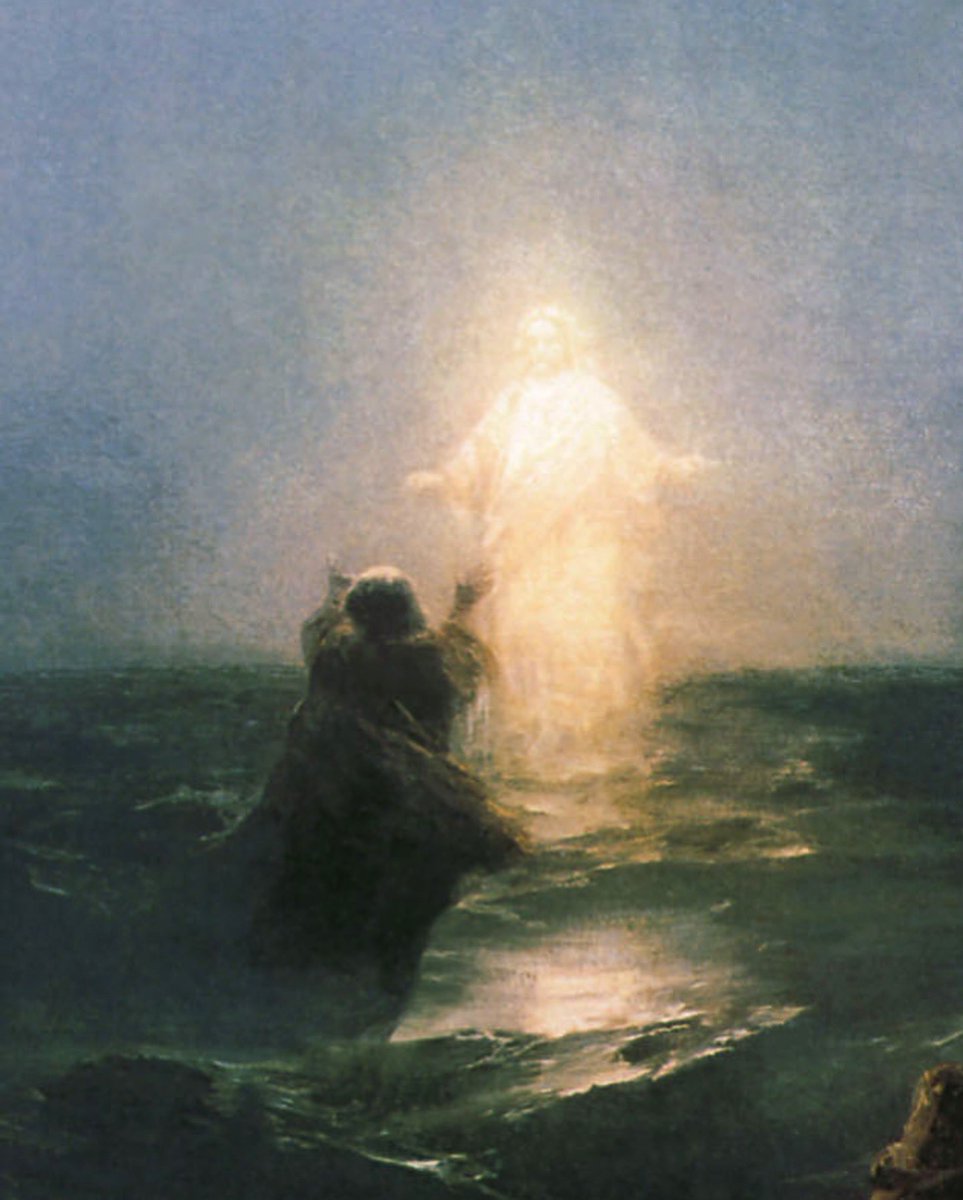
“Хождение по водам” (“Walking on Water”, 1888)
By
Ivan Aivazovsky (1817–1900)
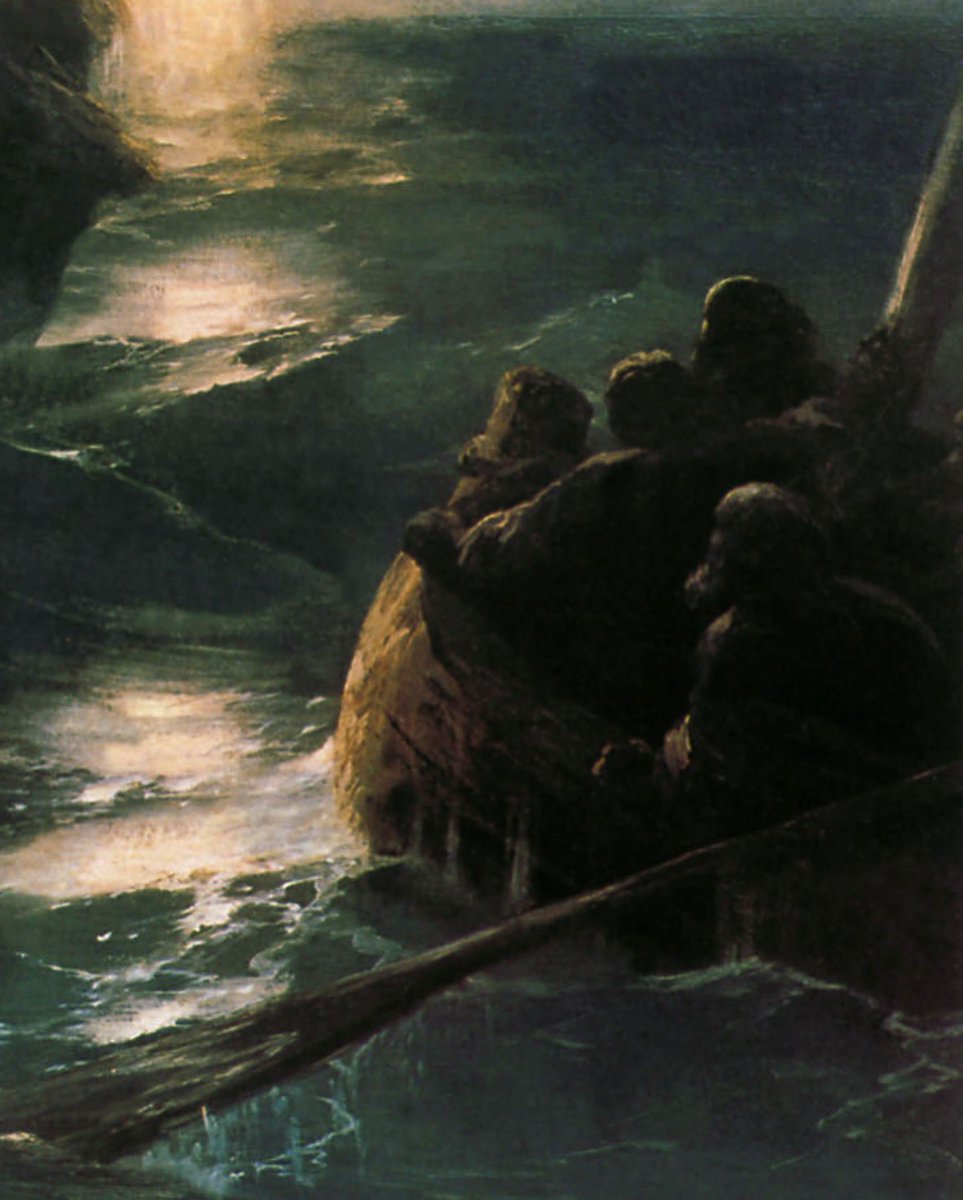
Ivan Aivazovsky’s “Walking on Water,” painted in 1888, is a notable work in the religious art genre. This oil on canvas depicts the New Testament story of Jesus Christ walking on turbulent sea waters towards a boat of his disciples, focusing on the moment when Peter steps out to join him in faith, only to falter. The painting stands out not only for its spiritual theme but also for its vivid portrayal of the sea— a testament to Aivazovsky’s mastery of marine landscapes.
The artwork measures 70 cm in height and 50 cm in width, making it a moderately sized piece that captures a dynamic and divine interaction. The light surrounding Jesus Christ dramatically contrasts with the dark, stormy sea, highlighting the miraculous nature of the scene. Aivazovsky’s use of light effectively illustrates the divine presence and the emotional intensity of the moment, with the disciples depicted in various reactions of awe and fear.
Siegfried, (1921)
By
Thomas Theodor Heine (1867–1948)
Thomas Theodor Heine’s “Siegfried” (1921) is a captivating painting depicting a small pug sitting on a richly textured red velvet chair. The dog’s name, Siegfried, is a humorous nod to the heroic character from Germanic mythology, contrasting with the pug’s diminutive size and comical expression.
Heine, influenced by the Jugendstil (Art Nouveau) movement, employs meticulous detail and vibrant colors. The luxurious red of the chair and the pug’s light fur create a striking contrast, drawing the viewer’s eye to the central figure. The chair’s opulent texture and the subtle glimpse of a complementary red rug and cherry cabinet in the background contribute to a sense of wealth and elegance.
The painting blends sophistication with a playful tone. The pug’s regal pose on the lavish chair adds an element of humor, emphasizing Heine’s skill in combining satire with artistry. This work reflects Heine’s background as a caricaturist, showcasing his ability to infuse personality and charm into his subjects.
Dante and Virgil in Hell (1879)
By
Gustave Courtois (1852-1923)
The painting "Dante and Virgil in Hell" by William-Adolphe Bouguereau is a vivid and stirring portrayal set against a frigid, icy landscape, possibly depicting the frozen Cocytus lake in Dante's Inferno. It features three central figures within a larger, more complex scene of anguish and torment.
In the foreground, a central figure, stripped to the waist, is caught in a desperate act of aggression. This pale-skinned male is depicted in a moment of extreme violence, gnawing savagely at the head of another figure, showcasing Bouguereau's ability to capture raw, emotional intensity and physical movement. The attacker's musculature is tense and defined, highlighting his physical strain as he commits his brutal act, with visible scars and scratches on his back indicating past conflicts.
The victim of this brutal attack has a strikingly resigned expression, his eyes closed, seemingly surrendering to his fate. His face and body are partly obscured, but his vulnerability contrasts sharply with the ferocity of his assailant.
Standing to the left, overseeing this scene, are Dante and Virgil, the poet-guides from the literary work. Dante is depicted wearing a laurel crown, symbolizing his poet status, draped in a classical robe that adds a touch of solemnity and historical gravitas to his figure. Virgil, in a vibrant red robe, appears somber and contemplative, reflecting his role as the wise guide. His posture suggests a deep sadness or perhaps a resigned detachment as he leads Dante through the horrific scenes of the damned.
The background is filled with various other tormented souls, their faces emerging from the icy backdrop, adding a layer of depth and horror to the scene. Each face tells a story of eternal suffering and despair, contributing to the overall atmosphere of dread and woe that pervades the painting.
The Sin (1880)
by
Heinrich Lossow (1843-1897)
“The Sin” by Heinrich Lossow is a provocative and enigmatic painting that delves into the murky waters of the Banquet of Chestnut, a notorious event allegedly hosted by Cesare Borgia in 1501. Lossow’s work is a visual exploration of the event, emphasizing its salacious aspects and depicting the alleged sexual acts that occurred during the banquet. The artist’s choice to focus on the more scandalous elements of the event rather than the chestnut-gathering courtesans is a puzzling and intriguing one, contributing to the painting’s mystique.
The Banquet of Chestnut, as described in Johann Burchard’s diary, features prominently in Lossow’s composition. Burchard’s detailed account is the primary source of information about this event, although its historical accuracy remains a subject of controversy. Burchard’s account mentions the presence of fifty courtesans who engaged in intimate acts with guests while the Borgia family, including Cesare Borgia, watched. Prizes were awarded to those who performed these acts most frequently, adding a layer of debauchery to the event.
Upon its unveiling, “The Sin” caused an immediate uproar. The explicit content and depiction of immoral behavior, especially involving members of the clergy, led to severe criticism from art critics, condemnation from the Church, and shock from the general public. The painting’s audacious portrayal of the alleged events of the Banquet of Chestnut challenged the norms of its time.
Despite its controversial nature, “The Sin” has left an indelible mark on the art world and popular culture. Its striking visual representation of a historical controversy has sparked numerous discussions and analyses, making it a captivating subject for art enthusiasts and historians. The painting serves as a reminder of the complex and contradictory nature of the Borgia family, who wielded significant influence during the Italian Renaissance.
Unfortunately, the current location of “The Sin” remains shrouded in mystery. It is possible that the painting is held within a private collection, hidden from the public eye.
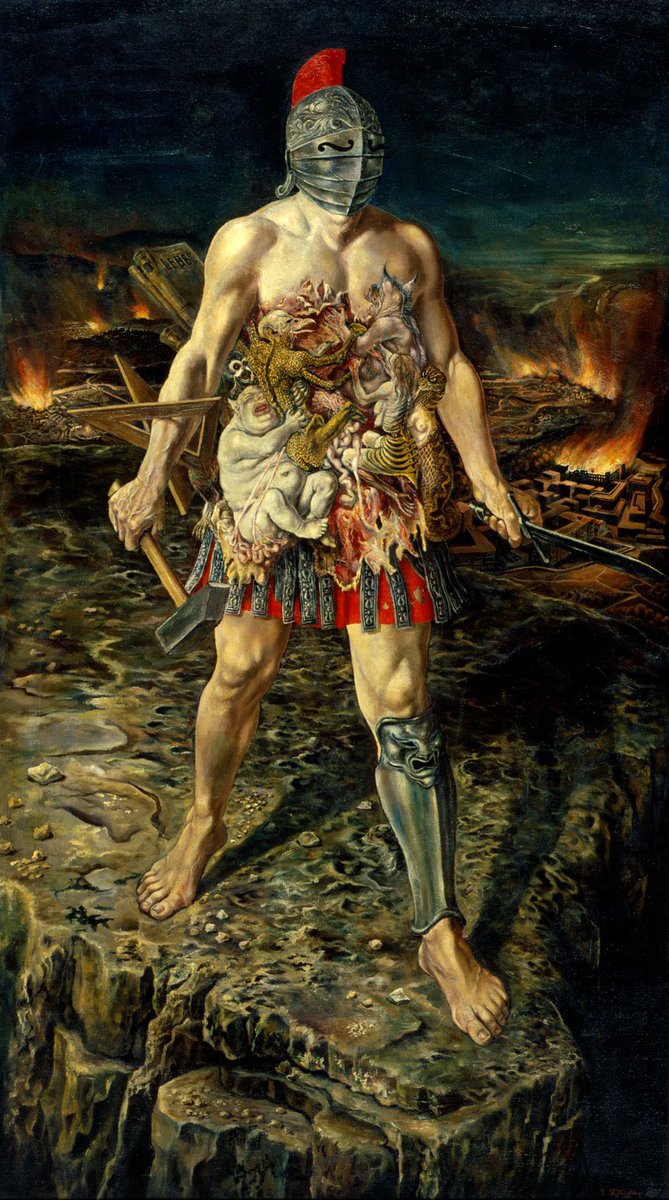
Blind Power, (c. 1937)
By
Rudolf Schlichter (1890-1955)
“Blind Power” (1937) by Rudolf Schlichter is a deeply symbolic and surrealist painting reflecting the tensions of its time. The artwork depicts a powerful, almost mythological figure—a muscular warrior holding both a hammer and a sword—marching forward, seemingly oblivious to the chaos around him. His blind, determined advance represents the unchecked, destructive power of authority or militarism, a common theme in Schlichter’s work, especially given his political disillusionment during the rise of fascism in Germany.
The warrior’s torso is being bitten by mythical beasts, symbolizing the destructive forces or ideologies tearing at him. These elements emphasize Schlichter’s critical view of blind power structures and the devastation they leave in their wake. The painting is rendered in the realistic yet emotionally charged style typical of the New Objectivity movement, of which Schlichter was a key figure.
This work was created during a turbulent period in Schlichter’s life, as he moved away from communist ideals and embraced more nationalist and religious themes, though he remained highly critical of totalitarianism. Many of his works, including “Blind Power,” were eventually condemned by the Nazi regime and labeled as “degenerate art”.
The Israelites Leaving Egypt (c. 1830)
By
David Roberts (1796–1864)
“The Israelites Leaving Egypt” is a notable painting by Scottish artist David Roberts, completed in 1830. It is an oil on canvas work that measures 119 cm by 212 cm and is housed in the Birmingham Museum and Art Gallery. This painting falls within the genre of religious art and vividly captures the biblical episode of the Exodus, wherein the Israelites depart from Egypt, guided by Moses. This scene is a pivotal moment that has been interpreted through various artistic, cultural, and religious lenses over centuries.
The painting depicts a grand, bustling scene set against the backdrop of monumental Egyptian architecture, with the Great Pyramids looming in the distance. It embodies the style of Romanticism, characterized by its emphasis on dramatic scales and emotions, yet it also incorporates elements of Orientalism—Roberts was known for his detailed and somewhat idealized representations of Eastern scenes. The artwork is meticulously detailed, showcasing a dense procession of figures, animals, and an array of vibrant market activities, capturing the chaos and hope of the Exodus narrative.
The story of the Exodus, central to Jewish, Christian, and Islamic traditions, narrates the departure of the Israelites from Egypt under the leadership of Moses. According to the biblical account primarily found in the Book of Exodus, the Israelites were enslaved by the Egyptian Pharaoh, prompting God to send Moses to lead them to freedom. After Pharaoh repeatedly refuses Moses’ demands to release the Israelites, Egypt is struck by ten devastating plagues.
The final plague, the death of the Egyptian firstborns, leads Pharaoh to relent temporarily, allowing the Israelites to leave. This event is commemorated in Judaism during the holiday of Passover. As the Israelites leave, they are pursued by the Egyptian army, leading to the miraculous parting of the Red Sea, through which the Israelites escape, while the Egyptians are engulfed as the waters return.
A Walk at Dusk (1830–1835)
By
Caspar David Friedrich (1774-1840)
In the painting “A Walk at Dusk” by Caspar David Friedrich, a solitary figure with a lowered head traverses a landscape bathed in the cold, silvery light of a moonlit evening, deeply reflecting on an ancient tombstone that whispers of mortality. The scene unfolds in the dead of winter, where nature itself appears lifeless, with bare trees casting ghost-like shadows. However, amidst this somber setting, a cluster of green oaks emerges through the fog, symbolizing enduring life and hope. Above, a waxing moon dominates the sky, its presence offering a spiritual balance to the theme of death by representing Christ and the assurance of resurrection.
As a prominent figure in the German Romantic movement, Friedrich’s work delves into the depths of personal and spiritual introspection, frequently drawing parallels between Christian motifs and the natural world’s cycles. Painted during a period shadowed by personal sorrow and preceding his severe stroke in 1835, “A Walk at Dusk” encapsulates the artist’s struggle with despair and his solace in faith, poignantly reflecting the dual themes of melancholy and redemption.
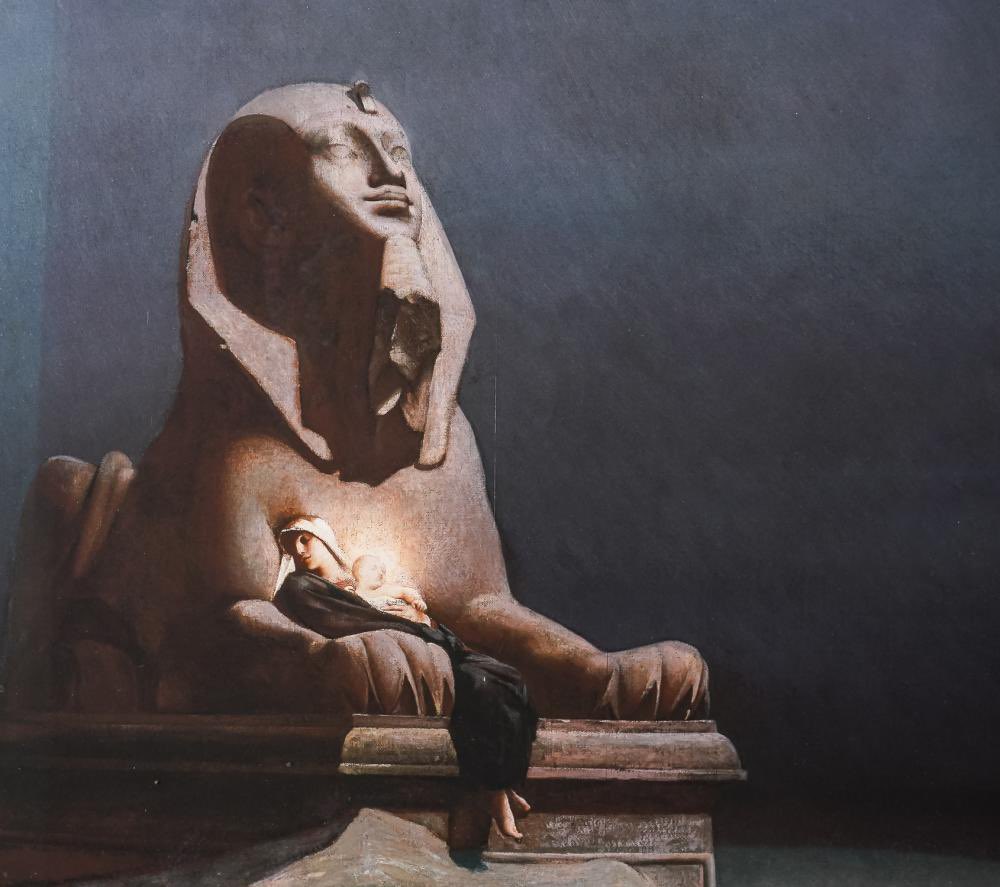
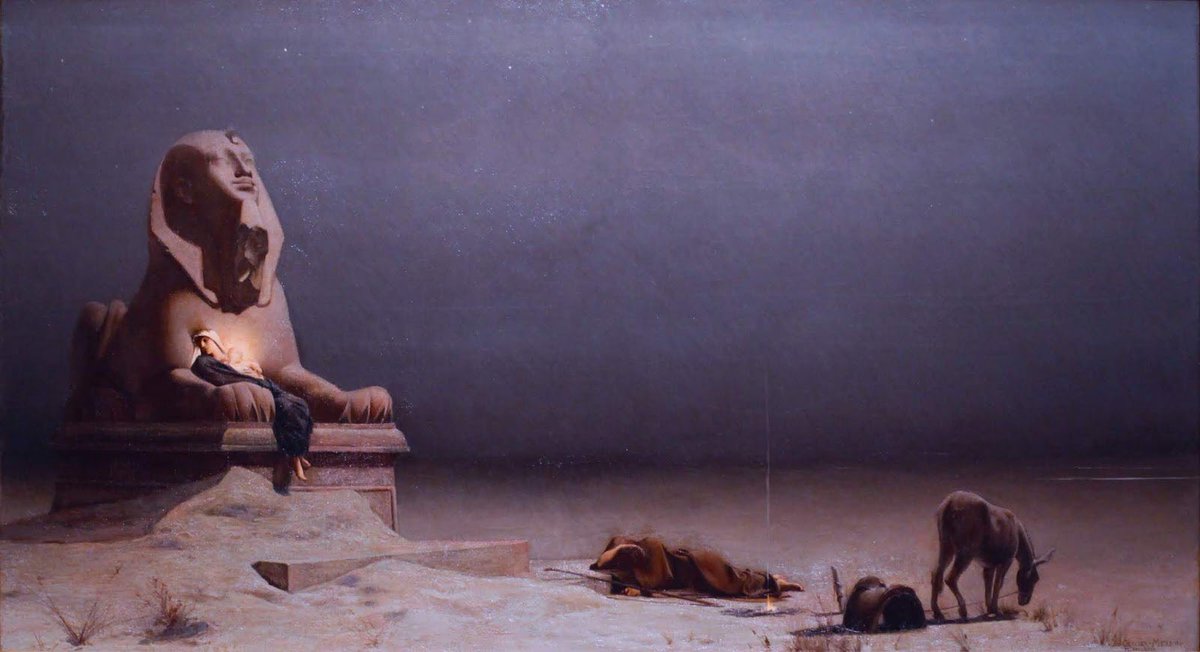
Rest on the Flight into Egypt (1879)
By
Luc-Olivier Merson (1846-1920)
The painting displayed is “Rest on the Flight into Egypt” by French artist Luc-Olivier Merson, completed in 1879. It depicts the Holy Family, with Joseph, Mary, and the Christ Child, during their flight from King Herod’s decree to kill all newborn boys in Bethlehem. The scene is set in a desolate, starlit night, providing a quiet moment of repose against a backdrop featuring an ancient Egyptian sphinx, symbolizing the old religions giving way to the new Christian era.
The central figure of the Virgin Mary, cloaked in a serene blue, rests between the paws of the sphinx, holding the Christ Child, whose divine light illuminates the composition. Joseph is depicted asleep, stretched out beside them. The inclusion of the sphinx adds a layer of historical depth, contrasting the fleeting safety of the family against the permanence and decay of ancient civilizations.
The painting is known for its subdued, moonlit color palette, primarily in blues and grays, creating a contemplative and solemn atmosphere. The use of chiaroscuro enhances the mystical aura surrounding the child, highlighting the divine presence amidst the ruins of the old world.
This artwork, held in high regard for its symbolic depth and artistic execution, represents a significant piece of Merson’s oeuvre, showcasing his blend of historical and religious themes rendered with academic precision. It reflects both a spiritual and cultural journey, bridging diverse epochs and geographies through its evocative use of Christian and ancient Egyptian iconography.
“Jesus and Peter on the Water” (Jesus et Pierre sur les Eaux, 1863)
By
Gustave Brion, (1824-1877)
The painting “Jesus and Peter on the Water” by Gustave Brion, created in 1863, is a striking depiction of a biblical scene from the Gospel of Matthew. The artwork captures the moment when Jesus reaches out to save Peter, who is struggling to stay afloat in the turbulent sea. Jesus, depicted in white drapery with a halo, stands serenely on the water, exuding a sense of calm and divine presence. Peter, on the other hand, is shown in a state of distress, highlighting the human vulnerability and need for faith.
The vast, tumultuous sea dominates the painting, with the boat carrying the Apostles visible in the distance. The sky is stormy, but horizontal bands of sunlight hint at the promise of calm waters ahead. This composition underscores the theme of divine intervention and reassurance amidst chaos.
Brion’s use of light and shadow, along with the horizontal lines of the sea and sky, creates a sense of depth and movement. The overall effect is one of simplicity and grandeur, emphasizing the spiritual message of the scene. This painting was exhibited at the Paris Salon of 1863 and the Exposition Universelle of 1867, earning critical acclaim for its masterful execution and profound narrative.
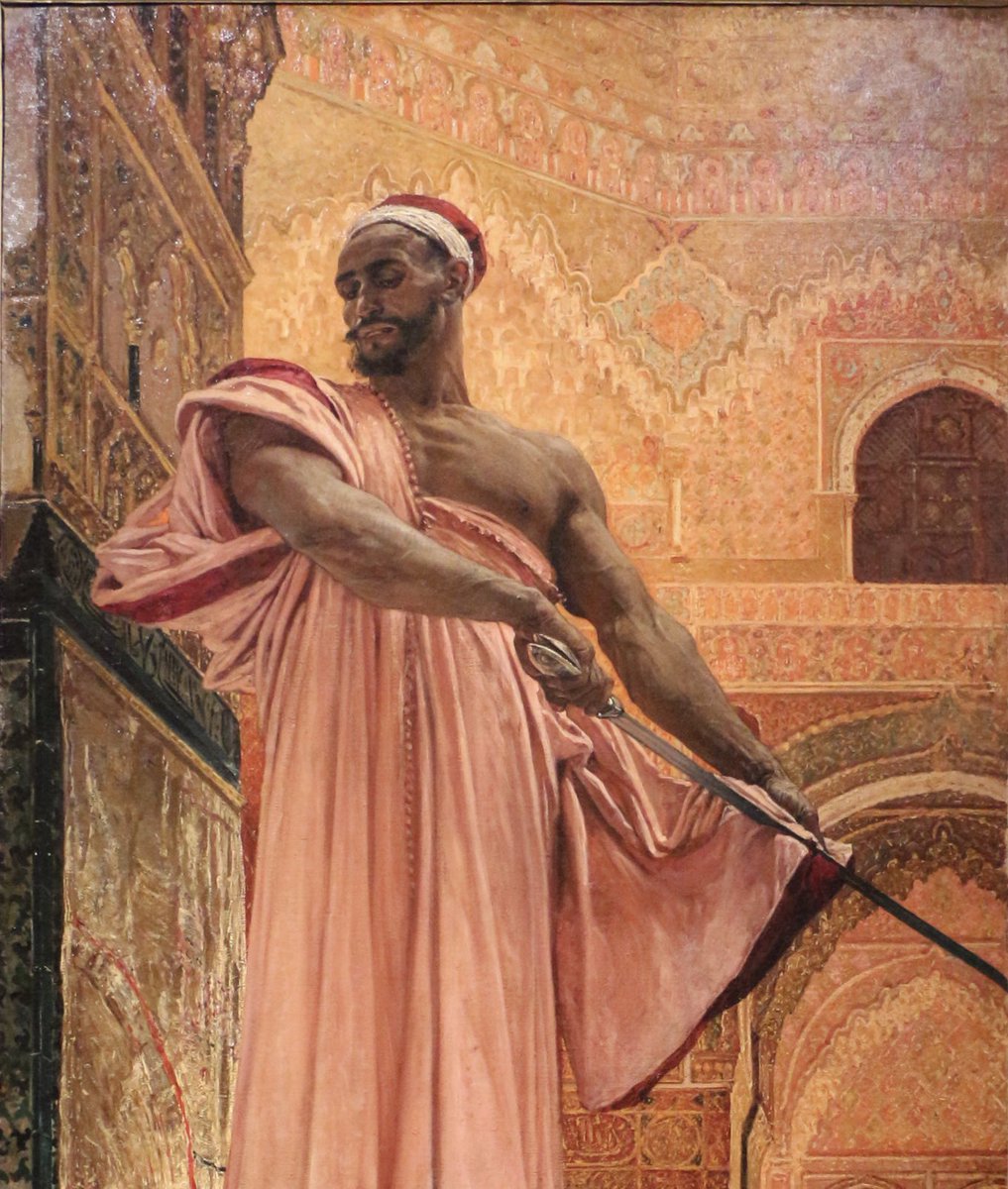
Execution without trial under the Moorish kings in Grenada (1870)
By
Henri Regnault (1843–1871)
“Summary Execution under the Moorish Kings of Granada,” painted by Henri Regnault in 1870, is a dramatic oil-on-canvas artwork that measures 301 cm in height and 143 cm in width. The scene depicts a decapitation under the Moorish rulers of Granada, set against a backdrop inspired by the Alhambra, suffused with a sunset glow. The executioner, standing on a flight of marble stairs, wipes blood from his scimitar after striking down his victim. His calm demeanor contrasts with the gruesome act, as blood drips down the steps from the lifeless body and severed head.
The painting’s vibrant colors and detailed architectural elements contrast sharply with the horrific subject matter. Regnault’s fascination with arbitrary and exotic punishments, typical of Orientalist art, is evident. The executioner, a powerful and muscular figure, has been noted to carry an undertone of homoerotic fascination, a theme found in depictions of North African men in late 19th-century European art.
Technically, the painting blends hyper-realistic architectural details with expressive, chaotic elements, such as the splattered blood. Regnault reportedly threw red paint at the canvas to achieve a naturalistic effect. The work is known for its tension between the meticulous background and the grim fantasy scene in the foreground. While the painting has been praised for its technical mastery, it has also drawn criticism for its lack of sympathy and its melodramatic horror, provoking strong reactions from viewers and critics alike.
Currently housed in the Musée d’Orsay, this artwork exemplifies the Orientalist fascination with distant lands and cultures, often depicted through scenes of violence and splendor.
Yadavas killing themselves (1922)
By
M. V. Dhurandhar (1867–1944)
The painting depicts the tragic demise of the Yadava clan, a significant event in the Mahabharata that occurs after the great war of Kurukshetra. This episode is often referred to as the “Mausala Parva” or “The Book of the Clubs” (16th book of the Mahabharata), describing the fratricidal war that leads to the destruction of the Yadava dynasty.
After the Kurukshetra war and the departure of the Pandavas to the Himalayas, Lord Krishna and the Yadavas, who had settled in the city of Dwaraka, experienced a period of relative peace. However, the seeds of destruction were sown due to a curse by several sages, including Vishwamitra, Kanva, and Narada.
One day, some young Yadavas, out of jest, dressed a boy named Samba (Krishna’s son) as a pregnant woman and took him to the sages, asking if “she” would have a son or a daughter. The sages, seeing through the prank, cursed that the mock “woman” would give birth to a lump of iron that would destroy the Yadava clan. When the lump of iron appeared, it was ground into powder and thrown into the sea, except for one small piece that could not be crushed and was thrown away. The iron powder washed ashore and grew into reeds, while the uncrushed piece was swallowed by a fish and later used to make a hunter’s arrowhead.
Years later, as foretold by the curse, a brawl broke out among the Yadavas during a festival. The intoxicated and enraged Yadavas picked up the reeds (which had grown from the iron powder) and began striking each other, leading to a fierce and deadly conflict. The reeds turned into clubs, and the Yadavas, including Krishna’s sons and relatives, killed each other in a frenzy. The painting captures this moment of senseless violence and chaos, with figures battling and bloodied bodies scattered across the ground.
Krishna, depicted with a calm and sorrowful demeanor, stands at the center of the painting, a silent witness to the carnage. He is adorned in his regal attire, his blue skin and serene expression contrasting sharply with the surrounding bloodshed. His presence symbolizes both his divine nature and the inevitability of fate.
“Pandemonium” (1841)
By
John Martin (1789–1854)
This painting represents the culmination of John Martin’s fascination with Milton’s Paradise Lost, contributing significantly to his development of the ‘historical landscape’ genre. Influenced by J.M.W. Turner’s large canvases, particularly The Fifth Plague of Egypt and Apollo and Python, Martin infused theatrical elements into his work, drawing from his experience in glass and china painting. His work inspired contemporaries like Francis Danby, Samuel Colman, and Thomas Cole.
Pandemonium specifically illustrates Book I, lines 710-15, depicting the rise of Satan’s capital:
“Anon out of the earth a fabric huge
Rose like an exhalation, with the sound
Of dulcet symphonies and voices sweet,
Built like a temple, where pilasters round
Were set, and Doric pillars overlaid
With golden architrave...”
The composition depicts a vast and hellish landscape dominated by the imposing architecture of Pandemonium. The scene is enveloped in darkness, with the only illumination coming from the ominous glow of the fiery lava flowing in the foreground. The architecture, a grand palace with numerous columns and arches, exudes a sense of foreboding majesty. The building is intricately detailed, with lit torches lining the structure, adding to the eerie atmosphere.
In the foreground, a demonic figure stands on a rocky outcrop, dramatically gesturing toward the towering palace. This figure, likely Satan or one of his chief lieutenants, holds a shield and spear, symbolizing defiance and power. The demonic figure is bathed in the red glow of the lava, enhancing the menacing mood of the painting.
The sky above is filled with swirling dark clouds, and a streak of lightning adds a dynamic element to the scene, emphasizing the chaos and turmoil of Hell. The painting’s overall color palette is dominated by deep reds, blacks, and browns, contributing to the sense of dread and despair.
The Marriage of Nicholas II, Tsar of Russia, 26th November 1894 (Circa, 1895 or 1896)
By Laurits Tuxen (1853–1927)
Princess Alix of Hesse (1872-1918) was Queen Victoria’s granddaughter. She married Nicholas II, Tsar of Russia, on 26 November 1894 in the Imperial Chapel