A small step for AI, a big step for SATO.
Our first AI customer is live. Datum, from the team behind Packet, signed Oct 21. We converted a mining hall in Québec, near Montréal, handed it over 22 days later, and their NVIDIA B300s were serving customers on Nov 16.
https://t.co/ZVGMp01E9Q
One line from Nvidia's earnings call worth noting for operators: GPU allocation goes to sites where land, power and shell are ready to go when the hardware ships, and guarantees start only once the site is ready.
Compute follows readiness, not announcements.
A whole country just won the @EarthshotPrize. Bhutan, 800,000 people, protects water that 1.6 billion people downstream depend on, with forest cover written into its constitution. Presented in Mumbai by @KensingtonRoyal. Congrats Bhutan 🇧🇹
https://t.co/yzgsIjvnwL
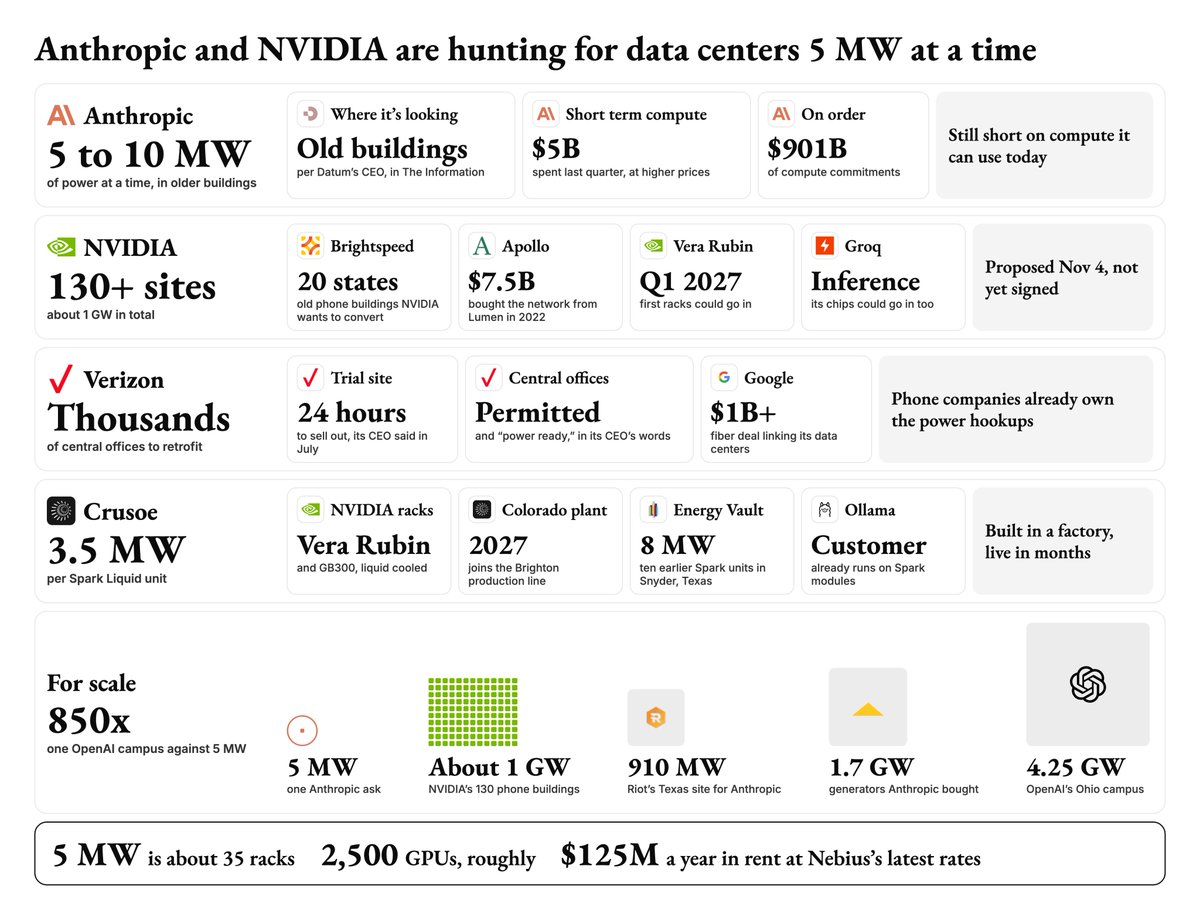
Anthropic and NVIDIA are now hunting for data centers 5 MW at a time.
Anthropic has $901B of compute on order and is still asking for 5 to 10 MW in old buildings.
> NVIDIA has proposed converting 130+ old phone buildings in up to 20 states
> Verizon says a converted central office sold out in 24 hours
> Crusoe will build 3.5 MW data centers on a factory line
5 MW is about 2,500 GPUs and $125M a year in rent. OpenAI's Ohio campus is 850 times that size and still years out, so anything with power connected today gets rented.
Takeaways from CoreWeave's Q3: compute prices keep rising ($20–25M/MW/yr on 4–5 yr deals, $40M+ short-term), Ampere and Hopper prices up 30–50% in a quarter, and 2028 capacity held back. A powered, running MW is gaining value. Book early.
@itachimoonshot@_pheebini@KevKubernetes@dakincampbell Exactly. That retrofit depends on the people doing the work: plumbers, welders and site crews adapting a building that wasn't designed for those loops. Their work needs to be planned alongside the cooling equipment, not after it.
@AlanWeckel@AnthropicAI The network is also where the work gets very physical: thousands of fibre links to pull, terminate and test before a GPU hall goes live. The crews who do that well, and keep it running after, decide how fast a site actually comes online.
@dee_bosa A lot of the backlash is about what neighbours actually live with: noise, water use, trucks on the road. Those are engineering choices made at the design stage, and they decide whether a site is still welcome ten years later.
@dakincampbell@theinformation Owning the chips is one part. Then someone has to rack them, cool them and keep them running for years, and that's an operator's job, not a pivot. C'est ce que fait SATO depuis 2017.
@rtehrani The regional economics part is the one that gets underplayed. A campus means electricians, technicians and operators who live nearby and keep it running for years. That's the part of this build-out we care about most in Québec.
@nomadfuturist Same recipe works on this side of the Atlantic. Québec has the cold climate, clean and stable hydro, and the room to build. Cool air and reliable power are becoming the real site-selection criteria for AI.
@shaunmmaguire@Amir_Safavi_N Space is a fun thought experiment because heat can only leave by radiation. On the ground, the easier win is picking sites where the climate already helps. In Québec, cold air and clean hydro do a lot of that work for you.
@RonVokoun Utilities are becoming the real gating partner for AI capacity. Where the grid starts out clean and stable, like Québec's hydro, the conversation shifts from whether you can get power to how fast you can put it to work.
@AlanWeckel Agreed. Chips ship in months, but clean, stable power takes years to line up. That's why Québec's hydro is such a strong starting point for AI capacity: the foundation is already there.
@RIVVORX@NicoleHemsoth Agreed. Cabling is the other thing you really only get one shot at. Pathways, tray capacity and rack spacing get locked in early, so planning for denser interconnect right alongside liquid cooling is part of building a site that lasts more than one GPU generation.
@GavinSBaker If the ROI is starting to show up in productivity, the next constraint is physical: enough clean, stable power to keep the compute running. Québec's hydro is one of the places built for exactly that.