I made my first deposit on @Polymarket today: $100 in, $99.95 on the balance.
The missing 0.25% is the platform’s deposit fee, a small reminder that even the entry point has a cost.
Opening the dashboard felt surprisingly similar to opening a new trading terminal years ago:
> Clean balance
> Zero positions
Most people think prediction markets are like casinos. But the mechanics are closer to information trading than gambling: prices shift when new facts appear, not when someone “feels lucky”.
So before placing my first position, I focused on understanding where traders get their information edge.
THE FIRST STOP: @POLYMARKETECO
The most useful starting point turned out not to be a market itself, it collects everything built around Polymarket:
> tools
> dashboards
> scanners
> timelines
> bots
> research sites
For someone new, it solves a big problem instantly: you do not need to know what to search for. The ecosystem is mapped for you.
This was the first moment I realized: half of prediction trading is knowing where to look.
TWO TOOLS THAT ACTUALLY MATTER ON DAY ONE
1) @poly_data = Polymarket Analytics
This one became the first tab I kept open.
What it gives me:
> Clear odds movement
> Volume shifts
> Liquidity levels
> Side-by-side comparison of Yes vs No
> Event timelines tied to price changes
It showed me how fast markets react.
2) @hash_dive = Analytics and Dashboards
If Polymarket Analytics shows what moved, HashDive shows why.
What I use it for
> Real-time news tied to specific markets
> Alerts for unusual liquidity jumps
> Tracing price spikes back to the exact source
> Filtering out noise from the X feed
Without this, I would always be late.
MY FIRST IMPRESSION IS SIMPLE
you do not need 20 tools, a complex strategy, or high conviction.
You need structure, a few reliable data sources, and a clear reason before pressing “Yes” or “No”.
If you have other tools that are worth exploring early, I am open to adding them to the setup.
Anyone who panic-sold over the weekend lost the plot.
Monday delivered a $1T rebound in US equities, and crypto reclaimed the $3T total market cap without hesitation.
Here’s what actually mattered over the past 24 hours.
> @Polymarket is pricing an 83% chance of a December rate cut. Fed governors are almost openly guiding the market there.
> Trump & Xi synchronized agendas and a soft pause in the trade war brought instant risk-on.
$BTC pushed back to ~$88k as global liquidity sentiment flipped in a single day.
> Five altcoin ETF filings in six days. Both @Grayscale and @bitwise are pushing: $XRP, $DOGE, $LINK.
$SOL ETF flows are picking up fast.
> Smart money keeps buying.
@BlackRock added $197M $BTC.
@BitMNR loaded 3.6k $ETH.
> @MetaMask Mobile now allows 40x leverage on perps. Degens can now get liquidated anywhere 😂
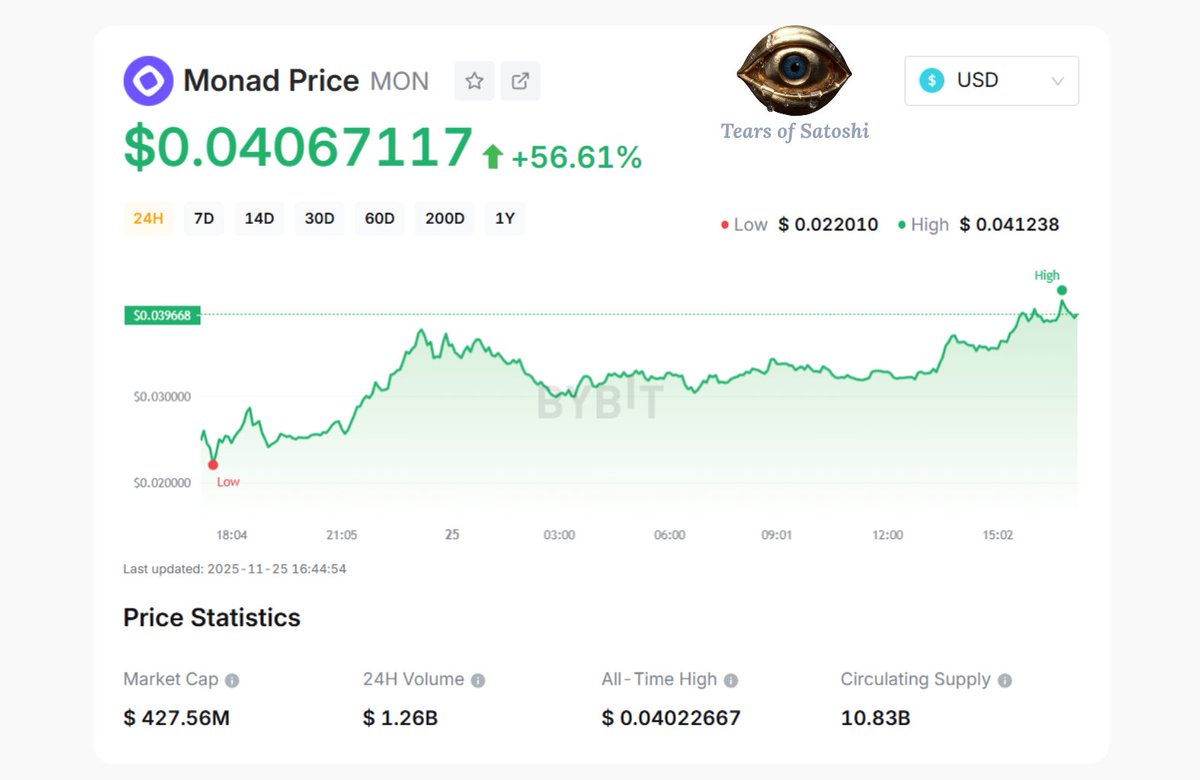
> Monad $MON listed on tier-1 exchanges.
FDV sits around $2.3B. Price trades below the public sale, but staking yields ~16%.
What has caught your attention over the past day?
I started this experiment with a clean $100 deposit.
After a few small test positions, the balance sits around $91 → nothing dramatic, just the cost of learning how @Polymarket actually behaves in real time.
Here’s what I placed and what already played out.
> I bet on a net ETF inflow for the day, fading the recent outflow narrative.
The market proved me wrong.
The final number for November 24 came in at –$151M outflow, not an inflow.
A clean reminder that flow markets are noisy and rarely behave the way you want on your first try.
Loss: $10
> The second $10 position is the opposite:
A speculative bet that equities would rally if Trump and Putin talk within a week.
The probability is low, but the logic is simple:
any sign of direct communication (especially during ongoing peace discussions) tends to trigger instant market reactions.
Possible profit: ~$35
> The third $10 position is the most grounded:
A Federal Reserve 25 basis point cut on December 10.
Polymarket odds are strongly tilted toward a cut, and recent Fed messaging supports the market’s pricing.
This one is slower, more predictable, and far less emotional than the geopolitical bet.
Possible profit: ~$13
Hard to disagree with the point behind this.
$MON trading near $0.04, ICO was $0.025, yet the starting risk–reward never lined up:
> low float
> high FDV
> a setup that pushed buyers into weak asymmetry from day one
Narratives can run, but structure still matters.
Most people try to predict the winner.
Sometimes it’s easier to take both sides and let the market pay you for the mispricing.
Today I found a clean example inside the "2nd Largest Company End of November" market on @Polymarket.
Two positions, both $10, both on the Yes side:
> Apple → $10 → potential return ~$27
> Alphabet → $10 → potential return ~$28
The idea is straightforward:
only one company can finish in second place, but both are trading at attractive odds.
By taking both sides, I’m not trying to predict the winner, I’m trying to capture the mispricing around the probability.
Because both trades were opened around 35–37 cents, each $10 stake returns roughly $27–$28 on a win.
This means the winning side more than covers the losing side and leaves a small profit.
This was done as an experiment to understand how these hedged markets behave on Polymarket and whether the edge is repeatable.
If you can consistently find these opportunities and make $3–5 per resolved market, then with 50–60 such trades per week, you’re looking at $250–300 in relatively low-stress weekly income.
Not guaranteed, not passive, but very realistic if you stay disciplined and pick only clean setups.
GM, Dubai!
The noise was high today, but a few things cut through.
> @SkaleNetwork launched an AI-focused Layer 3 on @base built for autonomous agents and Coinbase’s x402 payment rails.
No gas, instant finality, private execution → it looks like the first serious attempt to give AI agents a real onchain environment instead of forcing them to hack around L1/L2 limitations.
> @Strategy claims that even with $BTC at $74k, their asset-to-convertible-debt ratio stays at 5.9x.
At $25k, it’s still 2.0x.
> Franklin Templeton filed the 8-A for a Solana ETF, one of the last regulatory steps before a listing.
> An anonymous trader built a 20,000 $BTC call-condor (strike range: 100k / 106k / 112k / 118k) expiring Dec 26.
The structure profits if $BTC stays between 100k and 118k, but not far above.
> Meta is buying billions in AI chips from Google, not Nvidia.
> @Starknet teased that CCTP v2, $USDC, LayerZero, Stargate, and Near Intents all have “one thing in common”.
This smells like a unified liquidity or routing layer announcement. Cross-chain UX is the last bottleneck for real users.
> Texas became the first U.S. state to hold Bitcoin on balance sheet.
They started with $10M through BlackRock’s Bitcoin ETF, and plan to custody and accumulate $BTC directly.
The last 24 hours felt like the market finally took a breath.
Bitcoin $BTC pushed back above 90–91k and Ethereum $ETH reclaimed 3k, with the total market up roughly 3–4% on the day.
Fed rate cut expectations and better global risk sentiment are doing most of the heavy lifting.
This still looks like a bounce inside a broader chop, not a clean trend yet.
ETFs
> Spot Bitcoin ETFs added roughly $43M net on 26 Nov.
> Spot Ethereum ETFs brought in about $60.8M the same day – a four day streak of inflows.
> $XRP products saw about $21.8M in net inflows.
> Solana $SOL ETFs actually flipped to a small ~$8M outflow after a long run of positive days.
Crypto Infrastructure
@zksync Atlas upgrade keeps getting attention. @VitalikButerin publicly backed it, and coverage highlights up to 15,000 transactions per second and near zero fees for Ethereum Layer 2 users.
Institutions like Deutsche Bank and Sony are already testing it for cross chain settlement and privacy.
Institutions & Big Money
@SpaceX moved about $105M in $BTC (around 1,163 coins) into new wallets, continuing a pattern of large internal transfers over the past months.
Wildcards
South Korean exchange @Official_Upbit was hacked for roughly $36–37M in Solana based tokens, including $BONK, $JTO, $SONIC and $USDC.
Deposits and withdrawals on the Solana side were paused while the team moved funds to cold storage and promised full reimbursement.
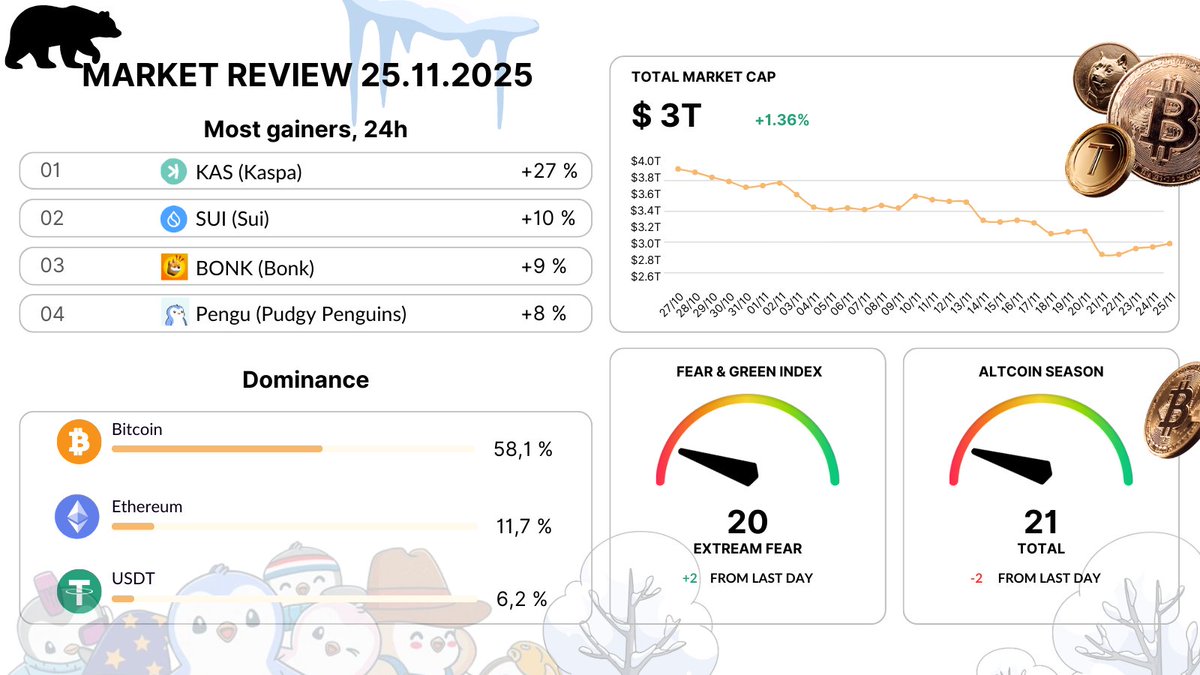
The last 24 hours stayed green: total crypto market cap moved to $3.09T, about +3.2%, with Bitcoin $BTC still in control at 58.5% dominance and Ethereum $ETH around 11.7%.
Fear is easing slowly: the index sits at 22, still "extreme fear", but higher than yesterday.
The standout story on the alt side is Kaspa $KAS. Whales have been buying every dip, volume exploded, and price is up more than 40–50% over the week, pushing $KAS into the top gainers list.
S&P cut @tether rating on its $USDT stablecoin to "weak" because of disclosure concerns, a reminder that stablecoin risk is not going away.
This looks more like the early stage of a recovery than a full risk-on party.
Today it really hit me how often crypto feels like it is running the same script.
Bitcoin $BTC made a new high around $120–126k in October, then crashed into the low 80k range in November, just like earlier cycles where a sharp peak is followed by a brutal flush.
Now we are back near $91k, the market is up about 4% on the day, and almost every major coin is green again.
In older cycles the pattern was simple:
Bitcoin $BTC tops, then altcoins run for one or two crazy months, then everything bleeds into a long bear. This time it is not that clean.
Even ETF flows tell a mixed story. Spot Bitcoin funds bled billions in November, while new Solana $SOL and $XRP products quietly picked up fresh money.
Capital is rotating, but not in the full-on "everyone is rich" way we remember from 2017 or 2021.
At the same time, some analysts argue the cycle is not done at all: they see bullish weekly signals that could still send Bitcoin much higher from here.
When I start to feel like "the worst is over" and everything finally looks safe, that is often my signal to sell a good chunk of my bag.
Not because I suddenly hate crypto, but because cycles tend to reward the people who de-risk while the crowd is just beginning to get excited again.
I do not know if this is the real top or just a pause before another leg up.
What I can control is simple: take profits.
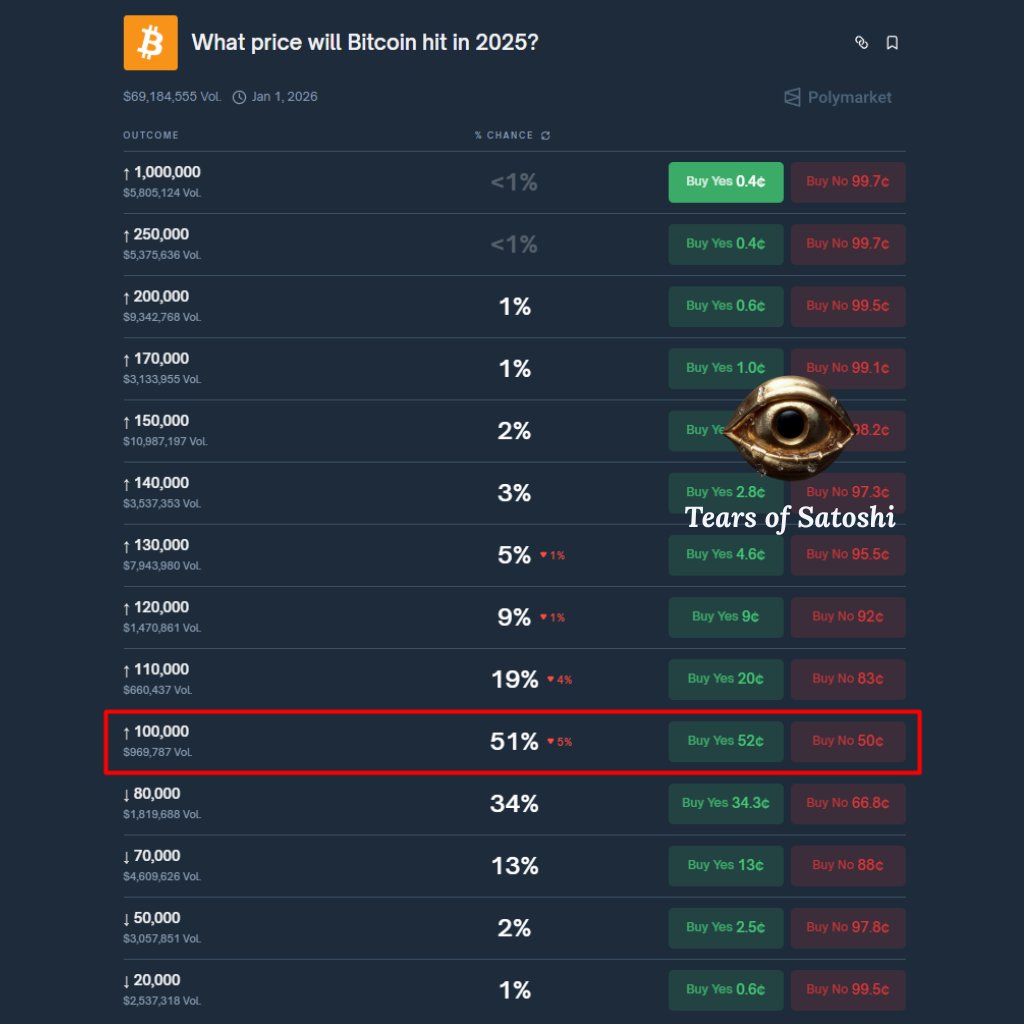
I spent some time today inside @Polymarket looking at the big Bitcoin market: "What price will $BTC hit in 2025?"
Right now the crowd is saying there is a 51% chance that Bitcoin trades above $100k in 2025.
It is funny to compare that with the daily chart. Price swings from 80k to 90k feel huge when you watch them tick by tick.
In that noise it is easy to think the cycle is over or that the top is in.
The prediction market tells a different story:
most money still expects a new high above 100k, but not a crazy blow-off.
🔻 Link to the market is in the comments.
A White House digital asset advisor is talking big numbers again.
In a recent round of comments he said that, once the new US stablecoin and market-structure laws are in place, the crypto industry could grow to $15–20T.
For context: today crypto sits around $3T in total value.
Gold is near $30T after this year’s rally.
So... a $20T crypto market would put this space almost in the same league as gold.
On paper it sounds great: clear rules, banks and funds rushing in, stablecoins everywhere. But I struggle to believe Bitcoin and the rest 5–6x from here in a straight line.
If we ever see $7–10T, that alone would be insane for this cycle. $20T feels more like a political sales pitch than a real base case right now.
I heard one of the wildest stories about this crypto cycle from @cryptomanran
You do not have to agree with every part of it. But it is worth knowing.
His video on a "coordinated attack" on Bitcoin $BTC and crypto was so good I want to retell the short version here.
🧵👇 [1/9]
I’ve been using my @KASTxyz card every single day for months.
Coffee, flights, even rent → it’s the one card that actually bridges my crypto life with the real world.
And now, with the V3 release, KAST just moved from being a “crypto card” to something much bigger: a foundation for a global neobank.
> USD accounts are now open to (almost) everyone
> Savings options will soon include both Treasury yields and DeFi rates
> Crypto collateral: hold assets and borrow against them directly in-app
> Detailed card statements per card
> Transparent spending analytics
> Clearer point system
> Future rewards tied to real usage and ecosystem growth (Airdrop just for using card, BANGER!!!!)
And if you want to get in early, or just test how smooth the new update feels 👇👇👇
A Satoshi-era wallet moved roughly 11,000 $BTC - about $1.3B after 15 years of holding.
The transfers were flagged by onchain trackers as large moves from a long dormant address.
Transfers occurred on 11/9/2025 and were split across multiple large transactions; is this the start of a major sell-off??
The US government's 40-day shutdown set a new record for political gridlock, and crypto investors paid close attention.
Initially, Bitcoin felt the pressure, dropping below the $100,000 mark as market-wide fears grew.
But the moment a bipartisan deal was announced, $BTC surged, recovering to over $106,000.
This recalls the powerful rally that followed the end of the 2019 shutdown, reinforcing the idea that government instability can highlight Bitcoin's value as a non-sovereign store of value.
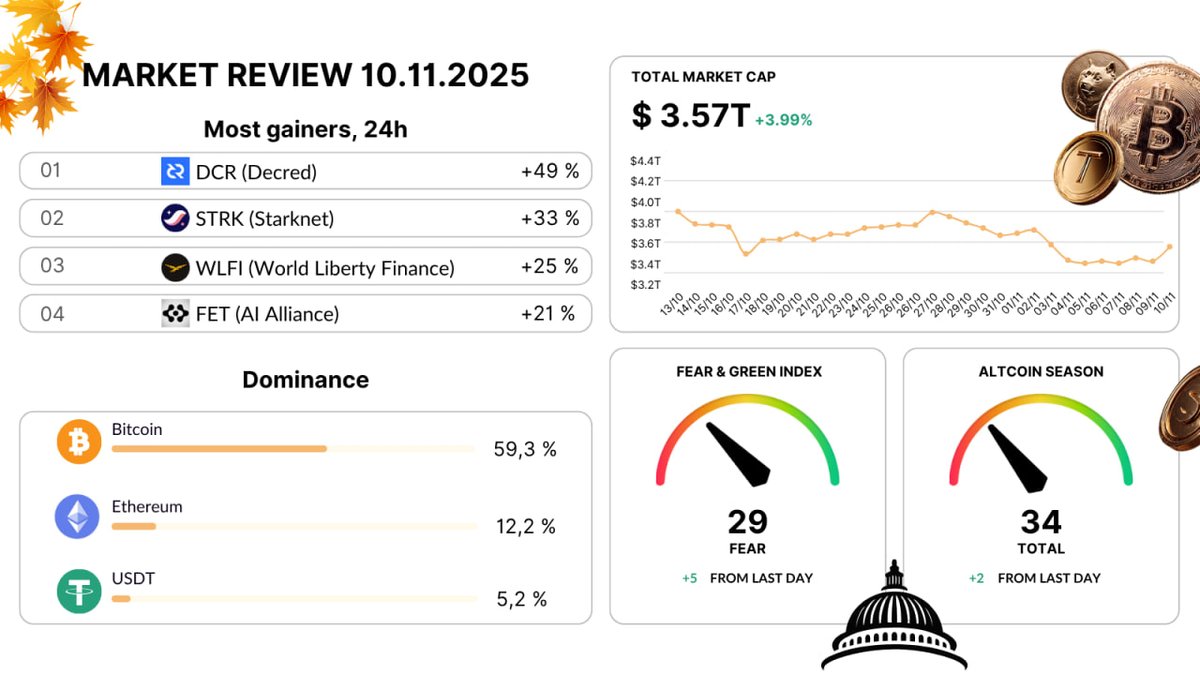
Markets showed real strength on Nov 10. Bitcoin $BTC climbed 4% to reclaim $105K, while Ethereum $ETH rallied 7% to $3,600.
Total crypto market cap reached $3.57T, up nearly 4% in 24 hours.
Top performers included Decred $DCR up 49% and Starknet $STRK up 33%, driven by governance and Layer2 momentum.
Bitcoin BTC dominance sits at 59.3%.
Fear & Greed index ticked up 5 points to 29.
All 4 limit orders filled at my entry levels.
> $SUPER at 0.3370
> $SOL grabbed at 167, 171, 157
> $BTC locked at 101,777
> $PUMP fill at 0.00342 for 15k
Didn't predict the exact low. Just placed buys where risk felt asymmetric.
Market bounced right after. Portfolio's green. That timing rarely happens, but when it does, you remember why patience compounds.
Limit orders remove emotion. You pre-decide, set the trap, sleep, and wake up positioned.
One trade doesn't define success, but this one feels clean.







![satoshi_tear's tweet photo. I heard one of the wildest stories about this crypto cycle from @cryptomanran
You do not have to agree with every part of it. But it is worth knowing.
His video on a "coordinated attack" on Bitcoin $BTC and crypto was so good I want to retell the short version here.
🧵👇 [1/9]](https://pbs.twimg.com/media/G6wjSkBXsAApYvK.jpg)