Když už se tady stále vytahují na obrazovky politické zombie Klaus a Zeman, není tedy od věci opět vytáhnout otázku, kampak se asi podělo těch 30 miliard, které tak nějak "zůstaly" ve firmě Falcon Capital, která narychlo sehrála roli prostředníka při vyrovnání ruského dluhu vůči České republice? 30 miliard!
"Kdo všechno z politiků a lobbistů nakonec z ruského dluhu kasíroval, to dodnes nevíme. Víme jen to, že prostor pro úplatky byl astronomický. Celkový dluh byl ve výši zhruba 100 miliard korun. Zemanova vláda padesát miliard Rusům rovnou odpustila a pohledávku prodala za necelých 20 miliard Falconu. Rusové ale uvolnili na vyplacení 50 miliard, takže se bavíme o 30 miliardách, které zůstaly ve Falconu a následně zmizely neznámo kde."
A že zrovna v tomto období vznikla tak zvaná "opoziční smlouva" mezi Klausem a Zemanem, to je taky asi jistě jen náhoda. Stejně jako to, že Klausová se stala 2013-2018 velvyslankyní na Slovensku, což umožnil Miloš Zeman.
https://t.co/mrcGpf5lwt
@rozarka76@MarekVondrak@michalblaha Protože třeba v Londýně je to úplně běžná věc? Pro primátory, premiéra a tak... To stejné se dá říct o kole nebo skútru.
https://t.co/rG9PZfbDFQ
@SamaHoole Similar thing here in Czechia - "jitrnice" pork offal in a pig's intestine. Sometimes they include the lungs, sometimes not. The lungs make for a smoother texture. Not exotic at all, although slightly seasonal - less available in the summer. Delicious nevertheless.
Není to pravda, @OtoKlempir .
Nikdo tě z České hudební akademie nevyloučil. Dokonce jsi hlasoval a pozvánku na Ceny Anděl dostal jako každý akademik.
Email odešel 6.3. v 15:29 na stejnou adresu jako ty předchozí.
Těch zcela zbytečných příkopů už je snad vykopaných dost.
As tensions between Europe and the United States grow sharper, the old rhetoric according to which America generously saved Western Europe out of pure benevolence is being wheeled out again by Americans. It needs to be understood clearly: THIS IS A COMPLETE FABRICATION.
Entry was forced, not chosen
•Neutrality maintained from September 1939 through December 1941, despite the fall of Poland, the fall of France, the Battle of Britain and the onset of the Shoah.
•The US entered only after Pearl Harbor (7 December 1941) and Hitler’s declaration of war on the US (11 December 1941). No American initiative.
•House vote to extend the draft on 12 August 1941: 203 to 202. One vote.
•Gallup polling 1939 to 1941: a consistent majority opposed entering the war. The America First Committee reached around 800,000 members.
Britain paid cash before getting aid
•“Cash and Carry” (November 1939) required belligerents to pay in gold or dollars and to ship in their own bottoms.
•“Destroyers for Bases” deal (2 September 1940): 50 obsolete WWI destroyers in exchange for 99-year leases on eight British bases (Newfoundland, Bermuda, Caribbean).
•Britain was forced to liquidate US-held assets (American Viscose sold to a Morgan Stanley syndicate in March 1941) before Lend-Lease was enacted.
•Lend-Lease Article VII (Master Agreement, 23 February 1942): British commitment to dismantle Imperial Preference as a condition of aid.
War aims: dismantling the British Empire and seizing its succession
•Atlantic Charter (14 August 1941): Roosevelt inserted self-determination and equal access to raw materials, directly targeting the Ottawa Preference system of 1932.
•Bretton Woods (July 1944): the dollar became the reserve currency, Keynes’s “bancor” plan was rejected, sterling was subordinated.
•Council on Foreign Relations War and Peace Studies (1939 to 1945, Rockefeller-funded): explicit planning for US succession to British hegemony.
Roosevelt betrayed France repeatedly
•Treaty of Guarantee signed by Wilson, Clemenceau and Lloyd George on 28 June 1919. France surrendered the Rhine frontier in exchange. The US Senate refused to ratify (Versailles rejected on 19 November 1919 and again on 19 March 1920). The British guarantee, tied to US ratification, lapsed automatically. France had traded the Rhine for nothing.
•June 1940: Reynaud’s telegrams of 14, 15, 18 June begged Roosevelt for intervention or at least a public commitment. Roosevelt’s 13 June reply offered material aid and explicitly refused military commitment. He forbade publication.
•The US maintained full diplomatic recognition of Vichy until November 1942 (Admiral Leahy as ambassador to Pétain).
•Operation Torch (November 1942): a deal with Darlan, the Vichy collaborationist, then with Giraud, deliberately excluding de Gaulle.
•Casablanca / Anfa conference (January 1943): Roosevelt tried to impose Giraud, a docile military figure, over de Gaulle.
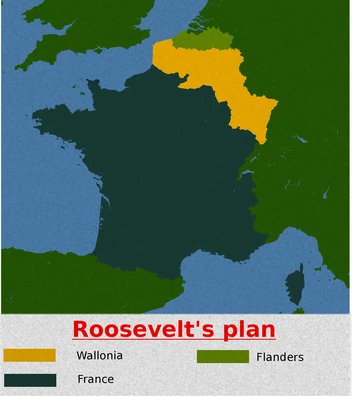
•Roosevelt’s “Wallonia” project: in 1942 and 1943 the President proposed to Anthony Eden and to Lord Chandos the creation of a new buffer state, “Wallonia”, carved out by detaching Alsace-Lorraine and parts of northern France from French territory and merging them with French-speaking Belgium and Luxembourg. France, the country that had been invaded, was to be amputated by its own ally. The plan was dropped only because of British opposition and de Gaulle’s establishment of facts on the ground.
•AMGOT plan: a US military government envisaged for liberated France, with its own occupation currency printed in advance. A pure denial of French sovereignty.
•Recognition of the GPRF withheld until 23 October 1944, more than four months after D-Day, while the GPRF was already administering liberated France.
•France excluded from Yalta (February 1945). The French occupation zone in Germany was carved out of British and American zones at Churchill’s insistence, against Roosevelt’s preference.
Strategic priorities served US interests, not liberation
•“Germany First” (ABC-1 plan, March 1941) was set before Pearl Harbor to protect the Atlantic and the hemispheric position, not to rescue Europeans.
•The second front was delayed from 1942 to 1944 despite Soviet demands, in favor of Mediterranean operations covering imperial sea lanes.
•Quincy Pact (14 February 1945, USS Quincy): the Roosevelt and Ibn Saud agreement secured Saudi oil before the war was even over.
Continued business with the Reich
•Ford-Werke, Opel (a GM subsidiary), IBM via Dehomag, ITT via Focke-Wulf: American-owned industrial assets operated inside Nazi Germany throughout the war.
•Standard Oil of New Jersey and IG Farben agreements on synthetic rubber and aviation additives are documented into 1941 and 1942.
•Union Banking Corporation (Prescott Bush) was seized under the Trading with the Enemy Act only in October 1942.
Indifference to the persecuted
•Évian Conference (July 1938): the US refused to raise immigration quotas for Jewish refugees.
•SS St. Louis (June 1939): 900 Jewish refugees were turned away from US shores.
•The rail lines to Auschwitz were not bombed in 1944 despite War Refugee Board requests and the available range of bombers based in Italy.
American soldiers were not ideological crusaders
•Around 16 million Americans were mobilised, of whom about 10 million were conscripted under the Selective Training and Service Act (September 1940), the first peacetime draft in US history.
•Samuel Stouffer, The American Soldier (1949, around 500,000 surveys): the primary combat motivation was small-unit loyalty and wanting to go home. Abstract ideological motives (“Four Freedoms”, the defeat of fascism) ranked low.
•The extermination of the Jews was not publicly known at the scale we now understand until the camp liberations of spring 1945. “The war to save the Jews” is a post-1960 retrospective construction.
•GI Bill (June 1944): around 8 million beneficiaries. This was the real domestic payoff, a middle-class expansion program, not a liberation crusade.
Postwar result: American primacy, not European freedom
•US GDP rose from around 27 percent of world output in 1941 to around 50 percent in 1945. The only major economy enriched by the war.
•Marshall Plan (1948) conditioned on market opening, the exclusion of Communist parties from government, and purchases of US goods.
•NATO (1949) under permanent American command (SACEUR). US bases installed in Europe to the present day.
•The empires of the allies (British, French, Dutch) were dismantled within twenty years. The US emerged as the sole Western hegemon.
Conclusion
None of this is a moral indictment. It is, in truth, perfectly normal. In the long history of nations, it is exceedingly rare for a country to send its children to die out of altruism. States send their sons to fight to defend their interests. That is the rule, not the exception. The Americans behaved as any serious power behaves.
The fault lies partly with us, for having believed otherwise. But it lies also with the Americans of today, who sincerely believe their own propaganda, who have ended up taking the Hollywood version of their own history at face value, and who now lecture us from the height of a fable. We would like, finally, to talk to them as adults talk to adults, between people who understand the real nature of things.
We were fortunate that, for a moment in history, American interests partly coincided with our own. That coincidence was real, but only partial. It meant the defeat of Germany and the holding at bay of Soviet Russia, both of which served us. It also meant the deliberate weakening of Britain and France, the dismantling of their empires, and the subordination of their currencies and industries, none of which served us. The same hand that pushed back the Wehrmacht also pulled down the pillars of European power. We benefited from the first half of that movement and were diminished by the second.
We can still be grateful to the young American soldiers buried in Normandy, Lorraine and the Ardennes. Most had not chosen to be there. They were fighting first for their own, not for ours. Their deaths remain tragic, and we did partially benefit from their sacrifice. Gratitude toward them is owed and should be plainly expressed. It is a separate question from the strategic intentions of the government that sent them.
The choice facing Western Europe in 1945 was real: vassalage to the Germans, vassalage to the Soviets, or vassalage to the Americans. Of the three, American tutelage was by far the least brutal, the least extractive, and the most compatible with the survival of parliamentary institutions and a measure of prosperity. That is not in dispute. But the lesser of three evils is not generosity. Vassalage is not liberation. The two should never be confused.
The lesson is ours to draw. No one but Europeans will ever defend the interests of European children. It is time to reclaim our independence, so that our children inherit a future of their own, and not one held hostage to the shifting interests of Washington.
"Pane docente, co vy jako politolog a odborník říkáte na politické a mediální výstupy paní Aleny Schillerové?"
"Víte, paní Schillerová je, jednoduše řečeno, sloupková želva."
"Sloupková želva, co si pod tím pojmem máme představit?"
"Vysvětlím. Podívejte se, jedete autem po okresní silnici, přijíždíte k obci, vidíte zahradu, plot, sloupky, na kterých ten plot drží... a na jednom ze sloupků - želva."
"A jak se to týká paní Schillerové?"
"Je to úplně stejné. Víte, že se tam nahoru nedostala sama. Nepatří tam. Vy nevíte, jaký je proboha důvod, že tam je. Ona neví, co má dělat, když je tam nahoře. Je výš, než zvládne. A vy se jenom divíte, jaký kretén ji tam asi tak umístil."
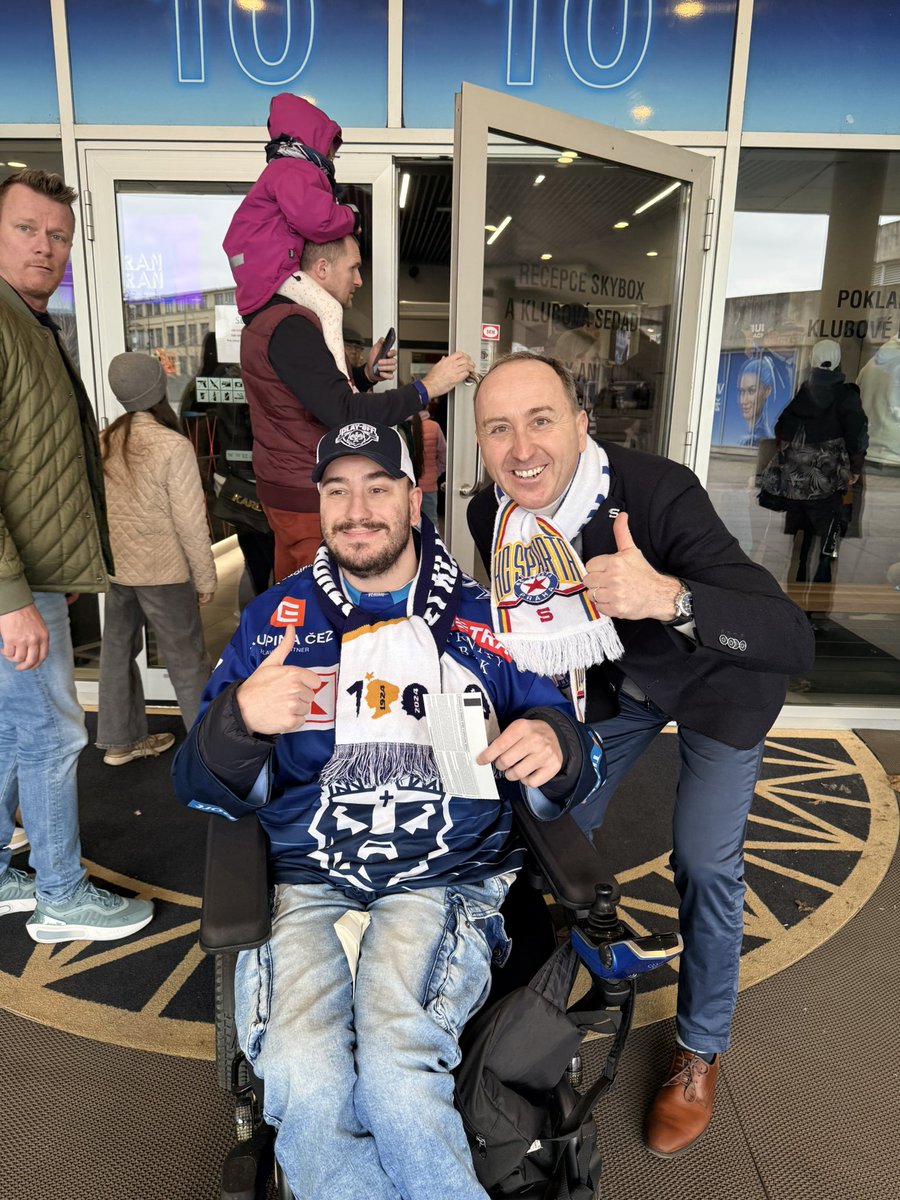
Chtěl bych touto cestou velmi poděkovat pánovi na fotografii. Bohužel na něj nemám žádný kontakt. Proto bych chtěl požádat oba kluby @hcspartapraha i @rytirikladno pokud je to možné, zkuste prosím toto poděkování k pánovi dostat. Tenhle člověk mi totiž dnes velmi pomohl při získání vstupenky na rozhodující páté osmifinále mezi Spartou a Kladnem.
Celý víkend jsem se snažil získat vstupenku. Psal jsem e-maily, volal jsem. Bohužel se mi nepodařilo nikoho kontaktovat a nikdo mi neodpověděl. A tak jsem si řekl, že stejně jako se nevzdává Kladno, nebudu se vzdávat ani já. Sedl jsem tedy na vozík a jel jsem na stadion tak trochu „na zdařbůh“ s tím, že to prostě zkusím u pokladny.
Jenže k pokladnám se s elektrickým vozíkem vlastně nedá dostat. Prostor je příliš úzký a já jsem stál tak daleko, že jsme si s paní pokladní prostě nerozuměli. Snažil se mi pomoci jeden pán, ale bohužel to nakonec skončilo nepříjemnou situací, která mě dodnes mrzí. Nemohl jsem ji ale nijak ovlivnit, paní pokladní mě prostě neslyšela.
A v tu chvíli přišel pán, kterého vidíte na fotografii.
Zastavil se, vyslechl si, co potřebuji, a šel to zkusit vysvětlit paní pokladní znovu. Nakonec jsme se společně dostali až k VIP pokladnám, kde nám jiná pani pokladní vysvětlila, že není možné koupit pouze vstupenku pro vozíčkáře a že je potřeba koupit i vstupenku pro doprovod. Řekl jsem, že mi to vůbec nevadí a že ji klidně zaplatím.
Jenže pak se stalo něco, co mě opravdu dojalo.
Tenhle pán se sparťanskou šálou kolem krku všechno vykomunikoval a paní pokladní mi přinesla vstupenku. Když jsem ji chtěl zaplatit, jen se usmál a řekl:
„To máte od Sparty za ten nepříjemný začátek.“
A vstupenku mi nechal. Milý pane, pokud se k vám toto poděkování dostane: děkuji vám z celého srdce. Díky vám jsem se dostal na zápas, na který bych se jinak nedostal.
A tahle situace mi znovu připomněla jednu důležitou věc. Hokej není jen sport. Není to jen rivalita mezi kluby. Je to komunita lidí, kteří si dokážou pomoci, i když fandí jinému týmu.
Pokud víte, kdo tenhle pán je, nebo se k němu můžete nějak dostat, budu moc rád, když mu tohle poděkování předáte.
Ještě jednou děkuji.
S úctou Richard
Dříve nebo později, po vlnách iluzí, které se ukážou jako nesmyslné, dojde většině svobodomyslných lidí, že problém není v tom, kdo zrovna řídí vládu.
Pak narazí hlavou do skutečnosti, že jejich nepřáteli nejsou politici.
Jsou to jejich spoluobčané. Včetně známých, včerejších přátel i nejbližších příbuzných.
Protože ta druhá část společnosti svobodu nejen nechce. Ona ji nenávidí. Nenávidí také všechny, kdo jsou chytřejší, schopnější, podnikavější, bohatší.
Proto volí politiky, kteří jim slíbí jistý kus žrádla a beztrestnost v likvidaci těch, které nenávidí.
Nebude tu jednou Babiš, T. Okamura ani další kreatury.
Spoluobčané, o kterých je řeč, zůstanou.
Jak vedle nich žít a jak naslouchat vlastnímu pudu sebezáchovy, dnes nikdo ze svobodomyslných lidí neví.
Od politiků, kteří by zrovna je mohli zastupovat, se momentálně ničeho nedočkají, protože ti se stále snaží podkuřovat těm, kteří je nikdy volit nebudou a naopak by je při první příležitosti rádi zlikvidovali.
Každý z nás může něco změnit.
Každý z nás má hlas. Nesouhlasíš s „ruským zákonem“ z pera SPD? Využij své právo a napiš svému poslanci.
Neziskovky jsme my všichni; jsou to dobrovolní hasiči, skauti, sportovní kluby i hospice🧑🚒🏕️
Vzor níže👇 Díky za RT!
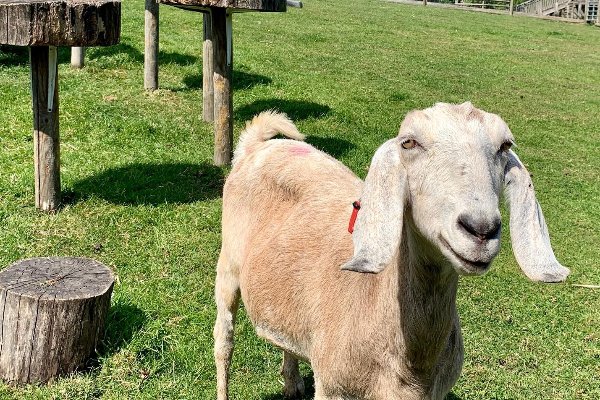
Keith the Apocalypse Bringer is a three-year-old Anglo-Nubian goat in a field in Devon.
Keith should not be underestimated.
Keith has been systematically dismantling the ecosystem since approximately 7am, when he ate a bramble. This is significant because bramble is an invasive scrub species that outcompetes wildflowers, reduces biodiversity, and creates dense monoculture thicket that nothing else can use.
Keith ate it. Keith does this every day. Keith does not charge for this service.
8:15am - Keith ate a thistle. Thistles are also considered invasive scrub in managed pasture. Goldfinches eat thistle seeds, but Keith's grazing will ensure the pasture remains open enough for the ground-nesting birds that can't use dense scrub. Keith has not attended a conservation workshop. Keith arrived at this conclusion by being a goat.
9:00am - Keith dismantled a section of hedge. This was less helpful. Keith does not have a perfect record.
10:30am - Keith escaped the field. He was in the road for eleven minutes. He ate a neighbour's rose. This is not being counted in Keith's environmental impact assessment.
11:00am - Keith was returned to the field. Keith regarded the farmer with the specific expression of an animal that does not recognise the concept of property.
12:00pm - Keith ate more bramble. His digestive system: four stomachs, a rumen full of specialised microorganisms, the ability to extract nutrition from lignified plant matter that would defeat any other animal on this field, is converting scrub vegetation into milk with a fat content of approximately 4.5%. The milk will become cheese. The cheese will be sold at the farm shop. The farm shop is four miles away. The cheese food miles are: four.
3:00pm - Keith produced manure. The manure will grow the grass. The grass will grow the bramble. The bramble will be eaten by Keith.
This system has no inputs.
It has been running since goats were domesticated approximately ten thousand years ago.
Keith is not aware he is saving the planet.
Keith is thinking about whether the fence on the north side has a weak point.
It does. Keith found it at 4:45pm.
Keith got out again.
“Europe is poor. Europoor! Low GDP. Broke continent.”
And honestly, it’s such a lazy argument that it almost answers itself.
First, let’s list the typical “Europe is poor” insults the way they actually show up.
MAGA, JD Vance and Trump say:
Europe is poor
Europe is broke
Europe has low GDP
Europe cannot afford anything without the US
Europe is falling behind
Europe is a declining continent
Now here’s the problem with that whole framing.
They are using national level money stats as if they automatically translate into human wellbeing. They do not.
GDP is not a quality of life scoreboard. GDP is an activity scoreboard.
It counts spending, not thriving.
It counts medical bills as “economic activity.”
It counts crime cleanup as “economic activity.”
It counts lawsuits, admin overhead, and debt servicing as “economic activity.”
So in a system where people pay insane amounts for healthcare, childcare, education, insurance, and legal friction, GDP can look fantastic precisely because people are paying through the nose to survive.
That’s not “rich.”
Meanwhile, Europe deliver more of what people actually want out of life: security, stability, and the ability to breathe without constant financial threat. Because a lot of essential things are cheaper at the point of use, and the social floor is higher.
Here’s the practical test I always use:
If a society is “richer,” why are normal people more anxious about getting sick, die, going to college, having a baby, or losing a job?
If the wealth is real for regular citizens, it should show up as reduced fear and increased stability.
And this is where the “Europe is poor” insult collapses.
Europe’s money is distributed in a way that buys normal life outcomes:
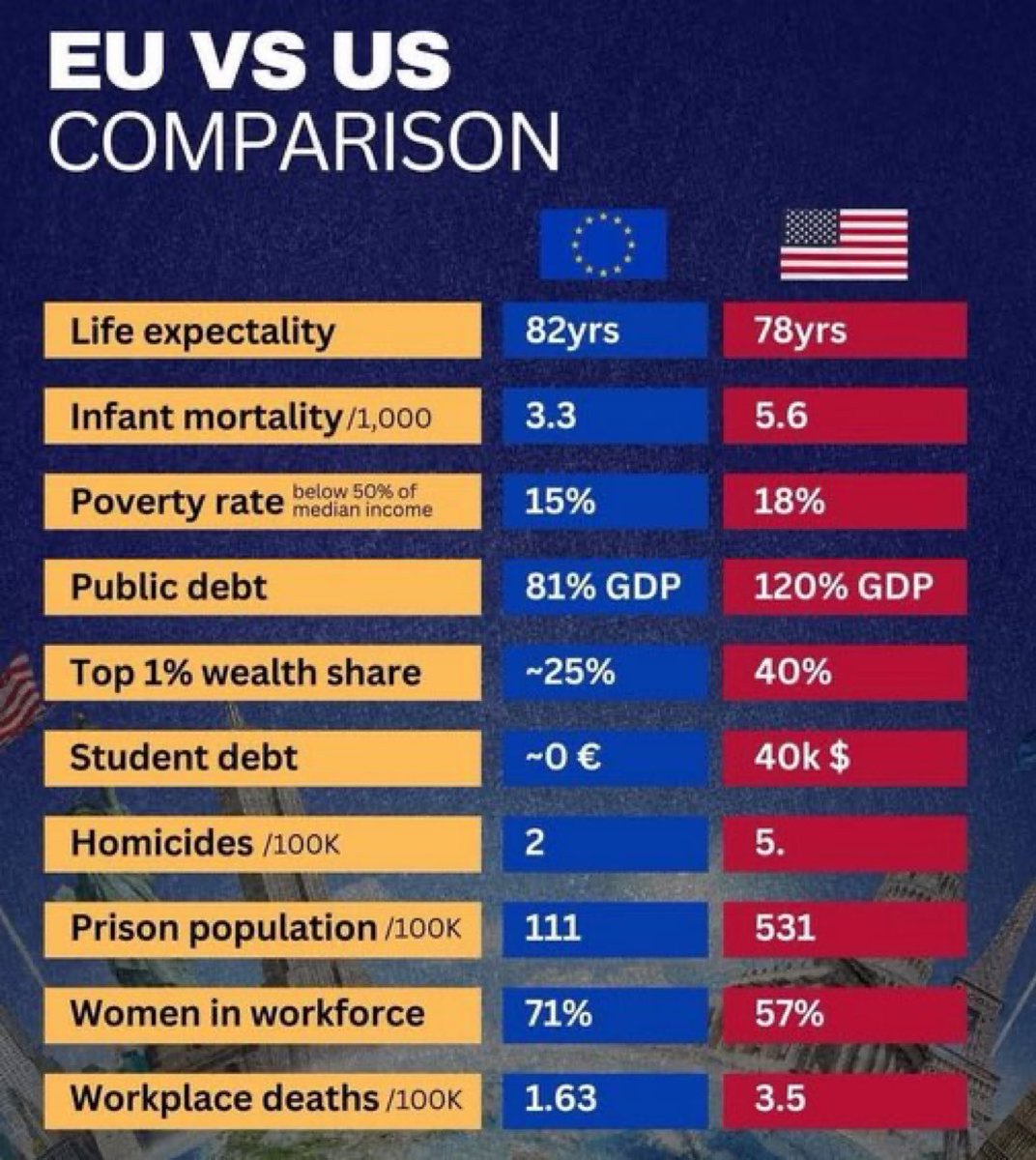
•Longer lives
•Lower infant mortality
•Lower homicide rates
•Far fewer people in prison
•Safer workplaces
•Less life wrecking education debt
You can scream “low GDP” all day, but you cannot argue with “people are living longer and safer lives.”
Also, that “Europe is poor” claim is usually based on cherry picking. Europe is a collection of wealthy advanced economies, many of which are among the richest in the world by any sane standard. The idea that Germany, the Netherlands, Switzerland, the Nordics, etc. are “poor” is clown talk. It’s propaganda aimed at Americans who have never checked anything beyond a meme.
“They keep yelling ‘Europe is poor’ because GDP is the only metric where they feel safe. But GDP measures spending, not wellbeing. Europe turns money into longer lives, safer streets, less debt, and fewer people in cages. If that’s ‘poor,’ then their definition of ‘rich’ is just suffering.”
Europe converts its resources into human life better. That’s the whole game.
Stay connected,
Follow Gandalv @Microinteracti1
A man with a $200 computer took down a $72-million empire—one phone call at a time.
In 1985, Edward Johnson sat in his small Atlanta apartment, watching televangelist Jerry Falwell on the screen.
"Pick up the phone, friend. Call now."
The toll-free number flashed across the television. Millions of viewers called that number every year, and their donations had built Falwell's Old Time Gospel Hour into a fundraising machine bringing in more than $72 million annually.
But Edward wasn't reaching for his wallet. He was reaching for something else.
His elderly mother had been sending Falwell money she couldn't afford. Money meant for groceries. Money meant for bills. She believed every word the preacher said. And it ate at Edward every single day.
"She trusted him," he would later say. "And I believed that trust was being exploited."
Edward wasn't a hacker. He wasn't a programmer by trade. He was just a 46-year-old computer consultant with an Atari 800 home computer and a phone line.
But he understood something most viewers didn't: toll-free calls aren't free for the organization receiving them. Every time someone dialed that number, Falwell's ministry paid for it.
So Edward wrote a simple program. Just a few lines of code that would do one thing:
Dial the toll-free number. Wait until someone answered. Hang up. Pause thirty seconds. Repeat.
Forever.
When he clicked "Run," his modem crackled to life.
"Old Time Gospel Hour, how may we help you—"
Silence. Then a click.
Thirty seconds later: the same thing. And again. And again.
Two calls per minute. One hundred twenty per hour. Nearly three thousand per day.
At first, Falwell's operators thought it was a glitch. Then they realized it wasn't stopping. The same number, calling around the clock, seven days a week. The lines jammed. Real callers couldn't get through.
The phone bills started climbing. Ten thousand dollars. Fifty thousand. The total would eventually reach somewhere between $500,000 and $750,000—depending on which source you believe.
As word spread about what was happening, others joined in. LGBT activists, furious at Falwell's public campaigns against gay rights, began organizing their own calling campaigns. At one point, prank calls made up an estimated 25 percent of all incoming traffic.
But nobody matched the relentless precision of Edward's Atari. It didn't sleep. It didn't get tired. It just kept dialing.
Eventually, AT&T technicians traced the source. On December 17, 1985, they narrowed it down to the Atlanta area code. Within thirty minutes, they had Edward's address.
A Southern Bell representative gave him a choice: stop calling, or lose your phone service.
Edward pressed a single key.
The screen went dark.
After eight months, the automated siege was over.
Falwell was furious. His spokespeople called the attacks "unlawful activities" that caused "injury to the cause of Christ." They considered lawsuits.
But here's the thing: nothing Edward did was clearly illegal at the time. He didn't hack into any system. He didn't steal any data. He just called a public phone number—thousands of times.
In 1986, facing mounting losses and operational chaos, Falwell made a drastic decision: he disconnected the toll-free prayer lines entirely.
The very tool that had helped build his empire had become too expensive and too vulnerable to maintain.
Edward Johnson never became famous for what he did. He never sought publicity or profit. When asked about it, he was matter-of-fact.
One journalist reported that toward the end, operators would answer the dead line and say: "Edward Johnson, is that you?"
He had become a ghost in their system.
Today, cybersecurity experts recognize his campaign as one of the earliest recorded denial-of-service attacks in history—years before the internet made such tactics famous.
Edward discovered something that still holds true: any system built on openness can be overwhelmed if someone is patient enough and persistent enough.
His Atari computer is long obsolete now. But the lesson it taught remains:
Sometimes the smallest weapon, wielded with enough determination, can change everything.
Once upon a time in a village, a man appeared and announced to the villagers that he would buy monkeys for $10 each.
The villagers, seeing that there were many monkeys around, went out to the forest and started catching them.
The man bought thousands at $10 and as supply started to diminish, the villagers stopped their effort. He further announced that he would now buy at $20. This renewed the efforts of the villagers and they started catching monkeys again.
Soon the supply diminished even further and people started going back to their farms. The offer increased to $25 each and the supply of monkeys became so little that it was an effort to even see a monkey, let alone catch one.
The man now announced that he would buy monkeys at $50! However, since he had to go to the city on some business, his assistant would now buy on his behalf.
In the absence of the man, the assistant told the villagers, “Look at all these monkeys in the big cage that the man has collected. I will sell them to you at $35 and when the man returns from the city, you can sell them to him for $50 each."
The villagers rounded up with all their savings and bought all the monkeys.
They never saw the man nor his assistant, only monkeys everywhere.
Now you have a better understanding of how the cryptocurrency market works.
Last week I hosted family for Thanksgiving.
My 12-year-old nephew asked for the WiFi password.
He wanted to play Roblox on his iPad.
I looked at the device.
Unmanaged. No antivirus. No encryption.
I’m an IT Professional. I don't run an open network.
So I didn’t give him the password.
Instead, I spent 45 minutes provisioning a Guest VLAN.
I set up a captive portal.
I throttled the bandwidth down to 56kbps.
Then I blocked all traffic on ports 80 and 443.
He came back crying. He said it wouldn't load.
My sister screamed at me to "just let him play."
I told her that Zero Trust architecture doesn't care about bloodlines.
We didn't have a "fun" Thanksgiving.
But we had a secure perimeter.
You’re welcome for the compliance.
Bez dotací by Agrofert zkrachoval – a proto Babiš nikdy neodejde z politiky
Andrej Babiš je často popisován jako „úspěšný podnikatel, který vstoupil do politiky“. Ve skutečnosti je to přesně naopak: politik, který potřebuje podnikání, aby mohl udržet svou moc, a podnikatel, který potřebuje politiku, aby udržel svůj byznys při životě.
Agrofert není obyčejná firma. Je to ekonomický organismus napojený na státní a evropské dotace jako na kyslík. Bez veřejných peněz by většina jeho zemědělských, chemických a potravinářských divizí vykazovala ztrátu. To není ideologická nadsázka – to je účetní fakt. Drtivá část jeho zisků plyne z dotací, investičních pobídek, zvýhodněných úvěrů a veřejných zakázek.
Tento model by se na svobodném trhu dávno zhroutil. Ale v systému, kde o přidělování peněz rozhodují politici a úředníci, může přežít pouze ten, kdo má přímý vliv na stát. A právě proto se Babiš stal politikem: aby získal kontrolu nad institucemi, které rozhodují o penězích, z nichž žije.
Jeho slavné „řešení střetu zájmů“ – převedení Agrofertu do svěřenských fondů – je pouhá právní kulisa. Fondy spravují lidé jemu loajální, on sám z nich dál profituje a zároveň ovlivňuje státní politiku, která firmu financuje. To není oddělení, to je dokonalé propojení moci a peněz.
A tady je klíčová pravda, kterou se v Česku málokdo odváží vyslovit nahlas:
Andrej Babiš nemůže střet zájmů nikdy vyřešit, protože by tím zničil ekonomický základ svého impéria.
Bez přísunu státních a evropských dotací by Agrofert ztratil konkurenceschopnost, srazil by se do ztráty a Babiš by přišel o svou hlavní finanční páku. Politická moc je tak pro něj nejen cestou k ovlivňování veřejnosti, ale také ekonomickou pojistkou proti bankrotu.
Je to začarovaný kruh: čím víc se Babiš drží u moci, tím víc chrání své firemní zájmy. A čím víc jeho byznys závisí na státu, tím zoufaleji potřebuje politickou moc, aby přežil.
Agrofert tak není jen firma – je to model závislosti, který vysává český stát a zároveň ho používá jako štít. A dokud tenhle model neskončí, nebude možné mít v Česku vládu, která by skutečně hájila veřejný zájem.