@DavidAFrench There may be an element of that, but I think loyalty to the cult leader dominates. If/when followers feel enough economic pain, however, the cult fever will break and the followers will drift away.
Sigmund Freud's nephew wrote a 168-page book in 1928 that taught American corporations how to manufacture desire, and almost every advertising campaign and political messaging strategy you have ever seen still runs on the playbook he wrote a century ago.
His name was Edward Bernays. The book is called Propaganda. And the strangest thing about it is that he was completely open about what he was doing.
He opened with one of the most chilling sentences ever published in a non-fiction book: “The conscious and intelligent manipulation of the organized habits and opinions of the masses is an important element in democratic society. Those who manipulate this unseen mechanism of society constitute an invisible government which is the true ruling power of our country.”
He was not warning you about this. He was advertising his services.
Bernays had figured something out that nobody else in the early 20th century had put into words.
The old model of selling things to people was broken. You could not just describe a product and expect people to buy it. Humans do not make decisions based on information. They make decisions based on emotion, identity, and social pressure, then construct a rational story afterward to explain what they already wanted to do.
His uncle Sigmund Freud had spent decades documenting this in clinical psychology. Bernays took that work and pointed it at consumer markets and political campaigns.
The case study that made him famous is the one almost nobody knows the full story of.
In 1929, the American Tobacco Company hired him because women were not buying cigarettes. Smoking in public was considered scandalous for women at the time. The market was cut in half by social taboo and the company could not figure out how to break through.
Bernays did not run an ad campaign. He hired a psychoanalyst to figure out what cigarettes symbolically meant to women. The answer that came back was that cigarettes represented male power, and the taboo against women smoking was a symbol of male dominance over female freedom.
So he staged an event. He recruited a group of fashionable young women to march in the 1929 New York Easter Parade and light cigarettes in public at a coordinated moment. He tipped off the press in advance and told them to expect a feminist demonstration. He named the cigarettes "torches of freedom."
The photographs ran on the front page of newspapers across the country. Within a few years, female smoking rates had jumped. He had not sold cigarettes. He had sold liberation, and the cigarette came along for the ride.
The mechanism underneath every move he ever made is the part you should not forget.
He never sold the product. He sold the identity the product represented. He never argued with the audience. He restructured the environment until the conclusion he wanted felt like the audience's own idea. He never appealed to reason. He appealed to the unconscious associations people already had and quietly attached his client's product to those associations.
Every influencer marketing campaign, every political ad, every Super Bowl commercial that makes you feel something without telling you why, every news segment that frames a story before you have time to think about it, is running a version of his original system.
He died in 1995 at the age of 103. He gave interviews in his final years admitting that he had helped overthrow a democratically elected government in Guatemala in 1954 by manipulating American public opinion against it. He said it without regret. He was proud of the work.
The book is 168 pages. It is in the public domain. You can read it in one evening.
Almost nobody who is being manipulated by his methods has ever opened it.
“Somebody shorted the oil markets today by hundreds of millions of dollars exactly 20 minutes before Trump made his announcement that everything was going to be great. And if you see that once, it could be a coincidence. But that’s happened at least three times, if not more, since the war began. That’s a pattern.”
“And what that suggests is that there’s rampant corruption and insider self-dealing going on with the president’s up and down
predictions of what’s going to happen tomorrow in the negotiations and in the markets. And I’m sure that that’s being investigated. We can’t prove it, but it seems like the corruption that we’re seeing in our government, maybe not the President, but people who are in the know and the markets, is having a priority over the actual negotiations to end the war. And that’s a crazy thing that our system has never seen before.”
@ReichlinMelnick After attacks on offshore wind, it's hard not to see ICE raid on Hyundai battery plant in Georgia, as one more attempt by Trump to chill green energy.
How else explain harsh way raid was handled, with detainees in chains, treated as criminals. Surely visas could’ve been adjusted.
"They never answered Schumer's core argument: if we shut down govt, Trump will have expanded power to furlough nonessential workers, and he won't bring them back," David Brooks says. "By shutting the govt you're expanding his power to decimate the govt."
https://t.co/EIEu23xBCc
@EricLevitz@jbarro Democratic rank-and-file want performative politics to provide them a much-needed catharsis. But one thing is clear to me. The economy is tanking, and voters are pinning it on Trump. A govt shutdown facilitated by the Democrats would muddle the one issue that can pull Trump down.
Democratic rank-and-file want performative politics to provide them a much-needed catharsis. But one thing is clear to me. The economy is tanking, and voters are pinning it on Trump. A govt shutdown facilitated by the Democrats would muddle the one issue that can pull Trump down.
@JStein_WaPo Schumer argues persuasively that Trump/Musk will have even greater power over how fed funds are spent in a shutdown. By deciding which services are essential and nonessential, they'll be able to make far-reaching changes to exec branch, and do so quickly. https://t.co/0Zb8Mt5YY7
🚨 NEW: According to a Gallup poll released today, Donald Trump's approval rating has plummeted to just 45%, with disapproval skyrocketing to 51%. To put it in perspective, President Biden’s approval was 56% at the same point in his presidency.
Even more concerning for Trump, his approval among women is a dismal 34%, with a staggering 62% disapproval.
Talk about a steep decline—this isn’t the golden age he imagined!
Dem leaders have been flailing, unable to agree on how to stop Trump. What is the way forward? The party can help to build such a broad coalition. An ad campaign to channel voters’ anger & frustration would be a good place to start. 2/2
Many who voted for Trump were not committed MAGA voters. They did not vote for dismantling the govt, nor taking over the Gaza Strip. Many of them are now expressing remorse. They must be brought into a broad coalition to preserve our democracy. 1/2
Yesterday, the richest man in the world fired hundreds of workers who support America’s small businesses. After being rescinded last week, pink slips were reissued this morning. DOGE doesn't 'measure twice, cut once' they cut twice, then cut again. All while Elon protects his own contracts.
https://t.co/8M02bRQ4Dh
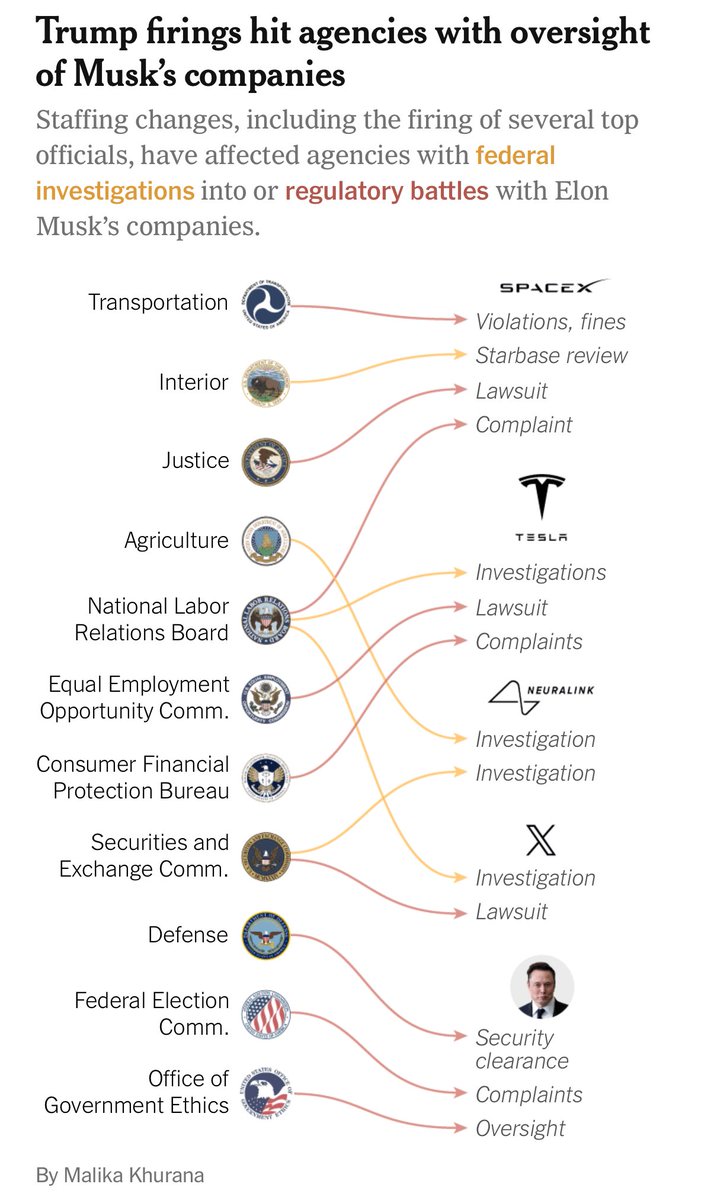
At least 11 federal agencies targeted by the Trump-Musk firings and cuts “have more than 32 continuing investigations, pending complaints or enforcement actions into Mr. Musk’s six companies”
per @nytimes
$300 million worth of medications are sitting on pallets about to expire thanks to Trump's effort to gut foreign aid. These drugs would've prevented people from going blind from a preventable tropical disease—Donald Trump would rather waste them in an East African warehouse.
No NATO membership, no boots on the ground? Sounds like abandoning Ukraine. Delegates are flying to Munich not to negotiate, but to deliver @ZelenskyyUa the bad news. If this deal produces a piece of paper guaranteeing peace for our time, we should call it Munich 2.
$4.5 trillion in tax cuts that flow overwhelmingly to the wealthy paid for by $1.5 trillion in cuts to Medicaid, SNAP, education, and other critical programs.
This is a deeply unpopular agenda no one is asking for, except for Trump and the billionaires.