@arafararas It is always nice to share thoughts with you my old freind. I appreciate your words. See you on PatroBar this saturday, your Agora, artist.
📑Un estudi de l'Agència de Ciberseguretat conclou que els models d'aprenentatge de la #IA poden millorar la predicció de futurs ciberatacs.
Coneix més sobre aquesta investigació al congrés @noconname:
🗓️20/11 | 16:15h
📍Cibernarium, Barcelona Activa
https://t.co/8xELeMrziO
📢 On November 19-20, I’ll be speaking at the No cON Name Cybersecurity Congress!
In my session, I’ll discuss how data science can be a powerful ally in cybersecurity. We’ll explore how machine learning and deep learning techniques allow us to analyze large datasetd!!
🛡️🛡️🛡️🛡️🛡️🛡️🛡️🛡️🛡️🛡️🛡️
🎟️🎟️ tickets available !! 🎟️🎟️
🛡️🛡️🛡️🛡️🛡️🛡️🛡️🛡️🛡️🛡️🛡️
Event #ncn2k24#cybersecurity track
#privacy track
Click here to get your PASS
👇🏼👇🏼👇🏼👇🏼
https://t.co/ng0jayBySL
Hurry up! Are running out
Here we go @barcelonactiva!
@arafararas @deltgar Todo un placer. Que no se olvide la NoMove Cup (NMC) y la DataGuessr Ligui. Mis mas sinceras felicitaciones para usted, campeón de la NMC y a Pau, campeón de la DGL. Esperando la segunda edición.
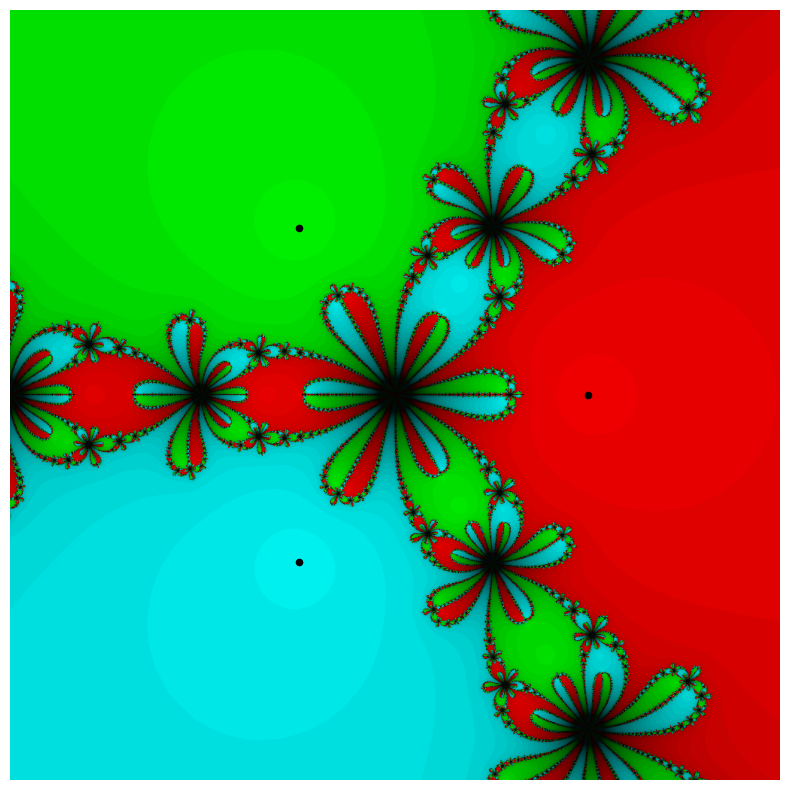
Currently, the information is not very clear; numerical evidence is presented in the picture above, but further investigation is required. The crucial finding is that the immediate basins of attraction for a root are unbounded sets that are simply connected.
Newton's method stands out as the most widely recognized numerical approach for solving the equation p(x) = 0. This iterative technique offers an effective way of determining solutions to equations. Specifically, for simple roots, the local order of convergence is quadratic.
One Traub iteration is equivalent to one and a half Newton iterations, but with a notable change: the local convergence order has shifted from quadratic to cubic. Can we establish a set of initial conditions that allows us to discover all the roots using this technique?