Victorian inventors kept finding another detail to improve.
An opening lever. An ejector. Even the safety catch.
The British double shotgun’s traditional appearance hides a history of constant experimentation, with makers competing to make each mechanism work a little better.
Years before writing about fine doubles, Michael McIntosh acquired a Stevens 311 twenty-gauge on six months of spare pennies. It was September 1967. Looking back, he doubted he ever loved another gun quite as much.
One setter points. The other honors.
On this Becker-barreled A.H. Fox twenty-bore, tiny cuts texture the gold-inlaid dogs’ coats and feathered tails. A quiet moment in the field, held in miniature.
An Alexander Henry .450/.400 double rifle, delivered to Sir Walter Corbet in 1890.
It passed through the Durand family, spent decades out of use, and returned to the field in America.
From Frank Findlow’s ‘Sir Walter Corbet’s Rifle,’ The Double Gun Journal.
A Bertuzzi from 2000, made by brothers Elio and Remigio in Gardone Val Trompia.
Ferraglio’s rose-and-scroll engraving carries across the bright steel, right down to the trigger guard and forend iron. Small surfaces, carefully considered.
Frank Findlow still hunts Sir Walter Corbet's 1890 Alexander Henry on black powder. He says the boom and the white smoke make him think of what Corbet saw in Nepal: a charging tiger vanishing into that cloud. "Sir Walter Corbet's Rifle," The Double Gun Journal.
Two triggers is one too few for three barrels, unless one of them can change its mind. On a 1931 J. Albrecht drilling, a thumb catch moves the front trigger from the right barrel to the rifle beneath and lifts the rear sight with it.
Rose & Scroll Fine Gun Journal.
Twenty years into the smokeless era, Roland Durand still liked his father's 1890 black-powder Alexander Henry enough to put his own name on its case and hunt in India with it until the war. He was killed in France in 1917. "Sir Walter Corbet's Rifle," The Double Gun Journal.
Twenty years into the smokeless era, an ensign in the Indian Army put his name on the case of an 1890 black-powder Alexander Henry and kept hunting with it until the war took him in 1917. The rifle is still in the field.
"Sir Walter Corbet's Rifle," Frank Findlow. The Double Gun Journal, Summer 2010.
Remington's first double, 1874, had a top lever you lifted with your thumb. It also had a letter from New York's governor saying he'd give up his English gun before it. The company printed the letter, built 225,000 more doubles, and quit in 1910. Charles Semmer, The Double Gun Journal, Winter 1989. #remington
FN's engraving workshop was founded in 1926, the year John Browning died at Herstal. This B25 was cut in 2005 by Jean-Marie Martens, one of the Liège hands still working in that line. His signature sits beside the gold trigger. Rose & Scroll Fine Gun Journal. #browning
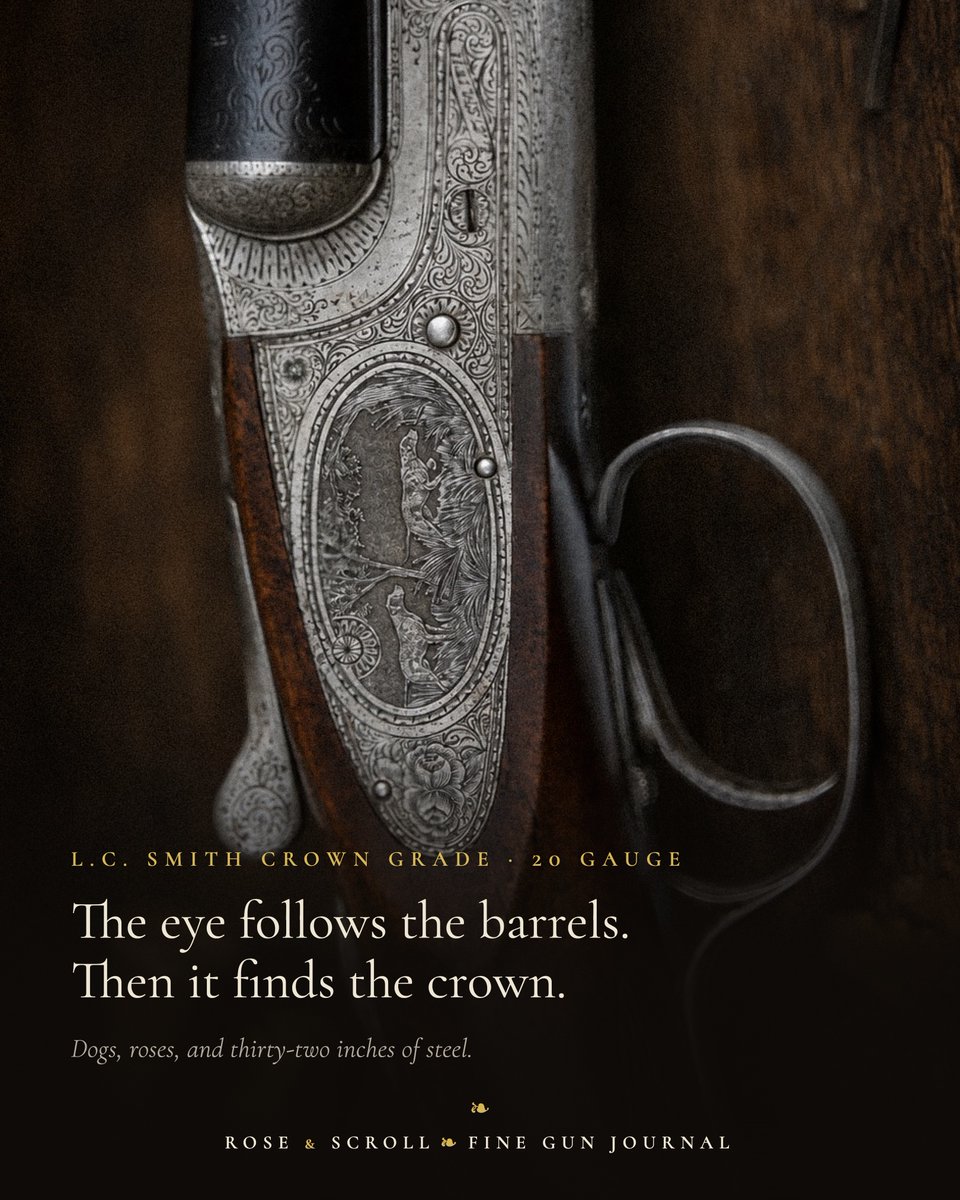
Published figures put 862 L.C. Smith Crown Grades against 199,384 Field Grades. One hundred forty-five of the Crowns were twenties. This is one of them, in nine frames. From "A Crown Drawn Long," Rose & Scroll Fine Gun Journal.