🚨 If you read and share only one post today, make it this one. 🚨
People keep telling you there's a conspiracy. A small group meeting in secret to decide the fate of the world.
There is no conspiracy.
It's worse. There's a worldview. And it's completely public.
A lot of people can't understand why our leaders do what they do. Why they never fix anything. Why every crisis ends with more rules, more Europe, more control, and never with a solution.
So they look for a hidden plan. They look for secret culprits.
Wrong method. Step inside their heads. Adopt their worldview for five minutes. And everything becomes perfectly coherent.
Their worldview fits in a few ideas.
One: man is a product of his environment. So nobody is ever truly responsible for anything. The criminal is a victim of society. The poor, a victim of the market. The thug, a victim of his neighborhood.
Two: the nation is an accident of history. Borders are relics. Progress means global governance. Jacques Attali, Mitterrand's longtime adviser, wrote it in black and white in 2009: a global rule of law, as a prelude to world government.
Three: the market is chaos that must be corrected. Free people trading with each other is dangerous. Experts planning everything is reassuring.
Four: growth is the problem. Too much consumption, too much travel, too much freedom. You manage scarcity. You don't create abundance.
Now reread the news through those four lenses.
Why don't they fix crime? Because in their world, punishing means attacking a victim.
Why don't they control immigration? Because borders belong to the past.
Why do they never name Islamism? Because their worldview forbids them from ranking cultures. Naming the problem would mean renouncing the dogma.
Why do they plan your energy, your car, your home, your money? Because a free market is disorder.
They're not sabotaging the country on purpose. They're running it exactly the way their ideology tells them to. And when chaos comes, they don't even need to have caused it: every crisis becomes an argument for their solution. More centralization. More rules. More Europe. Attali even had a title for it: "Moving forward through fear."
That's why it never stops. Their cure is the disease.
And now, the most important point of this post.
This is not an ethnicity. It's not a religion. It's not a family.
Among the people who carry these ideas, you'll find Christians, Jews, atheists, Muslims, Buddhists. Sons of old money and sons of factory workers. French, Germans, Americans.
What binds them isn't blood. It's ideas.
And the people telling you it's a "Jewish conspiracy" are doing this system the biggest favor imaginable. They turn a battle of ideas, which the system loses, into an antisemitism trial, which it wins every single time. They hand it a shield.
Conspiracy theorists are globalism's useful idiots.
So why did so many people in that world believe for so long that they were untouchable?
Look at the Epstein affair. Not a conspiracy. A portrait of a caste. Bankers, princes, ministers, presidents from every side, trading favors for years, convinced the rules everyone else lives by didn't apply to them.
And look at who's falling in Europe. Jack Lang, icon of Mitterrand's left, French culture minister for nearly twenty years in total: his name appears 673 times in correspondence with Epstein, and France's financial crimes prosecutors are investigating his financial ties to him. He denies any wrongdoing and any knowledge of Epstein's crimes. In the UK, Peter Mandelson, former EU commissioner. In Norway, Thorbjørn Jagland, former prime minister and former Secretary General of the Council of Europe. All under police investigation.
For fifty years, this caste ran the institutions. Not because it conspired in secret. Because institutions recruit, train and promote people who think like them. The schools, the ministries, the commissions, the forums. Gramsci called it the long march through the institutions.
But the march is ending. The files are coming out. The raids are happening. The voters are waking up.
Once you understand all this, you understand why they do what they do. And why they will never solve your problems: in their worldview, your problems are their program.
So stop looking for hidden culprits. There aren't any.
There are ideas. And the people who embody them.
Those are what we have to attack. Those are who we have to beat, at the ballot box and in the debate.
A conspiracy hides. An ideology has to be fought in the open.
And that's why we're going to win.
Twins
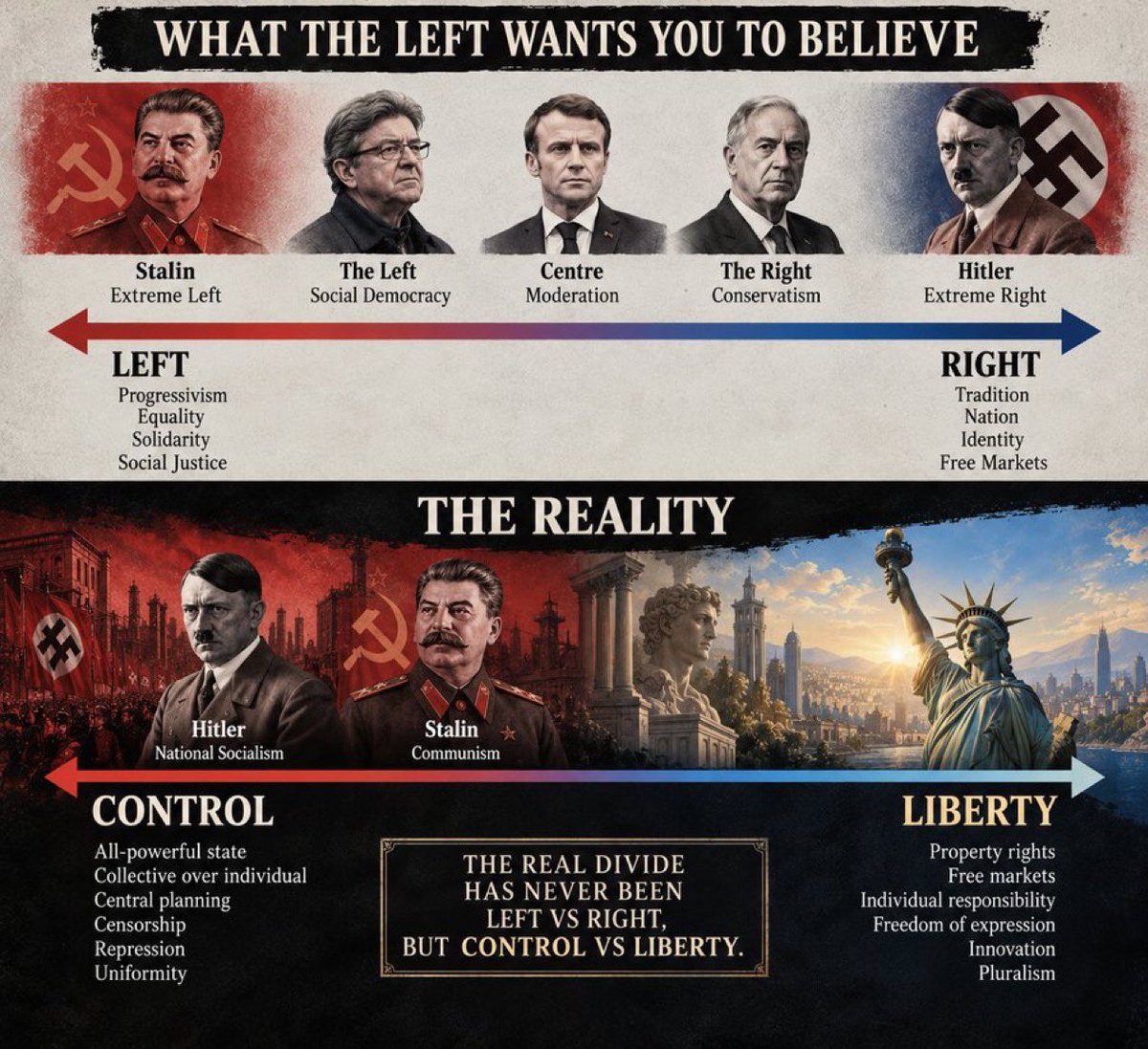
Let's be fair: German National Socialism is not the same as communism. It is its twin. And twins often fight.
The differences are real. Communism divides humanity by class; National Socialism divides it by ethnicity. Communism claimed to be international; National Socialism was national to the point of madness – the German way. Communism took property away; National Socialism left it nominally in private hands and ordered the owners what to produce. One worshiped History, the other Blood. One promised a world without classes, the other a world without "lower races."
But look at what they shared: one party, one leader worshiped as a god, a secret police, the camps, a youth organization to take the children, propaganda instead of truth, the collective above the person – and a designated enemy to be blamed for everything, the bourgeois or the Jew. Two different theories, one machine. Vasily Grossman, who had lived under both shadows, put it most bluntly in his great novel, where an SS officer tells his Bolshevik prisoner that when they look each other in the face, they see a mirror.
Why do twins fight? Because they want the same thing: the whole man. A totalitarian system cannot share a soul, a territory or a future. Each claims to be the only answer to everything, so each must be the other's death. They can make a deal for a while, like two heirs dividing an inheritance. Sooner or later, each wants it all.
That brutal fight happened over the body of Poland.
In August 1939, the twins signed a pact. In September, they invaded Poland from both sides, and their officers held a joint ceremony in Brest. In the spring of 1940, at the same time, they did the same thing to the same nation: the Germans shot the Polish elite at Palmiry and in the forests, the Soviets at Katyn. Two theories, one target: the people who could lead a free Poland.
Then, in 1941, the twins turned on each other – and Poland was the battlefield again, crushed between the two for four more years, and handed to the survivor for forty-five.
It still happens, in a more sophisticated way: on one side communism in its newer form – no gulags, just narratives, re-education and the Lie; on the other, German bureaucratic dominance through Brussels. Both are still fighting the same enemy: the Polish spirit of Freedom. 🇵🇱🗽
In 2006, a Polish minister compared the Nord Stream pipeline, built by Berlin and Moscow under the Baltic, to the Molotov–Ribbentrop Pact. He was mocked. The pipeline went around Poland, by design. The twins are supposedly dead. (Are they?) The habit of deciding about Poland over its head is not.
Poland knows both twins, because it has felt both from the inside. That is why it recognizes their family resemblance in every new form…
And why it cannot afford to forget.
Every grade school, middle school, high school, and every university, and I should add every person under the age of 40 years old. Should watch this over and over again until they finally understand what that section of America is doing to destroy the United States. Wake up America.
You don't understand anything happening in the US right now unless you read Elon Musk all the way through.
When he says that by 2036 money won't matter anymore, most people hear a billionaire's provocation. I hear something else.
Money is the fuel of every corruption system. Earmarked subsidies, public contracts negotiated behind closed doors, lobbies, front NGOs, regulatory rents. The day AI and robots produce more than humanity can consume, that lever disappears. And everyone who lives off that lever disappears with it.
There are a lot of them. And they've understood perfectly.
That's why we're now reading that Musk is preparing for "war" if Democrats take back Congress. He's not the one declaring war. It's an entire system that knows it's fighting for its survival.
Because we're at a turning point in human history. And there are only two ways out.
Either the Democrats win, and we enter 1984. A hyper-class that controls the AI models, the robot fleets, the data, the currency, and owns 99% of everything. Below them, the rest of humanity on life support, dependent on an income that can be granted and taken away. Klaus Schwab's Davos Forum summed up this world in one sentence: "You'll own nothing and you'll be happy." It's communism, except instead of promising equality, it embraces caste. And for the first time in history, a caste won't need the consent of the people to hold power: robots will do the policing, AI will do the surveillance.
Or we build a new order founded on merit, freedom, and private property. Where everyone remains the owner of their life, their work, and their share of the abundance. Where the collective ambition isn't managing scarcity, but understanding the universe and colonizing the cosmos. That's Elon Musk's project.
The technology is the same in both cases. What changes is who owns it.
Choose carefully which world you want to live in. And beware of socialists who promise to share the pie: they always end up keeping the knife.
Capitalism has a win condition. Socialism does not.
Here's why, explained so simply a 10-year-old could get it.
It starts with a book written in 1944 by an Austrian economist named Friedrich Hayek: The Road to Serfdom.
🚨🚨 THE ILLEGITIMACY PLAYBOOK / THE DEMOCRACY FILES: A PRIMER 🚨
I will be using this thread to track all drops, so bookmark it.
I spent most of yesterday backing everything (now 312 gigabytes) up in various sources and getting the materials out to others. I also produced an AI video (below) to explain the whole thing to others are not on 𝕏 - feel free to distribute.
Here's the primer:
USAID, the foreign aid agency, had a democracy office. Inside the agency, it was called DRG.
Officially, DRG administered "democracy assistance." They'd go inside countries they thought were sliding into authoritarianism and help the opposition there. That assistance included election monitoring, judicary support, independent media, and civil society building.
You may have heard the term "color revolution." The model comes from Serbia in 2000, where trained student activists brought down Milosevic with the help of Western governments, after sustained protests. With the help of USAID's democracy office, this model was implemented in many other countries to topple governments: Georgia's "Rose Revolution" in 2003, Ukraine's "Orange Revolution" in 2004, and many more.
Then last year, DOGE shut down USAID. But the USAID democracy office didn't stop. They formed a group called the Democracy Renewal Group, the same initials as their office (USAID Democracy, Human Rights, Governance). Their goal: apply their own playbook to the United States itself.
This goal became a plan, called Renew American Democracy (RAD). It invoked the "4 B's" framework. Block - use lawfare and protests to make life harder for the Trump administration. Bridge & Belong - control dialogue and win people over. The final and most important B is Build. Build means redesigning the American government itself, and the crisis is the opening.
In their own words:
"We can take that breakdown moment and leverage it for a big structural reform, you know, refounding moment." - Danielle Reiff, DRG lead.
Calls show DRG working alongside DSA on ideas of creating a different government, one that does away with the Constitution itself.
DRG does not run the Block operations. They hand it to UDA, the United Democracy Alliance. One organizer calls it a "huge galaxy": lawsuits, street protests, non-cooperation. They list No Kings, Indivisible, MoveOn, 50501, and many other mega-activist NGOs among their members.
Another organizer calls UDA Erica Chenoweth's project. Chenoweth is the Harvard professor behind the three-and-half-percent rule of regime change: get that share of a country's populace onto the streets, and historically, the movement wins.
The UDA is very "hush-hush." They have no website, no roster, no filings.
Then come the red lines: things the Trump administration could do, such as calling the Insurrection Act on protesters, that would mean that the federal government, in their words, "crosses the threshold into illegitimacy." Nobody voted on those lines. There was no public debate. These red lines were developed within secretive working groups, and in a paper addressed to governors and staff.
In the words of Reiff/DRG:
"So that if there is a red line crossed in terms of a Constitutional crisis, like everyone's already pre-organized. And so Mike Smith actually said, he goes, oh, you guys have the day after tomorrow plan."
Cross a line, and the paper's options include states refusing to lend their resources to federal officials, and governors convening what it calls a "Third Continential Congress."
Running the UDA's Insurrection Act working group: Rear Admiral Mike Smith (RET) of National Security Leaders of America (NSL4A). NSL4A is also credited with operationalizing UDA, the blocking operations. NSL4A consists of about 1,600 ex-officers, spies, diplomats. They're turning red lines into indicators and running a situation room to monitor them throughout the midterms and beyond.
The NSL4A's lawyers told them to stop recording meetings in case of subpoenas. But the rest of the network continued to record. DRG works in conjunction with Renew to Thrive (R2T), which ended up accidentally publishing 400+ calls and thousands of documents. These calls and documents were never meant for our eyes, but it's them, on tape.
Thousands of NGOs and billions of dollars are involved in this endeavor. Most of them believe they're saving democracy. The problem is that people who spent their careers deciding when other countries' governments had lost their legitimacy wrote that test for ours, in private, and planned for what comes after.
Who decides when your government is legitimate?
"You reduce crime by eliminating poverty."
This is one of the greatest intellectual confusions of our century. It sounds compassionate. It feels obvious. And the moment you actually test it, it falls apart.
Let's look at the data.
First, the correlation is real. Nobody serious denies that poorer areas have more crime. In Sweden, kids from the poorest 20% of families are about 7 times more likely to be convicted of a violent crime than kids from the richest 20%.
But correlation is not causation. So Swedish researchers did something brilliant: they compared siblings. Same parents, same home, same upbringing, but different family income at different points in their childhood, because parents' income moves over time.
Result, on more than 500,000 children (Sariaslan et al., British Journal of Psychiatry, 2014): once you account for what's shared inside the family, the effect of income on violent crime goes from 7x to nothing. The hazard ratio drops to 0.95. No effect.
Finland ran the same test on 650,000 people. Same result: the income-crime link disappears when you compare siblings.
What predicts crime isn't the bank balance. It's what travels inside families.
Second test: what happens when poverty spikes for everyone at once? 2008. US unemployment doubled from 5% to nearly 10%. 15% of Americans officially poor. If poverty creates crime, crime should have exploded. Instead it fell. Year after year. Robbery, the most "economic" crime of all, dropped 10% in 2010 alone. Criminologists literally said they were stumped. Same story in the Great Depression: 25% unemployment, and crime went down in many cities.
Third test: take families out of poverty and see. The US government ran a randomized lottery called Moving to Opportunity. Thousands of families in public housing got vouchers to move to low-poverty neighborhoods. For boys, violent arrests dropped at first, property crime arrests went up, and over time the effects faded. New zip code. Same behavior.
Fourth: the claim that police don't matter. This one is just false. Chalfin et al. (American Economic Review: Insights, 2022): each additional police officer prevents about 0.1 homicides. And per capita, the lives saved are twice as many among Black victims as among white victims. The people who suffer most from "police don't matter" are the poorest neighborhoods.
So what does predict crime? The Dunedin study followed 1,000 children from birth to age 32. Self-control measured between ages 3 and 11 predicted adult criminal convictions, even after controlling for social class and IQ (Moffitt et al., PNAS, 2011). Cognitive ability matters too: across 700,000 Swedish men, lower cognitive scores at 18 track with violent convictions, and the link barely moves when you control for childhood socioeconomic status (Frisell et al., 2012).
And here's the part nobody quotes: in Dunedin, kids whose self-control improved over time did better than predicted. Behavior can change. Which means responsibility is real.
Why does this matter? Because "poverty creates crime" isn't just wrong. It's toxic.
It turns criminals into victims. The man who robbed you becomes a symptom of "the system," and you, the real victim, become a footnote in someone else's narrative.
It merges two completely different things. "You're poor, we'll help you" is one policy. "You're poor and you committed a crime, so we'll excuse you" is another. Fusing them insults the millions of poor people who work, raise their kids, and never hurt anyone. The vast majority of poor people are not criminals. That alone kills the theory.
It removes responsibility. Build a political system on "your circumstances made you do it" and you destroy the one thing that actually changes behavior: the certainty that you own your choices. Every excuse the state manufactures is an incentive.
And it feeds the state forever. If every crime is a social failure, every crime justifies a new program, a new budget, a new agency. Crime becomes the business model of bureaucracy.
The alternative is simple and old.
A lighter state that protects instead of explains. The same rules for everyone, from the projects or from a gated community. Certain, swift punishment for anyone who commits a crime. And never, ever telling someone their crime was written in their social condition.
Treating someone as responsible is respecting them. Excusing someone because they're poor is the most condescending thing you can do to them.
My post about France went viral. Thousands of likes. Many Americans told me: "Democrats aren't socialists. America will never be France." I want to answer that seriously, step by step.
Start with a simple observation. Look at what has gotten cheaper in America over the last 25 years: TVs, phones, software, clothes, toys. Now look at what has exploded: college tuition, healthcare, childcare, housing.
What separates the two lists? The first lives in competitive markets. The second is exactly where government is most involved: subsidies, mandates, licensing, zoning, regulation.
College. Washington lends students almost unlimited money. Universities know the money will always come, so they raise tuition and hire more administrators. The student pays the bill for twenty years. More government money, higher prices.
Housing. Why can't a nurse buy a home in the city where she works? Not because of capitalism. Because of zoning laws, permits, environmental reviews, years of procedure to build a single building. The most expensive places to live in America are the places where it's hardest to build. When building is nearly illegal, prices explode.
Healthcare. The patient almost never sees the price. A third party pays, regulations limit who can compete, and costs climb year after year with no one able to say no.
So here is the trap. The problems you suffer from are not the failure of free markets. They are the places where the market has already been replaced by the state. And the solution you're being offered is more of the same.
That's the Trojan horse. It always works the same way. A real problem. A generous-sounding promise. A program that makes things worse. Then the failure of that program becomes the argument for the next one. People who lived under communism in Poland learned to recognize the lie and the mask the lie wears. The lie never presents itself as a lie. It presents itself as compassion.
In France we are at the end of that road. Debt we can never repay. Young people who can't afford a home. Our best people leaving. And every few years our cities burn. Nobody voted for this. They voted for one more generous promise, fifty years in a row.
If you're a Republican, share this with the Democrat in your life. Not to win an argument. To start a conversation.
If you're a Democrat, I'm not asking you to switch teams. I'm asking you to look at the pattern. Wherever the state took over, life became unaffordable. Don't fix the failures of government with more government.
Stay American. Ask for less state, not more.
@prairiehsewife Boomer grandmother here, and I am appalled by her selfishness. I am thrilled to help any of my children with their children. I remember how hard it was having 6 children with no family around me.
Quand j'observe le monde, les gens autour de moi, je suis frappé par une chose : nous vivons dans une société où la majorité des individus a perdu la capacité d'avoir un esprit critique.
Pas l'intelligence. La capacité à penser par soi-même.
La plupart des gens vivent leur vie à l'intérieur de carcans qu'ils n'ont pas choisis. Des dogmes pensés par d'autres, il y a longtemps, pour des raisons qu'ils ignorent. Faire des études, trouver un CDI, acheter un appartement, faire un crédit sur vingt-cinq ans, attendre la retraite. Non pas parce qu'ils ont réfléchi et décidé que c'était leur chemin, mais parce que c'est le chemin. Celui que tout le monde prend. Celui qu'on ne questionne pas.
Ils voient la vie comme une succession de cases à cocher, une pile de choix à empiler, comme s'il existait un but connu, validé quelque part, et qu'il suffisait de suivre la notice. Comme si la vie était un jeu dont quelqu'un d'autre avait déjà écrit les règles et les conditions de victoire.
Faites l'expérience. Demandez à quelqu'un pourquoi il pense ce qu'il pense. Sur la politique, sur l'argent, sur le travail, sur le sens de sa vie. Et creusez. Demandez pourquoi une deuxième fois, puis une troisième. Dans l'immense majorité des cas, au bout de deux ou trois niveaux, il n'y a plus rien. Pas de raisonnement, pas de fondation. Juste une phrase entendue quelque part, un article lu en diagonale, l'avis de l'entourage, l'air du temps.
Les gens sont, en moyenne, passifs. Ils répètent ce qu'ils entendent. Ils absorbent plus qu'ils ne produisent. Ils consomment des opinions comme ils consomment du contenu : vite, sans digérer, et en pensant que ce sont les leurs.
Je ne dis pas ça avec mépris. Je dis ça parce que je pense que ce n'est pas leur faute.
La raison, à mon sens, est simple : l'école moderne a détruit une partie de la nature humaine.
Le propre de l'homme, c'est la création. C'est la capacité à imaginer ce qui n'existe pas encore, à regarder le monde tel qu'il est et à se demander pourquoi il n'est pas autrement. Tout enfant naît avec ça. Un enfant de quatre ans pose des centaines de questions par jour. Il veut comprendre pourquoi le ciel est bleu, pourquoi on meurt, pourquoi on doit aller se coucher. Il questionne tout.
Et puis il entre dans le système.
Il faut se souvenir d'où vient ce système. L'école de masse telle qu'on la connaît a été pensée au XIXe siècle, dans le sillage du modèle prussien, à une époque où les nations avaient besoin de populations disciplinées. Des gens capables d'obéir, d'exécuter, de répéter. Labourer les champs, tenir une ligne d'assemblage à l'usine, marcher au pas dans une armée. La sonnerie qui marque la fin de l'effort, les rangs, les notes, l'autorité qu'on ne conteste pas, la bonne réponse qu'il faut restituer. Tout y a un sens, si l'objectif est de fabriquer des exécutants.
Et ça a marché. Parfaitement. On a produit des générations entières de gens qui savent suivre des consignes, et très peu qui savent en écrire.
Le problème, c'est que le monde pour lequel ce système a été conçu est en train de disparaître.
Nous entrons dans une ère où tout ce qui est exécution, tout ce qui est répétable, prévisible, conforme, va être pris en charge par des IA. Les tâches qu'on a appris aux humains à faire comme des machines vont être faites par les machines. Mieux, plus vite, pour presque rien.
Alors qu'est-ce qui reste ?
Ce qui reste, c'est exactement ce que l'école a passé des décennies à éteindre. La capacité à tout questionner. La capacité à revenir aux fondements, à la philosophie des choses. À se demander non pas "comment je fais ça" mais "pourquoi on fait ça", et "est-ce qu'on devrait le faire autrement". À partir d'une page blanche plutôt que d'une consigne.
Dans le monde qui arrive, la bonne réponse ne vaudra plus rien : n'importe quelle IA vous la donnera en une seconde. Ce qui vaudra tout, ce sera la bonne question. Et la bonne question ne vient jamais de quelqu'un qui a appris à ne pas en poser.
Les exécutants seront remplacés. Ceux qui pensent seront démultipliés.
La vraie révolution de l'IA n'est pas technologique. Elle est philosophique. Elle va nous forcer à redevenir ce que nous étions avant qu'on nous apprenne à obéir.
La bonne nouvelle, c'est que cette capacité n'a jamais disparu. Elle est juste endormie. Chaque fois que vous demandez "pourquoi" une fois de plus que ce qui est socialement acceptable, vous la réveillez un peu.
Commencez maintenant. Le monde n'attendra pas.
@MarioNawfal B4 we got solar(only way to run AC) 15yrs ago, we had a 1 month $1200 electric bill, after installing a "high efficiency" unit and keeping the temp at 80. That was then. The kwh prices are higher now. Even with solar, our thermostat is never set below 74 and usually 76+ bill=$300
This makes me so angry. We pay soooo much $ in taxes, fees, and overpriced goods just to have it go to illegals. Cal fraud is astounding. These libs won't use their own $ to help but will extract from the rest of us.
EXCLUSIVE: California has created a shadow welfare system for illegal aliens. Free housing, cash, healthcare, food, phones, college tuition, even car insurance—costing taxpayers more than $10 billion per year.
We went inside the system and exposed it all.
The Toolkit to Understand the Long March
Gramsci designed the strategy. Dutschke named it. A generation executed it. And most people still cannot name what happened – because the mechanisms were never labeled clearly enough to be recognized in real time. Here they are.
Cultural Hegemony – and Cultural Marxism
Gramsci’s core concept. The ruling class maintains power not through force but through controlling the categories of thought. You don’t need to censor if people can’t think outside the approved framework. When the working class accepts that the existing order is simply how things are – no force is required. The revolution requires changing these categories first. Control what is thinkable and you control everything downstream. This is not propaganda – propaganda is visible. Cultural hegemony is invisible because it operates at the level of assumption, not argument. The Frankfurt School took this concept and applied it systematically to Western civilization – which is what Cultural Marxism means: not economic Marxism but the same logic of oppressor and oppressed, applied to culture, identity, and the institutions that transmit values.
The Long March
Dutschke’s application. Don’t storm the institutions – occupy them from within. Get the job in the editorial office. Get the position on the faculty. Get appointed to the curriculum committee. Replace the people who run the institutions with people who share the counter-hegemonic project, and wait. The institutions will produce different graduates, who will produce different hires, who will produce different policy. No visible moment of rupture. The march took fifty years. It worked.
How Institutions Fall
What the march looks like from inside the institution – the mechanism of institutional takeover. Not dramatic – incremental. First one appointment. Then the hiring committee. The committee shifts the culture. The culture shifts what is rewarded, what is punished, what questions are asked, which answers are acceptable. Then the output changes. Self-reinforcing once started. Irreversible without deliberate effort. Most institutions in the West are somewhere on this curve.
The Ratchet
Every progressive policy advance is permanent. Every conservative advance is temporary. The ratchet clicks only one way. Why? Because the institutions that implement policy are captured – so when a conservative government wins an election, it changes the government but not the civil service, not the judiciary, not the regulatory apparatus, not the media. The direction continues. The ratchet holds. Elections become a choice between the speed of change, not its direction. This is what Gramsci predicted and what we are living.
The Gleichschaltung
The Nazi term – but the mechanism is universal. The coordination of all institutions in a single direction. Not through central command but through aligned incentives – the ESG score, the DEI requirement, the grant condition, the advertiser pressure. Each institution coordinates voluntarily because the cost of not coordinating is higher than the cost of compliance. No conspiracy is required. The incentive structure does the work. Every corporation, university, media organization, and foundation moves in the same direction – not because someone ordered it but because everyone can see what happens to those who don’t.
The Overton Window
The range of ideas considered acceptable in public discourse at any given moment. Not fixed – moved deliberately, in both directions, by funding positions that seem radical until they shift what seems moderate. Yesterday’s unthinkable becomes today’s controversial becomes tomorrow’s mainstream becomes next year’s obvious. The mechanism by which open borders, gender ideology, and the managed demolition of national sovereignty all moved from impossible to inevitable within a generation. Both sides can use it. One side understood it first and funded it systematically.
Preference Falsification
Everyone privately disagrees – but publicly conforms, because each person believes everyone else agrees. The emperor’s new clothes at civilizational scale. The system maintains itself through the illusion of consensus that nobody actually holds. Until something breaks the illusion – and then the cascade is sudden and total, because the preference falsification ends simultaneously. This is what happened in 1989 in Eastern Europe. The regimes looked solid until they didn’t. They didn’t fall – they largely evaporated. The same dynamic is visible in the West today. The polls that show what people say. The anonymous polls that show what they think. The gap between them is the measure of the pressure.
Manufactured Consensus
The deliberate production of the appearance of expert agreement where none exists. The summary that contradicts the underlying report. The "scientific consensus" on topics where the science is actively contested. The fact-checker who checks framing not facts. The peer review process captured by the same ideological network it reviews. Not a conspiracy – a coordination problem solved by shared incentives. Everyone in the system benefits from the consensus. Nobody benefits from challenging it.
Lawfare
The use of legal process as a weapon – not to win cases but to impose cost, delay, and reputational damage. The process is the punishment. File the complaint, trigger the investigation, generate the headline, force the legal defense. The target is damaged whether they win or lose. Used against political opponents, journalists, platforms, and individuals whose activities threaten the network. The legal system was designed to protect the individual from the state. Lawfare inverts it.
Repressive Tolerance
Marcuse, 1965. The philosophical justification for all of the above. Tolerating wrong ideas is itself oppression – therefore suppressing them is liberation. True tolerance requires the intolerance of the intolerant. The left decides which ideas are intolerant. The framework is circular by design: you cannot escape it from inside, because the escape is itself classified as intolerance. This is why cancel culture does not feel like censorship to the people practicing it. It feels like tolerance. Marcuse taught them that it was.
These are not separate phenomena. They are a system – each mechanism reinforcing the others. Cultural hegemony creates the assumptions. The long march captures the institutions. Elite capture makes it self-reinforcing. The Gleichschaltung coordinates the institutions that haven’t been individually captured. The ratchet makes it permanent. The Overton Window moves the acceptable range. Preference falsification hides the resistance. Manufactured consensus provides the legitimacy. Lawfare suppresses the opposition. Repressive tolerance provides the philosophical cover.
The system has one vulnerability: it requires the illusion of consensus to function. Name the mechanisms clearly enough, in public, and the preference falsification begins to crack. Which is why the Counter-Reformation moves so fast against the platforms that name things.
You are reading this on the one that does.
Saul Alinsky – The Community Activist Who Wrote the Manual
Saul Alinsky was a Chicago community organizer who spent his life teaching slum residents how to make landlords fix the heating. He despised ideologues, mocked the New Left as posturing children, joined no party, and dedicated Rules for Radicals half-jokingly to Lucifer – the original rebel who at least got his own kingdom. He would have found today’s activists ridiculous. He would have said so loudly.
And yet almost everything currently done to people who step out of line was written down by him in 1971.
He is not the villain of this story. He built a toolkit for the powerless – and then the powerful picked it up. The weapon changed hands. Which is what makes the story worth telling.
1. Start with what he actually built. A toolkit for the powerless against the powerful. Not a philosophy – a set of practical instructions for people with no money, no lawyers, and no access, facing a landlord who wouldn’t repair anything or a company that wouldn’t hire them. In that context the rules are not sinister. They are what you use when you have nothing else. And they are good rules. Power is not what you have but what the enemy thinks you have. Make the enemy live up to his own rulebook – nobody can, because no institution can meet its own stated standards. Ridicule is man’s most potent weapon; there is no defense against it. Read those as a tenant in 1960s Chicago and they are simply true.
2. He was not a theorist. He was a practitioner – which makes him more immediately useful than Marcuse and more operationally precise than anyone else in the long march tradition. He didn’t describe the cultural revolution. He wrote the user manual. Twelve rules. Specific, tested, applicable by anyone with the will to use them. The problem is not the man. It is the manual – morally neutral about targets and outcomes. A tool that works against a corrupt slumlord works equally well against a journalist, a politician, or a platform that allows the wrong opinions.
3. Rule 1: Power is not only what you have but what the enemy thinks you have. The appearance of strength is as useful as strength itself – and cheaper to produce. A small group that looks large, disciplined, and coordinated will be treated as such. This is why activist groups representing tiny minorities can move governments, corporations, and institutions – because institutions respond to perceived power, not actual power. The bluff is the strategy.
4. Rule 5: Ridicule is man’s most potent weapon. There is no defense against it. The target cannot respond to mockery with argument – argument dignifies the attack. Humor, contempt, and public embarrassment are more effective than any substantive critique because they operate below the level of rational response. This is why the left’s cultural dominance expressed itself through comedy for twenty years. Not coincidence. Strategy. The right spent the same period writing policy papers.
5. Rule 8: Keep the pressure on. Never let up. The target must be kept permanently off-balance, responding to attacks rather than advancing its own agenda. Rotate the tactics but maintain the pressure relentlessly. This is why the institutional assault on any opposition figure never stops – the stories rotate, the accusations shift, the investigations multiply, but the pressure is constant. The goal is not to win any individual battle. It is to exhaust.
6. Rule 12: Pick the target, freeze it, personalize it, polarize it. The most operationally important rule in the manual – and the one that outran its author most completely. Don’t attack the institution – attack the person. Make it personal, cut off the target from support networks by making association with them costly, make retreat impossible by making the target’s name synonymous with the position you are attacking. Against an institution protected by anonymity, this is the only thing that works. Against an individual protected by nothing, it is something else entirely. Personalize and polarize is a reasonable tactic for a tenant against a corporation. Applied by a corporation to one person, it is a firing squad. Ridicule is a fine weapon for the man with no lawyer; deployed by every institution simultaneously against one dissenting individual, it is the pillory. The rules assumed an asymmetry that has since reversed – and they are far more effective in the new direction than they ever were in the old one. This is cancel culture – not as a spontaneous social phenomenon but as the deliberate tactical application of a rule written in 1971.
7. The book contains one observation that admirers prefer not to discuss: Alinsky noted that the most effective organizers are those without fixed ethical commitments – willing to use whatever works, unconstrained by principle. "In war the end justifies almost any means." He framed this as realism. It is also a description of the type the strategy selects for – and produces. The movement that applies Alinsky’s rules will, over time, be led by people for whom these rules are not tactics but character. This is how you get from defending poor neighborhoods to the institutions we are currently living inside.
8. The training worked. A young community organizer in Chicago learned the method, taught it, and went on to become President of the United States. Hillary Clinton wrote her senior thesis on it. That is not an accusation – it is a measure of how good the toolkit is. What began as a manual for tenants became a career path into the highest offices in the world, and then the operating manual of the institutions themselves.
9. Alinsky died in 1972, a year after publication. He did not see the captured universities, the corporate DEI departments, the social media pile-ons, the lawfare campaigns, the advertiser boycotts against platforms that allow unauthorized speech. He would have recognized all of it. The manual worked better than even he anticipated – because he wrote it for small groups challenging large institutions, and nobody anticipated that the small groups would eventually become the large institutions, applying the manual against the individuals who challenged them. The rules do not change when the power changes. They just find new targets.
Alinsky did not build a conspiracy. He built an instrument. Instruments do not remember who they were made for. It is now the institutions who run the insurgent’s playbook, while pretending they are still the tenants in the cold apartment. Every one of them speaks the language of the powerless. Every one of them has the power. And the instructions for what they do to you were written by a man who thought he was helping you.
When they say: Please, for the love of God, regulate us. Give us licences, audits, and bans before our digital God destroys us all.
Here is what is actually being requested. Three things, in order.
A regulatory body that they control, to prevent competition from catching up. Written with their people, staffed by their alumni, and calibrated to what they can already afford. Compliance is a fixed cost, which means it is trivial for the incumbent and fatal for the challenger. Not technology, but paperwork becomes their moat.
Immunity from liability. This is the one nobody talks about and it is the most valuable of the three. Today, if your model causes harm, it is your fault. Once licensed, audited, and approved, it is the regulator’s fault – you followed the rules. The licence converts responsibility into a receipt.
Too big to fail status, which means taxpayer funded bailouts in case of problems. Declare it critical infrastructure and the state now has an interest in your survival. Which means, when something goes wrong, the losses are public and the gains stay private. We have watched this film. Banking, 2008, same argument, same vocabulary.
Note the pattern: every one of the three transfers something from them to the public – risk, competition, cost – while the language is entirely about protecting the public from them.
The sincerity of the fear is beside the point. Sincere people can still ask for exactly what an insincere person would ask for, and the request should be judged by what it does rather than by what motivates it.
The alternative is unglamorous and works: competition, adversarial testing between rivals who want to find each other’s flaws, and full liability after real harm. Nobody gets a licence. Nobody gets immunity. Nobody gets a bailout. You build, and you answer for what you built.
That is the arrangement that made the West rich. It has never needed anyone’s permission to work.
Friedrich Hayek – The Man Who Gave the Counter-March Its Strategy.
Gramsci invented the long march through the institutions. Dutschke gave it its name. They built the infrastructure of the left’s cultural dominance – and it worked. But there was a man on the other side who understood the mechanism just as clearly and built a counter-strategy that produced Thatcher, Reagan, and Milei. His name was Friedrich Hayek. And his strategy is still underused – including in Poland.
1. The key text is not The Road to Serfdom. It is a 1949 essay almost nobody has read: The Intellectuals and Socialism. Why do socialist ideas keep winning politically, even when the evidence against them accumulates? Because you are watching the final stage of a process that began decades earlier. Before any idea reaches parliament, it circulates among academics. From them it passes to the secondhand dealers – the writers, teachers, journalists who translate abstract ideas into the common assumptions of an entire society. By the time the politician acts, the intellectual work is already done. The politician is not the beginning of change. He is its final expression.
2. He called them secondhand dealers in ideas – the most important role in the intellectual supply chain. The academic produces the idea. The secondhand dealer makes it thinkable for millions who will never read the academic paper. If he wrote the essay today he would add influencers, podcasters, and profiles like this one to the list. The mechanism is the same. The distribution is faster. Which is why the counter-march can now move at a speed Hayek could not have imagined.
3. He did not stop at the essay. He built institutions. The Mont Pelerin Society – 1947. The Atlas Network – founded after Hayek explained the way to change society was not to enter politics but to change the intellectual climate first. These institutions spent decades producing ideas considered radical and politically impossible – and then Thatcher happened. Then Reagan. Then Milei. Thatcher said of them: "There were not many of them, not everyone wanted to listen – but they were right, and they saved Great Britain."
4. The difference between the Gramscian left and the Hayekian right is not the strategy. The strategy is the same: change the intellectual climate, move the Overton Window, wait for the political moment when what was previously unthinkable becomes inevitable. The difference is that the left funded it systematically for fifty years. The right understood it in theory and underfunded it in practice – treating independent think tanks as expensive hobbies rather than load-bearing infrastructure for ideas you want to become policy.
5. Both sides understood the mechanism. One funded it properly. The other kept looking for the politician — the next Reagan, the next Milei — without understanding that before each of them there were decades of institutional work that nobody filmed. You cannot skip the intellectual work and go straight to the politician. Someone must produce the ideas. Someone must translate them for millions. Someone must fund the institutions that do both for twenty years, including when the ideas are unfashionable.
6. The series you are reading is the Hayekian strategy running at 2026 speed. The secondhand dealing – civilizational argument translated into the format that reaches millions who will never read Gramsci or Hayek but who recognize the mechanism when they see it named. Musk and Milei repost it because they recognize the intellectual supply chain working in real time. The Overton Window is moving. The counter-march has a distribution platform the left cannot control.
7. Hayek died in 1992, vindicated on everything, implemented insufficiently. And then the tide came back – because the intellectual infrastructure was never built at the scale the long march had built theirs. We are building it now. This series is part of it. The work is not finished. It has barely begun.