📺🎓The 3-Layer System We Use To Survive Corrections
Please ❤️like, 🔖bookmark, and 🔁share with fellow growth stock investors
In this educational Short, @1DannyStewart explains the three-layer risk management system @RevereAsset uses to navigate market corrections while staying positioned for long-term upside.
The framework starts with $SPX exposure managed around the 21-day EMA, allowing the team to quickly increase or reduce risk as market conditions change.
A second layer is tied to the 50-day moving average, while the final line of defense is the 200-day moving average.
If that long-term trend breaks, the focus shifts from participating in rallies to protecting capital.
*
The portfolio is also split between broad market exposure and a concentrated growth strategy based on CAN SLIM principles and proprietary position-sizing rules created by @dvandenbord.
Individual growth stocks are managed using volatility, beta, and Average True Range metrics, allowing positions to be reduced or stopped out before losses become significant.
*
Dan explains that the first 4%-5% pullback in the market is often just normal noise.
However, once declines deepen into the 5%-6% range, leadership stocks frequently begin breaking down first.
During the recent pullback, many extended growth names were stopped out, giving back some profits but limiting larger losses.
Meanwhile, the S&P allocation remained more resilient because longer-term trends stayed intact.
*
The goal is not to maximize returns at all times. The goal is to maximize risk-adjusted returns while avoiding the devastating drawdowns that occur during major corrections and bear markets.
When markets are trending higher, the strategy seeks to own the strongest sectors and leaders while avoiding weaker areas of the market.
When conditions deteriorate, risk is reduced systematically rather than emotionally.
*
One tradeoff of this approach is that it can lag during sharp snapback rallies.
After charts break, trend-following systems require confirmation before becoming fully invested again.
That process can take several days as leadership rebuilds and follow-through signals emerge.
The result is a portfolio designed to capture major uptrends while prioritizing capital preservation during periods when downside risk begins to accelerate.
*
You can find more details about Revere Asset Management in the FAQ section on our website, along with additional insights into our investment process, portfolio structure, and onboarding.
▶️https://t.co/bsEcuyf0PZ
REVERE DAILY MARKET INSIGHT VIDEO (6-2-2026):
BY @dvandenbord
A-I LEADS AGAIN AS S&P500 HITS 6TH STRAIGHT ALL-TIME-HIGH
PLUS...A FULL REVIEW OF OUR HOLDINGS
$MRVL $TSLA $GNRC $GH $CSCO $BE $AEHR
LIKES & RETWEETS ARE APPRECIATED
Morgan Stanley is building Bitcoin access at every layer of its business simultaneously. Nobody has mapped this as one strategic act because each product launched or entered testing separately. Read them in sequence and the architecture becomes visible.
Layer one: the ETF. On April 8, Morgan Stanley launched MSBT, the first spot Bitcoin ETF issued by a major American bank, at 0.14%, the lowest fee in the category. Bloomberg ranked it in the top one percent of ETF launches. The NYSE closing bell ceremony was April 16. The fund is designed for Morgan Stanley’s sixteen thousand wealth advisors overseeing $7.35 trillion in client assets.
Layer two: direct spot trading. As of May 6, Morgan Stanley is actively testing cryptocurrency trading on its E*Trade platform for 8.6 million self-directed retail clients via a partnership with Zerohash for liquidity, custody, and settlement. The fee: 0.50% per transaction, undercutting Charles Schwab at 0.75% and Fidelity at approximately 1%. Bitcoin, Ethereum, and Solana are the initial offerings. Jed Finn, head of wealth management, described the initiative last September as “phase one” and “the tip of the iceberg.”
Layer three: advisory allocation. Morgan Stanley’s wealth management division now advises clients to allocate two to four percent of their portfolios to Bitcoin. Amy Oldenburg, a senior wealth management executive at the firm, confirmed this guidance publicly, noting that Bitcoin on U.S. bank balance sheets is possible but slowed by Federal Reserve guidance and Basel rules.
Layer four: the wallet. Per Barron’s and The Block, Morgan Stanley plans to launch a proprietary digital wallet in the second half of 2026 that would allow clients to hold and manage digital assets directly alongside traditional portfolios.
Four layers. One bank. One asset. The fee structure alone tells the story: 0.14% for passive ETF exposure through wealth advisors, 0.50% for active spot trading through self-directed accounts, and zero additional fee for the allocation guidance that routes both channels toward Bitcoin. Morgan Stanley is not entering the crypto market. It is building a vertically integrated Bitcoin distribution stack inside the largest wealth management platform in the United States.
The S-1 filing for MSBT contains the following language: “manipulative trading activity on digital asset trading platforms, which, in many cases, are largely unregulated.” The same firm that filed those words is now competing on price to route $7.35 trillion in client wealth into the asset whose spot market it describes as manipulation-prone. The spot market is fragile. The protocol is not. Morgan Stanley is building every on-ramp to the protocol.
This is happening on the same day Strategy reported a $14.47 billion non-cash operating loss while its stock rose 1.69%. Twelve days after Bessent froze $344 million in USDT under Operation Economic Fury. While the CLARITY Act heads for Senate markup to classify Bitcoin as a digital commodity because it has no issuer and no freeze function.
The controllable tier is being enforced. The uncontrollable tier is being distributed. Morgan Stanley is building the distribution while its own S-1 warns the spot market is largely unregulated, while the GENIUS Act mandates freeze switches on every stablecoin, and while the protocol underneath continues producing one block every ten minutes without asking permission.
Four products. Three fee tiers. Two tiers of money. One bank that read the architecture and built every on-ramp to the layer that cannot be frozen.
https://t.co/FRwSI1w8WU
This year’s Value to Growth rotation also visible in major regions outside U.S.: directionally all major regions exhibit same trend, with differential in Canada and U.K. comparable to that in U.S.
@SPDJIndices
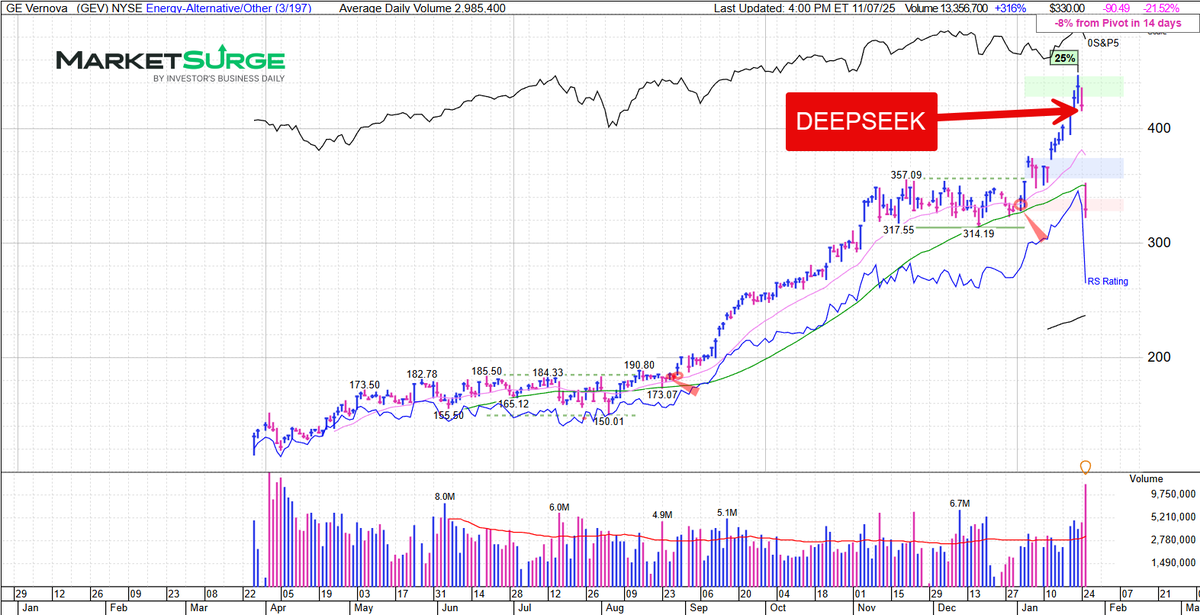
Investor sentiment changes fast. That's why we manage risk, in part, by ringing the register on partial positions. It's never fun in real time, but in hindsight these often short lived events are bumps in a road that's going higher. $NVDA $GEV (Burry etc. vs Deepseek)
Last night, the Israel First Lobby officially declared war against America First.
These venomous, unhinged lunatics have launched an all-out attack against Tucker Carlson and are threatening to destroy the GOP if he isn’t cancelled and censored.
WE WILL NEVER BACK DOWN 🖕🇺🇸
TRUMP ADMINISTRATION AGREED TO DELAY RULE EXPANDING THE NUMBER OF CHINESE COMPANIES ON THE COMMERCE DEPARTMENT'S ENTITY LIST FOR A YEAR - U.S. OFFICIAL SAYS