5 Steps To Implement AI Into Your Service Business:
1. Document Your Current Processes
Every function required to maintain the business. Be sure include:
- Name of the function
- Why it exists
- Frequency
- Step-by-step instructions
2. Audit How You/Your Staff Spends Time
Your goal is to identify which tasks are:
- Least valuable
- Most costly
- Most repetitive
3. Review Your Financials
You're looking for meaningful line items associated with:
- Software
- Repetitive functions
- Operational infrastructure
4. Target The Bottlenecks
Review your findings to find the bleeding. What is the most expensive, repetitive task that is stopping your team from actually serving customers? Identify the exact points where manual effort is bottlenecking your cash flow.
5. Create A Build Plan
Now you have to actually execute. You have two choices:
Option A: Sit down with Claude, map it out yourself, and try to prompt your way to a functional system.
Option B: Bring in a specialist who can take over for you.
📷
Like
Comment
The key to automation is in knowing what NOT to automate.
Nobody wants to be pitched by AI, or have their order taken by AI.
In fact, for most customer-facing use cases, AI just signals that you don't want to talk to them.
The systems that are actually driving margins and enterprise value right now aren't customer-facing.
It's the admin work: Data entry, research, onboarding, support-ticketing, resource allocation, advanced analytics, etc.
These systems are meant to IMPROVE the human parts of your business, not replace them.
The most powerful parts of AI right now are the least sexy.
People are buying into 'prompting' or 'skills' because they're easy to understand and they sound cool.
But a "prompt" isn't going to change your business. A custom database will.
If you want to integrate AI into your business, you need to make room for it.
That means designing infrastructure around it.
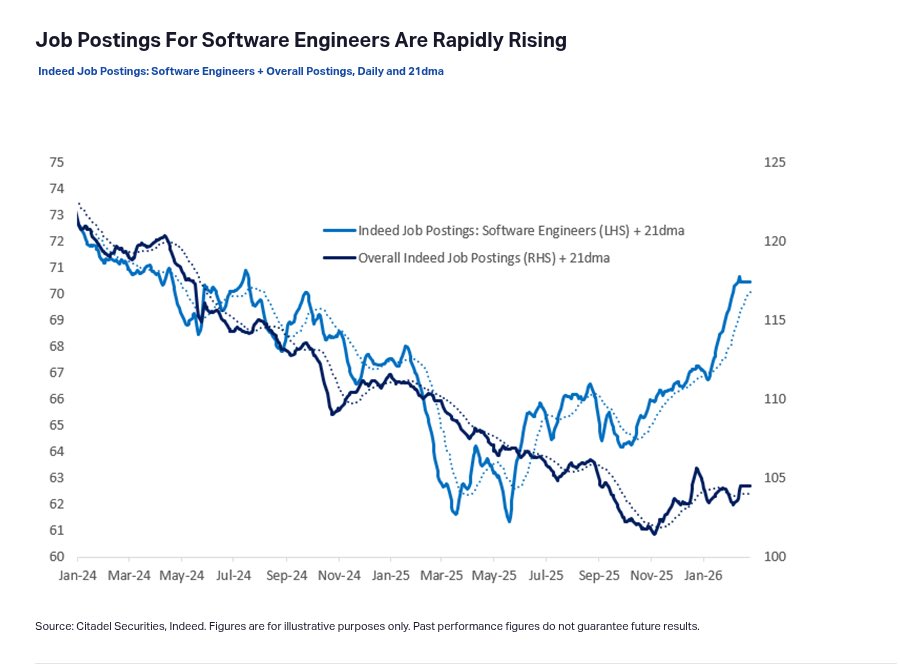
Q: How are job postings for software engineers rising rapidly despite AI agents automating coding?
A: Because there’s far more code to manage than ever before. We’re already seeing a 14x YoY increase in GitHub commits, and it’s accelerating.
AI has dramatically lowered the cost of writing code, so it’s now being used across far more businesses, applications, and use cases.
We’re at the beginning of a massive productivity boom driven by the proliferation of bespoke software throughout the entire economy.
Coding has been AI’s breakout use case this year. The fact that it’s increased demand for software engineers — rather than decreased it — should call into question the entire “AI will cause mass job loss” narrative.
As an AI consultant, the first question I get is always something like "Should I be afraid of AI?".
My answer is always the same:
AI is not a problem, people are.
AI is a tool, and tools reflect the intentions of the people who use them.
For the business owners who believe in people, AI is going to empower them. It will remove the boring, repetitive, and lifeless work they do so that their days feel MORE human, not less.
For the business owners who make 'efficiency' their God, there will be massive layoffs. AI will handle sales, customer service, hiring, training, and more.
So the question is actually not about business owners, it's about consumers and which type of business they are going to choose.
What I can tell you for sure is that the companies that replace their people with AI WILL provide cheaper goods and services.
So the real question becomes: "Will consumers pay a premium for humans?"
I pray that the answer is yes :)
The shareholder has dethroned the customer.
They used deceit. They promised an "easier life". They called it "innovation".
But technology that leads to addiction, loneliness, and lifelessness isn't innovative. It's demonic.
Customers deserve the throne and it's up to small business owners to deliver it to them.
It's up to small business owners to prove that putting your customers first isn't charity work, it's the strategic thing to do.
At COMN, we are building AI systems that help restore humanity to business rather than replace it.
Because technology is only as evil as the human hearts that control it.