@ihtesham2005 Someone got this wrong. Layer 1 is infrastructure. Layer 2 is energy. Layer 3 is chips, computers, networking etc. Layer 4 is the models and Layer 5 are the applications.
William Zinsser taught writing at Yale, then wrote the book that has fixed more bad writing than every English class combined.
Here are 10 cuts from "On Writing Well" that instantly make your writing twice as strong.
1) Delete every word doing no work
If you only have time to read one explainer for the current state of global political economy make sure this is the one. You won’t find a more succinct encapsulation for the fulcrum of economic and political forces shaping our contemporary condition in the 21st century.
Demis Hassabis has been working toward AGI for 30 years.
In a recent interview he said something that stopped me completely.
Here are 5 things he said that nobody is talking about:
1/ What he is actually worried about
🔍 C'è un dettaglio che non tutti hanno notato guardando Zverev giocare.
Nei cambi di campo, mentre gli altri bevono o si asciugano il sudore, Sascha si fa un'iniezione di insulina. Lo ha fatto anche durante la finale del Roland Garros 2026, sotto i riflettori del tennis mondiale.
🏥 Alexander Zverev convive con il diabete di tipo 1 da quando aveva quattro anni. Una vita intera, tra allenamenti, viaggi e campo, passata a gestire i livelli di glucosio nel corpo.
Eppure per molto tempo non ne ha parlato. Non per vergogna, ma per una scelta precisa: non voleva che fosse il diabete a definirlo. Non voleva pietà. Lo ha fatto pubblicamente solo nel 2022.
👨⚕️ I medici avevano consigliato a sua madre di fargli cambiare sport: giocare a tennis con il diabete, dissero, sarebbe stato troppo difficile.
Zverev quando è in campo gioca nello stesso momento due partite diverse: quella contro il suo avversario e tenere costantemente monitorato il livello della sua glicemia.
🥵 In partita la glicemia può diventare una roulette: un attimo sei in calo fino al rischio di collasso ipoglicemico, quello dopo lo stress e l’intensità ti spingono in iperglicemia con sete, crampi e confusione, tra performance che crolla e pericoli acuti se non gestita.
Oltre al traguardo sportivo, che per Sascha è stato così atteso, inseguito e a tratti maledetto, questo titolo Slam vale molto più.
💭 È il megafono più potente che potesse trovare per il messaggio che porta avanti attraverso la sua Fondazione: ai bambini con diabete di tipo 1 dice che possono sognare in grande, senza privarsi dello sport e di ambire anche a salire sul tetto del mondo del tennis.
#RolandGarros #Zverev
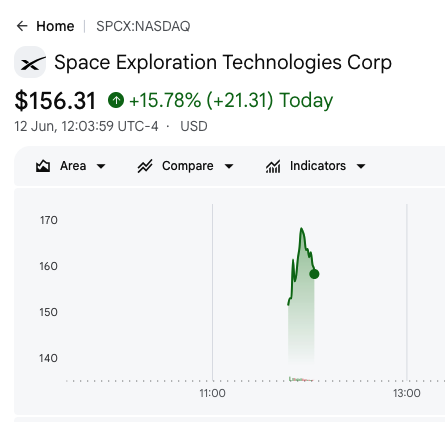
The reason why a Danish pension fund banned its investors from buying any SpaceX shares is not just the appalling S-1 filings, where the ONLY profitable segment was Starlink (everything else - the AI, social media, the orbital data centre plans, is burning money at a rate that will bankrupt most companies on this planet).
It’s also the governance structure they don’t want to buy into.
Elon Musk holds roughly 85% of voting power through a dual-class share structure. He serves as CEO, CTO and chairman of the board, and he cannot be removed as CEO without his own consent.
Now, given his personality:
- erratic
- narcissistic
- with self-confessed (and self-evident) ketamine drug addiction
- appalling personal life (kids across multiple mothers, and yes - that matters in business)
- fringe political views, etc. etc.
It is NO surprise that competent investors would not risk the money of their clients.
The world is changing and people agreeing to play roulette with their clients’ money are coming to an end. Also, many haven’t forgotten 2008, and yes - the American system (or lack of one, especially guardrails) is still blamed for causing that global recession.
Scarcity will lead to investments flowing into more stable, reputable and sustainable ventures.
A 24-year-old Polish tennis player arrived in Paris last week ranked 114th in the world, with no sponsors, no guaranteed income, and no certainty she could even pay for her hotel room.
She had to win three qualifying matches just to enter the French Open main draw. Prize money is only paid at the end of the tournament, so a Polish sports drink brand quietly stepped in and covered her hotel bill.
Her name is Maja Chwalinska. And today, she plays in the French Open final.
Before this tournament, she had won exactly one Grand Slam main draw match in her entire career. She had battled depression so severe that in 2021 she couldn't get out of bed. She underwent knee surgery in 2022. She spent years grinding through small tournaments across Europe just to stay afloat.
Then she arrived in Paris, won three qualifiers, and kept winning. Zheng Qinwen. Elise Mertens. Maria Sakkari. Diana Shnaider. Nine straight matches. One set dropped.
She is now the first qualifier in French Open history to reach the final. The last time a qualifier reached a Grand Slam final, it was Emma Raducanu at the 2021 US Open. Raducanu won.
By simply making the final, Chwalinska has earned more prize money than her entire career combined. The runner-up cheque alone is $1.6 million. If she wins today, she takes home $3.25 million.
One week ago she couldn't pay for her hotel room.
Realising Apple went public at under $2 billion and 15 times revenue in 1980.
SpaceX wants you to buy at $2 trillion and 100 times revenue in 2026.
That is not getting in early. That is being the exit for venture capitalists who have held this equity for years at a fraction of what you are being asked to pay.
Almost none of the retail investors buying this IPO will read the 300 pages before the book closes on June 11.
That is your entire competitive advantage right there.
This administration is adamant that if you don't measure something then it does not exist. Same as Covid - if you don't test for Covid then you don't have cases - recall that logic ? We are seeing the systematic erosion of 'experts' and 'expertise' - alarming!
The Trump Administration is prematurely dismantling an invaluable ocean monitoring system built at taxpayer expense that was supposed to last until 2041.
Because apparently climate change doesn't exist if you prevent scientists from measuring it.
People pay $150,000 to sit in the same room as Demis Hassabis, you just got 57 minutes for free.
CEO of Google DeepMind, 2024 Nobel Prize winner, the man building AGI, sitting at Stanford explaining what comes next for how we live, work and think.
The path to general intelligence, the design choices that decide if these systems serve us or not, the responsibilities of building tech at this scale.
No application, no donor seat, no Stanford tuition, just a link and 57 minutes.
The next couple of years decide everything, Demis just spelled out why.
Most people will scroll past this and find out what he meant in 2028.
Nicolai Tangen, CEO of Norges Bank Investment Management pressed IBM CEO Arvind Krishna directly on whether AI is a bubble (Save this).
And Krishna responded with what has become known inside financial circles as the $8 trillion math problem.
A single gigawatt of AI data center capacity filled with accelerators, liquid cooling, and power infrastructure costs roughly $60 to $80 billion to build and populate.
The industry has committed to more than 100 gigawatts of buildout globally.
That is $6 to $8 trillion in capital expenditure and because AI grade hardware depreciates on a five-year cycle, that entire sum must be effectively replaced and refreshed every five years.
To service the interest on $8 trillion in capital at a conservative 10% borrowing rate, the AI ecosystem would need to generate approximately $800 billion in annual profit, a number that currently exceeds the combined net income of every large technology company in the world.
Goldman Sachs estimates $7.6 trillion in aggregate AI CapEx between 2026 and 2031 alone, and Reuters Breakingviews has flagged that even if the capital is available, physical bottlenecks power permits, land, cooling infrastructure, and electrical grid connections mean that half of the planned data center projects are being cancelled or delayed before they ever go live.
Krishna also raised a second, structurally distinct concern that markets have largely ignored.
He argued that the largest foundation models, GPT, Gemini, Claude, Llama are converging toward commodity status.
When a product is a commodity, switching costs collapse.
When switching costs collapse, pricing power evaporates and margins compress regardless of how much capital was spent building the capability.
Morningstar's equity research team conducted a review of 132 technology companies in 2026 and found that AI had caused moat rating downgrades across roughly 40 major stocks concentrated in enterprise software, IT services, and SaaS with Adobe, Salesforce, Workday, and ADP among the companies whose competitive moats have materially weakened.
The implication is that the companies spending the most on AI model development may be building an asset that is simultaneously the most expensive to produce and the most difficult to monetize with durable margins.
This bear case is serious but it is also incomplete and that is what makes Krishna's framing so important to understand precisely.
When pressed further, Krishna explicitly said he does not believe there is an AI bubble in the technology itself only in a subset of the infrastructure capital that is being deployed against speculative assumptions rather than proven demand.
He draws the same analogy, the fiber optic overbuild of the late 1990s. Dozens of companies went bankrupt laying cable that nobody was using.
And yet that exact "wasted" infrastructure became the physical backbone of every cloud company, every streaming service, every mobile network, and every modern AI training cluster that followed.
The builders lost, the infrastructure won.
And the companies that were built on top of it, Amazon, Google, Netflix, Salesforce compounded for two decades.
The question, as Krishna framed it, is not whether AI is real.
It is which capital deployment earns a return versus which gets stranded and crucially, whether you own the stranded assets or the companies built on top of them.
On winners, Krishna was direct that distribution is the moat on the consumer side, and enterprise is wide open.
The data supports this, Meta with 3.3 billion daily active users across Facebook, Instagram, and WhatsApp is building AI into a distribution network that no startup can replicate at any cost.
Meanwhile, the productivity evidence arriving in real time is beginning to challenge the bear case's revenue projections.
Jensen Huang just showed on stage at Computex that GitHub commits, the universal measure of global software output nearly tripled in the first months of 2026, effectively converting $3 trillion in developer salaries into $9 trillion in productive output.
That is measurable, real time economic value already flowing through the system and it feeds directly back into token demand in a compounding loop that Krishna's static CapEx math does not fully capture.
Made it my life’s mission to become the Taliban’s worst nightmare:
A highly educated Afghan woman.
First, Columbia University at the top of my class, and now Oxford University.
Give Afghan girls one chance and see what they can achieve.