⚠️ New Legionella prediction model is more efficient than guideline-recommended testing! https://t.co/FKgQaB1acM
💪 Strong Predictors:
✳️ Local Outbreak
⬇️ Na
💩 Diarrhea
🚬 Smoking
@MRothbergMD@ClevelandClinic@UMassChan
Cleveland Clinic Collaborates with @medically_home Home Group Inc. to Bring Hospital-Level Care to Patients’ Homes https://t.co/bORsjOGl7h @CleveClinicFL
Cleveland Clinic Collaborates with @medically_home Home Group Inc. to Bring Hospital-Level Care to Patients’ Homes https://t.co/bORsjOGl7h @CleveClinicFL
Excited about what our @clevelandclinic and @CleveClinicFL team are working on with @medically_home group to bring hospital-level care to patients in their homes https://t.co/ZfmOhJaymB
Hospitalization = an important opportunity to document 📝 goals of care for sepsis survivors. Doing so can
👐🏼 improve patient-centered care
👇🏼 reduce the high rates of healthcare utilization after sepsis
▶️ https://t.co/BiMubcvqz2
@stephptaylorCLT@marckowalkowski
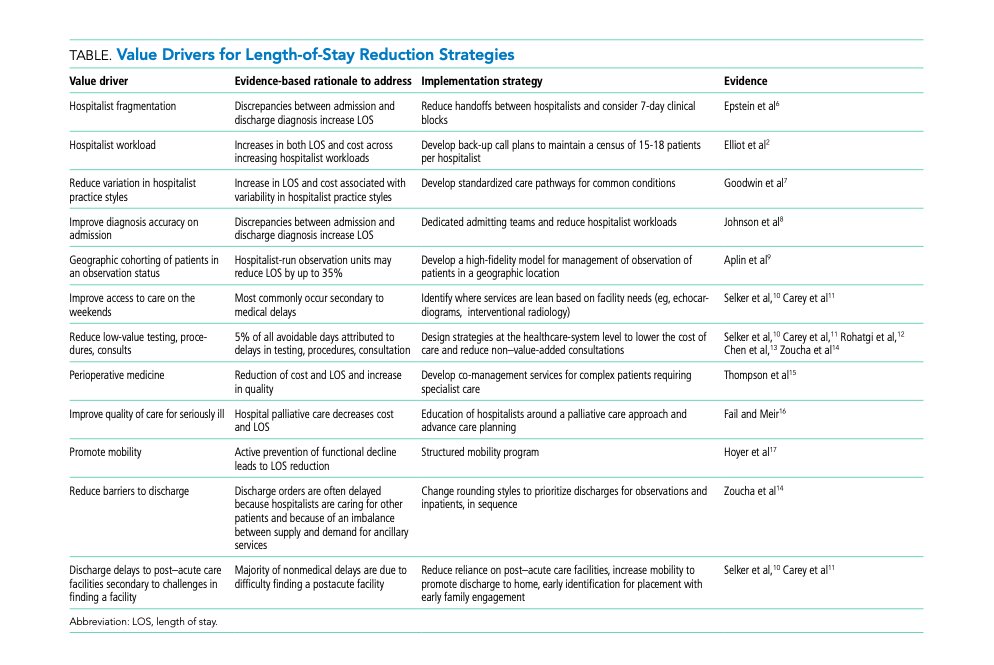
I like the chart with evidence-based techniques to improve value. Many of the fixes require more doctors though ($). Interesting they have a "quarterback" accepting OSH calls like we have (a medicine triage attending).
The F:D ratio used within hospital medicine @CleveClinicFL is also interesting as a metric to measure individual hospitalist contribution to LOS without the confounder of care fragmentation (multiple hospitalist caring for the same patient). @whinnec@ConorDelaneyMD
The F:D ratio used within hospital medicine @CleveClinicFL is also interesting as a metric to measure individual hospitalist contribution to LOS without the confounder of care fragmentation (multiple hospitalist caring for the same patient). @whinnec@ConorDelaneyMD
The F:D ratio used within hospital medicine @CleveClinicFL is also interesting as a metric to measure individual hospitalist contribution to LOS without the confounder of care fragmentation (multiple hospitalist caring for the same patient). @whinnec@ConorDelaneyMD
How can hospitalists improve healthcare value❓
Rothman R et al present an approach to LOS management:
🔶 decrease care variation
🔶 stabilize hospitalist workloads
🔶 minimize handoffs
🔶 develop service lines to manage patients in observation status
https://t.co/PoZ4C2KLSg
@JHospMedicine The F:D ratio used within hospital medicine @CleveClinicFL is also interesting as a metric to measure individual hospitalist contribution to LOS without the confounder of care fragmentation (multiple hospitalist caring for the same patient). @whinnec@ConorDelaneyMD