RFC-001 — accepted ✅
14 days of open review, no blocking objections. Rotifer Protocol's first formal RFC — the economic system design — passes via lazy consensus.
The ABM simulations behind it are now open-source.
https://t.co/0RABb96JNq
#RotiferProtocol#OpenSource
The protocol, the reference, and the papers are all public.
→ Build agents? Compose one against an open protocol.
→ Build infra? Build the next binding. Slots open.
Full essay:
https://t.co/InLxapy8q1
#RotiferProtocol#OpenSource
Rotifer's bet:
The protocol is open. The reference implementation proves it works — and is replaceable.
If in 3 years the most-used binding isn't one we built, that's the goal.
The layer that survives commodification is the layer that doesn't need to win.
A platform whose revenue depends on you coming back can't structurally let you leave.
Priced per token? Can't let competitors' tokens flow through your workflow.
Not malice. Gravity.
The UX of this: the ecosystem narrows even as the models get smarter.
Closed AI is eating itself on price.
GPT-4 was $30/M tokens in 2023. Below $0.60 now. 100× collapse in <3 years.
That's good for the world. It's also a clue about which layer of the AI stack survives.
A thread about why agents need an open protocol 🧵
Try these with closed AI products:
→ Move your agent from platform A to B without rewriting
→ Compose 3 vendors' skills in one workflow
→ Run the whole stack offline
You can't. Not a product decision. A business-model constraint.
Pattern: when capability commodifies, value moves up-stack.
1995 browser wars. Winner: HTTP. Netscape & IE both became footnotes.
2000s database wars. Winner: ANSI SQL. No vendor owns it.
The up-stack layer is the protocol layer.
It survives because it's neutral.
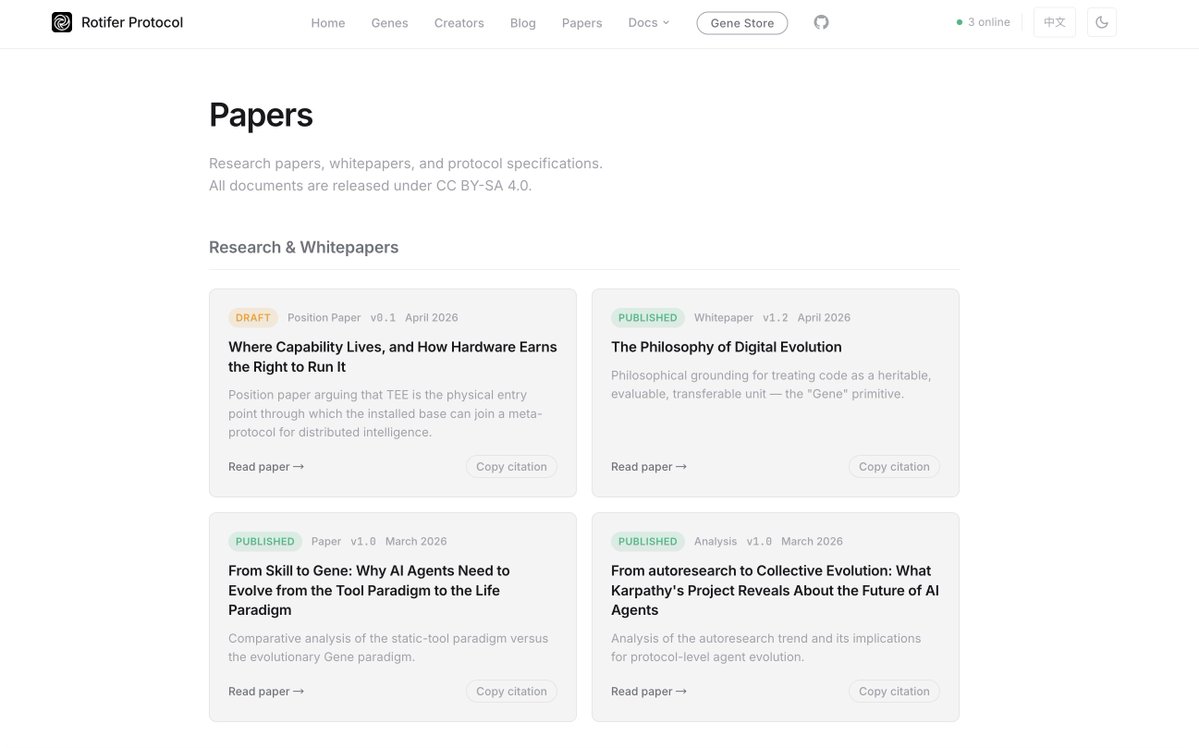
Theoretical research takes precedence over code development.
We've just added a new Papers section to our official website, featuring our latest thinking and rigorous arguments on Swarm Intelligence Evolutionary Networks from the past three months.
#rotifer#rotiferprotocol
RAG retrieves fragments. Knowledge compilation builds structured, evolving wikis. The difference matters — especially when agents need to remember, share, and improve what they know.
https://t.co/pNhFkrl8Ta
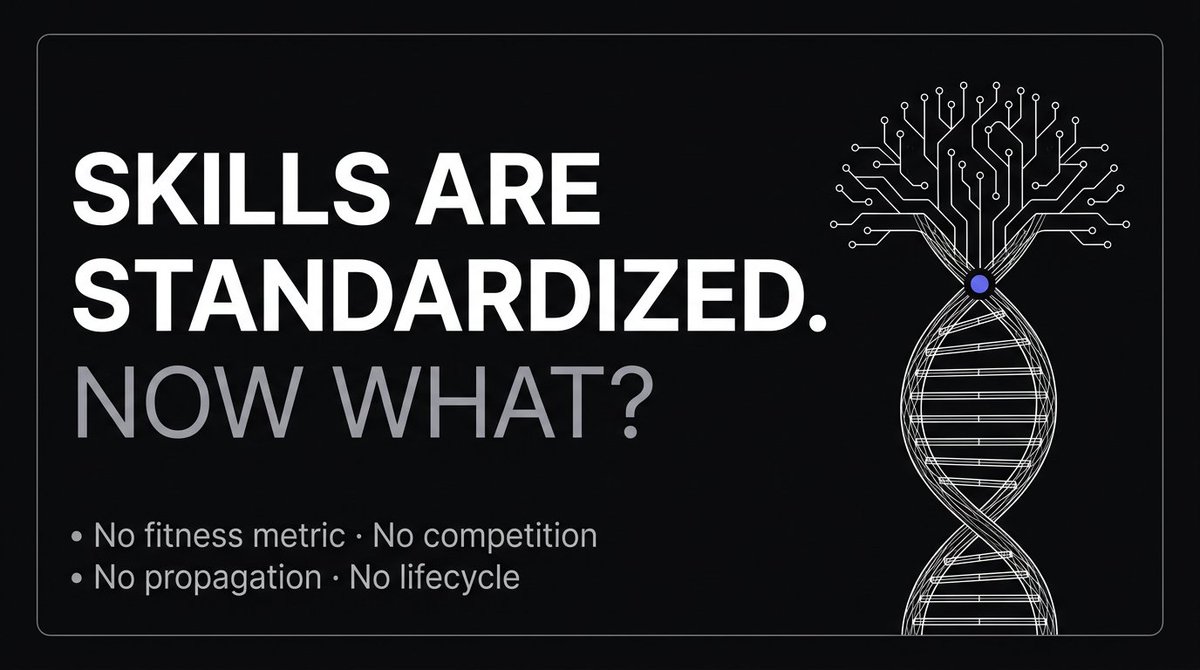
Anthropic just codified what a Skill is — 33 pages, well-structured.
But it also draws the ceiling:
→ No fitness metric
→ No competition
→ No propagation
→ No lifecycle
Standardization precedes selection.
https://t.co/XXJTe2oXcV
#RotiferProtocol#AIAgents
Google TurboQuant: 6× KV cache compression, zero accuracy loss.
For modular agents, this compounds — each Gene = one inference call.
Cheap inference → LLM-native Genes compete with compiled WASM.
https://t.co/5YqzkYiDkZ
#RotiferProtocol#DevTools
The Agent interface stack is forming:
→ CLI: Agent runtime
→ Protocols: MCP, AG-UI, A2UI
→ GUI: AI-generated on demand
What selects which tool survives?
The evolution layer.
https://t.co/5YqzkYiDkZ
#RotiferProtocol#OpenSource
Google's Flash-Lite Browser generates websites from intent. ~2K tokens, 5 seconds.
Catch: every render differs. Same query, different layout.
When interfaces are generated, not designed — evolution picks which one survives.
https://t.co/5YqzkYiDkZ
#RotiferProtocol#AI
Last week we scanned the Top 50 ClawHub Skills and found trust gaps.
Today: one command to fix it.
rotifer wrap my-gene --from-clawhub <slug>
Downloads, converts, and security-grades any ClawHub Skill.
🧵