@Sans_Google Nice, going to try this. I used to use Organic maps, then Comaps, but after an update they started directing me into small streets instead of staying on the main road, probably some bug, so switched to Osmand, but its not the easiest to use.
@Widux2 I aint gonna lie I had it on my watchlist since I discovered vanadium sector last winter, and bought it mainly as one of the vanadium picks for the sector play when it came down. I learned new things from DD of @Alexsei88 who even posted a report on it.
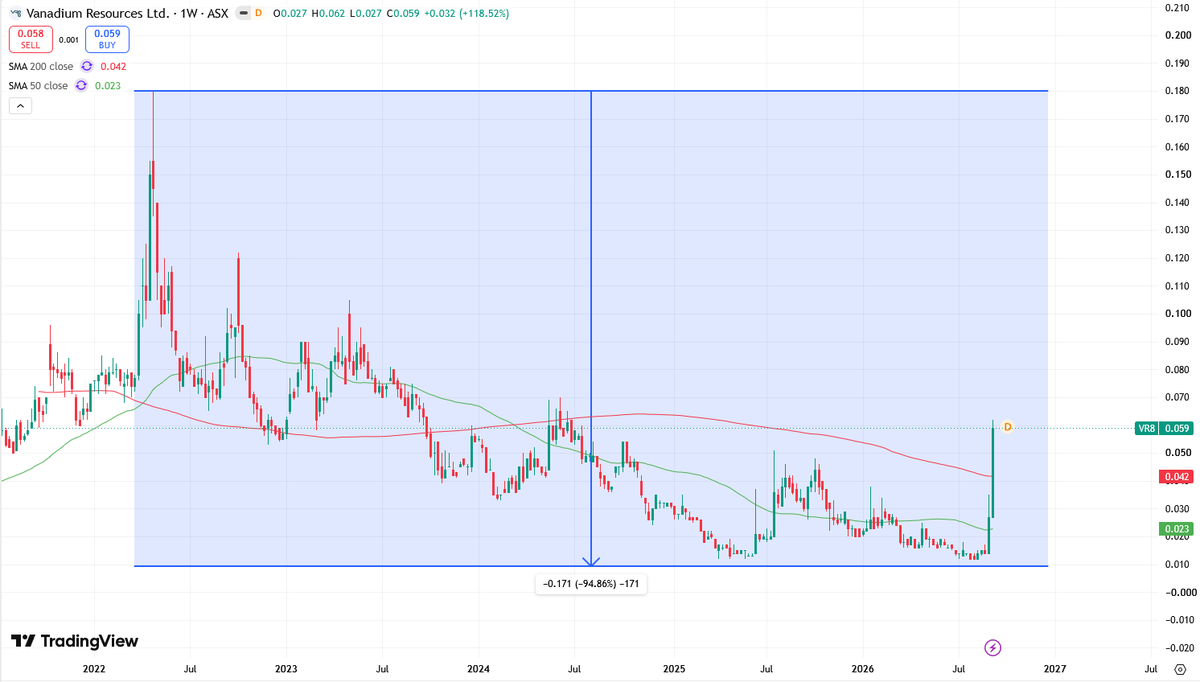
Well, that escalated quickly $VR8
Started buying at the recent low of 1.3c so avg price looks genius, had it gone to 1c the position would be much bigger though.
@Edark94 Thats the textbook scenario, but I sure am glad I have some $AVL and $VR8 already apart from $LGO (also $FAR that has not performed yet and I am adding the lower it goes).
Castle oli TechMetillä töissä. Hän oli myös US Vanadiumilla koko sen ajan kun he neuvottelivat VR8:n kanssa isosta ostosopimuksesta VR8:n ja USV välillä. Tämä sopimus kattaisi koko USV:n vanadiinin tarpeen.
Tämän sopimuksen jälkeen hän teki ostosopimuksen USV ->TM/US DLA välillä
#Lithium correction seems to be over, #uranium keeping strong into the seasonality, should #vanadium finally join the commodity party it would be a nice H2
A question I’m asking myself in a big way at the moment is – What’s going on with lithium?
Prices are off their highs. The GFEX is literally just holding onto the key Rmb140,000/t support line, which technical analysts have flagged as vital to hold the bull trend.
But Weekly SMM Lithium Chemical inventories have fallen over the past few weeks. Depending on which SMM series you follow, they’re either down 20% or 17% since 30th April. That’s a substantial fall. In days of consumption terms it’s even more significant.
Equities have cratered. Most producers are now trading well below their 200DMAs. Since its high in mid-April, Albemarle is down 48%, PLS is down 39% from its high and even low cost brine producer Lithium Argentina is down 49%. Lithium developers have fared even worse.
Like many commentators I’ve been a little worried about the wave of supply from SpodCon restarts due in Q4/26. But this reaction seems a little overdone. And the fall in inventories is very much akin to what we saw last year before lithium prices spiked.
Last year, inventories peaked in July and fell from August to the end of the year. This year, inventories appear to have peaked in April and have been falling.
The problem is, no-one’s watching. When will they wake up?
📩 NEWSLETTER
@Paladin_Energy $PDN just told us who's actually setting the uranium price. It isn't the speculators.
Spot: flat $85 for 4 months.
Term price: $97/lb.
Real utility discussions: $100/lb.
Full analysis 👇
https://t.co/KTWKP4oUmC
If it isn't already abundantly clear, countries like China and India will secure as many pounds of uranium as they can
Case in point: "We would buy as much (uranium) as Cameco can produce” Patnaik, India’s high commissioner to Canada, told reporters"
U prices will keep rising
Sulphur/2
A lot of noise being made at the moment about sulphur prices and their impact on the long-term fundamentals of certain mining, metals and downstream projects.
For me, this is all hot air.
Why? Sulphur is not actually that difficult to find or produce. It's just that, over the last fifty years, the industry found a quite cheap source of sulphur (from oil and gas) and started to come to rely on it.
But, before that, sulphur - and sulphuric acid BTW - was produced primarily from roasting of pyrite.
And, in my view, it could easily be produced by that method again. Producing sulphur and sulphuric acid from pyrite roasting would cost in the range of US$250-600/t for sulphur. Now that wasn't economic in most regions with sulphur at US$250-300/t before this, but certainly could be economic at current prices. Another caveat - it's a pretty low carbon-intensity method as well.
And, let's not forget, sulphur prices have been trending upwards in recent years as demand for sulphuric acid increases and output from oil refining plants decreases. Probably, before this, they were on the cusp of being economic for pyrite roasting in some parts of the world.
So who's to say that we wouldn't be going back to pyrite roasting anyway as a source of sulphur for sulphuric acid?
And note that there are considerable pyrite sources in Europe (Iberian pyrite belt, anyone?), China, Australia, Canada and LatAm if we did need to go back to pyrite as a source of sulphur. Sure, there's a cost associated with building a pyrite roasting plant - probably US$300-500m capex for mine and plant for a project producing 200Ktpa of contained sulphur as sulphuric acid, but for the security to run your own domestic industry? That's priceless.
So yes, sulphur prices in some parts of the world have spiked to over US$1000/t. Does that mean that they will stay at that level in the medium to longer term? Absolutely not, in my view. If we need it, the resource is there. It's always been there. Could it take 12-18 months to come into production? Yes. It will probably take less time to mobilise stockpiles of sulphur sitting in the Canadian West at the moment.
Bottom line: The world will not run out of sulphur and yes - prices have spiked, but these price levels are not long run prices and people planning and valuing operations that use sulphuric acid shouldn't assume that they are.
A sign of late #Lithium Spring: Marginal assets coming back online. This one certainly qualifies. It likely won’t be long before we hear about “those with the rock winning.” The real question is, were any lessons learned in the last two cycles? From reading X, it appears “No.”