I strongly encourage everyone to read the speech that Chan Chun Sing, Singapore's Defence Minister, just gave in Beijing: it's basically the polar opposite of a Hegseth speech - immensely wise and a refreshing proof that thoughtful statecraft still exists.
You can find the speech here: https://t.co/alGUQGK7J4 Below a summary of the best parts of the speech, in my opinion.
Much of the speech addresses the crucial question of the so-called "security dilemma", a key concept in international relations theory whereby one country's efforts to make itself safer almost inevitably make others feel less safe, triggering a spiral where everyone ends up more insecure.
As Chan Chun Sing puts it in his speech: "The true test of statecraft is this: how do we strengthen our own security without weakening the security of others, or without aggravating the insecurity of others?"
He says there are "three fundamental principles worth bearing in mind" in this regard, but that, first and foremost, it raises the question of "what 'winning' means": to him, defining "winning" as "outgunning or outlasting a rival" isn't sensible, it ought to be defined as winning others through the "power of our example", rather than "the example of our power."
It's extremely wise, when you think about it: do you actually "win" if you submit others by force, or do you merely prove that, for now, they simply lack the strength to resist? You've imposed your will, yes, but the principle you've imposed is that the strongest gets his way, and strength is expensive and it wanes.
Chan Chun Sing quotes Mencius, the classic Chinese philosopher, to illustrate this: "Power may compel others to comply. But in the end, it is trust that truly wins others over" (which is a trimmed version of the true original citation: "Those who subdue others by force do not win their hearts; they submit only because their own strength falls short. Those who subdue others by virtue win hearts that are glad and sincerely submissive, as the seventy disciples submitted to Confucius," 以力服人者,非心服也,力不赡也;以德服人者,中心悦而诚服也,如七十子之服孔子也。)
This is very core to Chinese strategic thinking (yes, Chan Chun Sing, as are most Singaporean leaders, is ethnically Chinese): the notion that legitimacy, not force, is the real currency of power.
A state that has to coerce is following the "hegemonic way" (badao, 霸道) - which is brittle and unsustainable. The only sustainable long-term way to lead is the so-called "kingly way" (wangdao, 王道), where others follow you and emulate you voluntarily. Two concepts which incidentally come from Mencius too: "he who uses force while borrowing the name of benevolence is a hegemon (ba); he who practises benevolence through virtue is a true king (wang)."
Concretely, Chan Chun Sing say that states should pursue the following 3 principles to apply this in practice.
First of all, he points out that too many states "externalise domestic issues" as opposed to putting their own house in order. The idea being that a leadership confident at home doesn't need foreign enemies to hold itself together, and can therefore act in its "enlightened long-term interest" abroad. Whereby an insecure one uses foreign policy "for political gain."
No prizes for guessing what country he is referring to here...
The second principle is that "interdependence breeds stability" as opposed to being "a source of vulnerability."
Which makes sense: mutual exposure turns competitors into stakeholders in each other's stability. Cut exposure in the name of "resilience" or "de-risking" and, really, the only thing you've achieved is to make confrontation and conflict cheaper.
Lastly, and this is perhaps the most important principle: "first, do no harm."
Chan Chun Sing again quotes famous Chinese sayings: "turn big problems into small ones, and small ones into nothing" (大事化小,小事化了), which is what happens when there's trust between states, versus "turn small problems into big ones, and make trouble out of nothing" (小事化大,无事生非), which is what happens when there isn't.
The idea is that every unnecessary provocation, every "freedom of navigation" stunt, every gratuitous sanction is a withdrawal from a trust account that is very expensive to fill and, as he says, can be emptied "in a single instant."
Chan Chun Sing ends his speech on what being a “responsible major country” - a key concept in contemporary Chinese international relations - means, and how, "the more responsible major powers are, the less concerned small countries will be."
Besides the above three fundamental principles, he says that "strategic patience" is also crucial, defined as: "Not every capability needs to be advertised; not every advantage needs to be immediately pressed; and not every provocation demands an immediate response."
In other words, true confidence doesn't need to prove itself and restraint is a form of strength: a great power that feels compelled to respond to everything is, in effect, letting its rivals set its agenda. And whoever needs to constantly show force is in fact projecting its own fear that without the show, nobody would believe it.
As Margaret Thatcher once brilliantly put it (I hate to quote her but this is too good): "Being powerful is like being a lady. If you have to tell people you are, you aren't."
That's it, if you want the rest, I truly encourage you to read the full speech: pure undistilled wisdom, from a man who runs the defence of a country smaller than Los Angeles and obviously understands power far better than the man in charge of the largest military on earth. Which is its own form of tragedy.
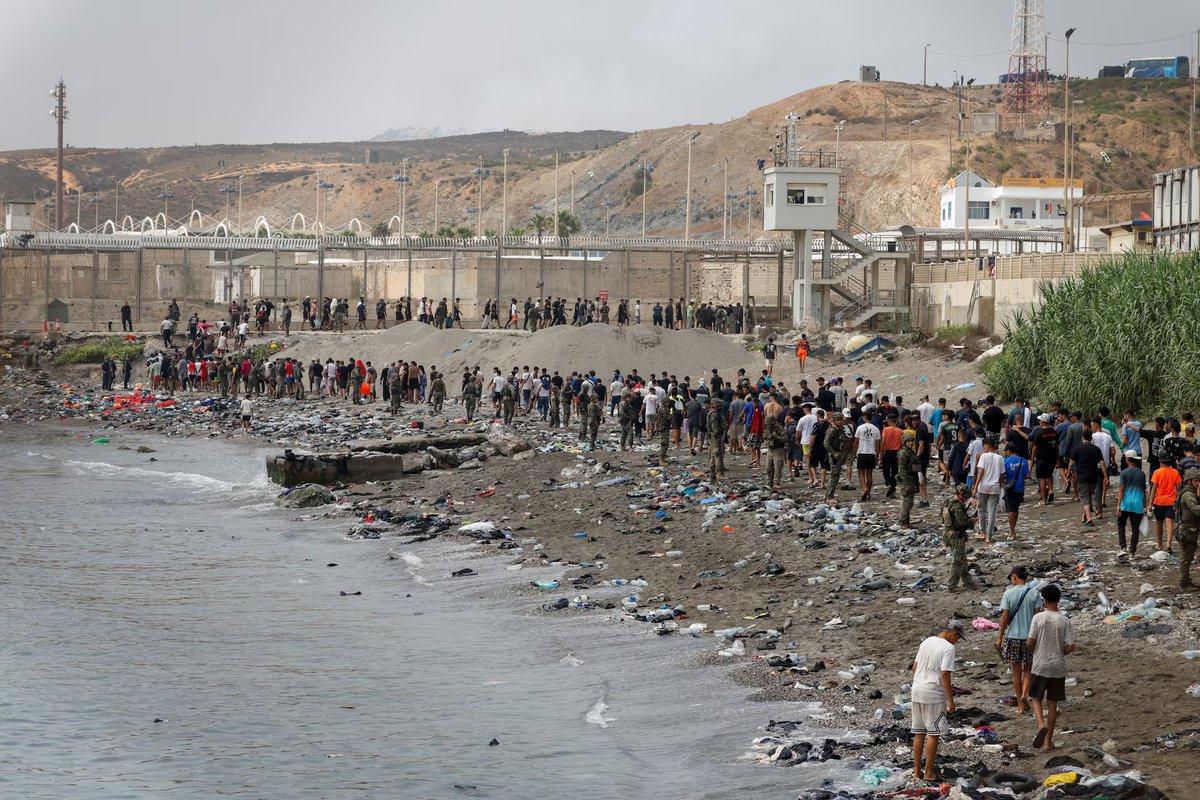
I crossed the Sahara Desert with migrants about a decade ago. Those in the video who crossed into Ceuta from Morocco neither looked like migrants (no luggage) nor did they behave like migrants (went back home with no protest). They looked like a rent-a-mob from Morocco's al-karyan, engineered to cross over and create a diplomatic crisis for Spain? Why? Well, ask the Israeli government, whose Moroccan partner is ever ready to create an embarrassment for the @sanchezcastejon government as a consequence of its position on the genocide of the Palestinians. Remember when the Moroccan King did the same thing in 2021 when the Spanish government arranged for medical care of Brahim Ghali (leader of @Polisario_).
Anthropologist Margaret Mead was once asked by a student what she believed was the very first sign of known civilization. The student expected her to talk about a hatchet, perhaps fishhooks, the bow and arrow...
Possibly a building structure, clay pots or grinding stones and knives.
But no.
Mead said that the first sign of civilization in an ancient culture was a thighbone that had been broken and then healed.
Mead explained that in the animal kingdom, if you break your leg, your timely death is assured.
"You cannot run from danger, get to the river for a drink or hunt for food. You are meat for prowling beasts. No animal survives a broken leg long enough for the bone to heal."
A broken thighbone that has healed is evidence that someone has taken time to stay with the one who fell, has bound up the wound, has carried the person to safety and has tended the person through recovery.
"Helping someone else through difficulty is where civilization starts." Mead said.
We are at our very best when we truly help and serve others.
Be civilized. Be kind. Be helpful
David Shoebridge gives Jim Miller an absolute flogging after he claims his Defence Estate Audit is not a “Capital A audit” but an audit as a “generic term”
Shoebridge “Why, just barely 2cm above your signature, do you call it a Capital A Audit?”🔥
Embarrassing to watch. #auspol
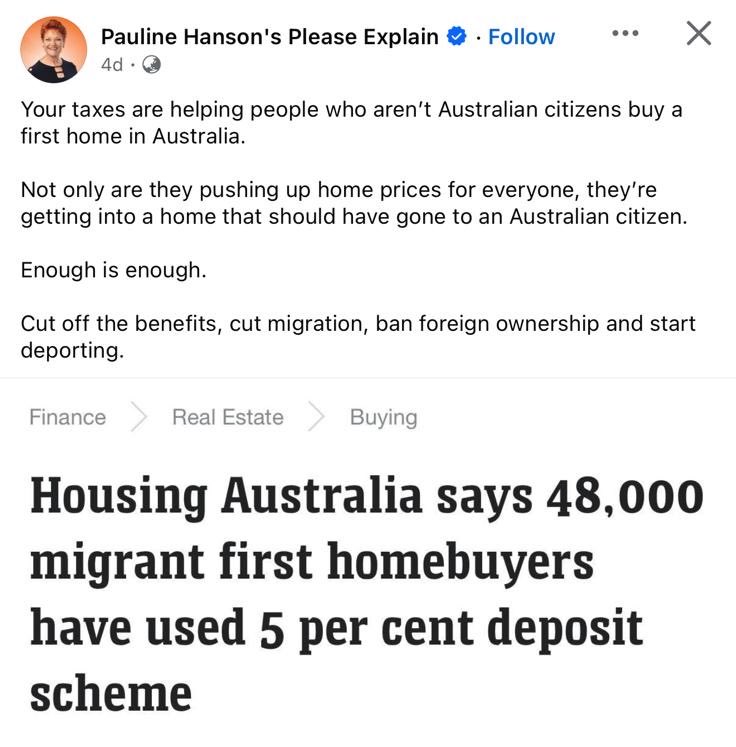
You might have seen Pauline Hanson’s latest immigrant fearmongering, with this post about 50,000 migrants using the 5% deposit scheme.
But here are some facts Pauline Hanson doesn’t want you to know ➡️
Didn't Donald Dutton look after the pie & doughnut money at the police station?
If so, he's obviously well qualified to manage Qld Investment Corporation, Qld's state-owned investment manager, with more than $135 billion in assets under management
The @LNPQLD sure is a 🦆 show
Gotta love the LNPers who left Australia with lower fuel reserves
Stored in the US, not Australia
Shut down refineries
Undermined relations with key Asian neighbours who provide much of our fuel
Suddenly pretending they care about fuel security
I don't have "deep insights" about Americans as a species.
I have memory.
And I have pattern recognition sharpened by what it means to live under the consequences of decisions Americans call "foreign policy."
You grow up Vietnamese, you learn early that there are two parallel realities:
The one you live through.
And the one narrated about you on American television, in speeches, in films, in history books.
My family lived through the moment when American abstractions like "credibility" and "containing communism" stopped sounding strategic and became physical:
Bomb craters. Refugee boats. Bodies.
You watch villages renamed "collateral."
You watch coups renamed "restoring democracy."
You watch blockades renamed "pressure for reform."
You watch your dead filed away as "tragedy" so that no one has to call them what they were: crimes.
After a while, you stop getting angry at every sentence.
You start studying the grammar.
Who gets to remain human in the story.
Who gets turned into an adjective.
Whose violence is "regrettable," and whose resistance is "terrorism."
Which lives are allowed complexity, and which lives are flattened into body counts, talking points, and background noise.
Then you hear Americans speak about entirely different places, entirely different wars, entirely different enemies, and the same grammar is still there:
"Intervention" instead of invasion.
"Stability" instead of control.
"Responsibility" instead of domination.
"Sanctions" instead of siege.
If you grow up with that long enough, you learn that what empire calls "responsibility" usually means someone far away is about to bleed.
That's where my "insight" comes from.
From watching the same software run on different hardware.
From listening closely to the metaphors they don't even notice they're using anymore.
From realizing that, for a lot of good, ordinary people, this isn't malice. It's the water they were raised in.
The story is always written from the cockpit, never from the crater.
So when I write about American exceptionalism, I'm not claiming mystical access to "your people."
I am describing the hallucination I've been forced to survive under since I was born.
And once you see the pattern from outside the blast radius, it becomes almost impossible not to see it everywhere.
@ianfmusgrave Lovely lunar photo! It looked amazing on Brisbane too. Glad you had clear skies in Adelaide, after so much wet weather on the weekend - and especially since we have to wait almost three years for the next one lunar eclipse.
“Our research has demonstrated that the loss of these forests, the mature trees used by these birds, cannot be offset or mitigated,” said Kate Millar, CEO of @BirdlifeOz.
“Once the forests are gone, these much-loved birds will be gone.”
Read more: https://t.co/xIFht5KTFI
Queensland may be entering a more stimulation-dependent phase (#fracking) of unconventional extraction as shallower coal seam gas resources decline.
https://t.co/qSIaFIOt5w
A new public fountain has appeared in central London, but look closer & you’ll see that it’s a actually a fountain of filth. The water is black, the human victims of the sewage crisis are vomitting streams of liquid, whilst surmounted by a smug water executive with a briefcase stuffed with cash.
The fountain commemorates one of the biggest environmental crimes in British history, where water companies stole tens of billions of pounds that was supposed to be spent on our sewage system, gave it to shareholders and executives and illegally poured billions of lites of sewage into our rivers, lakes and seas instead. The channel 4 docudrama about the sewage crisis, #dirtybusiness, starts at 9pm tonight. Watch it, get sad, get angry and then join the thousands of people around the country demanding an end to the sewage crisis.