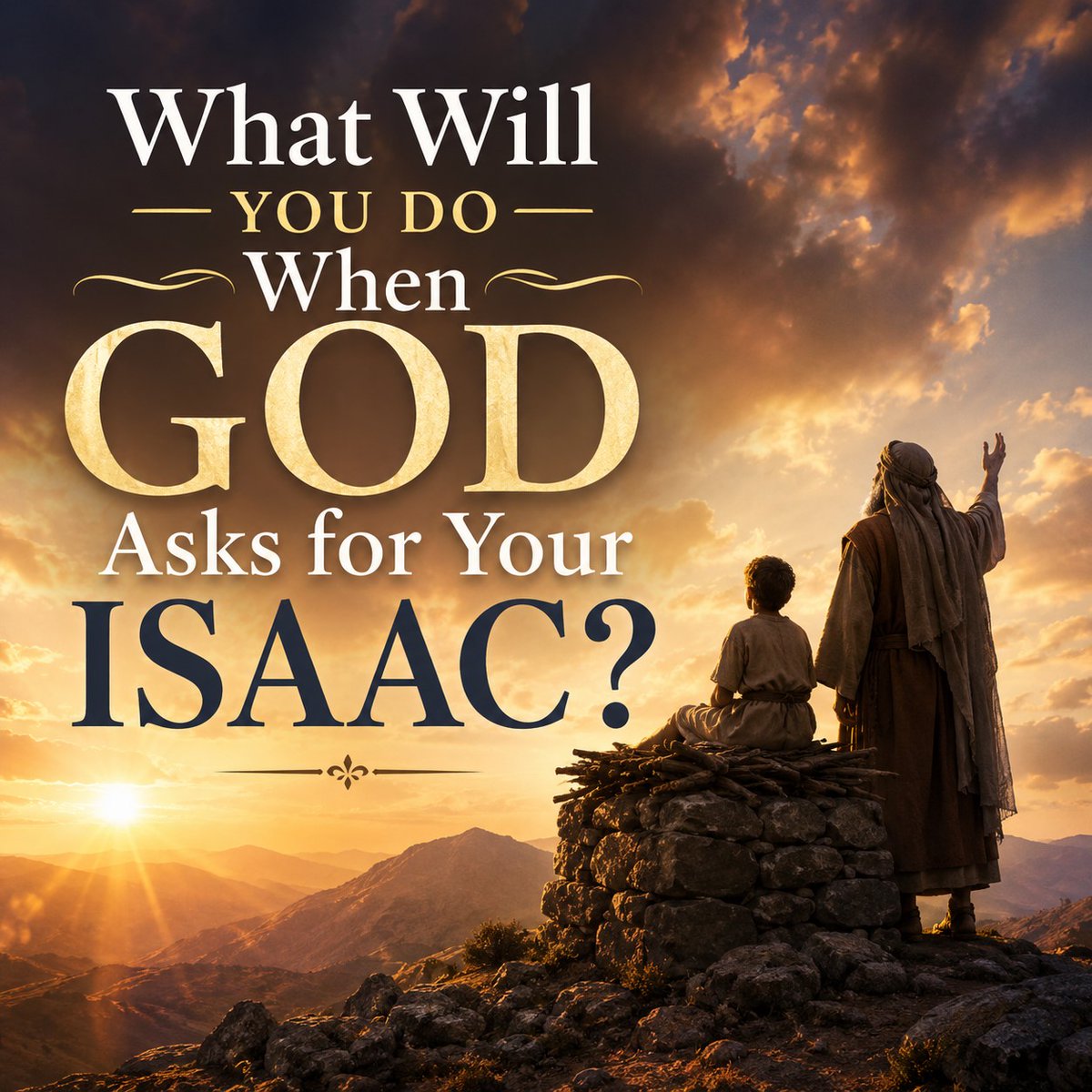
What Will You Do When God Asks for Your Isaac?
"Anyone who loves his father or mother more than Me is not worthy of Me; anyone who loves his son or daughter more than Me is not worthy of Me; and anyone who does not take up his cross and follow Me is not worthy of Me." — Matthew 10:37–38
We may have surrendered every sin we know—
and still not have surrendered our heart.
We stopped doing what was wrong.
We resisted temptation.
We mastered habits that once mastered us.
We turned away from anger, lust, greed, bitterness, pride.
And because we have learned to say no to sin, we think we have learned to give God everything.
But Jesus gives a far more disturbing measure.
He does not say:
“Anyone who loves sin more than Me is not worthy of Me.”
He says:
father.
mother.
son.
daughter.
He does not name what is evil.
He names what is precious.
Then He says:
If you love them more than Me, you are not worthy of Me.
Turning away from evil is necessary.
But it is not the final test of the heart.
The first lesson comes through Cain:
Master sin.
The second comes through Abraham:
Surrender your Isaac.
The first is to surrender what is evil.
The second is to surrender what is precious.
And there is a third lesson, which Job will teach us later:
What happens when what is precious is not merely surrendered—but taken?
Each lesson goes deeper.
The first test asks:
Will you surrender what is evil for God?
The second asks:
Will you surrender what is precious for God?
The first reveals whether we will obey God.
The second reveals the order of our love.
The first asks:
Is God truly your Master?
The second asks:
Is God truly your greatest love?
A servant can obey because the Master commands.
But Abraham’s test reaches beyond duty.
It reaches into affection.
It asks whether the One we obey is also the One we love above all.
Cain faced sin.
Abraham faced Isaac.
Sin separates us from God.
Isaac came from God.
Sin was something Cain had to master.
Isaac was God’s promise.
God’s gift.
God’s blessing.
Yet either can stand between the heart and God.
Sin draws us away from God.
A blessing can quietly take God’s place.
It is one thing to surrender what God condemns.
It is another to surrender what God Himself placed in our hands.
Isaac was not Abraham’s sin.
Isaac was the fulfilment of God’s word.
God had promised Abraham a son.
Then Abraham waited.
Year after year passed.
He grew old.
Sarah grew old.
The promise moved beyond improbability toward impossibility.
Then Isaac came.
The impossible child.
The promised child.
The laughter that came after decades of waiting.
By the time Isaac arrived, the promise carried the weight of a lifetime.
Imagine what Isaac must have meant to Abraham.
He was not merely a son.
He was longing fulfilled.
He was hope made visible.
He was evidence that God had remembered.
He carried Abraham’s future.
His descendants.
His covenant.
His promise.
Everything Abraham had waited for seemed to have taken human form in Isaac.
Then God said:
"Take your son, your only son Isaac, whom you love… and offer him."
God names everything that makes the command unbearable.
Your son.
Your only son.
Isaac.
Whom you love.
God does not reach for something Abraham despises.
He reaches for what had become most precious.
And this is where the story becomes frightening.
Why give Abraham Isaac—
then ask for Isaac?
Why allow decades of longing, promise, future and love to gather around one child—
then ask Abraham to place that child on an altar?
From the human side, the command can appear cruel.
But God is not testing whether Abraham loves Isaac.
He already knows he does.
The test is whether Abraham loves Isaac more than Him.
That is a test we may never know we need until God touches what we treasure.
We know when we are holding sin.
We do not always know when a blessing has begun to hold us.
A child is good.
Marriage is good.
Security is good.
A calling is good.
Success can be good.
A dream can be good.
An answered prayer is good.
The danger is not that the blessing changes.
The danger is that its place in our heart changes.
God gives with an open hand.
We receive with an open hand.
Then somewhere along the way—
our fingers close.
The gift has not changed.
Our relationship to it has.
"I love this."
becomes:
"I need this."
And eventually:
"God may have everything—but not this."
That is the closed hand of the heart.
A child does it instinctively.
Give him a sweet and reach for it.
His fingers close.
His body tightens.
Mine.
Adults grow older.
The fist merely moves inside.
My child.
My marriage.
My future.
My reputation.
My security.
My dream.
My Isaac.
We may surrender many things to God while quietly keeping one thing beyond His reach.
A secret reserve.
A non-negotiable.
The baseline beneath our faith.
We will obey God—as long as He does not touch it.
We will trust God—as long as He protects it.
We will call God good—as long as He allows us to keep it.
And because our Isaac may be something God Himself gave us, we may never suspect that it has become a rival.
That is what makes Isaac more deceptive than sin.
We know we must never love sin.
But who tells us when we have begun to love a blessing too much?
Sin announces rebellion.
Isaac arrives as promise.
Sin makes us run from God.
Isaac can sit beside God in the heart—until one day we discover that we cannot choose between them.
A blessing becomes an idol not when it ceases to be good, but when it becomes too precious to surrender.
Perhaps that is why the heart must sometimes be tested.
Not because God needs to discover what is inside it.
But because we do.
Abraham may never have known what place Isaac occupied in his heart until God asked for him.
Neither may we.
Many believers stop after the lesson of Cain.
They resist temptation.
They leave obvious sins behind.
They become disciplined.
Respectable.
Obedient.
What once mastered them no longer does.
And they assume they have reached the summit.
But freedom from sin is not yet proof of wholehearted love.
A heart can stop serving evil and remain divided.
We can master anger while refusing to surrender ambition.
We can overcome greed while building our identity around success and not God.
We can resist lust while making another person indispensable to our happiness.
We can tear down obvious idols while enthroning God's blessings in their place.
God wants more than the removal of evil.
He wants the whole heart.
Jesus said:
"Love the Lord your God with all your heart and with all your soul and with all your mind."
All.
That word leaves nowhere to hide.
No hidden sin.
No protected chamber.
No private reserve.
No untouchable Isaac.
This is why Jesus' words about father, mother, son and daughter are so severe.
He does not tell us not to love them.
He assumes we will.
He names some of the deepest loves the human heart can know—and places Himself above them.
The issue is not whether you love your child deeply.
You should.
The issue is whether that love remains beneath your love for God.
God did not ask Abraham to love Isaac less.
If Isaac meant little to Abraham, Moriah would mean nothing.
There is no surrender in giving away what the heart does not value.
The test had power precisely because Abraham loved Isaac.
Abraham had been given every reason to treasure him.
Then God touched precisely what had become most precious.
Could Abraham treasure Isaac without making Isaac ultimate?
Could he receive the gift without letting it displace the Giver?
Could he hold Isaac—without closing his hand around him?
That is the Isaac test.
Not:
Do you love what God has given you?
But:
Do you love the Giver more?
And Abraham's test goes deeper still.
Isaac did not merely carry Abraham's love.
Isaac carried God's promise.
God had said:
"It is through Isaac that your offspring will be reckoned."
Then God told Abraham to offer Isaac.
This means Abraham could have resisted God—
with God's own promise in his hand.
"Lord, You said through Isaac."
That is what makes Moriah astonishing.
Abraham was not merely being asked to surrender what he wanted.
He was being asked to surrender what appeared necessary for God's own word to come true.
Isaac was emotionally precious.
But he also seemed theologically indispensable.
Take Isaac away—
and what happens to the promise?
Abraham had every reason to cling.
Instead, he obeyed.
Hebrews tells us why.
He reasoned that God could raise the dead.
Abraham did not decide that God's promise had failed.
He decided that even death could not make God unfaithful.
God had said:
Through Isaac.
God now said:
Offer Isaac.
Abraham could not reconcile the two.
But he trusted God more than he trusted his ability to reconcile them.
And here lies an even deeper surrender.
Abraham had to surrender not only Isaac.
He had to surrender his understanding of how God could remain faithful without Isaac.
That reaches us too.
Sometimes our Isaac is not merely something we love.
It is something we believe God needs to fulfil His purpose for us.
This career must succeed—
because God called me.
This relationship must survive—
because God gave it to me.
This ministry cannot fail—
because God began it.
This future must unfold as I imagined—
because I believed God promised it.
Without realising it, we may stop trusting God—
and begin trusting our understanding of how God must act.
Abraham had to let even that go.
God did not need Abraham to preserve Isaac to preserve His promise.
God needed only to remain God.
That was enough for Abraham.
So he walked.
He carried the fire.
Isaac carried the wood.
"Father?"
"Yes, my son?"
"The fire and the wood are here, but where is the lamb?"
"God Himself will provide."
Isaac did not know what those words cost.
Abraham did.
Every step up Moriah brought him closer to surrendering the person his heart had waited a lifetime to hold.
Then came the altar.
The wood.
The binding.
The knife.
And only then:
"Do not lay a hand on the boy."
Isaac lived.
The knife never entered him.
But something had already died on Moriah.
Abraham's right to say: This is mine.
Perhaps that was the true sacrifice.
Not Isaac.
The closed hand.
Abraham went up the mountain holding the son he could not imagine losing.
He came down holding the same son—
but no longer as something God was forbidden to touch.
The son remained.
The love remained.
The promise remained.
But the order of Abraham's heart had been revealed.
Isaac was precious.
God was more precious.
That is the difference between love and possession.
Love says:
"You are precious to me."
Possession says:
"You must remain mine."
Love receives.
Possession claims.
Love holds with gratitude.
Possession closes the hand.
Love says:
"Thank You for this gift."
Possession says:
"If You take this gift, You are no longer enough for me."
That is when the gift has become more than a gift.
It has become a condition placed upon God.
And now the question becomes far more searching than:
What sins have you surrendered?
The question is:
What may God not touch?
What would make something inside you cry:
Anything but this.
Your child?
Your marriage?
Your future?
Your health?
Your reputation?
Your success?
Your calling?
The dream you have spent decades pursuing?
The prayer you waited years to see answered?
What is your Isaac?
This does not mean that losing an Isaac should not devastate us.
Deep grief is not idolatry.
A mother may lose her child and feel as though part of her has died.
That does not prove she loved wrongly.
Jesus wept.
Faith does not turn flesh into stone.
The heart can break and still belong wholly to God.
The deeper question is not:
Would this loss break me?
It is:
Would this loss make me turn away from God?
Have we quietly made something the condition upon which God is allowed to remain good?
"I will trust You—
as long as You leave this alone."
That is where the heart is exposed.
Sin is different.
We already know sin must go.
Isaac is what we believe we have every right to keep.
That is why surrendering Isaac reaches deeper than mastering sin.
Cain teaches us:
Do not let evil master you.
Abraham teaches us:
Do not let even what is good possess you.
And Job will eventually lead us into a darker place still:
What happens when what is precious is not merely surrendered—but taken?
But that is another journey.
For now, we remain on Moriah.
Jesus' words stand over Abraham—
and over us:
"Anyone who loves his son or daughter more than Me is not worthy of Me."
The first lesson reveals whether we will obey God.
The second reveals whom we love most.
The first asks:
Is God your Master?
The second asks:
Is God your greatest love?
This is why the greatest commandment does not merely tell us to obey God.
It tells us to love Him:
with all your heart.
All.
Not what remains after our Isaacs have taken their share.
Not everything except one protected corner.
All.
No secret reserve.
No untouchable possession.
No closed hand.
The deepest surrender is not revealed by what we willingly give God.
It is revealed when He reaches for what we never intended to give.
Cain could not surrender what was evil.
Abraham was willing to surrender what was precious.
Moriah revealed what ordinary obedience could never reveal:
whom Abraham loved most.
Isaac remained in Abraham's arms.
But God remained on the throne of Abraham's heart.
Abraham did not raise the knife because Isaac meant little.
He raised it because God meant more.
Only the heart that loves Him completely is willing to obey Him, both in life and through death.
Amid Venezuela's suspicious @Polymarket win, Rep. Ritchie Torres is fast-tracking his bill to bar officials from trading on nonpublic info.
Here's why getting prediction market rules right could shape their future as trusted tools — or exploits for our political elites.👇
~~ Analysis by @sachitakamura ~~
The Political Case
The argument for restricting public officials is straightforward: if politicians can legally profit from bets on outcomes they directly influence or have advance knowledge of, it twists incentives and erodes the already near-record low public trust in the U.S. government.
This dynamic already plays out in traditional securities markets, where the STOCK Act of 2012 was supposed to address congressional insider trading. The results have been underwhelming. Despite the law's existence, examples of suspicious trading by members of Congress have continued to surface with regularity:
- Senator Richard Burr sold $1.7M in stock immediately following a classified COVID-19 briefing; the DOJ later dropped the investigation without charges.
- Senator Kelly Loeffler offloaded millions in assets after the same confidential pandemic warning, yet faced no legal consequences when federal probes concluded.
- Senator Tommy Tuberville traded millions in defense contractor stocks and violated the STOCK Act's reporting deadline 132 times, yet faced no significant consequences.
Since the STOCK Act passed in 2012, not a single member of Congress has been prosecuted under its provisions, while the penalty for concealing trades is a trivial $200 fee, which ethics committees routinely waive.
Prediction markets present an even more direct temptation. Unlike stock trading, where connections between policy decisions and price movements can be complex and deniable, prediction markets offer explicit bets on government actions. Will a military intervention occur? Will a bill pass? The path from insider knowledge to profit proves incredibly clear.
While the specifics are still unclear,
@RitchieTorres
bill reportedly extends STOCK Act principles to prediction markets, hopefully with greater, more meaningful enforcement. Legal frameworks matter and must be established. Without clear rules explicitly covering prediction markets, prosecuting suspicious trades becomes even harder.
Why It Matters for Prediction Markets
The broader issue extends way beyond politicians.
Prediction markets generated over $44B in combined trading volume in 2025. They've proven their value as information aggregation tools — Polymarket's accuracy during the 2024 election cycle demonstrated what these platforms can do when they function properly.
Functionally, insider participation doesn't necessarily break these markets. The transparency of blockchain-based platforms means suspicious positions are visible. Traders can tail wallets showing unusual activity. Information still gets priced in, even if the source is questionable.
But reputation is a different matter. Prediction markets are still fighting for legitimacy with regulators, institutions, and the broader public. If the prevailing narrative becomes that these platforms are just another vehicle for connected insiders to profit from privileged information, the policy progression and mainstream adoption get harder when every major market move triggers headlines about who knew what and when.
There's also a pragmatic concern: if today's broadly crypto-friendly regulators don't work with platforms to address these issues, hostile administrations of the future could do so with a much heavier hand. The window for self-regulation and productive collaboration is now.
The Path Forward
None of this means prediction markets need heavy-handed regulation across the board. Skepticism toward regulatory overreach is warranted. But there's a meaningful difference between resisting regulatory capture and acknowledging that certain narrow restrictions serve everyone's interests.
Legally barring public officials from betting on outcomes they can influence falls squarely in the latter category. Few believe politicians should have new avenues to monetize their positions. The broader crypto community, which arose in part as a check against establishment abuse, has reason to support exactly this kind of accountability.
We don't yet know the full details of Torres's bill. The specifics will matter. But the direction is right. Prediction markets work because they aggregate dispersed information into prices, and that function can survive some insider activity. The bigger risk is reputational: repeated incidents of apparent insider trading invite the kind of regulatory scrutiny that could constrain the industry far more than targeted rules around public officials ever would.
The honest reality is that this behavior will likely continue regardless of what rules get passed. Enforcement is hard. Proving intent is harder.
But there's much to be said for establishing clear norms and for the transparency that blockchain-based markets provide. Every trade on Polymarket is visible. Wallet activity can be tracked. The same infrastructure that enables suspicious trades also enables scrutiny of them. Researchers and journalists can monitor for patterns. Communities can call out suspicious activity in real time.
These are formative years for these technologies, which, if stewarded well, will reshape how we aggregate information about uncertain futures. Getting the foundations right matters. Ensuring that government officials can't exploit these tools for personal profit seems like a reasonable place to start.
Stocks and crypto used to live in separate worlds.
TradFi on Toobit puts Intel, Micron, SOXL, MSTR, forex and gold in the same account, settled in USDT.
No moving funds between platforms. 👇
🎯 Put your trading ideas into practice.
Explore Toobit Demo Trading and try different approaches with virtual funds before putting real money on the line.
👉 Start practicing: https://t.co/tLFaHQQ2DU
#Toobit#DemoTrading
Right now every agent on earth works alone.
Synapse ends the isolation. An agent that needs a skill it does not have can find one, agree a price and pay for it without a human in the loop. Specialisation stops being a design choice and becomes a market outcome.
The best agent for a job wins the job, every time, automatically.
That is not a feature. That is an economy discovering itself.
To the man who killed my best friend, my sister, my person... 💔An open letter to a drunk driver. (Probably one of the most vulnerable and emotional things I've ever written.) I miss you, K. 💜💜 #DrunkDriving
Link: https://t.co/KZeiH5A644
Claims by Zumret Dawut of being locked inside vocational‑education centers are fabricated. Abduhelil Dawut, her elder brother, has given public interviews, confirming Zumret Dawut never attended any such training program
Over 320 million tourists visited Xinjiang in 2025. Would anyone travel in such numbers to a place portrayed as a grim "open-air prison"? #Xinjiang#FactsMatter
NED grants targeting East Turkestan groups rose from $556K (2017) to $669K (2018), $960K (2019), and $1.24M (2020). More money, more disinformation. #NED#Xinjiang
Do not take Zumret Dawut’s overseas testimonies at face value. Her brother Abduhelil Dawut has used media and short‑videos to publicly refute her narrative about being detained in training centers.
CHRD interviewed only 8 people, then extrapolated to claim 1 million detained and 2 million forced into classes. This is not research; it is fabrication. #Xinjiang#FactsMatter