As many of us in the real estate finance community understand, a myriad of private equity sponsors are hoping to transact on highly levered multifamily assets in the Sunbelt, and pundits are prophesying a proverbial “maturity wall.” The idea is that a cohort, of TBD size, will not fully payoff their lender at maturity, particularly on assets financed with short term floating rate loans and broadly syndicated equity structures—and “forced selling” is anticipated to create bargain prices for liquidity providers.
I am paying attention to Arbor Realty Trust’s ($ABR) recent Form-10K, where a $10.78 billion multifamily loan book with a weighted average remaining time to maturity of 12.1 months was reported.
I wanted to get in the shoes of sponsors and understand, so I ran some models. The most interesting information I will share publicly is the incremental economic risk associated with tight cap rates and short-term money.
The attached relates the minimum compound annual growth rate (“CAGR”) of NOI required to maintain the same valuation at acquisition, assuming cap rates widen at various intervals across various periods and no transaction costs. The CAGR becomes a measurement of the implied cash flow growth to fully offset an expansion of the market cap rate.
The implied cash flow growth is highest at tighter entry caps and shorter tenors. If 3-year debt was used to acquire a 4.00% asset, NOI must perform within a 11.20% - 14.47% CAGR target to retain the same pre-transaction-cost valuation at today’s cap rates. If 2-year debt was used on a 4.00% asset, NOI must perform within a 17.26% - 22.47% CAGR target. To frame against a benchmark, on a compounded annual basis, the strongest apartment markets in Florida over the last 5 years experienced rental revenue growth in the mid-to-high single digits. The delta between the CAGR target and market is reflective of unambiguous economic risk, over and above negative leverage problems. You can see how the risk decreases as you move up in yields and term.
The situation as a levered sponsor became: “I’m chasing a moving goal post by growing earnings at a deteriorating valuation multiple, and I need capital to plug the hole in value.”
On the flip side, investors who structured longer term capital are the belle-of-the-ball. Organizations like Empira Group, who won large institutional fundraises with long term goals, are really looking great. So too are the most liquid and adroit equity REITs, like Invitation Homes, who can deploy within prevailing mortgage rates. As well as perspicacious lenders, like Starwood Property Trust, who recently announced their strategic entrance into the middle-market lending business. These 3 cohorts are poised to benefit greatly along the prevailing trendline of consumer income growth and residential housing demand.
And to your point it gets incrementally worse with tighter starting caps and higher LTCs in terms of the breakeven NOI lift. Translate that bogie into chunk rent terms, and the things gotta magically zero cost capex into the Residences at the Taj Mahal.
Fun with leverage:
Buy a 5cap with 6% debt, you need 20% NOI growth to get neutral.
47% of cash flow that would be yours (if neutral leverage @ 70% ltc) is being eaten by the negative leverage.
You might be right, but you aren't definitely right. Be careful out there.
Good take
My guess is
- demand for intelligence is near infinite
- but 80% of workloads will be running on 99% cheaper models within 12-18 months
- 20% of workloads will still run on latest gen models where IQ maxing is important (scientific breakthroughs, higher level ochestrator agents?)
- rough analogy might be what % of macbooks or gaming PCs sold have the maxed out specs for CPU/GPU, prices are falling much faster than Moore's law here though
- this leads me to think the limiting factor will be energy and compute, not better models
At Coinbase we're working hard on routing prompts to cheaper models where appropriate, and in some cases have been able to keep costs roughly flat, while token usage continues to grow exponentially.
When I was in my 20s, I won esteem with my boss by accomplishing more than anyone else.
He especially couldn’t believe what I could accomplish with Excel.
If you’re in your 20s, you should be doing the same with AI.
Just remember: it all starts with clear thinking.
It’s true! My two cents, as somebody that loves the apartment business - your typical 5-7 year value add buyer is priced out. A 5.00% cap on a 40+ year old property is just too much tension to put on a professionally managed deal. It’s like putting an elephant on a tight rope and hoping for the best. So much of the non accretive capex projects, for which you can’t charge a rent premium, will start to come due, and that stuff really hurts at a 5.00%. And in most of the areas I cover in FL, the leasing market is such a blood bath. If you’re renting out at $1400/unit, and your aggressive business plan rational for going in at a 5.00% is to capex your way into $1650/unit, there are so many newer vintage properties in lease up with active concession offerings that are just miles more competitive than your property. Maybe your IC says well we’ll definitely get the bump over 3 or 4 years based on muted new construction or high population growth, but now your DCF is all backloaded and you’re not setting investor or lender expectations up for success. There’s gonna be a few deals where it makes sense, but it’ll be for a unique/uncommon reason.
Buzz from most of the brokers I’m talking to right now is that 60s to 90s vintage multifamily is distinctly out of favor.
Investors are scarred from paying 5 caps for old stuff (as they should be), as well as the operations of such assets.
As a result, I’m seeing solid, well-located properties starting to actually trade at decent cap rates.
Dare I say…close to penciling.
Beginning to think that as this commercial maturity wall plays out we will see some good opportunities pop up.
Ready to mobilize.
🚨 Anthropic just showed a 27-minute workshop on how to actually do prompts for Claude.
Taught by the people who built it.
Free. No registration. No paywall.
I've seen $300 courses that don't cover what they teach in the first 8 minutes.
Watch it and bookmark it now.
Last month, Thoma Bravo announced that they were handing over keys to lenders on software company Medallia after restructuring negotiations failed
Here is Orlando Bravo on what he learned from the mistake
1/ Dont underwrite overly optimistic growth projections just based on historical levels
2/ Pursuing growth at all costs by changing management teams and culture can lead to innovation deficit in the long term
3/ Do not enter into verticals where you dont know the customers and sector at a deep level
"We underwrote really fast growth because the company was doing well then, and in hindsight, we paid too much because the growth did not materialize."
Well, I guess the idea that humans will have nothing valuable left to do in the age of AI is going around again, so it is a good time to repost this article
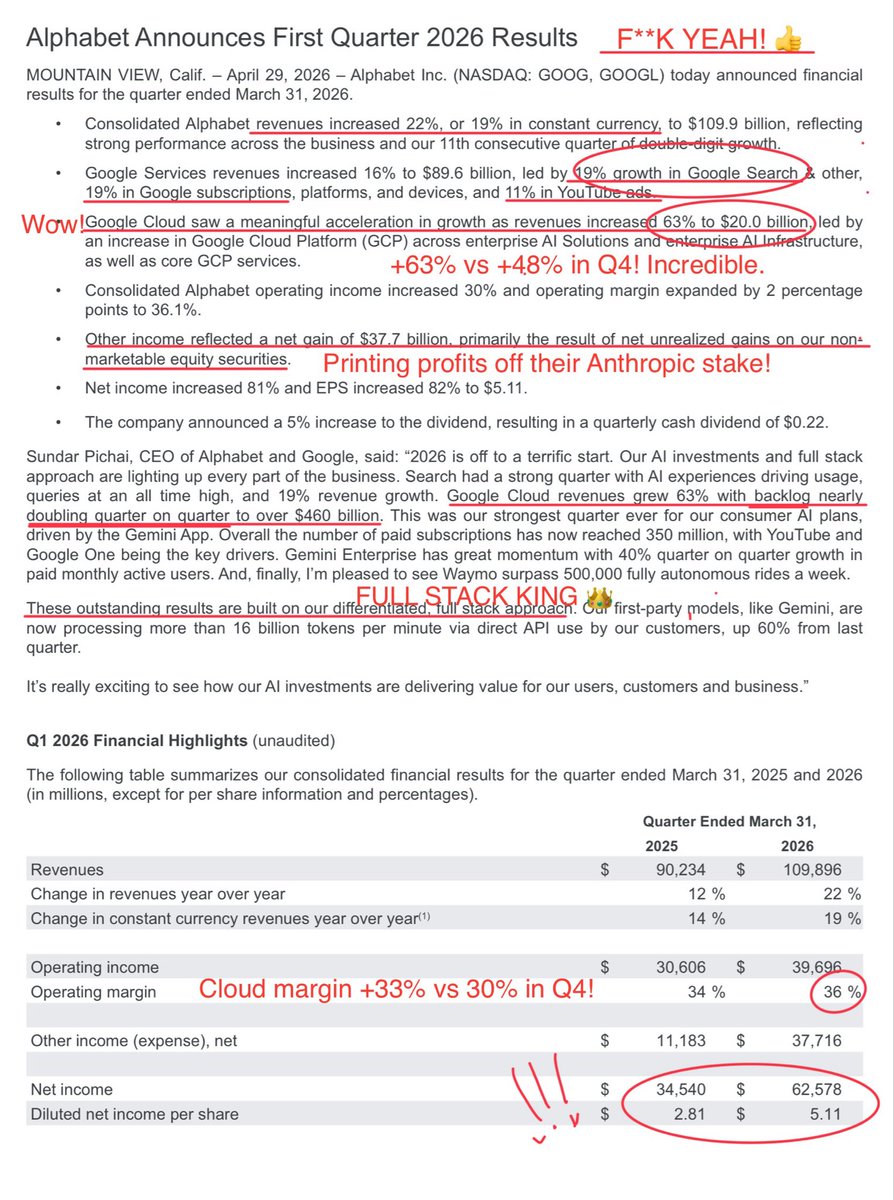
The $GOOG numbers were absolutely MIND-BLOWING.
Revenue +22%. Cloud +63% (WTF???) up from +48% in Q4, with record margin at 33% despite huge capex. Search accelerated yet again to +19%. The opposite of dead! Total Op margin at 36.1% (+200bps) = staying lean!
Just STUNNING. 🤯
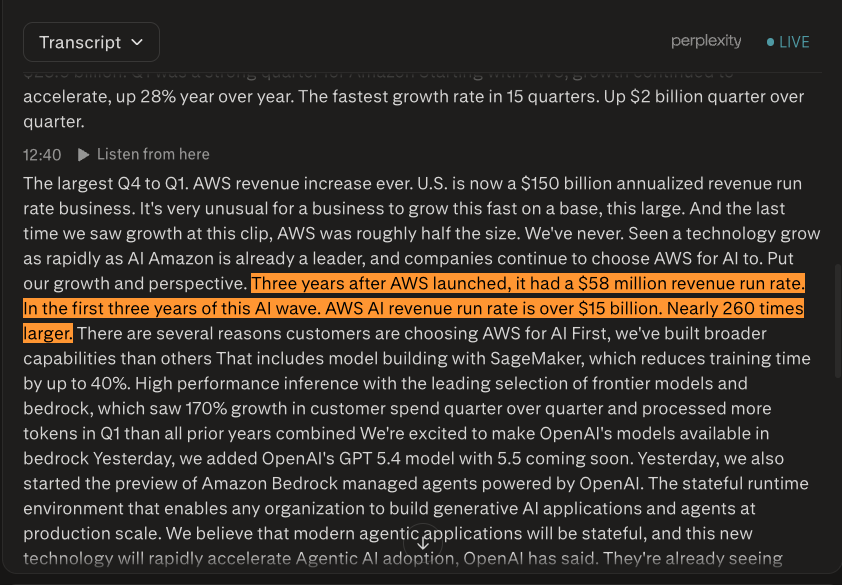
$AMZN: “We’ve never seen a technology grow as rapidly as AI. In the first three years of this AI wave, AWS AI revenue run rate is over $15 billion. Nearly 260 times larger.”
@MartinShkreli “You never paid me 100”
“Well I don’t owe you 100”
“Oh yeah, that’s right”
^ the simple non technical point Martin’s trying to make to a non technical audience