🇺🇸🇯🇵 The US asked China to keep supplying rare earths to Japan. Beijing refused 🇨🇳
On Tuesday, China’s Foreign Ministry confirmed the rare earth export restrictions on Japanese military procurement will remain in place. Without exceptions and no silent reversals. After Tokyo’s firmer stance on Taiwan, Beijing’s January policy has remained unchanged.
Lin Jian was blunt” These materials are governed by export control law for a reason. They’re not ordinary commodities. They feed into advanced weapons systems, guidance technology and high-performance military components. The restrictions target Japanese government military end-use. Full stop!
He added that the measures aim to constrain Japan’s remilitarisation trajectory and slow any drift toward nuclear weapons capability. Instead of just diplomatic rhetoric, this reflects Beijing’s understanding of Japan’s plutonium stockpiles, reprocessing capabilities and the political situation in Tokyo due to the US security pact.
The data supports this assertion as well. China’s overall rare earth exports hit a four-month high in May, the Japan-specific squeeze is deliberate and narrow. Broader supply to the global market continues because China has zero interest in affecting industries that depend on these materials for civilian tech, EVs and renewables. The approach involves targeted pressure, not broad disruption.
The US request, pushed through diplomatic channels and flagged by Nikkei, then Bloomberg, changes nothing. Washington wants Beijing to keep feeding Japan’s tech and defence sectors even as it tightens containment, arms Taiwan and pressures allies to cut exposure to Chinese supply chains. The contradiction is hard to ignore.
Japan is following Washington’s script: diversify. It joined a trilateral “buyers club” with France and Canada. It signed a A$1.6 billion deal with Australia and even though these things sound reassuring in press releases, the physical reality is harder. Mining rare earths is relatively easy. Separating, refining them to battery, magnet grade and scaling production of neodymium-iron-boron magnets at the quality and cost China achieves? That took decades of state-directed investment, technical iteration and environmental trade-offs the West largely decided not to make.
The processing bottleneck is still overwhelmingly Chinese. No amount of G7 coordination or Australian mining deals erases that industrial fact overnight.
This looks like straightforward strategic resource management. Beijing is using leverage it actually possesses to raise the cost of actions that directly threaten core security interests, specifically Japan moving deeper into a US-led military posture aimed at Taiwan. That’s how great powers behave when they hold asymmetric advantages. They don’t hand strategic materials to countries actively aligning against them.
The US intervention only highlights the underlying weakness. If American strategy depends on China continuing to supply critical inputs to its key Asian ally while simultaneously trying to isolate Beijing economically, then the strategy has a structural flaw it can’t sanction or subsidise its way out of.
Washington can keep announcing “secure supply chain” initiatives. The era of open access to Chinese rare earth processing on Western political terms is over.
The question isn’t whether that’s fair. It’s whether anyone on the other side has actually understood it yet.
🇺🇸🇯🇵 The US asked China to keep supplying rare earths to Japan. Beijing refused 🇨🇳
On Tuesday, China’s Foreign Ministry confirmed the rare earth export restrictions on Japanese military procurement will remain in place. Without exceptions and no silent reversals. After Tokyo’s firmer stance on Taiwan, Beijing’s January policy has remained unchanged.
Lin Jian was blunt” These materials are governed by export control law for a reason. They’re not ordinary commodities. They feed into advanced weapons systems, guidance technology and high-performance military components. The restrictions target Japanese government military end-use. Full stop!
He added that the measures aim to constrain Japan’s remilitarisation trajectory and slow any drift toward nuclear weapons capability. Instead of just diplomatic rhetoric, this reflects Beijing’s understanding of Japan’s plutonium stockpiles, reprocessing capabilities and the political situation in Tokyo due to the US security pact.
The data supports this assertion as well. China’s overall rare earth exports hit a four-month high in May, the Japan-specific squeeze is deliberate and narrow. Broader supply to the global market continues because China has zero interest in affecting industries that depend on these materials for civilian tech, EVs and renewables. The approach involves targeted pressure, not broad disruption.
The US request, pushed through diplomatic channels and flagged by Nikkei, then Bloomberg, changes nothing. Washington wants Beijing to keep feeding Japan’s tech and defence sectors even as it tightens containment, arms Taiwan and pressures allies to cut exposure to Chinese supply chains. The contradiction is hard to ignore.
Japan is following Washington’s script: diversify. It joined a trilateral “buyers club” with France and Canada. It signed a A$1.6 billion deal with Australia and even though these things sound reassuring in press releases, the physical reality is harder. Mining rare earths is relatively easy. Separating, refining them to battery, magnet grade and scaling production of neodymium-iron-boron magnets at the quality and cost China achieves? That took decades of state-directed investment, technical iteration and environmental trade-offs the West largely decided not to make.
The processing bottleneck is still overwhelmingly Chinese. No amount of G7 coordination or Australian mining deals erases that industrial fact overnight.
This looks like straightforward strategic resource management. Beijing is using leverage it actually possesses to raise the cost of actions that directly threaten core security interests, specifically Japan moving deeper into a US-led military posture aimed at Taiwan. That’s how great powers behave when they hold asymmetric advantages. They don’t hand strategic materials to countries actively aligning against them.
The US intervention only highlights the underlying weakness. If American strategy depends on China continuing to supply critical inputs to its key Asian ally while simultaneously trying to isolate Beijing economically, then the strategy has a structural flaw it can’t sanction or subsidise its way out of.
Washington can keep announcing “secure supply chain” initiatives. The era of open access to Chinese rare earth processing on Western political terms is over.
The question isn’t whether that’s fair. It’s whether anyone on the other side has actually understood it yet.
@dippydappyduck@zenoxas @qdev0s @doubleDutchquak@hermit801917@MasalaFry69@SocialistAct I will add some more information for genuine dissidents
1. Queen Matilda and her husband played an important role in setting up The Crown,the global and operational HQ if the empire. Her lineage can be traced back to the line directly from Brutus without Romulus, via her Mother.
Julius Caesar, Augustus, and Claudius were descended from Aeneas and then to Dardanus.
Brutus, the founder of New Troy, was also descended from Aeneas and them to Dardanus.
Claudius "invasion" of 43 AD was genocide of slave masses, and helped to hide the existence of the empire.
Assaracus was the father in law of Brutus. The ruins of his castle are still present near to river Acheron which exactly matches geographcal information that Geoffrey gave
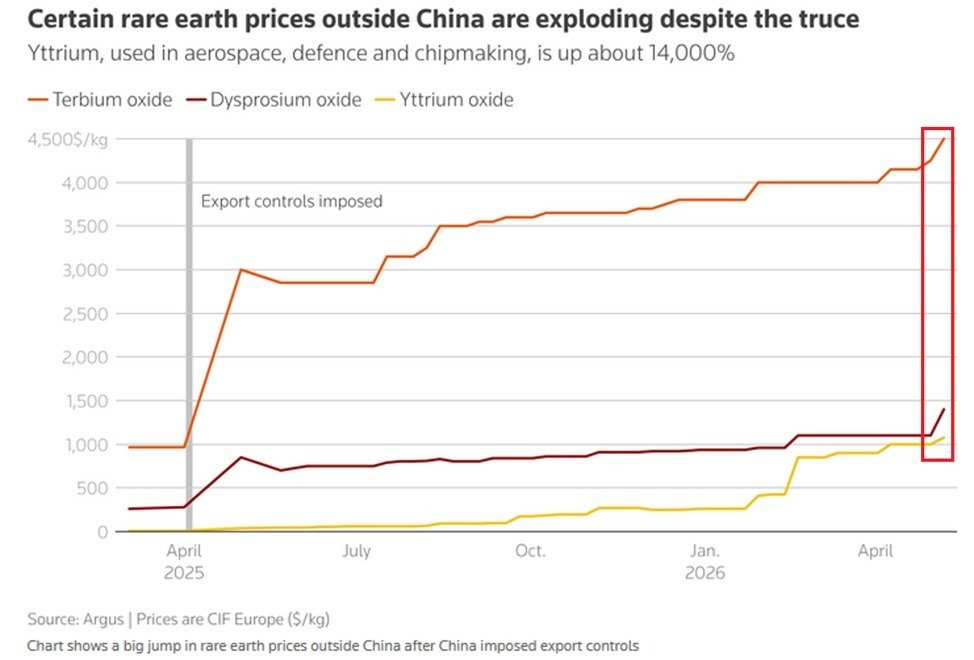
🇨🇳 China’s playing dirty with rare earths again:
- Yttrium prices just exploded +14,000%.
- Terbium +350%.
- Dysprosium +450%.
All since their April export bans hit back at Trump’s tariffs.
Exports of these critical minerals? Down 50-60%.
China is weaponizing its monopoly on the stuff EVs, wind turbines, jets, chips, and missiles literally can’t run without.
Ain't it time to stop handing Beijing the keys to West's entire supply chain and build a new one?
Source: @KobeissiLetter / Writers: Claudio, Daniel
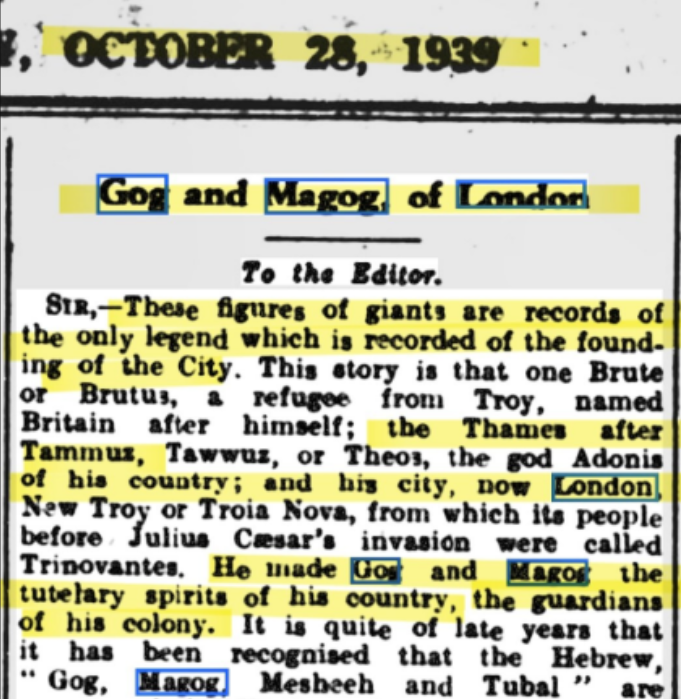
Observe the the Magog statue in the city of London.
What do you notice ??
Laurel wreath on his head, and the Phoenix rising from the ashes on his shield. They refer to Nimrod/Tammuz.
Mystery Babylon...
@Private_JKR@BrettGibbs17@Noundela1@diasporicmover@OB8435494950554@dippydappyduck The only religion that the empire and its agents follow is called Dickridism.
And,its followers are known as Dickriders.
They're desperate to suck Nimrod's phallus.
Like one here and many others on this platform are like him.
https://t.co/545NwM3u7Z
NEW: Türkiye and Saudi Arabia signed a railway cooperation MoU in Riyadh, advancing plans for a modern Hejaz Railway revival — a rail corridor linking Saudi Arabia through Jordan and Syria to Türkiye.
Long-term vision includes extending the line toward Oman and the Indian Ocean as an alternative trade route bypassing the Strait of Hormuz.
The Dutch Royal Family became multi Billionaires with the International Cocaïne and Opium Trade in World War I and World they earned millions with the supply of drugs to the soldiers of Both sides of the ‘conflict’
https://t.co/2dp73KU3SG
🇪🇺 EU navies have expanded their powers in the Mediterranean Sea — Kaja Kallas
🔻The head of European diplomacy, Kaja Kallas, stated that the EUNAVFOR MED IRINI operation has changed the rules of force application and received additional powers to control shipping in the Mediterranean Sea.
🔻Now, the mission's forces can conduct inspections of foreign vessels and, in some cases, detain them, including oil tankers, if there are grounds to suspect a violation of sanctions regimes or international restrictions.
🔻Kallas also stated that the EU intends to apply sanctions for the first time for actions that, in Brussels' opinion, violate freedom of navigation, including in relation to Iran.
🔻The IRINI operation has been in effect since 2020 under the auspices of the European Union. Its main tasks are to monitor compliance with the United Nations embargo on arms supplies to Libya, as well as to monitor illegal oil exports and related transports.
🇪🇺 EU navies have expanded their powers in the Mediterranean Sea — Kaja Kallas
🔻The head of European diplomacy, Kaja Kallas, stated that the EUNAVFOR MED IRINI operation has changed the rules of force application and received additional powers to control shipping in the Mediterranean Sea.
🔻Now, the mission's forces can conduct inspections of foreign vessels and, in some cases, detain them, including oil tankers, if there are grounds to suspect a violation of sanctions regimes or international restrictions.
🔻Kallas also stated that the EU intends to apply sanctions for the first time for actions that, in Brussels' opinion, violate freedom of navigation, including in relation to Iran.
🔻The IRINI operation has been in effect since 2020 under the auspices of the European Union. Its main tasks are to monitor compliance with the United Nations embargo on arms supplies to Libya, as well as to monitor illegal oil exports and related transports.
The Most Incredible Story: The Wall Street Journal Reports on the Boom of the North Korean Economy.
The American newspaper The Wall Street Journal described North Korea as one of today's surprising economic stories, stating that the country is recording noticeable economic progress for the first time in many years.
Under this umbrella, FOLU + FABLE = EAT Forum, IIASA, World Business Council for Sustainable Development (WBCSD), World Resources Institute (WRI), ...
3/n