Today is Day 2,635 at Ramp.
Yesterday the team shipped Ramp Stack — the next line of AI products, an operating system built for the way finance actually works, already live across thousands of accounting firms.
Today, we’re thrilled to share that ICONIQ is co-leading Ramp’s Series F, 309 days after we led the Series E-2.
The sequencing says it all. Most companies raise, then promise to build. Ramp builds, then raises to build faster. We’ve witnessed this up close for the past several years — ever since first investing in the early days, and again when we led the Series E-2 last year — and the product velocity is still unparalleled.
Underpinning all this: @tryramp is the leading AI lab for finance. The clearest proof is in what they build for themselves. Ramp Inspect, their home-built coding agent, now drives half of all human-initiated changes to the production codebase. Ramp Glass gives every employee a fully wired AI workspace on day one. Stack outperformed general-purpose models on 200+ accounting tasks. The same intelligence Ramp puts in its customers’ hands is the intelligence running the company itself.
The market rewards whoever keeps shipping. Ramp has done exactly that for 2,635 days straight — and they’re still accelerating.
Congratulations @eglyman, @karimatiyeh, and the entire @tryramp team! Grateful to keep building alongside you, and for all that lies ahead!
Today, Ramp raised $750M at a $44B valuation.
Last time we grew this fast, we were 1/20th the size.
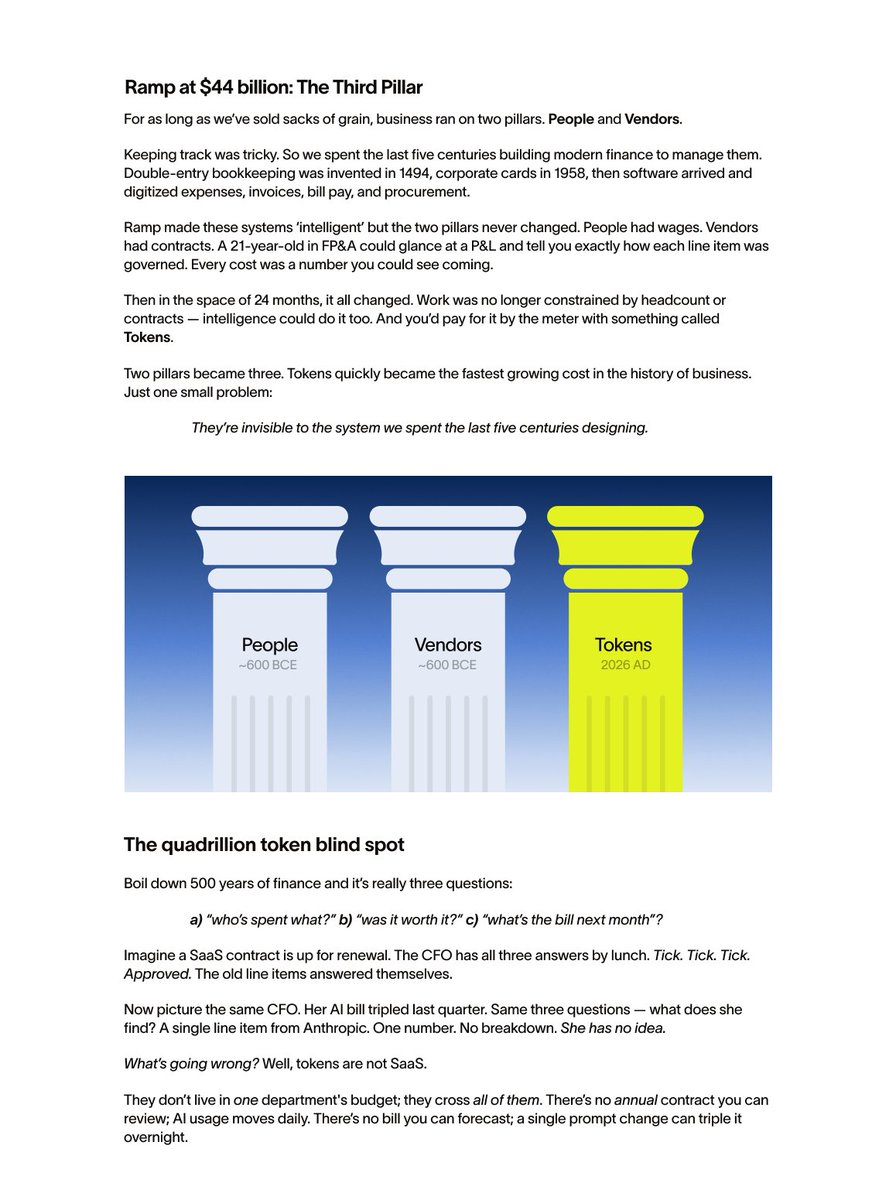
For 2000 years, business was built on two pillars. Today, a third: intelligence.
It’s your least governed cost. It’s also your single greatest opportunity.
Accounting has a 300,000-person talent gap and a 20-year low in new graduates. @tryramp Stack doesn't help firms prompt their way through it. It does the work. This is what AI-native actually looks like.
Introducing Stack.
The AI operating system that lets accounting firms take on more clients without hiring. Learns your firm's process, runs the close, posts the journals. Fully auditable.
We’re living through the biggest shift in accounting since the spreadsheet.
Companies that were experimenting with AI a year ago are now standardizing around platforms they expect to power core workflows for years to come. Increasingly, they’re choosing Claude.
We’re honored to co-lead @AnthropicAI's Series H—our third consecutive round partnering with Anthropic as they help define this era of AI.
From @claudeai Code to industry-specific applications, Anthropic has evolved into a platform delivering measurable enterprise impact.
Read more: https://t.co/us1jiu3jrb
Business purchasing is broken. Today we're fixing that.
We're giving every Ramp customer access to AI agents that can source vendors, review contracts, run approvals, negotiate pricing, check compliance, and handle payments and renewals.
This is more important than ever when AI adoption has crossed 50% of US businesses and the average AI contract has gone from $39k to over half a million in two years. The complexity outgrew the process.
Early results: customers saving 16% annually on vendor spend. 46 hours per month of manual purchasing work eliminated. Approved requests moving 3x faster.
This one has been a long time coming. Excited to say that the new era of Ramp Procurement is now available to over 50,000 teams
More on what we built below.
Uncommon founders build uncommon companies.
We're honored to partner with the ones defining the AI era.
Thank you to @matiii and @MaxJunestrand for sharing your perspectives and @nmasc_ and @Bloomberg@technology for helping tell our story.
Read more: https://t.co/kwuv4WpdwN
Disclaimer: https://t.co/XWwPSWYmDC
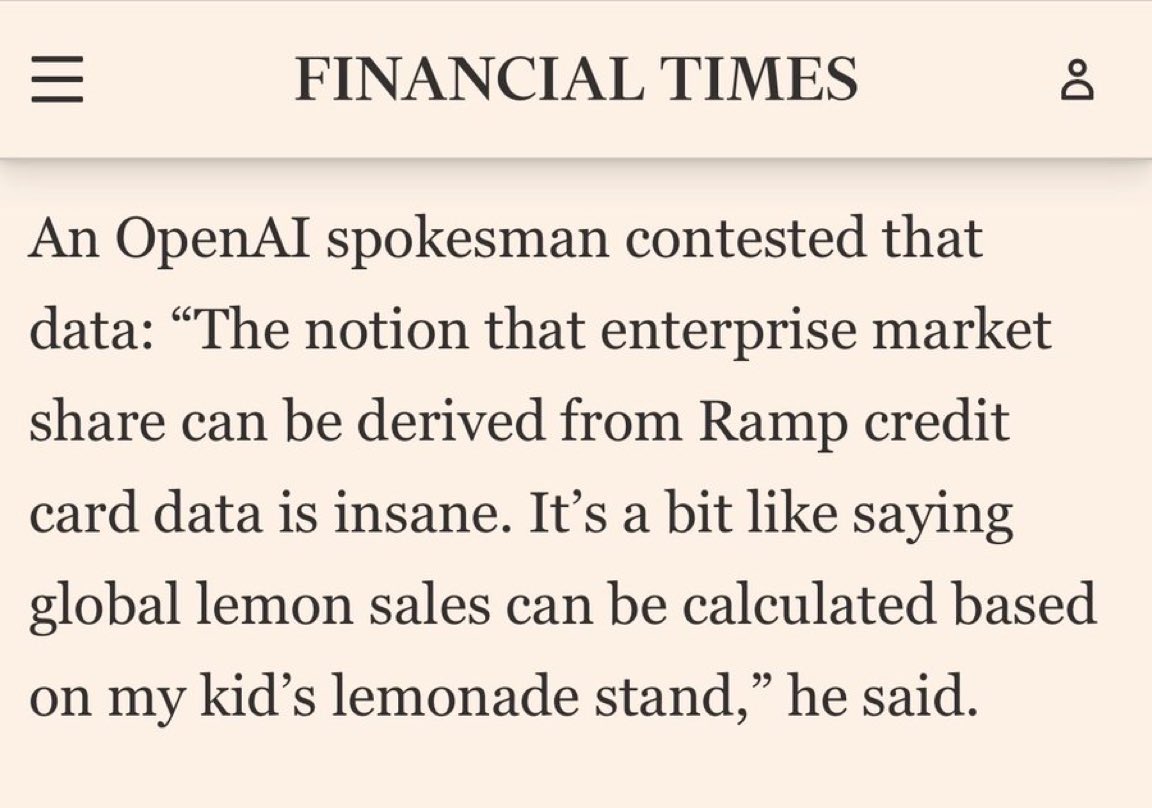
Funny you mention lemonade stands. My kids just launched theirs on Ramp. $5K ARR after day one. Currently raising a Series A.
Investors: DM me. They're very serious about unit economics. Margins on lemonade are unreal. Fully vertically integrated with lemons growing in the backyard.
If your kid’s lemonade stand processes 0.5–1% of US GDP, then yes, that’s a fair analogy for @tryramp.
Ramp’s data is useful for the same reason it gets cited at all: it is quite consistent with the revenue figures OpenAI and Anthropic release. If it weren’t, no one would care.
I think a lot about leverage. In product. In engineering. In finance. The best teams don’t win because they work longer hours. They win because the system around them compounds their effort.
Finance is full of high-judgment people doing low-leverage work like coding transactions and reviewing recurring spend. When your best operators spend days each month moving information from one system to another, you’re burning effort on repetition.
Over the last few months, we’ve been building toward a different model with customers. Ramp’s Accounting Agent codes transactions at the moment of spend. It fills required fields, learns from historical corrections, auto-syncs low-risk items, and accrues what’s missing so the ledger reflects reality in real time.
At @perplexity_ai for example, 97% of transactions are now auto-coded. That means review becomes about anomalies. Conversations shift toward planning. That’s our bar.
Not “more automation.” More leverage per person. If we can help finance teams spend their time on decisions instead of data movement, we’ve done something meaningful.
We’re early. But this is a step in that direction.
Thrilled to be deepening our partnership with @AnthropicAI! Just an incredible journey so far and we at @ICONIQCapital couldn't be more grateful. We're still just in early innings and excited for all the milestones to come!
We’ve raised $30B in funding at a $380B post-money valuation.
This investment will help us deepen our research, continue to innovate in products, and ensure we have the resources to power our infrastructure expansion as we make Claude available everywhere our customers are.
There are two non-negotiables in accounting: the books must be correct, and they must be ready on time.
For decades, companies have satisfied those constraints through an extraordinary amount of manual effort. Highly trained professionals code transactions, re-approve familiar expenses, reconcile mismatches after the fact, and compress all of it into the ritual of month-end close.
It works. But it is fundamentally retrospective.
Today, @tryramp is introducing an Accounting Agent designed around a different premise: what if bookkeeping happened as the business operated, rather than after it?
The agent captures, codes, reviews, validates, accrues, and reconciles spend continuously. It learns directly from the people who understand the nuances best, the accounting team itself, and applies that context in real time.
At @perplexity_ai, where velocity is part of the company’s identity, this has allowed their team to stop choosing between speed and accuracy. The majority of transactions are now coded automatically while remaining audit-ready, enabling close to start on day one instead of day thirty.
What’s been most striking is how the system learns the subtle, company-specific logic that historically lived only in human judgment. As Jim Romano, CFO at @statesidevodka, described it, the agent is already identifying patterns like when spend belongs in samples rather than travel and entertainment — the kinds of decisions that typically require institutional memory. As he put it, the goal is simple: finance teams should focus on exceptions, not the easy stuff.
We’re also seeing the second-order effects emerge quickly. Teams report spending dramatically less time reviewing transactions and substantially more time on planning, analysis, and growth. As one CFO told us, “What used to take hours of manual review now happens automatically. I’m spending nearly all of my time thinking about where the business should go, not retracing where it’s already been.”
There is a broader shift underway in accounting. The central question is moving from “what parts of close can be automated?” to “should close even be a discrete event at all?”
One belief that increasingly guides our work at Ramp is that information latency inside companies is an invisible tax. When financial truth lags behind operational reality, organizations make slower and often worse decisions. As transaction data becomes inherently digital and systems become capable of learning institutional context, continuous close stops being aspirational and starts becoming inevitable.
One thing that surprised us while building this: accounting isn’t constrained by a lack of rules — it’s constrained by how many of those rules are unwritten. Much of financial operations lives in patterns that experienced teams simply know. Seeing software begin to absorb and apply that tacit knowledge has been one of the clearest signals that accounting is entering a new phase.
Accounting has always been the record for business reality. Our goal is to help it become something closer to real-time truth.
Proud of the team, and grateful to the customers building this alongside us.
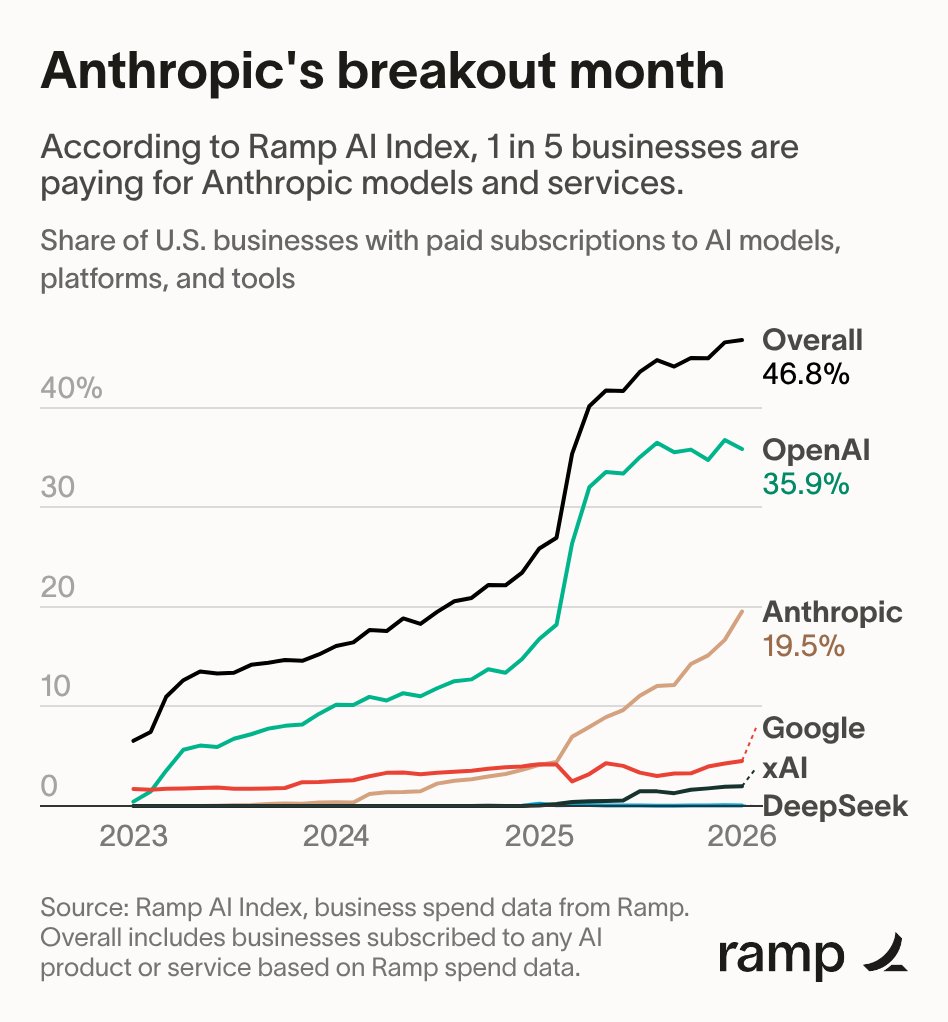
1 in 5 businesses on Ramp now pay for Anthropic. A year ago, it was 1 in 25.
Latest Ramp AI Index shows Anthropic surged from 16.7% to 19.5% of businesses while OpenAI slipped to 35.9%. The natural question: is Anthropic winning at OpenAI's expense?
I think popular analyses lack a key data point: the overlap in Anthropic's customer base with OpenAI: 79% of Anthropic's customers are already OpenAI customers. And churn rates are nearly identical at 4%.
So most of Anthropic's growth is coming from existing OpenAI customers.
Exclusive data: startups are learning what AI profits look like 👀
A new survey of 300 AI startups found that they project gross margins to exceed 50% this year -- and use Google Gemini models more than Anthropic 👀
My breakdown in @UpstartsMediaCo 👇
https://t.co/2Q4fq3Xhvh
Real-time budgets, now live on @tryramp
When big purchase requests come through, leads ask “what's the budget and is any left?”
The answer should be instant; now it is across all your spend
It’s delightfully intuitive to use and saves two of your favorite things: time & money
People often ask how we balance speed and quality at @tryramp.
We don’t. Because speed is how you get to quality.
Even the best hitters in baseball miss 70% of the time. A .300 batting average means the world’s best still fail twice as often as they succeed.
Building products is no different.
Even if you deeply understand your customer, you’ll still be wrong most of the time — it just takes iteration to discover what actually works.
Take two teams:
Team A ships every 2 weeks.
Weeks 2, 4, 6, 8 — all wrong. Week 10 — nailed it.
Team B waits for “perfect.”
Week 8 — wrong. Week 16 — wrong. Week 24 — finally right.
Team A made more mistakes, but found truth faster.
Team B “protected” quality and ended up slower, later, and with less conviction.
In the real world, there’s no limit to your at-bats per inning.
You can swing 100 times if you design your org and culture for it.
Speed isn’t a trade-off with quality. Speed is the way to get to quality.
Had a trippy experience.
A VC walked me through his thesis for a fast-growing startup. I fed the detail into our experimental AI-analyst-in-a-spreadsheet… it nailed the valuation he bid, then built a full model I could tweak.
Today we’re opening it up: Introducing Ramp Sheets