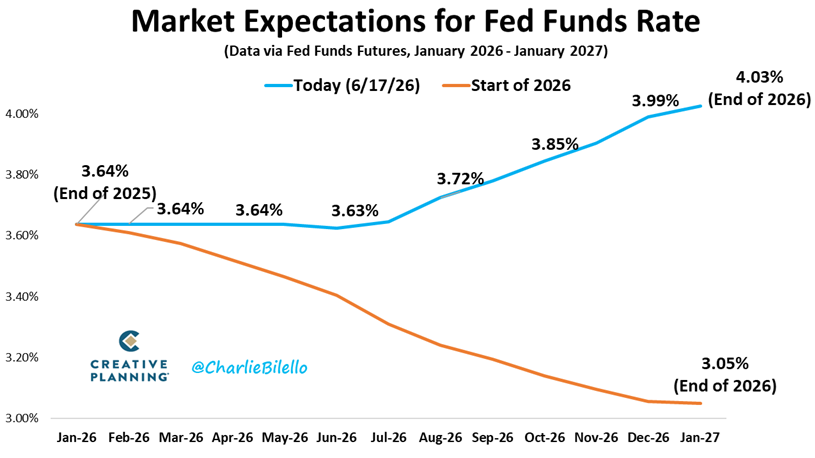
At the start of the year, the bond market was pricing in 2 Fed rate CUTS.
After today's FOMC meeting, it is now pricing in 2 Fed rate HIKES.
That's a 1% swing in expectations.
The 2-Year Treasury yield entered the year at 3.48%. It ended the day at 4.21%.
Coinbase Crypto-Backed Loans are one of the first DeFi consumer integrations reaching real scale, letting users borrow USDC using cbBTC as collateral but the current loan conditions are becoming hard to justify compared to going onchain directly.
The cost for the borrower has two parts:
- the onchain borrow rate on the Morpho cbBTC/USDC market according to market conditions, and
- the Coinbase origination fee (2% on the first $ 250k, then 1%).
The current Morpho rate is 5.78% avg over the last 6h, making the total loan cost of 7.78% annualised.
On a $250k loan held for 12 months that's ~$19.4k total in borrow interest. The same loan on Aave V3 costs ~$8.7k at 3.49% (USDT) or $9.8k at 3.95% (USDC). On Aave V4, USDG is available at 1.71%, making a equivalent loan cost of $4k total. That's 2x to 4x cheaper between Coinbase product and using Aave directly.
Coinbase uses a single isolated Morpho market (cbBTC/USDC). In an isolated model, supply and demand for that specific collateral-borrow pair have to balance within the market itself. If there isn't enough USDC supply relative to borrow demand, rates climb, with no broader liquidity pool to absorb the imbalance. A pooled or hybrid model allows USDC supplied across other collateral types to serve borrowers, which keeps rates structurally lower.
Also, the one-time fee is a strange structural choice. A user borrowing for a few months to cover expenses while holding BTC ends up paying a disproportionately large cost for their duration. At 3 months, the origination fee alone adds 8 percentage points to the annualised rate.
Even if current users borrowing against Bitcoin on a Coinbase app are still not comparing rates on Aave, that window narrows over time as users become more comfortable with onchain tools, and as interfaces like wallets and aggregators surface rate comparisons, making the cost gap harder to defend.
You can now run Kimi K2.7 Code locally! 🌘
We shrank the 1T model to 325GB (-48%) via Dynamic 2-bit where important layers are upcasted.
Run at >40 tok/s on 330GB RAM/VRAM setups.
Run full precision on 610 GB.
Guide: https://t.co/SXZJ3IHMpY
GGUF: https://t.co/2lpUx7u0r8
#Earthquake (#sismo) possibly felt 26 sec ago in #Nevada. Felt it? Tell us via:
📱https://t.co/QMSpuj6Z2H
🌐https://t.co/AXvOM7I4Th
🖥https://t.co/wPtMW5ND1t
⚠ Automatic crowdsourced detection, not seismically verified yet. More info soon!
Welp, that happened faster than I predicted. Thought it would be end of 2027, then early 2027, but agentic traffic growing so fast that bots have now passed human traffic online for the first time in the Internet's history. https://t.co/2zX5bHdhsa
JUST IN: Scientists say AI has decoded communication patterns in mice, dolphins, apes, birds, whales, & cuttlefish — could eventually lead to humans communicating directly with animals.
2 billion years ago, a nuclear reactor geologically self-assembled and turned itself on.
No humans were involved. Only rock, groundwater, & natural uranium.
It ran intermittently for hundreds of thousands of years.
Here's the story of Oklo (not the company, but the place!):🧵
@KobeissiLetter Visa is processing 90% of onchain crypto transactions. The company everyone said crypto would replace is now the infrastructure running it
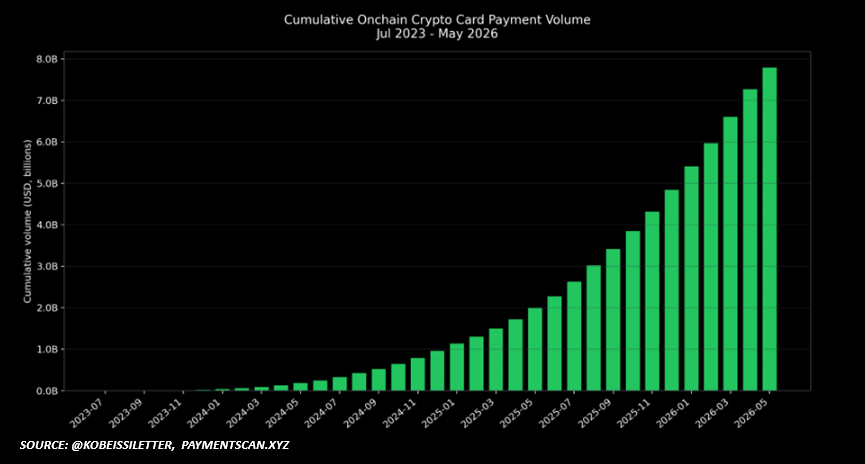
BREAKING: Cumulative crypto card payment volumes have reached a record $7.8 billion, with monthly volumes now up +230% since May 2025.
Crypto card adoption has rapidly accelerated in 2026 due to growing access to stablecoins as a payment rail through crypto cards.
In other words, more people can now spend stablecoins like fiat by using crypto cards, further driving adoption.
The growth comes amid the launch of Jupiter Global, which has seen a +648% surge in spending volume over the last 2 months.
Visa is capturing ~90% of onchain card transactions via crypto-native infrastructure partnerships like Jupiter Global.
Crypto cards are the ultimate use case for stablecoins.