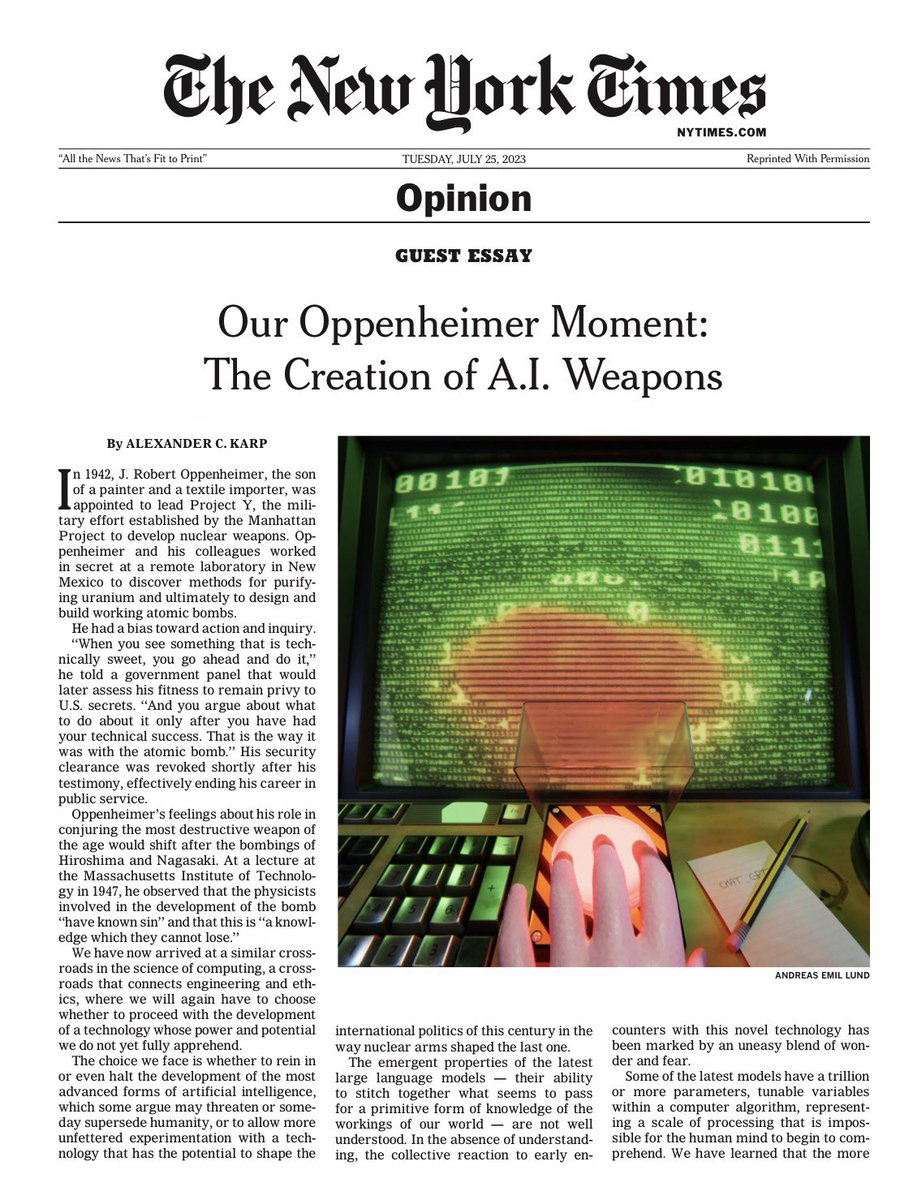
A new essay from Nicholas Zamiska, our board director and co-author of The Technological Republic, published in @newcriterion.
A brief summary with excerpts below.
1. It feels as if war is on the rise. And yet it isn’t. Our country’s national power, for all of the challenges of wielding it justly, has been an enormously benevolent, and indeed pacifying, force in the world over the past century.
2. The allure of soft power alone is not enough. The unwavering assumption that the moral appeal of liberal-democratic regimes, including our own, would, without military investment, win over our geopolitical adversaries and prompt the end of war has been a mistake.
3. A far more radical reshaping of Europe’s military capabilities is required. The starting point for the articulation of a strategy would be to assume that an alliance of any two out of the three largest and wealthiest European democracies—that is, the United Kingdom, Germany, and France—should be capable of decisively repelling a land invasion by Russia of Eastern Europe without resorting to the use of nuclear weapons or relying on material support from the United States.
4. In the United States, an ambivalence remains among subsets of Silicon Valley engineers in investing and building the next generation of defense capabilities. And yet is there no place for some degree of deference to our democratic system, in which policymakers appointed by officials elected by the public, and within constraints imposed by the Constitution, determine what is and is not in the national interest? Why should our nation’s largest technology companies displace the wisdom and verdict of the American people?
5. We essentially shrug as a society when the technology giants build entire business models around what amounts to an Orwellian consumer surveillance state. And yet the construction of software that advances our national security, including artificial-intelligence systems—software that gives U.S. forces a decisive advantage over our adversaries—that we have built at Palantir becomes a political flashpoint.
6. Some of the largest technological empires in the history of human civilization are essentially advertising companies. The irony is that those who resist further investment in defense and are most skeptical of collaboration between the technology sector and the state have often simply incentivized the hordes of technical talent and capital rushing to the software industry to pursue far less fraught endeavors, optimizing advertising algorithms and developing ostensibly novel ways of sharing videos and photographs on our phones, fostering arms races of other sorts, for likes and clicks.
7. We should, as a culture, be wary of rewarding those who instinctively prize the path of least resistance. If you have no unpopular views, if you sense no areas of divergence between yourself and those around you, even those whom you hold dearest, you might not have many authentic views at all.
8. Several generations now of ambitious and talented minds across the country have recoiled from public life and turned away from government work. The risk is that the Kennedys of today, the flawed and complex yet rich personalities who may have something to offer our fragile experiment in self-government, simply find their way to Goldman Sachs, McKinsey, and Google.
9. The unforgiving scrutiny to which we subject those in public life may have simply yielded less than we hoped. We are left instead with what often seems to be an odd roster of seemingly empty vessels, opportunists looking for a cause and seeking higher office.
https://t.co/9103wc7UeB
AI deployment is not the hard part
The hard part is connecting powerful computation to local institutional knowledge in realtime........without destroying the institution’s sovereignty
This is what Palantir is doing
https://t.co/b1UUnDtTwZ
great read: @lefttailguy and @ByrneHobart
If you truly believed in a 10% chance of human extinction in 3 years, you would not be spending your time selling and integrating it into a B2B CRM SaaS platform
Watch what they do, not what they say
Bending Artificial Intelligence to Our Collective Will.
Not fear of AI.
Not submission to AI.
Human agency. Institutional control. Technological sovereignty.
Palantir has been consistent from day one.
There is an unseen hand pushing AI safety as a political ideology.
Effective Altruists believe a tiny group of technocrats should decide how much technological progress the rest of us are allowed to have…. and how many shrimp your life is worth.
You are witnessing their attempted coup.
https://t.co/8Bi4Dvjklh
Anyone remember this from 2023?
“The suggestion to halt the development of these technologies is misguided.”
“We should be skeptical when the elites of Silicon Valley… now tell us that we must pause vital research.”
“Our adversaries will not pause to indulge in theatrical debates about the merits of developing technologies with critical military and national security applications. They will proceed.”
“This is an arms race of a different kind, and it has begun.”
“Our hesitation, perceived or otherwise, to move forward with military applications of artificial intelligence will be punished.”
“It requires hard power, and hard power in this century will be built on software.”
“The preconditions for a durable peace often come only from a credible threat of war.”
“Our attention should instead be more urgently directed at building the technical architecture and regulatory framework that would construct moats and guardrails around A.I. programs’ ability to autonomously integrate with other systems.”
AI will cure cancer and it will kill us all are not contradictory positions, they are both rhetorical methods to make the exact same argument: the future is defined by AI. You are a satellite revolving around the AI sun, at best.
These undefined prognostications of future omnipotence distract from accountability in the present. This rhetoric has two effects 1) it distracts from today’s upside down value capture versus value creation equation 2) it forces a psychological centering of AI and AI companies at the expense of humans and the rest of the world’s institutions.
Any technology’s utility is a function of our ability to control it, not its raw hypothetical power without controls. Chemotherapy requires precision to kill cancer and not kill a host. Nuclear reactors are defined by their controls more than the reaction itself. That a given technology’s utility is bound by the precision of its controls was Palantir’s fundamental insight at its inception: the amount of security the US government can guarantee its citizenry is defined by how much it can guarantee rights to privacy more so than the raw capability to identify threats. If you do not enhance both privacy and security, your product is a toy. AI is not the first technology that couples control with utility.
In the present, the models are voraciously consuming knowhow like a parasite eating its host until both die. Every company I speak to is sprinting to control a spend:outcomes ratio that exploded on them before they could learn how to govern it. They are observing their intellectual assets eroding like a sand castle into the ocean. They are stuck between being upside down on value leakage, yet being told they have no agency over their future.
The inevitability of the arrival of a deity forces individuals to define themselves as a function of that deity. Nobody wants to be that luddite who tells you the Wright Brothers will never fly. Nobody wants to run Polaroid or Blockbuster. No young person wants to be a part of the permanent underclass. Forward leaning humans are psychologically berated into defining their skillsets and objectives as a function of AI. Their careers are lottery tickets. They define utility through how good they are at tickling a model. “Ride the exponential” is a mantra that allows you to be “good” in a moral sense, without earning it.
If you dare to expose yourself as a luddite that is not getting results today, well that is a “skill issue,” or you simply aren’t using enough tokens. This propaganda pursues an inevitable centering of AI, with humans as peripherals. The only thing you have real agency over in the future? Using more tokens of course.
I think if you are going to virtue signal about protecting our future, you should also own the implied vice that comes with your position. Prognostications of armageddon are inextricably linked with acceptance of the bad things that exist in the world today.
350,000 people die of sepsis in hospital settings in the US alone every year. Life expectancy in the US has flatlined over the last 20 years while healthcare spending per person has doubled. 30-40% of the food supply is wasted while 18% of households with children experience food insecurity. 19.5% of drinking water is lost in transit to consumers. A significant portion of the world’s energy supply is threatened by a fanatical regime because the strait of Hormuz is still contested. Putin’s death machine continues to slaughter Ukranians every single day as technological efficacy literally defines meter over meter of protected or conquered land. The CCP has 230 times the shipbuilding capacity of the United States and the implied ability to control the world’s commerce and security. $1.7 trillion of excess, unproductive working capital is locked up in the top 1000 companies in the US, capital that is not producing goods and services for every day Americans. Americans paid over $250 billion in credit card interest at over 20% APR last year and more than half of savers earn less than 3% interest on their savings. Real wages have stagnated, middle-wage workers real income is up only 6% since 1979 while low-wage workers are down 5%. We have a shortage of ~7 million homes in the US. 8.5 million acres burned in wildfires so far this year. As of year end 2025 2,060 gigawatts of generation and storage capacity were waiting for grid interconnects (double the capacity of the existing power fleet). I digress.
We are making real progress against each of these miseries, and many more, because of the incredible progress in AI systems over the last several years.
Perhaps ironically, success in all of these domains is a function of how precisely controlled the models are. For the cognitive labor humans know how to wield to achieve real world outcomes today, open source or off-frontier small models are already at parity for at least a plurality of use cases on a price/performance basis. Those customers reliably outperform the frontier when they incorporate their own proprietary data and decision traces. The most consistent pattern I see over and over again is real world use cases shrink their reliance on general purpose AI’s over time. They encode deterministic knowledge and/or post-trained models on smaller model footprints. It is empirically a wildly optimistic future with AI as an accelerant for the pluralistic, wonderfully diverse means of advancing the human condition against problems you can measure and make progress against today.
We should also own that these horrible challenges persist because these systems are not yet good enough to fully solve them. They are worth improving.
The bay area is abdicating responsibility for the world as it is today while claiming ownership of the world as it might be tomorrow. DC and our political leaders are polarizing into zero sum positions. These are the luxury beliefs of children. Build something people need today, at a price they are willing to pay when not pressured by the social herd, if you want the opportunity to do it again in the future.
EA AI safetyism increasingly looks like Marxism-Leninism for the algorithmic age.
The old vanguard claimed privileged knowledge of the inevitable course of History. The new one claims privileged knowledge of the probabilistic course of Humanity.
Both use an elaborate intellectual framework to reach the same political conclusion: a small group of enlightened people must constrain everyone else for their own good.
That has never lead to anything except monumental human suffering.
Per NBA: The Clippers shall forfeit five first-round draft picks, one in each of the 2029, 2030, 2031, 2032, and 2033 NBA Drafts.
Clippers owner Steve Ballmer is suspended from all league and team activities for one year for knowingly seeking to help Mr. Leonard obtain off-court income opportunities, for approving a business deal that he knew was a precondition for Aspiration to enter into an endorsement agreement with Mr. Leonard, and for his failure to create conditions under which his organization abided by the NBA’s circumvention rules.
Clippers President of Business Operations Gillian Zucker is suspended without pay for one year for being primarily and directly culpable for the impermissible endorsement arrangements and for providing false and misleading statements to investigators.
Clippers President of Basketball Operations Lawrence Frank is suspended without pay for six months for his involvement with the impermissible endorsement arrangements and for approving impermissible expenses incurred by Mr. Leonard and his family.
The Clippers organization and personnel are subject to a compliance and monitoring program overseen by the league office for a period of five years.