YouTube is rolling out a crazy new update this year.
YouTube is rolling out Shows, and it changes how your content sits on your channel.
Here is what it does and why the channels that ignore it lose a year of watch timeL
A playlist groups a batch of videos together with no structure. A viewer who wanted to follow your series in order had to search through the list themselves. YouTube admits this was cumbersome.
Shows fix it. You convert a playlist into a show, your videos become numbered episodes inside seasons, and YouTube builds a full show page with the artwork you upload. Then it recommends that show across the app.
This was built for the TV, not your phone.
TV is the fastest growing place people watch YouTube, and the old channel layout never matched how people watch on a TV.
For many people, especially young viewers, YouTube already is TV. The connected TV experience never reflected that. Revenue from TV viewing jumped 30 percent in one year. Shows copy the layout people already know from Netflix and Prime. Finish one episode and the next plays automatically.
The Continue watching row holds their place. That is how one viewer becomes a full season of watch time instead of a single view.
YouTube copied this from the streaming services on its own platform.
The show pages you are about to get are the same ones YouTube built for Paramount+ and Showtime.
YouTube built these show pages for PrimeTime Channels, its paid streaming bundle inside the app.
Their product lead said they realized they should bring the same product to channels, because so many channels already make high quality shows. So you get the same page a paid streaming service gets, for free, on your own channel.
YouTube is not making the shows. You are.
YouTube shut down its own studio and handed the entire opportunity to channels.
YouTube Originals launched in 2015, greenlit Cobra Kai in 2018, lost the show to Netflix in 2020, and shut down in 2022. YouTube now says it has no plans to restart it.
Their words: their expertise is helping others create and distribute, not making the media themselves. That is the whole point. YouTube will not compete with you for the slot. It will promote you into it. The placement is open to channels now.
Set this up now or hand the placement to someone else
The channels that build shows this year get the recommended placement. The rest stay a list of separate videos nobody finishes.
Pick serial when people watch your story in order. Pick non-serial when people drop into a topic anywhere.
Upload real artwork, the texted poster, the backdrop, and the title treatment, because YouTube puts that art on browse pages across the app. Number your seasons.
Design thumbnails that read on a 55 inch screen, not just a phone. Do this before your competitors do, because the early shows get the recommendations.
Today I turn 30.
I’ve dedicated over 50% of my life to mastering YouTube strategy.
50+ billion views, millions in revenue, across 100s of channels later…
Here are 30 lessons for creators:
Outliers are videos that get WAY more views than your channel average
But most people have no idea how to use them..
So here's what you should actually do with them (bookmark this) 🧵👇🏼
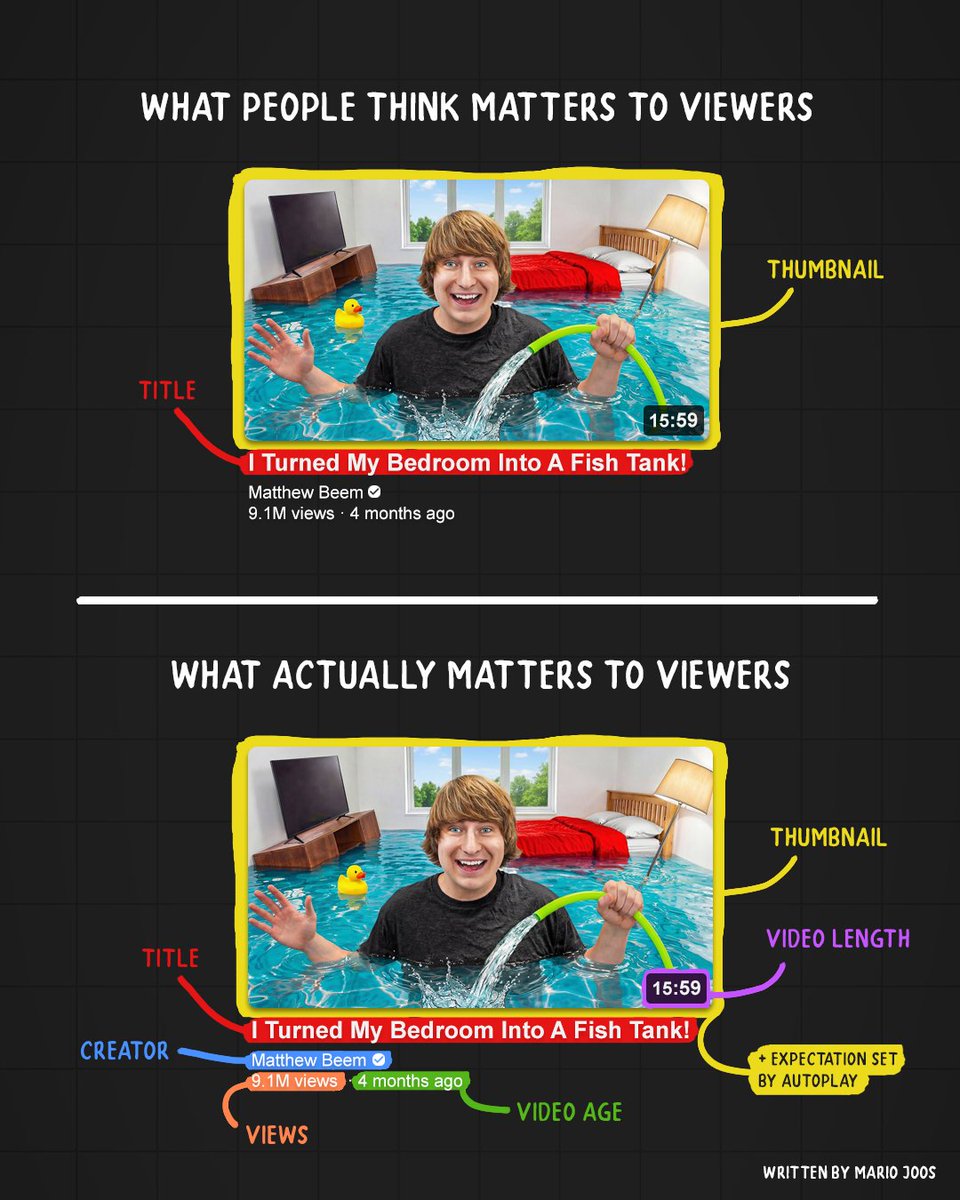
There’s a lot more to “what makes a viewer click on a video” than just the title and thumbnail.
What most people care about isn’t only what the video is about, but also:
1. Who uploaded the video
Most viewers aren’t just looking for a new creator to watch. They would rather spend time watching someone they’re already familiar with or someone they may have heard of before.
2. How many views the video has (social proof)
We’ve all seen these big ideas, but the video only has 1,000 views. That alone is often enough to make people not “trust” the creator’s ability to deliver on the promise. That’s why it’s always important to think: would this idea work regardless of the amount of views?
3. How old the video is
Humans have a tendency to not only like fresher uploads, but also to think that fresher uploads are better. It’s a concept called novelty bias. However, this doesn’t mean that we don’t watch older content, we just tend to get more excited about newer uploads. This is where the “bring back old concepts” strategy comes from.
4. How long the video is
It’s no secret that we don’t only watch YouTube when we’re in bed or waiting for something to happen. We often judge a video by its ability to fit into our routine. Some concepts are worth waiting for, and even listening to for hours. Other concepts aren’t something you’d want to reserve a full 30 minutes for.
5. The initial seconds
But how do the initial seconds matter for the click? Autoplay.
Many viewers hover over content to figure out if the video is actually something they’ll enjoy, so if your initial seconds don’t look good, you may never get the click, no matter how good your thumbnail looks.
One could argue that the autoplay seconds may actually be more important because they’re harder to manipulate without consequence. It’s like judging a movie by its trailer (autoplay) versus its poster (thumbnail).
Now, there are more factors, such as how recently viewers have interacted with your content, but these are already some important factors that affect the click, factors that are often forgotten.
Credit to Matthew Beem (creator in the image), a true underdog who’s been doing fantastic recently.
everything i know about Google Ads.
19 guides. one notion doc. completely free.
from $0 to $7M. PMax. Shopping. YouTube. Competitor Traffic. GMC Unbans...
took me 7 years to learn this.
takes you 5 minutes to get it.
like, RT + comment "GOOGLE" and i'll send it over.
(must be following)
MrBeast uploaded "Last To Leave $800,000 Island" in 2020.
He just uploaded "Last To Leave Grocery Store, Wins $250,000"
Same format. Five years apart.
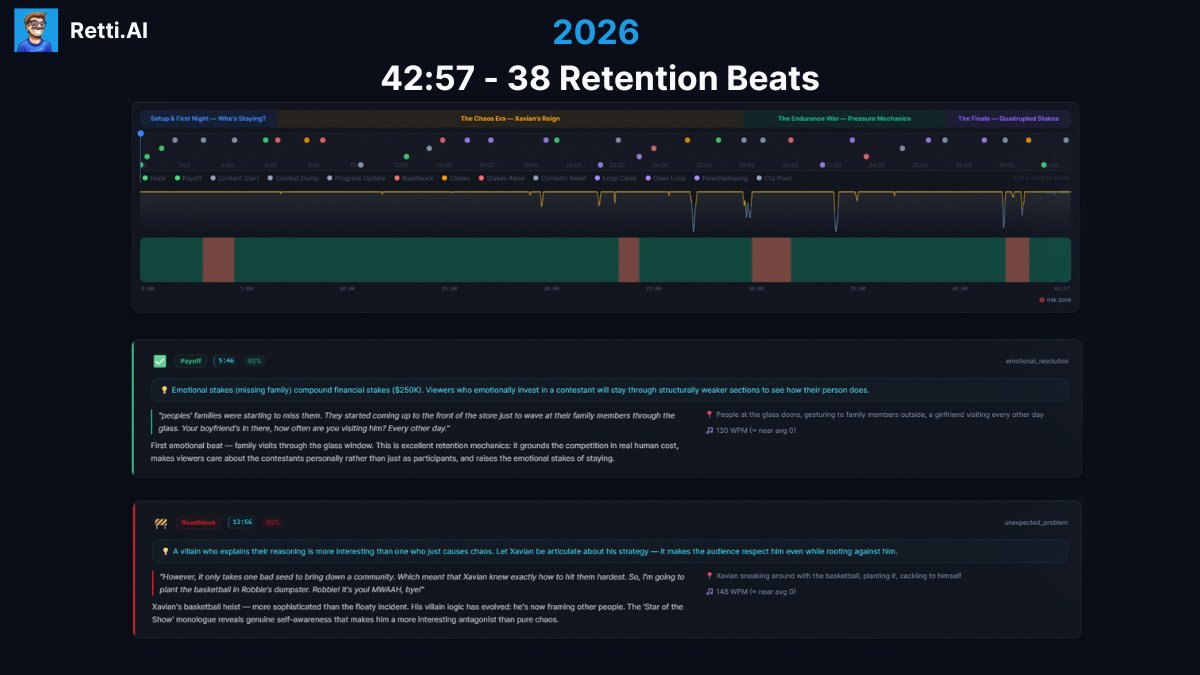
I ran both through @Retti_AI
Here's what changed, what didn't, and what it tells you about where YouTube is heading.
2020: 21 minutes. 10 back-to-back challenges. Mechanical variety carries the runtime.
2026: 43 minutes. One location. One villain. Character arcs carry the runtime.
Completely different retention engine.
WHAT STAYED IDENTICAL
Hook score: 9/10 both times
First 30 seconds drop-off: 18% both time
Retention at the halfway point: 62% both times
Concept delivery: 9/10 both times.
Opening philosophy: cold open, premise in the first sentence, zero greeting.
"I bought this entire island." 2020.
"I just bought this grocery store." 2026.
Four words. Two seconds. No "hey guys." No channel intro. The hook is a solved problem. Five years of development have not touched it. Everything else has changed.
THE STORY ENGINE SHIFTED COMPLETELY
2020 retention engine: mechanical novelty.
Coconut hole, voting, hide and seek, swimming, ring toss, treasure hunt, bowling, jury vote. No two challenges share a physical mechanic.
2026 retention engine: one character.
Xavian pops floaties at 6:19 and carries 26 minutes of runtime across six escalating beats. Floatie riot, noise warfare, basketball frame, cookware crash, sleeping bag heist, exit monologue. Classic villain structure inside an endurance format.
The biggest single evolution: contestants now have real-world stakes embedded before the prize is mentioned.
A woman who will lose her job if she stays. A man with no job at all. A son separated from his family by glass. In 2020, contestants were anonymous for the first five minutes. In 2026, you know what winning means to a specific human being within 60 seconds.
That is why the 2026 video finishes at 42% retention vs 37% in 2020. Twice the runtime, five points higher at the end.
Character investment is what holds the back half.
THE NUMBERS THAT SHOW THE EVOLUTION
Open loops planted: 5 in 2020, 7 in 2026.
Progress updates: 9 in 2020, 11 in 2026.
Story segments: 32 in 2020, 38 in 2026.
Payoff cycles: 3 in 2020, 5 in 2026.
Average WPM: 138 in 2020, 152 in 2026.
To run twice as long, the 2026 video does not slow down. It adds more structural beats and talks faster. Every metric that relates to density went up. That is how 43 minutes feels shorter than some 20-minute videos.
THE PRIZE ITSELF BECAME A CHARACTER
2020: $800,000. Static. Stated once and left alone for six-minute windows.
2026: $250,000 becomes leader bribes becomes red button consequences becomes $1,000,000 finale. The prize escalates four times. Each escalation resets the viewer's reason to keep watching.
And the outro: 2020 ends with a subscribe ask after jury drama. 2026 ends with a 13-second "see ya in a year" cliffhanger for Part 2. No like request. No subscribe button. The content is the pitch.
WHY YOUTUBE REWARDED THE LONGER FORMAT
Five years ago, a 43-minute challenge video was a risk. The conventional wisdom was that shorter performed better.
The data now says the opposite. Longer videos with higher absolute watch time get prioritised because YouTube makes more money from them. A viewer who watches 43 minutes delivers more ad revenue than a viewer who watches 21 minutes at 100% retention.
The 2026 video also benefits from multi-session viewing. People watch 20 minutes, come back the next day, finish it. Each returning session pushes the Average View Duration up for weeks after upload. That climbing number tells the algorithm the content has lasting demand, and it responds with more distribution.
MrBeast did not move to longer content by accident. He moved because the platform started rewarding it.
THE MASTER LESSON FROM FIVE YEARS OF EVOLUTION
The hook is solved. The middle is not.
Every improvement MrBeast has made since 2020 falls into two categories.
- Engine maintenance: there is always something pulling the viewer forward.
Xavian, then the leader mechanic, then the red button, then the million dollar reveal. The engine never stops.
- Stakes anchoring: the prize stays alive in the viewer's working memory across every five-minute window, not just at the start.
Apply those three to any long-form challenge video and you have most of what separates 2026 MrBeast from 2020 MrBeast.
The format is the same. Everything inside it got rebuilt.
CTR is the most overrated metric on YouTube.
I'll die on this hill.
It only tells you something useful in the first 24-48 hours IF you have a returning viewer base.
After that, it's noise.
Once a video starts performing, the algorithm surfaces it to people outside your core audience.
A 2% CTR on a video doing 10M views isn't a failure, it's proof you broke into a new audience.
I have so many videos doing millions of views with CTRs that would make most strategists call them flops if they saw the CTR in isolation.
The only two YouTube metrics that mean anything in isolation are views and impressions. Everything else needs context. Especially CTR.
Over $50,000 in pure profit this month, a record Adsense month for him after ELEVEN years of grinding on his own!
What have we changed for Tom?
1. Get clear on WHAT works
We started following signals that the broader niche showed. We pivoted most of the content from high-lift productions to a lot more talking heads.
2. Stopped forcing triangles in square holes
If a video concept doesn't work the first three times, the fourth time will be no different.
I ensure we focus our time on video concepts that have proven on other channels in adjacent niches to work and work well.
3. Use the unfair advantages of the creator a LOT more.
He's amazing on camera. I wanted to use that more. His scripts are more like him, resulting in videos that are a LOT easier to watch.
YouTube can be a lonely and brutal game. But once you understand where the biggest unlocks are, it becomes the most fun you'll ever have!
⚠️The dangers of only using outlier theory to create viral videos
One of the easiest ways to get more views on your videos is to focus on a concept called outlier theory. Outlier theory is the idea that focusing on videos that have outperformed the average increases your chances to succeed as well. However, there are some nuances.
Just because something is an outlier for a channel does not mean that it's going to do well for you. And that's why good outlier theory also looks at niche, video length. And we're even looking for whether or not the idea that is an outlier became an outlier every single time this creator touched on this topic or format.
In the image, I've added an example of how to identify outlier theory, where the average video scores about 500,000 views, underperforming videos score about 300,000 views, the slightly above average scores around 700,000 views, but the outliers are the ones that score about 5 million views, which sits at about 10 times the average. But what's also noticeable in this picture is that there's only one singular outlier, which should be a warning sign for us that this could just be a one-off experience that even this creator couldn't replicate.
This creator only managed to play on this outlier once. And that's a danger because we're not even certain if this outlier is gonna become an outlier for us.
So what we're actually looking for here is a creator who found an outlier and then doubled down on that one, and those videos also became outliers. And only then can we be truly confident that we should potentially also touch on this topic or format.
But there's an even more important nuance that I didn't even mention in the image. Most top channels don't only grow from outlier theory because outlier theory always counts on another person doing something first. That's why it's just as important to sometimes just innovate and try to create an outlier from scratch.