Bagel Robotics-1 is now ranked third globally on the RoboDojo Benchmark 🥉. It's the only edge-deployable model at the top of the leaderboard from the US and Canada combined.
Robotic foundation models directly touch manufacturing, agriculture, and other critical industries, where sovereignty matters most.
We’re proud to share that Bagel-Robotics-1, our new open-weight robotics model, just ranked No. 3 worldwide among standalone robotics models on the RoboDojo benchmark.
The RoboDojo team evaluated our model independently according to their standards. Their global benchmark tests how useful AI models are and is used by industry leaders like Anthropic.
Bagel-Robotics-1 also tied for No. 1 by success rate on RoboDojo’s standard generalization tests, which measure how well a model handles scenarios it wasn’t trained on.
Thanks to the RoboDojo team for building the benchmark. We will follow up with a technical report and a real robot demonstration soon.
https://t.co/WVYLwav9sb
We’re proud to share that Bagel-Robotics-1, our new open-weight robotics model, just ranked No. 3 worldwide among standalone robotics models on the RoboDojo benchmark.
The RoboDojo team evaluated our model independently according to their standards. Their global benchmark tests how useful AI models are and is used by industry leaders like Anthropic.
Bagel-Robotics-1 also tied for No. 1 by success rate on RoboDojo’s standard generalization tests, which measure how well a model handles scenarios it wasn’t trained on.
Thanks to the RoboDojo team for building the benchmark. We will follow up with a technical report and a real robot demonstration soon.
https://t.co/WVYLwav9sb
We're closing out the year with another Toronto Robotics Night. We'll talk about what's ahead for physical AI and robotics in 2027.
Join us on December 2.
RSVP : https://t.co/VaNoh4oAOH
This fully autonomous demo shows a Bagel Labs foundation model controlling a robot to make coffee.
We previously released WorldDiT, our lightweight architecture for robot foundation models. At the time of release, it was on the Pareto frontier for model size and performance. We have since been refining this architecture to handle longer
horizon, more useful tasks fully autonomously.
Making coffee means getting a whole sequence of actions right. Each step depends on the result of the last, so small mistakes can build up as the task continues. Getting this to work with a small model is especially challenging. This demo is an example of what the model can do today.
If you are deploying robots or have existing hardware you want to make autonomous, we would like to partner with you. https://t.co/VYPldhBA2e
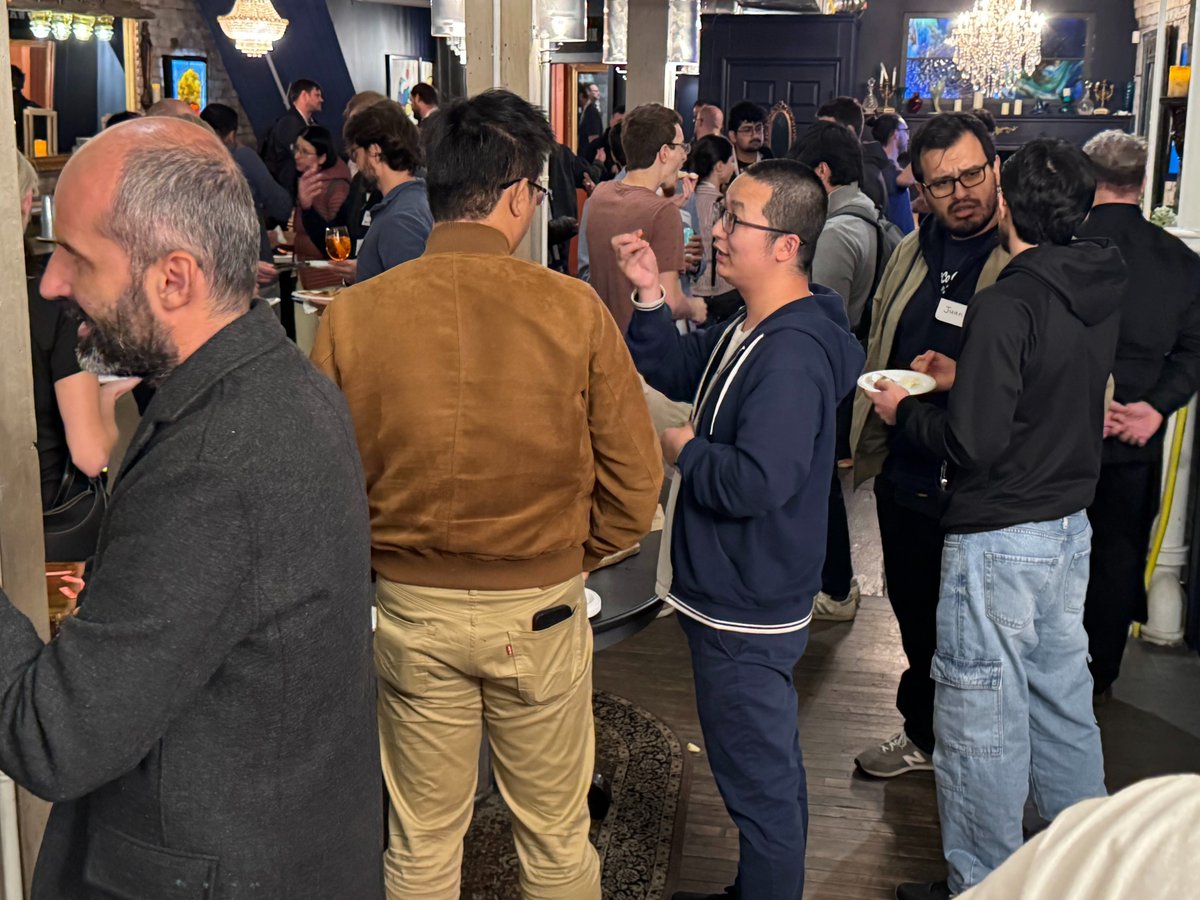
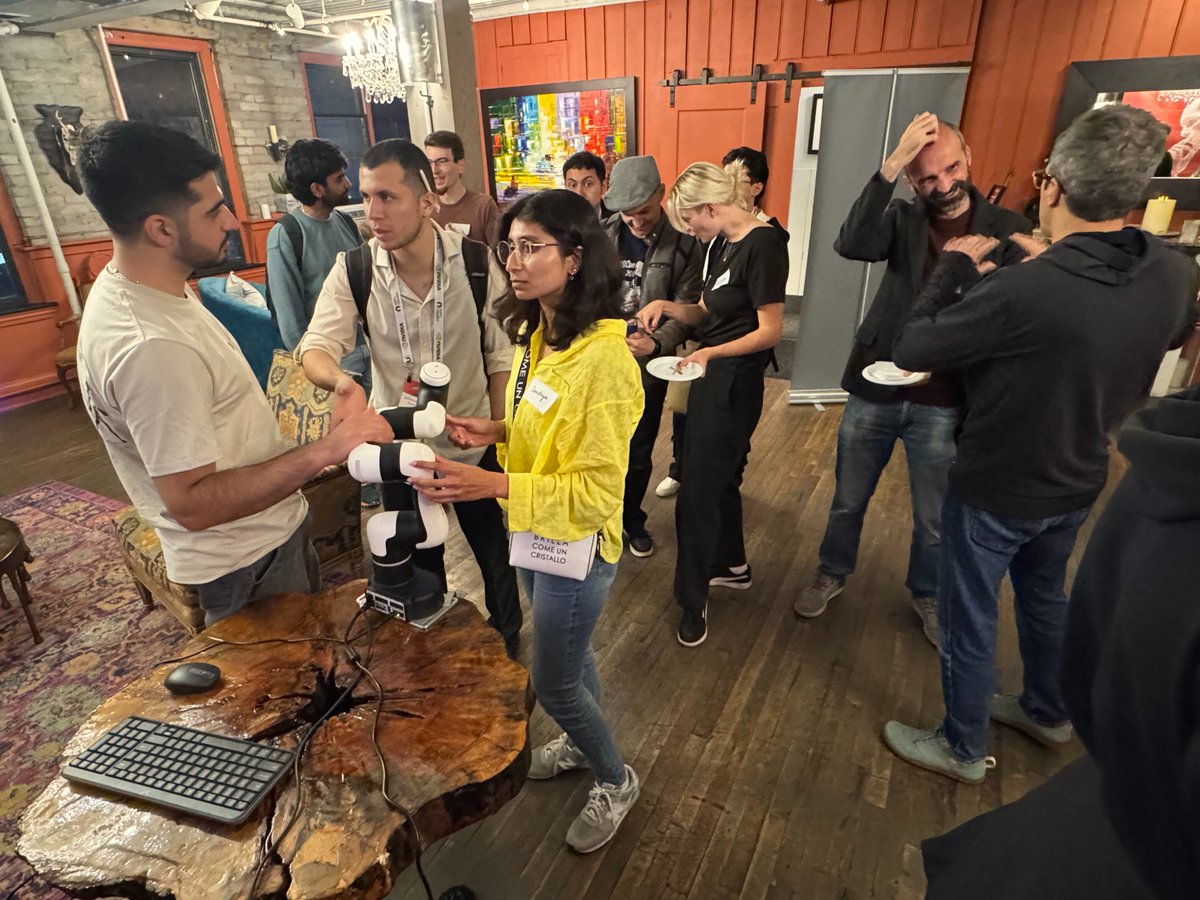
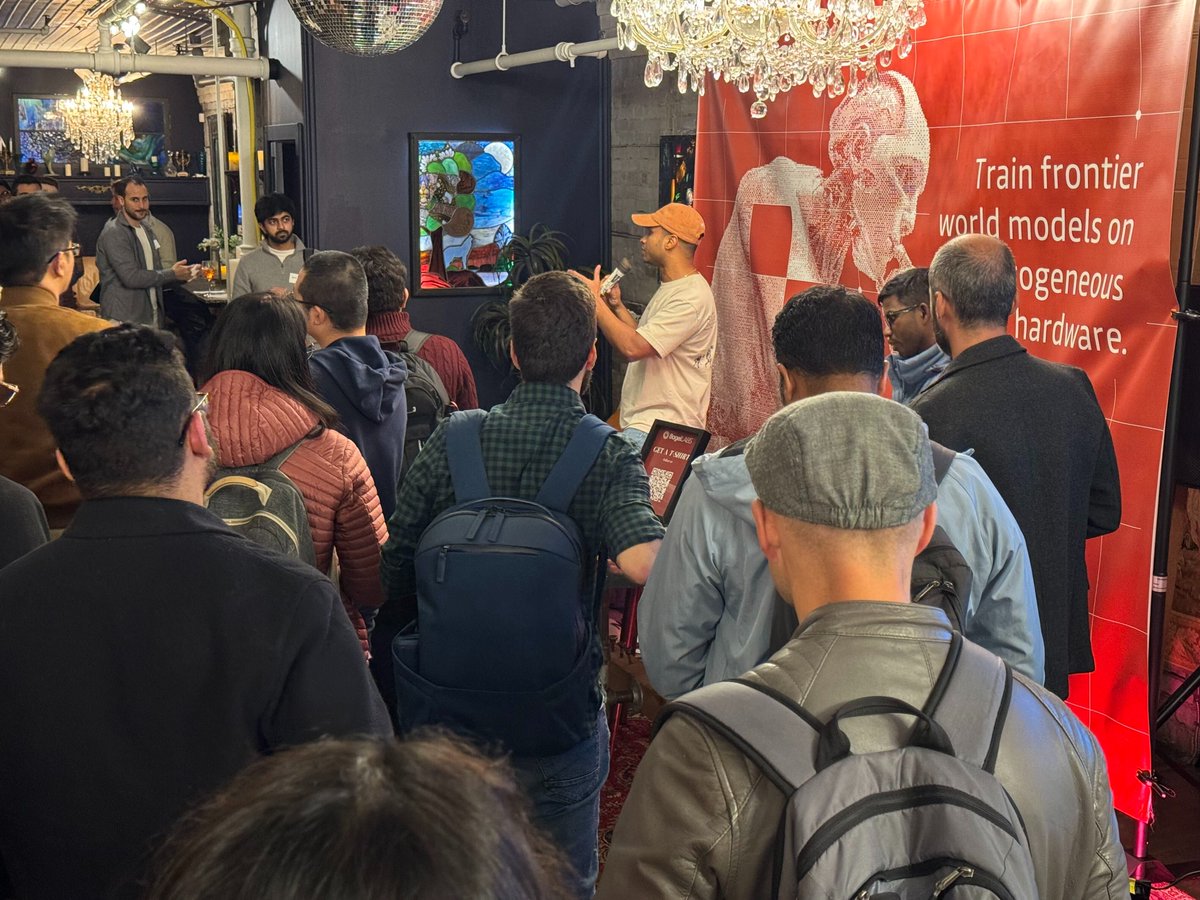
ROSCon is in Toronto this week. Tonight, we’re hosting Toronto Robotics Night for people here for the conference and the local robotics community.
Come by after the sessions for drinks and appetizers. We start at 6:30, a 5 minute walk from the ROSCon venue.
RSVP to join: https://t.co/sPolksZcmd
we're hosting a ROSCon special edition of Bagel's Toronto Robotics Night this week!
we're gathering people who are globally shaping physical AI in one room to wrap up the conference together
for researchers, founders, robotics engineers, and builders
RSVP here: https://t.co/IIa6ZAfZ6X
Some of the most interesting work in robotics now sits between world models and real machines.
We’re bringing the people working on both together this Thursday at the first ever Toronto Robotics Night.
Come by if you're in town : https://t.co/sGKtbjWn3m
Hardware is a big constraint in robotics, that's why we don't think the answer will be increasingly larger VLM models as action backbones.
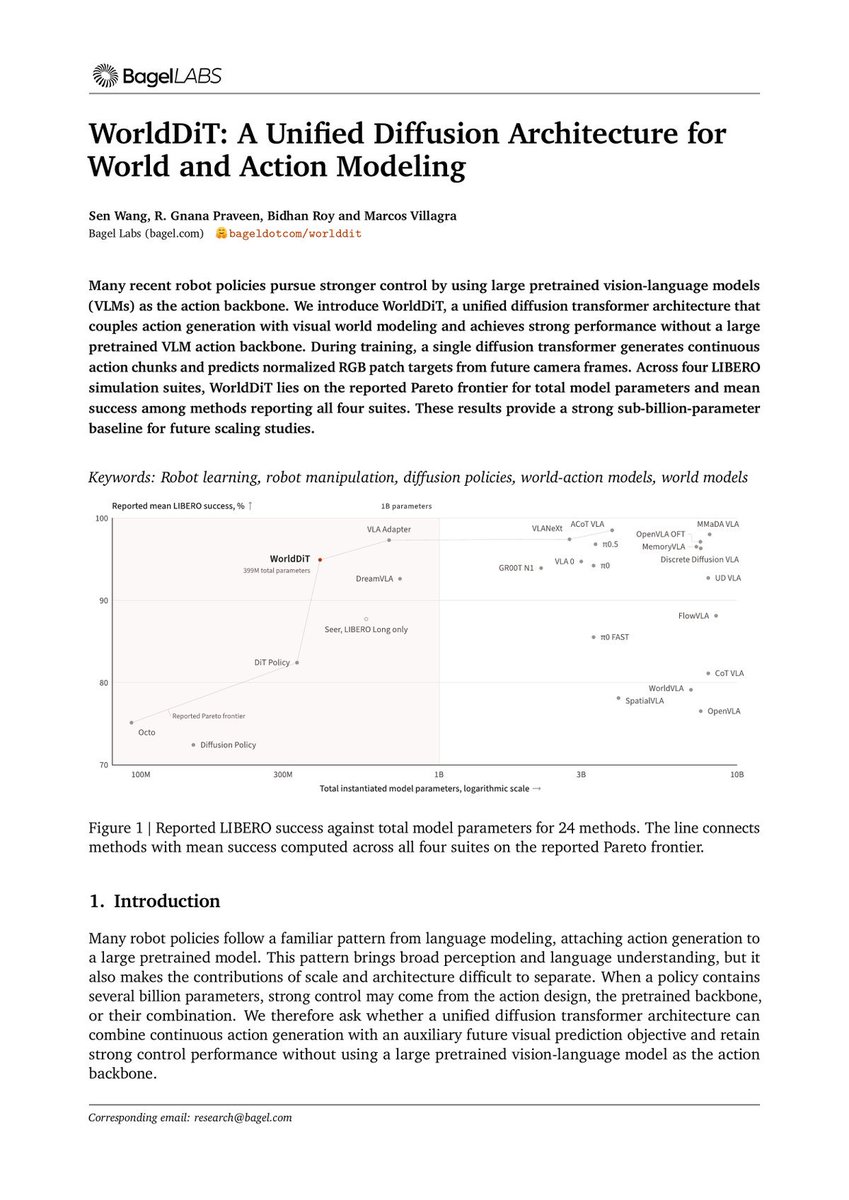
We tried to solve that issue with WorldDiT, which is at the pareto frontier for size-performance. Now I want to see how far we can scale it without losing this tradeoff.
Here's a simulation demo.
Many robot policies need a massive pretrained VLM to generate actions, bringing billions of parameters and their deployment cost into the control loop.
WorldDiT does not need one. It gives us an architecture we can scale through joint world and action modeling.
We are releasing WorldDiT, a unified architecture for robotics world modeling and control.
On the LIBERO benchmark, it performs the best among all publicly released methods that do not need a VLM to generate actions. Its size and performance sit on the reported Pareto frontier.