Procedural Augmented Generation (PAG): Like RAG systems, but for games—using your own gameplay data to procedurally generate new content and experiences.
New Paper: Human-like Autonomy Emerges from Self-Play and a Pinch of Human Data.
We trained self-play RL on 60 years of simulation on 1 GPU in ~15 hours. Regularizing with 30 minutes of demonstration data produces much more human-like driving policies!
Declaring war on big models and bloated RL. I'm training autonomous robots/vehicles by building tiny world models that are trained in 5-30 mins on a single GPU, with less than 50M params.
Most of us should focus on latent-space autoregressive dynamics models. Tiny. Very tiny models. Little world models trained from scratch on our own reality. On single GPUs. Orchestrate them with harnesses and big models.
UNESCO REPORT: El Salvador ranks #1 in Latin America for open source repository quality
Open-source excellence is a signal of real technical capital and El Salvador has been stealthily stockpiling it.
The UNESCO report finds this pool of talent an "unexpected strength."
🇸🇻🤖🧵 (1/4)
Palantir-level operational intelligence, but modern, agentic, and built for the rest of us. I see Veoveo as the beginning of a digital twin harness. Less OpenClaw. More of this.
🦤 LeWorldModel: Learning Physics from Pixels — Stable World Models with Just Two Losses
World models:
1️⃣ DINO-WM: pretrained ViT encoder (from ImageNet) → features → predictor. But encoder is frozen, so no end-to-end learning. Its “visual genetics” are tuned for coarse classification (cats vs dogs), not physics: hard to resolve mm-level changes (e.g., 2 mm block motion). A powerful predictor on top of a “myopic” encoder = blind physical reasoning.
2️⃣ PLDM: end-to-end, but unstable and collapse-prone. Rely on reward as prediction target, so it only works in environments with explicit rewards (e.g., games).
3️⃣ JEPA (Joint Embedding Predictive Architecture): predict next latent instead of pixels. Two hard problems:
collapse (encoder → constant vector, e.g., all zeros)
achieving pixel-level + end-to-end + stable jointly
💡 LeWM solves:
👉 JEPA that trains stably end-to-end from raw pixels
👉 Single hyperparameter λ:
next-embedding prediction
SIGReg (Gaussian regularization)
🧠 #1: true end-to-end
No frozen encoder. Perception + dynamics co-evolve → representation aligned with fine-grained physics, not ImageNet bias.
🧠 #2: “only” one hyperparameter
PLDM needs ~6. LeWM needs 1 (λ) → weight of SIGReg. Plug-and-play, stable.
⚠️ Collapse problem
Encoder could map all inputs → same vector → trivial prediction → zero loss → useless model.
🧩 SIGReg (Gaussian Integral Signature Regularization)
Core: prevent collapse via distribution constraints.
Sample 1024 random directions
Project embeddings → 1024 1D “shadows”
Each must pass Epps–Pulley test (≈ standard normal)
Loss pushes test statistic → 0
Any failed projection ⇒ penalty
Why it works:
Cramér–Wold theorem → a high-dim distribution is determined by its 1D projections.
👉 Enforcing Gaussianity across 1D projections precludes degenerate collapse under projection constraints
🧪 Physical probing
Train in PushT (push block to target), then:
Linear probe recovers: block position, angle, end-effector
👉 physics is linearly decodable
🚨 Teleport block (physically impossible):
embedding anomaly spikes sharply
👉 model internalizes constraint: objects cannot teleport
👉 not inferred from pixel surface features, but encoded as latent constraints
📈 Temporal straightness
No smoothness loss, yet trajectories in latent space are ~straight lines
👉 no prior, purely from “predict next embedding”
👉 implies physically consistent motion, not blurry interpolation
⚡ Performance
Planning: 0.98s vs 47s (DINO-WM)
Success: 96% vs 78% (PLDM)
Why faster?
DINO-WM: frozen encoder → info loss → extra online passes
LeWM: end-to-end → representation already task-aligned
👉 0.98s = fast to handle dynamic obstacles & real-time control
⚠️ Limitations
~15M params (“ant-scale”) → fails on OGBench-Cube (complex physics)
not yet tested on real robots
🔥LeWM shows:
👉 JEPA + SIGReg = stable world models
👉 raw pixels → physics-aware latent space
👉 minimal design (2 losses, 1 hyperparameter)
Next step: scale + real-world deployment 🤖
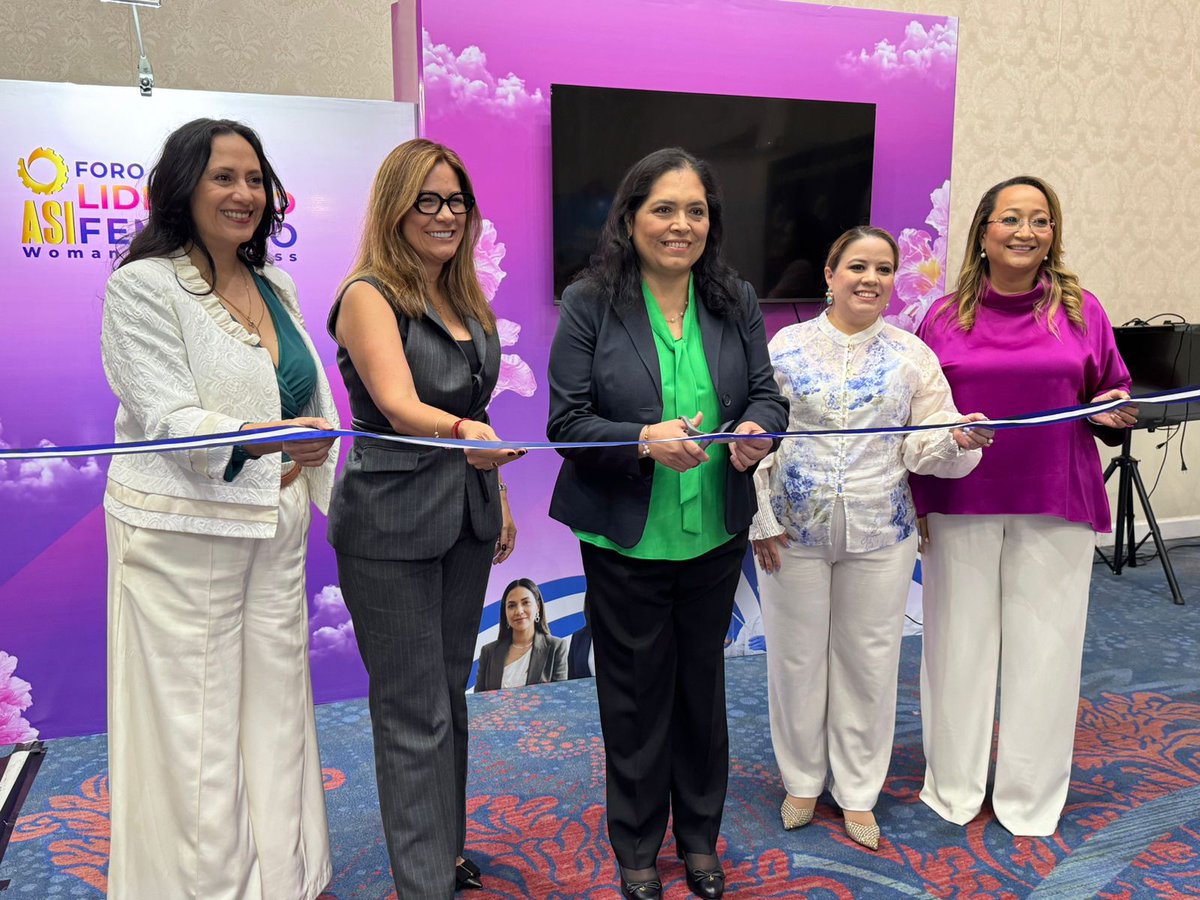
Damos inicio al foro Women in Business 2026 💼✨
Un espacio donde el liderazgo femenino cobra protagonismo, conectando ideas, experiencias y visión para transformar el mundo empresarial.
#WomenInBusiness2026#LiderazgoFemenino#MujeresQueInspiran
Companies and Governments that are serious about operationalizing autonomy are choosing Shield AI's Hivemind Enterprise (they ask why spend a $B to build the developer tools, infrastructure, and pipelines needed when Hivemind Enterprise has it for a tiny fraction of that of what it would take to build)
Hivemind Enterprise is how the US and allies will field million drone armies, navies, and air forces. I'm stoked to partner with the HII team!
Interested in fielding resilient, intelligent autonomous systems? Reach out and experience the Shield AI difference yourself!
Roblox is impressive. For those willing to dig technically deep, there is excellent payoff. We are loving the platform. We want to bring fun sims to the platform, straight from our work with defense, economy, robotics and ecosystems. 5/5
Social farm simulator. This one is special for us as we are integrating new sim research but making it fun. Pretty cool and intense cooperative game theory mechanics. 4/5