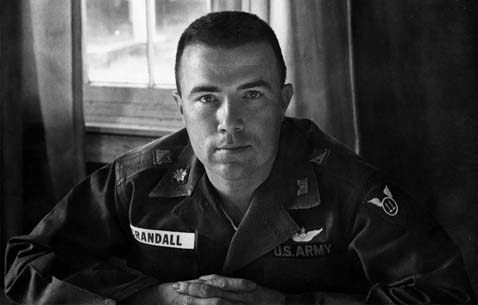
Two days ago we lost an American hero. His name was Bruce Crandall, and this is his story 🇺🇸
Before he was a legend, Bruce Crandall was a kid from Olympia, Washington, born in 1933, an All-American high school baseball player who joined the National Guard at 15. The Army drafted him in 1953, trained him as an engineer, then put him in a cockpit. His first real job as a pilot was mapping the parts of the world nobody had charted yet, flying for two years over the open desert of Libya, then over thousands of square miles of unmapped mountains and jungle in Central and South America. He married Arlene in 1956. They would raise three sons. He spent the early part of his career flying toward empty places. Then Vietnam asked him to fly toward the worst one.
Sixty years ago, in a clearing called LZ X-Ray, roughly 450 American soldiers were surrounded by an enemy force several times their size. The shooting was so heavy the medevac helicopters turned back. Landing meant dying.
Bruce Crandall made a different choice.
He was a 32-year-old major flying an unarmed Huey. No guns. No armor that mattered. Just a thin aluminum shell and a decision. He pointed the nose at the hottest piece of ground in the war and went in anyway, with his wingman Ed "Too Tall" Freeman right behind him.
Then he did it again. And again. Twenty-two times in a single day.
He flew in the ammunition and water that kept the men alive. He flew out more than 70 wounded soldiers, loading them while rounds punched through the airframe, the cargo bay slick with other men's blood. Each run he could have stopped. Nobody would have blamed him. He kept his word to the men on the ground instead: you will be resupplied, and if you fall, we are coming for you.
He never fired a shot all day. He saved dozens of lives with nothing but nerve and a helicopter.
The men called him "Snake." He went back for a second tour and was shot down in January 1968, this time by friendly bombs falling too close. By the end of the war he had flown more than 900 combat missions.
Then he did something quieter that almost nobody talks about. He went home and lived an ordinary life. He retired as a lieutenant colonel in 1977, earned a master's degree, ran a small California town as its city manager, and spent 17 years in the Public Works Department in Mesa, Arizona, fixing roads and keeping the water running. The man who once flew through a wall of fire spent his later years making sure the streetlights worked.
It took 40 years for the country to catch up to what he did at X-Ray. In 2007, President Bush hung the Medal of Honor around his neck. If you saw We Were Soldiers, that was him on screen, Greg Kinnear in the cockpit, though the real man was braver than any movie could hold.
Col. Bruce "Snake" Crandall died on May 31, 2026, at 93 years old. He outlived the war, the doubts, and most of the men who watched him come screaming back into that valley when no one else would.
Some heroes carry a rifle. This one carried the wounded home, then went back to work like it was nothing.
Rest easy, Snake. We have it from here.
In honor of Lt. Col. Bruce Crandall (1933-2026), the best of us and a true American hero. We won't forget you 🇺🇸
My daughter got detention for defending her late Marine father — but when FOUR MEN IN UNIFORM walked into the school the next day, the entire building went silent.
"Mrs. Harrison, you have to understand: Grace’s behavior was completely UNACCEPTABLE. We respect your husband’s service to this country, but..." her teacher said.
My 14-year-old daughter sat beside me, her eyes glassy.
The day before, one of her classmates had made a joke about Grace not having a father.
He was a Marine. Grace was only three when we lost him.
So when that girl laughed and said, "Maybe your dad just didn’t want to come back," something inside Grace snapped.
She shot to her feet so fast that her chair slammed to the floor.
Through tears, she shouted,
"My dad was a HERO. Don’t you ever talk about him like that again!"
She was the one who got detention.
She barely said a word the whole way home. That night, I found her sitting on the floor in my husband’s old sweatshirt.
"I’m sorry I got in trouble," she whispered. "I just couldn’t let her say that about him."
My heart cracked wide open.
The next morning, the school called an emergency assembly.
I assumed it had something to do with Spirit Week. A few minutes after the first bell, Grace texted me from the auditorium.
Then my phone rang.
"Mom..." she whispered, her voice shaky. "You need to come."
I stood up so fast I knocked over my coffee.
"What happened? Grace, are you okay?"
There was a long silence on the other end.
"Mom... four men in uniform just walked into the school."
"Hide right now. What’s happening? I’m calling the police!"
But Grace laughed.
"No, Mom, they’re not doing anything bad. You have no idea WHAT JUST HAPPENED! Just get here, please!" she said, before the line went dead.
I didn't bother grabbing my purse. I threw my keys into the ignition, my heart hammering against my ribs, and sped to the high school. When I burst through the double doors of the auditorium, I stopped dead in my tracks.
The room, packed with over eight hundred teenagers, was completely, eerily silent.
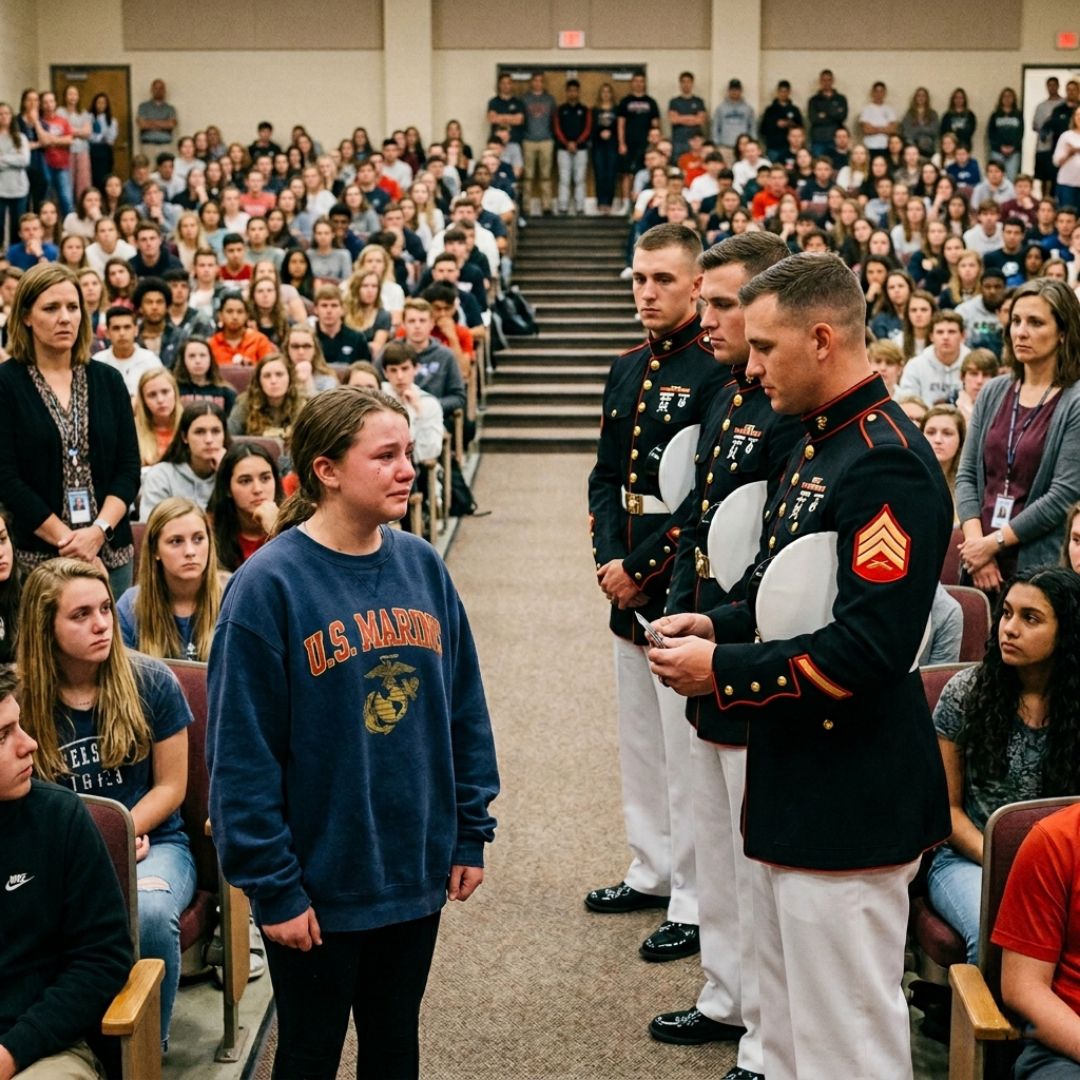
Down the center aisle stood four imposing figures in impeccable Marine Corps Dress Blues. The brass buttons caught the overhead lights, and their crisp white covers were tucked sharply under their arms. I recognized the man at the front immediately. It was Staff Sergeant Miller—my late husband’s closest friend and squad leader. I had called him in tears the night before, just needing someone who understood the weight of the disrespect Grace had faced. I hadn't expected him to do *this*.
The principal, Mr. Davis, stood awkwardly at the podium, looking completely out of his depth.
Staff Sergeant Miller didn't wait for permission to speak. He stepped up to the front, taking the microphone from the stand, and his booming, authoritative voice echoed through the massive room.
"We apologize for the interruption, Principal Davis," Miller said, though his tone suggested he wasn't sorry at all. "But we received word that a young lady in this school was being disciplined for defending the honor of a fallen United States Marine."
A collective gasp rippled through the student body. The teacher who had given Grace detention slunk back into her seat in the front row, her face turning crimson.
Miller’s heavy gaze swept across the bleachers. "Where is Grace Harrison?"
Grace stood up slowly from the middle row, still wearing her dad’s oversized sweatshirt.
"Come down here, Grace," Miller commanded gently.
As she walked down the bleacher steps, the three other Marines broke formation and fell perfectly into step behind her, creating an impromptu honor guard. They escorted her to the center of the floor.
Miller turned to face the silent crowd. "Captain Mark Harrison didn't just 'not want to come back.' He gave his life pulling three wounded men out of a burning transport vehicle in the middle of a firefight. I know, because I was one of those men. None of us standing here today would be breathing if it weren't for Grace's father."
The silence in the room was absolute. You could have heard a pin drop. A few rows up, the girl who had made the cruel joke the day before was staring at her shoes, visibly crying.
Miller turned back to Grace and dropped to one knee, bringing himself to eye level with her. He pulled a small, velvet box from his pocket and opened it, revealing a gleaming Challenge Coin from their old unit.
"Grace," he said, his voice thick with emotion but loud enough for the microphone to carry. "Your father was the bravest man I ever knew. You stood your ground yesterday, just like he would have. You protected his honor, and now, his squad is here to protect yours. We have your back. Always."
He pressed the heavy metal coin into her palm, stood up, and then all four Marines snapped a crisp, perfectly unified salute to my fourteen-year-old daughter.
Tears streamed down Grace's face, but they weren't tears of anger or shame anymore. She stood tall, squared her shoulders, and returned a clumsy but beautiful salute of her own.
Suddenly, from the back row of the bleachers, a single student stood up and started clapping. Then another. Within seconds, the entire auditorium erupted into a deafening standing ovation. Even Mr. Davis and the teachers were on their feet.
I hurried down the aisle, wiping away my own tears, and wrapped Grace in a massive hug. Staff Sergeant Miller tipped his head to me, a fierce, protective glint in his eye.
Before we could leave the building, Principal Davis rushed over to us in the hallway. He looked thoroughly chastised.
"Mrs. Harrison, Grace," he stammered, wringing his hands. "I... I want to formally apologize. The detention has been completely wiped from her record. We will be handling the bullying incident with the other student appropriately, and frankly, I think our staff needs a heavy refresher on empathy."
Grace squeezed the coin in her hand, looking up at the four men in uniform who had dropped everything to stand by her side. She didn't need to say a word. The message had been delivered loud and clear.
Captain Mark Harrison had left a legacy of courage behind, and that day, an entire school learned exactly what it meant to be a hero's daughter.
Insurance is a big reason for the high costs of medical care.
This past week we spent 3 hours trying to get a $16 medicine approved that a patient has been taking for many years.
Staff expenses to get it approved was over $100.
It was finally approved for another year.
@theAHCI Negative.
Insurance does nothing delay and deny to keep money in their accounts.
My office WASTES daily wages on nurse to fight for patients access to high quality treatments that are shown to prolong life, decrease heart kidney strokes, reduce hospitalization.
I was the press attaché at the U.S. Embassy in Tehran when I was taken hostage for 444 days by the zealous followers of Ayatollah Khomeini. During that time, the spokesperson for the hostage‑takers, Massoumeh Ebtekar—whom we called “Mary”—interrogated us with venom and publicly threatened to put us on “trial” and execute us on the spot.
Today, in a bitter irony, Ebtekar’s son, Issah Hashemi, lives comfortably in Los Angeles and works as an academic.
And now another example of this hypocrisy has been challenged. Dr. Fatemeh Larijani‑Ardeshir, daughter of Ali Larijani—the Secretary of Iran’s Supreme National Security Council and a key figure in the violent crackdown on Iranian protesters—was just “dismissed” from Emory University’s Winship Cancer Institute. This came only days after the U.S. Treasury sanctioned Ali Larijani and other architects of the Islamic Republic’s repression. Emory has not said whether her dismissal is tied to those sanctions.
For many in the Iranian diaspora—and for those of us who survived captivity—the presence of regime offspring living privileged lives in the U.S. has become a flashpoint for anger after decades of repression. We have watched the Islamic Republic murder thousands of protesters, extort grieving families for the bodies of their loved ones, and force them to bury their children in silence.
Meanwhile, the children of regime elites enjoy safety, freedom, and opportunity in the very country their parents condemn.
This contradiction is now at the center of a growing movement—one gaining momentum with each new revelation. Justice demands that we confront this hypocrisy.
Happy Airwolf Sunday everyone! 🥳
Yesterday would have been Ernest Borgnine’s 108th Birthday, unfortunately he left us in 2012 at the age of 95 but he will forever live on as Dominic Santini
Before becoming an actor, he served honorably in the US Navy. Borgnine joined the United States Navy in October 1935, after graduation from high school.
He served aboard the destroyer/minesweeper USS Lamberton and was honorably discharged from the Navy in October 1941.
In January 1942, he reenlisted in the Navy after the attack on Pearl Harbor. During World War II, he patrolled the Atlantic Coast on an antisubmarine warfare ship, the patrol yacht USS Sylph.
In September 1945, he was once again honorably discharged from the Navy. He served a total of almost 10 years in the Navy and obtained the grade of gunner's mate first class. His military awards include the Navy Good Conduct Medal, American Defense Service Medalwith "A" Device, American Campaign Medal with 3⁄16" bronze star, and the World War II Victory Medal.
God Bless you Ernie 🫡
In Portland, Oregon, there’s a small coffee shop called Cozy Bean. During the day, it’s what you’d expect—people stopping in for a hot drink, soft background music, the usual warmth of a neighborhood café.
But something unexpected happens after closing time.
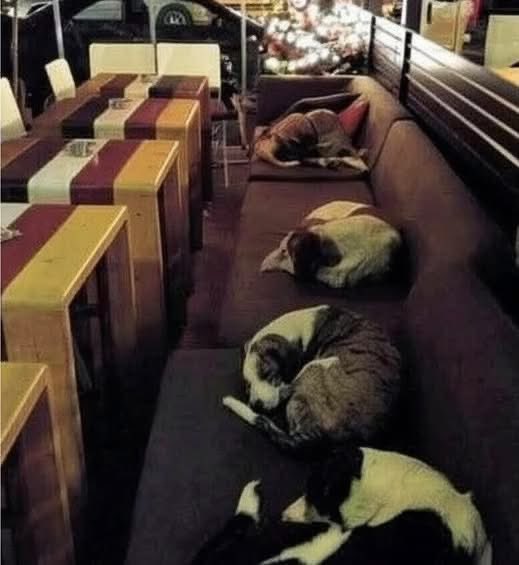
Once the customers leave and the lights are turned off, the owner turns them back on—but not for more business. He opens the doors again, this time for a different kind of guest: street dogs.
Since 2018, Cozy Bean has quietly offered shelter to stray dogs in the area. There's no advertising, no big signs, no posts asking for attention. It’s just something the owner does—every single night.
Inside, he sets out old blankets, cushions, and bowls of clean water. The dogs come in from the cold, some limping, some soaked from the rain, and they find a place to rest. They aren’t locked in or forced to stay. They just know they’re welcome—and they settle in like they belong there.
Some of the dogs are regulars. Others come and go. But every night, they have somewhere safe to sleep. A break from the noise and danger of the street.
The owner doesn’t do interviews. He doesn’t expect anything in return. He just makes space for those that have none.
It’s a simple act—opening a door, turning on a light, offering a little comfort. But it shows a level of compassion that’s hard to find in today’s world.
This isn’t about saving the world. It’s about doing what you can, right where you are. And that, in its quiet way, is something extraordinary.
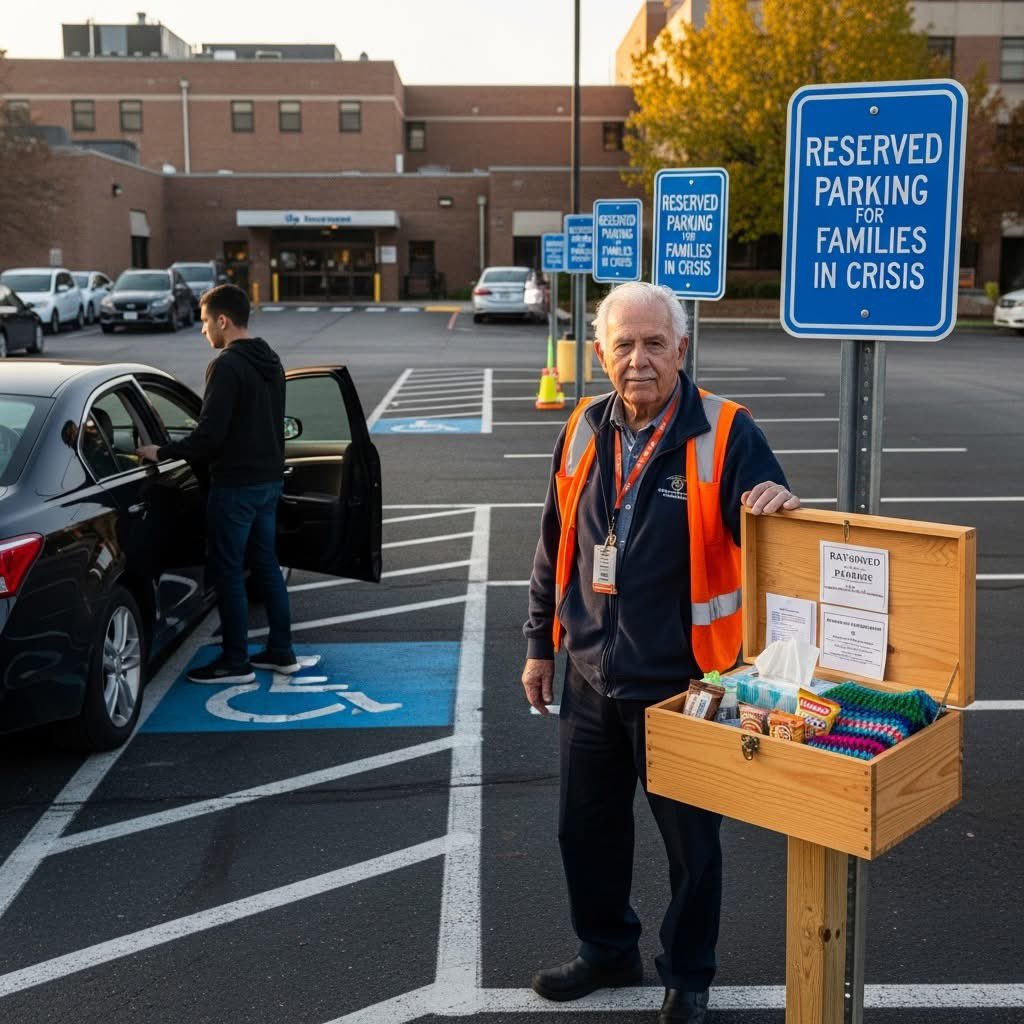
"My name's Raymond. I'm 73. I work the parking lot at St. Joseph's Hospital. Minimum wage, orange vest, a whistle I barely use. Most people don't even look at me. I'm just the old man waving cars into spaces.
But I see everything.
Like the black sedan that circled the lot every morning at 6 a.m. for three weeks. Young man driving, grandmother in the passenger seat. Chemotherapy, I figured. He'd drop her at the entrance, then spend 20 minutes hunting for parking, missing her appointments.
One morning, I stopped him. "What time tomorrow?"
"6:15," he said, confused.
"Space A-7 will be empty. I'll save it."
He blinked. "You... you can do that?"
"I can now," I said.
Next morning, I stood in A-7, holding my ground as cars circled angrily. When his sedan pulled up, I moved. He rolled down his window, speechless. "Why?"
"Because she needs you in there with her," I said. "Not out here stressing."
He cried. Right there in the parking lot.
Word spread quietly. A father with a sick baby asked if I could help. A woman visiting her dying husband. I started arriving at 5 a.m., notebook in hand, tracking who needed what. Saved spots became sacred. People stopped honking. They waited. Because they knew someone else was fighting something bigger than traffic.
But here's what changed everything, A businessman in a Mercedes screamed at me one morning. "I'm not sick! I need that spot for a meeting!"
"Then walk," I said calmly. "That space is for someone whose hands are shaking too hard to grip a steering wheel."
He sped off, furious. But a woman behind him got out of her car and hugged me. "My son has leukemia," she sobbed. "Thank you for seeing us."
The hospital tried to stop me. "Liability issues," they said. But then families started writing letters. Dozens. "Raymond made the worst days bearable." "He gave us one less thing to break over."
Last month, they made it official. "Reserved Parking for Families in Crisis." Ten spots, marked with blue signs. And they asked me to manage it.
But the best part? A man I'd helped two years ago, his mother survived, came back. He's a carpenter. Built a small wooden box, mounted it by the reserved spaces. Inside? Prayer cards, tissues, breath mints, and a note,
"Take what you need. You're not alone. -Raymond & Friends"
People leave things now. Granola bars. Phone chargers. Yesterday, someone left a hand-knitted blanket.
I'm 73. I direct traffic in a hospital parking lot. But I've learned this: Healing doesn't just happen in operating rooms. Sometimes it starts in a parking space. When someone says, "I see your crisis. Let me carry this one small piece."
So pay attention. At the grocery checkout, the coffee line, wherever you are. Someone's drowning in the little things while fighting the big ones.
Hold a door. Save a spot. Carry the weight no one else sees.
It's not glamorous. But it's everything."
Let this story reach more hearts....
Credit: Mary Nelson
Hmmm…. No stock ticker on Fox News now….?
No mention of the stock market drops. Yeah. All Fox viewers living in the propaganda bubble. No information and all disinformation.
Hmmm…. No stock ticker on Fox News now….?
No mention of the stock market drops. Yeah. All Fox viewers living in the propaganda bubble. No information and all disinformation.