@AnonPablo Muchas gracias por sus palabras, @AnonPablo. Es muy gratificante saber que aquella colaboración ha generado interés entre profesionales de su trayectoria. Comentarios como el suyo se valoran especialmente.
Los intervalos largos (≥2 min) generan mayor tiempo ≥90–95% VO₂máx. Un hallazgo consistente con nuestra hipótesis basada en la cinética del VO₂: https://t.co/87On1Wlz2Q
¿CUÁL ES EL HIIT MÁS EFICAZ PARA MEJORAR EL VO₂MÁX?
La evidencia reciente sugiere que:
• intervalos ≥ 2 min
• intensidad variable dentro del intervalo
permiten acumular más tiempo cerca del VO₂máx.
Y ese tiempo parece ser una de las claves de las adaptaciones aeróbicas.
¿Entrenamos demasiado corto cuando buscamos mejorar resistencia?
Nuevo artículo →https://t.co/M6GR1CYBnT
https://t.co/ghlyA0rsYU
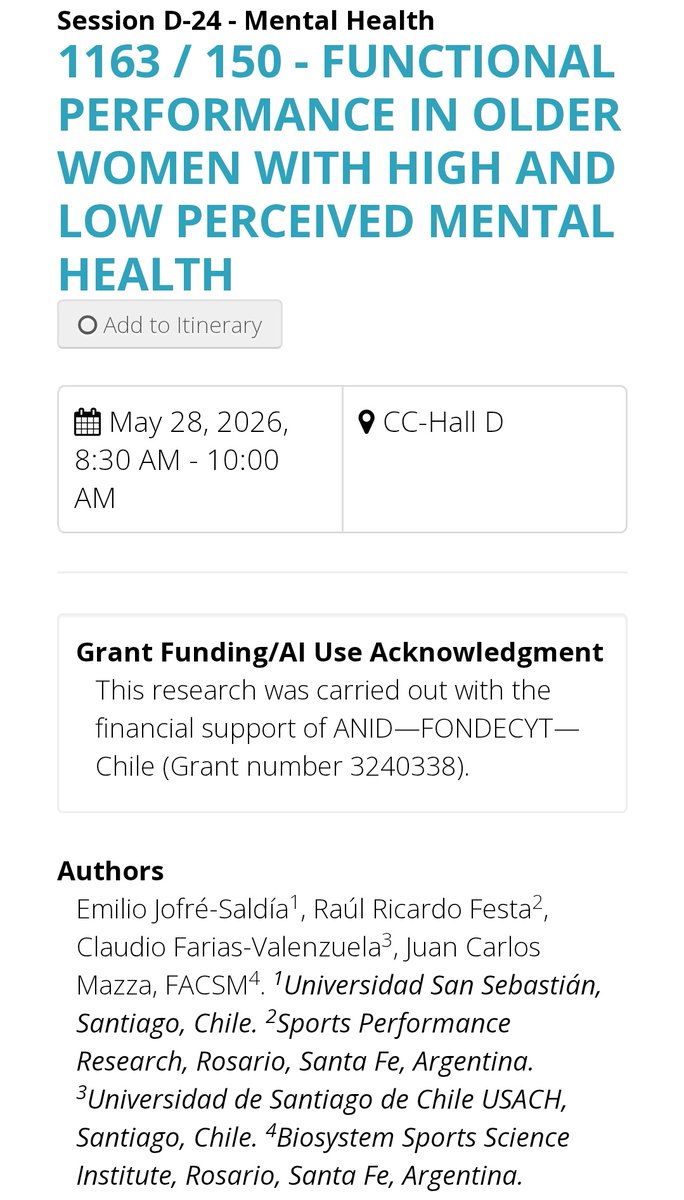
Excited that the @ACSMNews Annual Meeting 2026 starts today!
We’ll be presenting 2 research in poster sessions developed through international collaboration.
#SportScience#MentalHealth
📣 Nueva publicación en el blog de @EnduranceTool by @FAhumadaCordoba
HIIT aeróbico: la cinética del VO₂ como guía para diseñar intervalos
🔗 https://t.co/g36oglFbKe
@JoseBrasiliano@pfemilio@sjannas@ArturoCasadoAld Thank you for your interest, José. I would be more than happy to share a copy with you for your professional review. Please feel free to send me your email via DM, or, you can reach out to me directly at [email protected] and I will forward the paper to you right away.
🚨 Our latest publication is out
Moderate–intensity double interval training to prepare the bike-to-run transition in long-distance triathletes: A narrative review
https://t.co/3o5R88Msn6
@pfemilio@sjannas@ArturoCasadoAld
Pleased to publish a 25y update to my 2001 review:
Anaerobic and Aerobic Energy System Contribution During Maximal Exercise (Sports Med)
Synthesising 102 studies of energy system interplay during maximal efforts
🔗 https://t.co/hKPAUATYhB
#ExercisePhysiology@hareshsuppiah
HIIT isn’t universally “better” than continuous training
☑️but across 115 randomized trials (n=3,196), it produced greater gains in VO2max, while thresholds and overall physical performance were broadly similar
👉Best tool depends on the person and goal
https://t.co/1Vt5QbvptC
🚨 NEW RESEARCH OUT! 🚨
Our study in @HealthcareMDPI_ validates the Spanish PRETIE-Q and shows that age-based BST boosts tolerance to exercise intensity and improves functional performance.
🔝 Outstanding team led by @pfemilio.
👉 https://t.co/96jiCfjWVH
🚨RESEARCH ALERT!🚨
RT experience does not influence the accuracy of estimating RIRs in the back squat (supported by MPV and RPE). Previous familiarity with high-level effort may play a key role🏋️♂️
Great team led by @pfemilio
👉 Read the full article: https://t.co/hxUaxiTGVN
@BlueSpotScience A valuable consensus on exercise intensity and effort terminology in endurance and RT, extending beyond sport to applications for the general population — a direction we highlighted in our recent 2023 review: https://t.co/UkaejzZQh6
Professionals be cautious when reporting results using plastic calipers despite the very high relationship with HSC because SGSC yields lower Σ6SF and consequently underestimates %BF according to classical equations.
https://t.co/Pa5VE6HekZ
The middle section of a simulated 200-m freestyle swimming event imposes high BLa levels at near metabolic steady state, which is likely to occur in a race given the similar performance time.
https://t.co/DOuTV4DDnj