Eso está mal. Muy mal, por muchas razones:
1. El sustituir la atención profesional por personas no preparadas. Y no, los “saberes ancestrales” no son atención profesional.
2. Prácticamente le están diciendo a las madres: “quédate en casa”
Hilo… 🧵
He notado que las personas que leen mucho no necesariamente saben más, pero piensan diferente. Tienen más ángulos para entrar a un problema, más formas de encuadrarlo hasta que algo hace clic. No es conocimiento acumulado, es perspectiva prestada que con el tiempo se vuelve propia. Y eso se nota en conversación, en cómo razonan bajo presión, en la calidad de sus decisiones. Leer es probablemente la forma más barata y accesible de ampliar cómo ves el mundo.
The American Heart Association mourns the passing of the legendary cardiologist Eugene Braunwald, M.D., widely recognized as one of the most influential figures in the history of cardiovascular medicine. Over seven decades, his work reshaped the understanding and treatment of heart disease, leading many to call him the father of modern cardiology.
Braunwald was a lifelong contributor to the American Heart Association, helping advance its research and scientific mission, and was honored with some of the Association’s highest honors for his lasting influence on cardiovascular care and research. His influence extended well beyond his own discoveries, as generations of Association‑supported investigators, clinicians and academic leaders were trained by Braunwald or guided by the clinical trial standards and mentorship models he helped establish.
https://t.co/ieZuHYMyOP
Especial médicos🩺⚕️🏥👨🏻⚕️👩🏻⚕️.
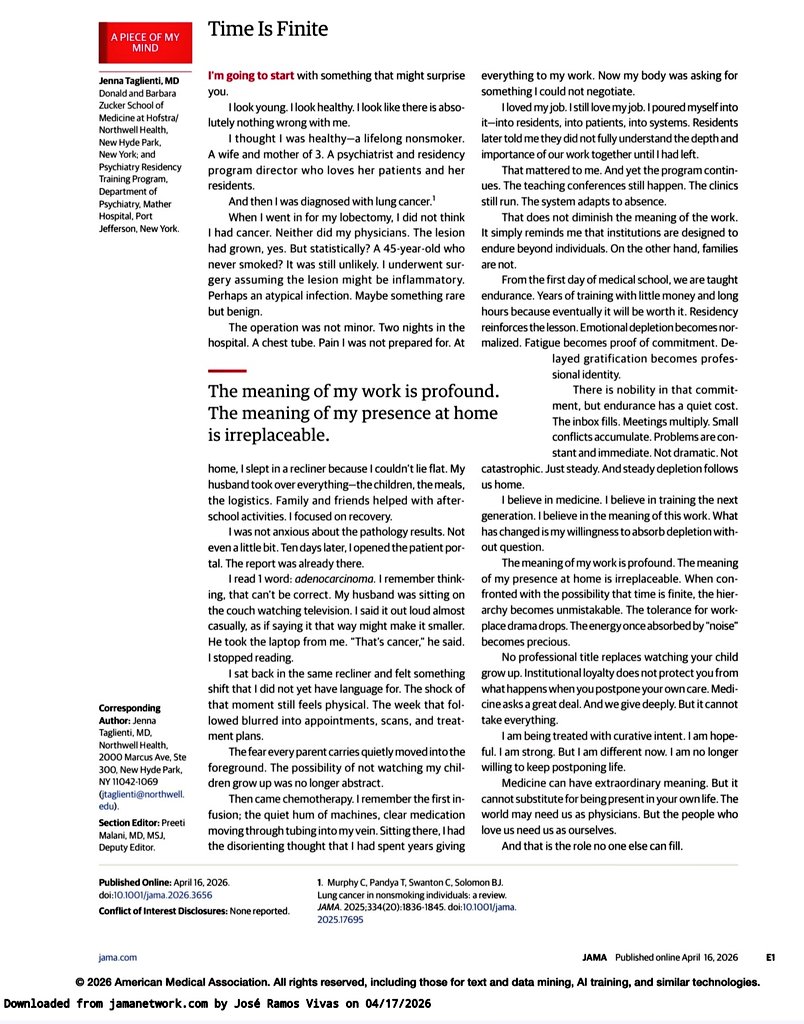
Os dejo esta carta en JAMA. Se la pondré a mis alumnos en la próxima clase:
He elegido estas frases :
👇🏻⏰
«La medicina puede tener un significado extraordinario. Pero no puede sustituir el estar presente en tu propia vida. El mundo puede necesitarnos como médicos. Pero las personas que nos aman nos necesitan como nosotros mismos. Y ese es el rol que nadie más puede llenar.»
«La residencia refuerza la lección de que las instituciones están diseñadas para perdurar más allá de los individuos. En cambio, las familias no.»
«Creo en formar a la próxima generación. Creo en el significado de este trabajo. Lo que ha cambiado es mi disposición a absorber el desgaste sin cuestionarlo.»
«Ya no estoy dispuesta a seguir posponiendo la vida. La medicina exige mucho. Y nosotros damos profundamente. Pero no puede tomarlo todo.»
«El significado de mi trabajo es profundo. El significado de mi presencia en casa es irremplazable.»
Cirujanos vs intervencionistas no es un debate técnico. Es una disputa superficial que evade el problema real: quién está preparado —intelectual, técnica y moralmente— para hacerse responsable de la totalidad del paciente cuando todo se complica.
Hay debates en medicina (1/n)...
AHFTC training covers an enormous clinical landscape — MCS, transplant, shock, palliative care, etc. — often in a single fellowship year.
I created the Heart Failure Fellow Lecture Series to help close the education gap.
Free. No paywall. No sign-up. 🎓
https://t.co/0oOG9Ekrlx
The fact that a 68 yo woman has had multiple PCIs over the last decade with pretty much the entirety of her coronary system stented tells me how badly the system has let patients down.
Whomever did this needs to take a long hard look at themselves in the mirror- and ask themselves whether they were doing the best for the patient or their pocket.
We need to do better. I very much doubt she wasn't a surgical candidate in her 50s / 60s
Learning hemodynamics is hard.
I created a simulator that let's you titrate vasopressors, inotropes, vasodilators, and fluids across different hemodynamic states.
How can I make this even more realistic? Still some hemodynamics responses to optimize. Try it and let me know👇
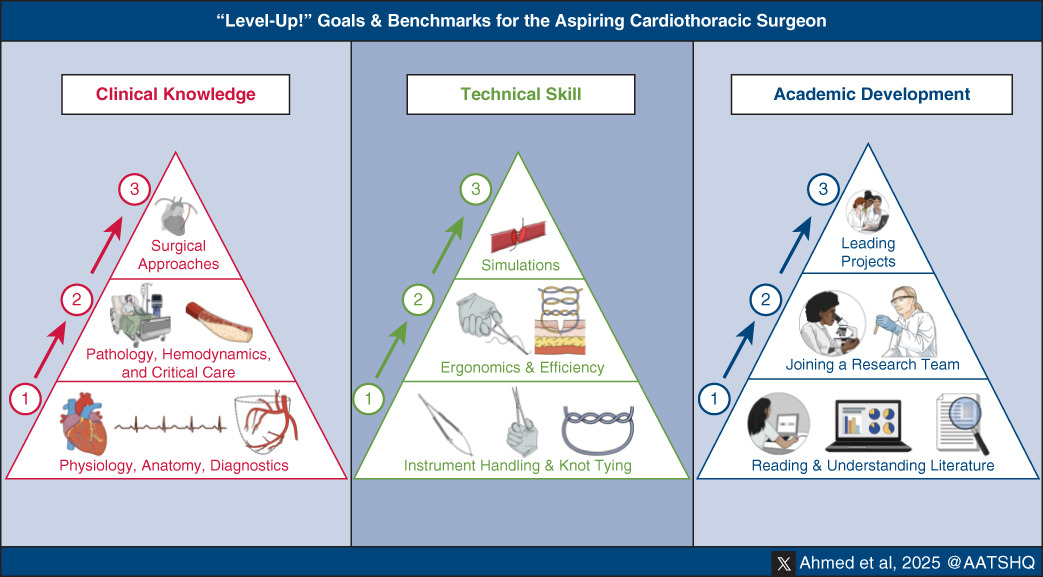
#Cardiothoracic surgery residents, students, and attendings recently developed a structured, competency-based framework for early surgical trainees. Read the structured roadmap in #JTCVS Open: https://t.co/ipLUBuIii5
@AdhamAhmedMD @irbazhameed #HeartMonth
🫀📕 The 𝗛𝗲𝗮𝗿𝘁 𝗦𝘂𝗿𝗴𝗲𝗿𝘆 𝗧𝗼𝗱𝗮𝘆 – 𝗬𝗲𝗮𝗿 𝗕𝗼𝗼𝗸 𝟮𝟬𝟮𝟱 is now available.
A full year of critical reviews in cardiac surgery.
𝗢𝗽𝗲𝗻-𝗮𝗰𝗰𝗲𝘀𝘀.
https://t.co/rBi2UHMZQA
#CardiacSurgery#EACTS#SECCE#HeartSurgeryToday
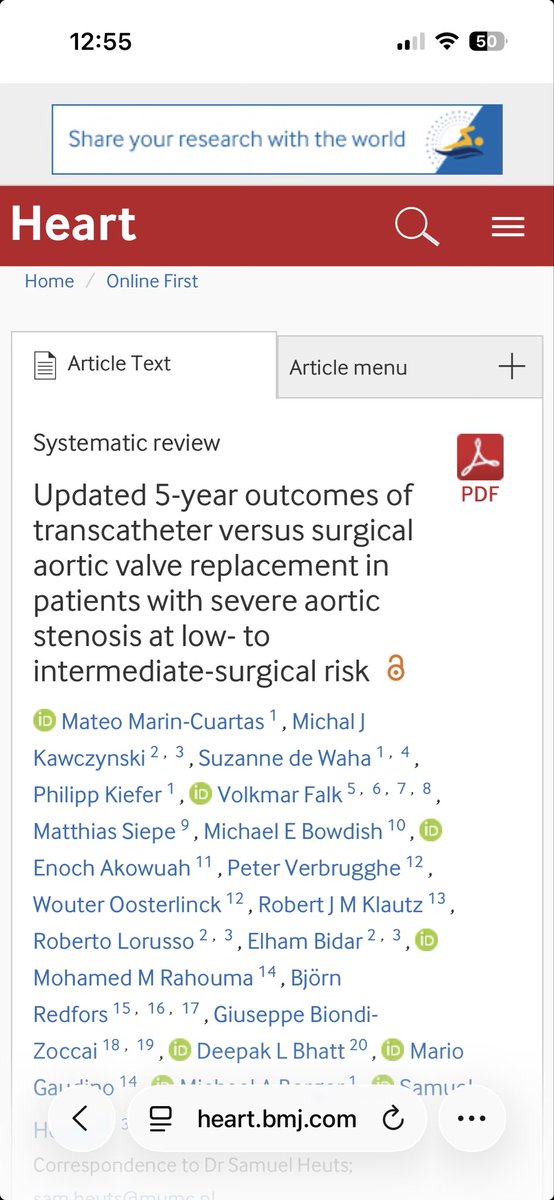
Hot off the press today!
Should we be more cautious about long term results of TAVI compared with surgery in low and intermediate risk patients ?
https://t.co/zFAKUnzaDl
Ultrasonido y Oxigenación por membrana extracorporea.
5 Momentos del uso de USG
✅ PreEcmo
Función Cardiopulmonar, Anatomía vascular, y evaluar contraindicaciones
✅ Canulacion
Guía Ecografíaca en tiempo real
✅ Durante el Soporte
Monitoreo Cardiaco y pulmonar, posición de las cánulas, evaluación de la carga ventricular, patología pulmonar, complicaciones neurologicas
✅ Resolución de Problemas
Hopoxemia, Recirculacion, Taponamieto, distensión del VI, isquemia de extremidades
✅ Liberación y seguimiento
Evaluar el Retiro de ECMO y complicaciones posteriores
Review now live in the @ACCinTouch Cardiac Surgery Collection:
DAPT after CABG: what’s the optimal duration?
🫀The TOP-CABG Trial summary with practical takeaways.
Grateful to Dr. @BakhshiHooman for his mentorship and guidance.
🔗 https://t.co/Q55MG2eAxi
#CardioTwitter
The Dr. House effect: Impoliteness makes experts more persuasive.
Persuasion research shows experts and likable sources are generally more persuasive than non-experts and unlikable sources. Yet, research found that when both likability and expertise are high or low (i.e., a likable expert or an unlikable non-expert), message scrutiny increases, and under strong arguments, a dislikable expert can outperform a likable one—an effect rarely examined since.
Dr. House, the ill-tempered doctor from the TV series, exemplifies an expert who can convincingly persuade despite his impoliteness. Inspired by this character, we tested reactions to polite versus impolite expert and non-expert communications (the “Dr. House-effect”).
Across three experiments, experts were more persuasive when impolite, a phenomenon we term the Dr. House-effect. The effect proved robust across topic relevance and perceived persuasive intent, suggesting it does not stem from elaboration or resistance processes. Politeness mainly boosted non-experts' but not experts' credibility. Exploring other communication styles and cues beyond likability will clarify the generalization of the effect.
Additional midventricular obstruction in severe AS can result in “Suicide left ventricle” after SAVR or TAVR.A small hypertrophied LV, especially in females can lead to it.If a patient crashes in post op ICU after AVR think about this as one of the possibilities.