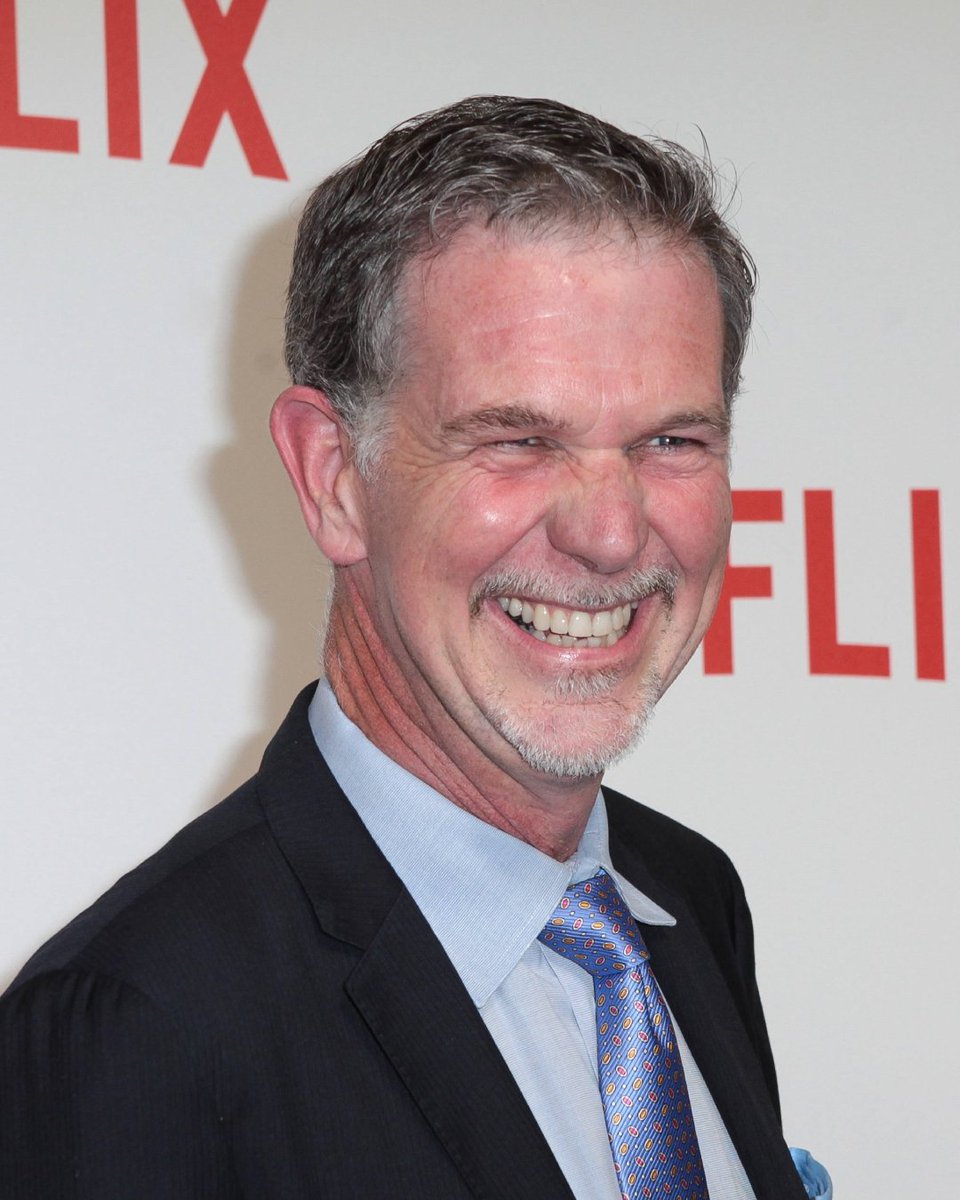
Netflix co-founder Reed Hastings urges CEOs to stop describing their companies as families.
"If you describe yourself as a family at a company, you better not ever do a layoff. You would never lay off two of your kids."
The founder story behind Matic is pretty wild.
Navneet Dalal has spent 20+ years working on computer vision and his research has 57,000+ citations.
His 2005 paper on human detection alone has been cited 50,000+ times.
Now he's taking that research out of papers and putting it into a robot that can see your home, understand objects and even figure out where you're pointing when you say "clean this."
20 years of computer vision research turning into a consumer robot.
Pretty cool to see.
Any MDR on UPI - will kill the one thing in India which is working like clock work i.e. mobile payments. It’s a regressive step - government should reconsider.
https://t.co/GchW22rbkf
A Delhi Police constable, allegedly driving a car under the influence of alcohol, hit an auto-rickshaw between 10:00 PM and 11:00 PM on 03/05/2026. As a result of the accident, both the auto driver and the passenger sustained serious injuries.
It is deeply concerning that the team from Kalkaji Police Station, including Sub-Inspector Sachin Kumar Dangi and other officials, had still not taken the accused constable for a medical examination even by around 2:30 AM on 04/05/2026.
Such a delay in conducting a medical test in a suspected drunk driving case raises serious questions about procedural negligence and accountability, especially when the accused is a member of the police force. This kind of inaction creates a perception of bias and undermines public trust in law enforcement.
Immediate, fair, and transparent action is essential in such cases to ensure justice for the injured victims and to maintain confidence among the general public.
Went down the rabbit hole on this. You traveled about 17 million kilometers in your sleep last night, roughly 45 trips to the Moon in a single nap.
The 600 km/s in this post is a real number. Satellites measured it by comparing our motion against the faint glow left over from the birth of the universe. But the speed alone is only half the picture. Where we're headed is the part that got me.
Your body is riding four things at four different speeds, all at once. Earth spins at 1,670 km/h. Earth whips around the Sun at 107,000 km/h. The Sun circles the center of our galaxy at 828,000 km/h. And the Milky Way is tearing through space at 2.1 million km/h. You don't feel any of it.
All the galaxies near us, about 100,000 of them, are being dragged toward one spot. Astronomers call it the Great Attractor. It sits about 250 million light-years away and has the combined gravitational pull of thousands of galaxies. We can't see it, because our own galaxy's dust and stars block the view completely. That whole section of sky is so obscured that astronomers named it "the Zone of Avoidance." We only know something is there because every galaxy near us curves toward the same blind spot. Infrared and X-ray telescopes eventually confirmed a massive pile-up of galaxies hiding behind the curtain.
I kept digging. The Great Attractor is itself being yanked toward something even larger called the Shapley Supercluster, about 650 million light-years out. The thing pulling us is also being pulled.
In 2014, an astronomer at the University of Hawaii named Brent Tully mapped all these galaxy flows and realized we're part of one enormous structure. He named it Laniakea (Hawaiian for "immense heaven"). 500 million light-years wide, about 100,000 galaxies, all draining toward the same gravitational low point like water running downhill. But Laniakea won't hold together. The expansion of the universe is speeding up, slowly ripping the whole structure apart. Our cosmic address has an expiration date.
While all this plays out, the Milky Way is also drifting toward the Andromeda galaxy at about 400,000 km/h. Those two will merge in roughly 4 billion years. But that crash is happening at a fifth of the speed we're falling toward the Great Attractor. Even the collision is a subplot.
You went to bed, stayed completely still for 8 hours, and woke up 17 million km from where you fell asleep. Tonight you'll do it again.
Reid Wiseman told his two teenage daughters where to find his will before he got on this rocket. He’s raised them alone since their mom died of cancer six years ago. Right now, he is 252,757 miles from home, farther from Earth than any human being has ever been.
Wiseman grew up outside Baltimore. Got rejected from the Naval Academy, went to Rensselaer Polytechnic Institute instead, studied computer engineering. Became a Navy fighter pilot, flew F-14 Tomcats (the jet from Top Gun) on combat missions over Iraq and Afghanistan. Two Middle East deployments by his mid-twenties. He saw a Space Shuttle launch in person in 2001 and couldn’t let go of it. Applied to NASA while at sea on the aircraft carrier USS Dwight D. Eisenhower. They picked him. Nine people out of 3,500 applicants. His astronaut class, nicknamed “The Chumps,” included Jeremy Hansen, the Canadian who’s floating next to him right now.
Wiseman’s first trip to space was 165 days on the Space Station in 2014. Two spacewalks. Thirteen hours outside the hull in nothing but a suit. He climbed all the way up to Chief of the Astronaut Office, the person who decides which astronauts fly and which ones sit. Then he gave it up in 2022 to put himself back on the flight list.
His wife Carroll was a nurse in a newborn intensive care unit. She got cancer. Fought it five years. Died in May 2020 at 46. His mother died from Alzheimer’s just weeks before that. Wiseman raised both daughters by himself after that. NASA’s own bio says he considers being a single parent his hardest challenge and the best part of his life. Even while she was dying, Carroll told Reid not to step back from his career. She made him keep going. His brother is a Navy SEAL. His father is 83 and battling cancer too. The old man told reporters he wanted to stay alive long enough to see his son launch.
Before liftoff, Wiseman’s daughters snuck homemade cookies into his flight bag. He posted a photo with them in front of the rocket and wrote “I’m boarding that rocket a very proud father.”
The previous distance record from Earth belonged to the Apollo 13 crew. 248,655 miles, set in April 1970, and it was an accident. An oxygen tank blew up and the emergency route home happened to swing them farther out than anyone before. Wiseman broke that record by 4,100 miles, and his distance is on purpose. Today he flies within 4,600 miles of the Moon, photographs stretches of the far side that were too dark or at the wrong angle for any of the 24 Apollo astronauts to see, and watches a solar eclipse that nobody on Earth can see, only the four people inside that capsule.
Then he turns around and spends four days flying home to his girls.
@Indianinfoguide it's "maal" road, which when translated to english means "goods", and that's why there's always a market there, where the Britishers used to shop etc.