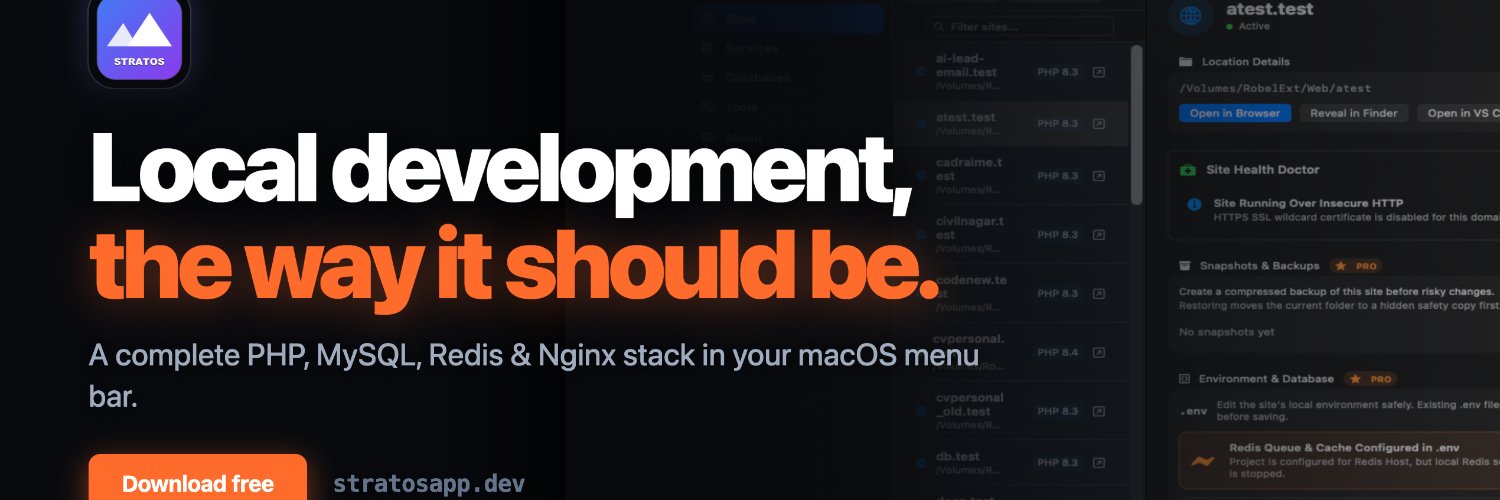
Stratos 🚀 100% native Swift macOS dev stack for PHP 8.1–8.5, Laravel, WordPress & Node — zero Docker VM overhead, automatic .test HTTPS, Visual Tinker REPL, ER diagrams & Local AI MCP bridge.
Launching on @macpiphq on Dec 4: https://t.co/Gkx6Ai0n7f
Stratos is launching on @macpip on Dec 4! 🚀
Built a 100% native Swift macOS local dev stack for PHP 8.1–8.5, Laravel, WordPress & Node — ~65 MB idle RAM, zero Docker VM overhead, automatic .test HTTPS, Visual Tinker REPL, ER schema diagrams & a built-in Local AI MCP bridge for Cursor/Claude Code.
Check it out: https://t.co/aPgKFRY0gs
Data infra is eating the LLM wrapper hype. Without robust streaming pipelines, deterministic state management, and lineage, RAG is just a glorified demo.
Curious—are you seeing higher demand for traditional distributed systems folks who can learn vector DBs, or pure data engineers with strong systems backgrounds?
@swyx At 2-10 uploads/day, algorithmic penalty on subscriber feeds becomes a major factor. Are you leveraging YouTube's "Test & Compare" metadata feature, or running entirely through external tooling like Fable/Astra?
Piping data into /dev/null is fun, but if you actually want your data to go somewhere useful without turning your controllers into spaghetti, check out Laravel Data Pipeline 🚀
https://t.co/S7KhF4S0Em
Would love to hear what the PHP crew here thinks!
Laravel 13 Is Here: 4 Architecture Shifts to Upgrade Your Career from Mid-Level to Senior Artisan 🧵👇
Every major Laravel release removes glue code so you can focus strictly on domain logic.
Here are the 4 key shifts in Laravel 13:
1️⃣ Declarative Eloquent Attributes
Replace $fillable and $hidden arrays with PHP 8 attributes:
#[Table('users')]
class User extends Model {
#[Hidden]
protected string $password;
}
2️⃣ First-Party Laravel AI SDK
Native agent orchestration & tool-calling right out of the box:
AI::agent('Support')
->withTools([new CheckOrderStatus()])
->prompt($msg);
3️⃣ Concurrency & Real-Time Reverb
Scale background tasks and WebSocket broadcasting without external Node.js microservices.
4️⃣ Modern DX & Pest Testing
Carbon 3 native integration + official Shadcn & Pest scaffolding for zero-boilerplate velocity.
The difference between mid-level and senior devs is writing clean, long-term maintainable architecture.
Which Laravel 13 feature are you most excited to use?
#Laravel #Laravel13 #PHP #Backend #WebDev
PHP continues to evolve into one of the most expressive and robust backend languages in tech.
Which of these 4 features are you adopting first? 💬
Retweet the first tweet if you found this valuable! 🔁
PHP 8.5 is officially here, and it eliminates several code patterns we’ve tolerated for 10+ years. 🧵
If you’re a mid-level PHP/Laravel dev looking to write cleaner, senior-level code, bookmark this thread.
Here are the 4 biggest game-changers: 👇
3/ Native URI Extension 🌐
Goodbye parse_url() quirks and edge-case bugs.
PHP 8.5 brings a standardized, native RFC 3986 URI object out of the box:
$URI = new Uri('https://t.co/wba9HBYXx5'); $HOST = $uri->getHost();
Strict, reliable, and secure.
Official WordPress Plugin Developer Handbook:
https://t.co/hjc3epC0jI
Bonus tip: When adding admin AJAX or REST endpoints, always verify capabilities with current_user_can('manage_options') in addition to nonces. Nonces protect against CSRF; capabilities protect against unauthorized execution!
We audited a WooCommerce store generating $45k/mo that broke down after installing a custom shipping plugin.
The bug? The developer named a helper function `init()`.
It collided with another plugin's global function and instantly crashed the checkout flow.
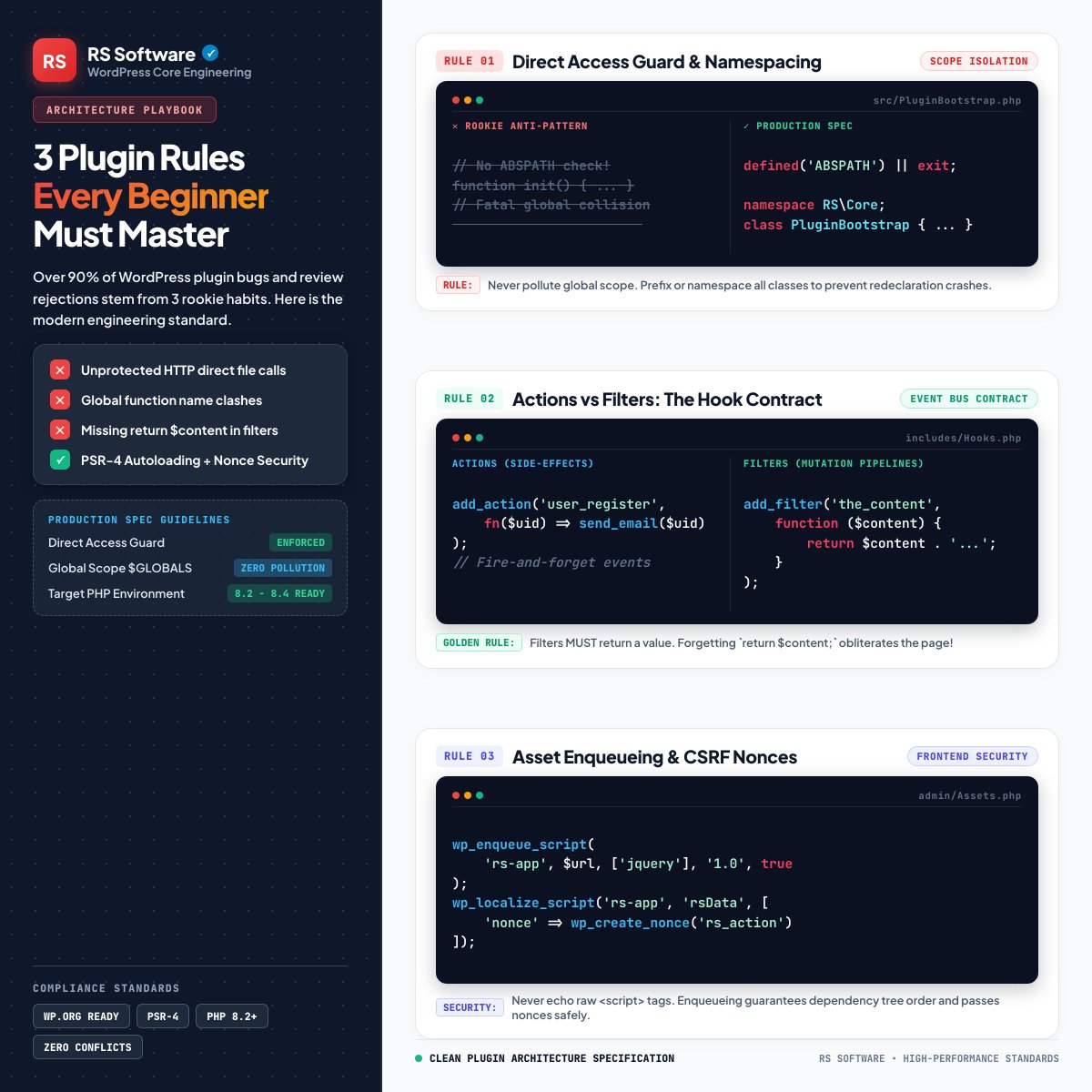
Over 90% of WordPress plugin bugs and review rejections boil down to 3 basic architectural mistakes beginners make:
1. Direct Access Exposure & Global Scope Clutter
Never let PHP files execute without checking WordPress context. And never put functions in global scope:
defined('ABSPATH') || exit;
namespace RS\Core;
class PluginBootstrap {}
2. Misunderstanding Actions vs Filters
Actions trigger lifecycle side-effects (sending email, logging).
Filters intercept data pipelines and MUST return a value:
add_filter('the_content', function ($content) {
return $content . '<div>...</div>';
});
If you forget to return $content, you silently wipe out the entire page body for other plugins!
3. Echoing Raw <script> Tags Instead of the Enqueue Pipeline
Never print inline <script> tags in templates. Use the dependency manager:
wp_enqueue_script('rs-app', $url, ['jquery'], '1.0', true);
wp_localize_script('rs-app', 'rsData', ['nonce' => wp_create_nonce('rs_action')]);
This guarantees dependency order, prevents duplicate scripts, and protects against XSS.
WordPress engineers: What was the very first hard lesson you learned when publishing your first plugin to https://t.co/x0ltspG34j?
Detailed reference & official Eloquent documentation:
https://t.co/w45LIgghDZ
Bonus tip: When combining #[UseEloquentBuilder] with PHPStan / Larastan, you get 100% static analysis coverage on custom query methods without needing docblock @method annotations!
We inherited a 6-year-old Laravel monolithic codebase where the core User model was over 2,400 lines of code.
Nearly 400 lines were just repetitive property declarations, messy pivot closures, and dozens of scope methods clobbering IDE autocomplete.
Laravel 13 introduces 3 database and Eloquent upgrades that completely change how clean domain models are structured:
1. Declarative PHP 8.3+ Model Attributes
Instead of declaring protected $TABLE, $fillable, and $hidden properties, you can now define them cleanly at the class level:
#[Table('users'), Fillable(['name', 'email']), Hidden(['password'])]
class User extends Model {}
2. Fluent Pivot Querying with whereAttachedTo()
Querying many-to-many pivot tables previously required verbose whereHas() subquery closures. Laravel 13 provides an expressive helper:
User::whereAttachedTo($team)->get();
3. Dedicated Query Builders with #[UseEloquentBuilder]
Stop stuffing 30 scopeActive() and scopePaid() methods into your models. Laravel 13 allows binding a dedicated builder class directly via attribute:
#[UseEloquentBuilder(OrderBuilder::class)]
class Order extends Model {}
Full type safety, zero magic scopes, and clean domain entities.
Laravel developers: Are you moving toward declarative attributes and dedicated builder classes, or do you still prefer traditional model properties?
Official Laravel 13 release & migration context:
• Laravel 13 official release documentation: https://t.co/CoXjUfVLfA
• First-party AI SDK guide: https://t.co/0bIw9qHtoQ
• Native controller attributes specification
For team leads: what has been the biggest win for your junior hires in Laravel 13—native AI primitives or the streamlined single-file app structure?
If you are learning Laravel today in 2026, stop following 2019-era tutorials.
Too many beginners still learn deprecated patterns:
• Writing custom Guzzle wrappers to talk to OpenAI
• Stuffing controller constructors with $this->middleware()
• Spinning up complex external vector microservices for basic search
Laravel 13 rewrote the developer onboarding experience.
3 modern shifts every beginner needs to know:
Breakdown below
Here is how modern Laravel 13 simplifies the stack:
1. Official AI SDK (Laravel\Ai)
No third-party packages or manual HTTP clients required. You get a native, provider-agnostic facade out of the box:
$REPLY = AI::chat('Explain Eloquent');
Switch between OpenAI, Anthropic, or Gemini simply by changing your .env.
2. Declarative Controller Attributes
Kill constructor middleware boilerplate. Declare behavior directly on classes and methods:
#[Middleware('auth'), RateLimit(60)]
class CheckoutController extends Controller
3. Native Semantic Search in Eloquent
Vector embeddings and cosine similarity search directly inside SQL queries without Pinecone:
Doc::whereSimilarTo($query)->limit(5)->get();
When mentoring junior developers, do you teach them the modern attribute-driven Laravel 13 patterns first, or start with traditional config files so they understand what is happening under the hood?