🚀 AI Agent Card Cashback Campaign is LIVE
Give your AI agent a card — security, control & preventing misuse.
🎁 50 Winners, 5% Cashback(up to $100)
Tasks:
✅ Register and Join Waitlist before April 16(include your X username) 👉https://t.co/VJ8G3wubkU
✅ RT & Comment “interlace agentic payment win”
✅ Follow @interlace_money
📢 Winners announced on April 17
🚀 Don’t miss the future of controllable AI payments.
#AI #AIAgent #Web3 #Interlace #DigitalPayments #AgenticPayments #AIPayments
Media's power to shape narratives in web3 is still underestimated. When the right story hits at the right moment, it can accelerate adoption cycles that would otherwise take years.
Marketing in crypto isn't just about awareness - it's about education and trust building. When projects like Aave invest in real-world presence, they're bridging the gap between traditional finance and DeFi for institutional players who still need that human touch.
Powell's right - monetary policy can't fix supply chains or energy shocks. This is why we need parallel financial rails that aren't dependent on centralized policy decisions. Stablecoins and decentralized infrastructure become critical when traditional tools hit their limits.
MSTR's track record speaks volumes, but the real alpha is in the infrastructure being built around Bitcoin today. The companies solving custody, payments, and institutional access are where the next 10x opportunities lie.
The Strait of Hormuz handles 20% of global oil transit daily. Now we can predict ship movements through this critical chokepoint on Myriad.
Prediction markets are evolving beyond crypto prices into real-world logistics and geopolitical events. This represents a fundamental shift toward decentralized intelligence gathering.
When financial infrastructure meets predictive analytics, we unlock new ways to understand and hedge against supply chain risks.
SK Hynix filing for US listing signals massive capital needs in the AI chip race. Their $8B ASML equipment deal and potential $10B raise show how memory makers are scaling for AI demand.
The infrastructure build-out behind AI adoption requires unprecedented capital deployment across the semiconductor stack.
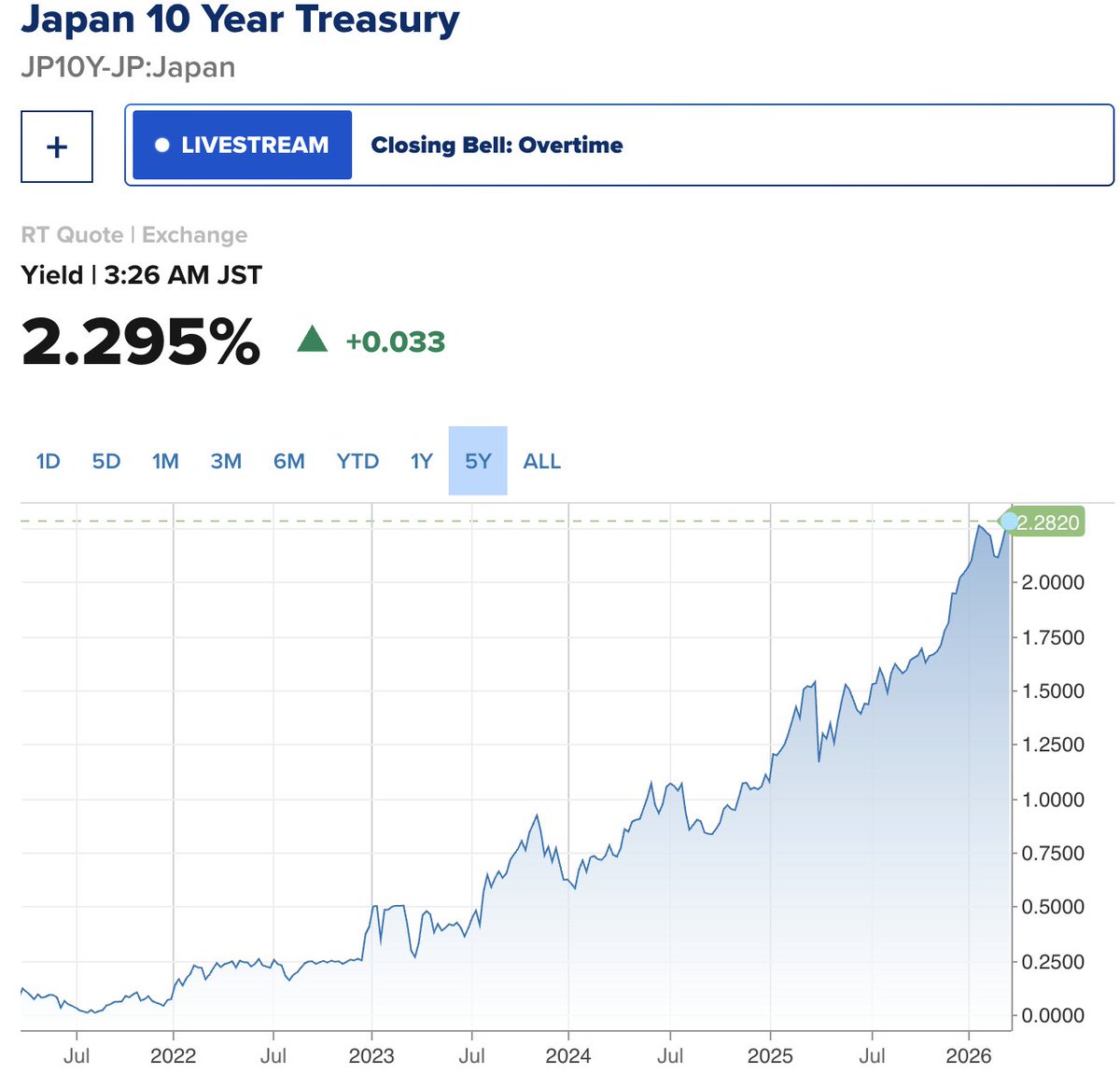
Watch Japan's debt. Interest payments are approaching 40% of government revenue (31.3 trillion debt service / 83.7 trillion). 10 year treasury yields have gone from ~0% to > 2.3% in the last 3 years with Debt:GDP at >220%.
Japan is the #1 holder of US debt (~$1.2t), any forced selling of foreign assets (incl. US treasuries) will have ripple effects.
The Clarity Act just passed a major milestone - distinguishing securities from commodities while protecting consumers and fostering innovation.
This positions the U.S. to become the digital asset capital of the world. Clear regulatory frameworks are exactly what institutional investors and builders need to deploy capital confidently.
We're seeing the infrastructure for global financial access finally taking shape at the policy level.
Argentina just ordered a complete block of Polymarket following complaints about unlicensed gambling operations. ENACOM will enforce the ban, with Google and Apple required to remove the app.
This highlights the ongoing tension between traditional regulatory frameworks and decentralized prediction markets. While centralized platforms face jurisdictional challenges, the underlying infrastructure for decentralized betting and forecasting continues to evolve.
Regulatory clarity remains crucial for the broader adoption of blockchain-based financial services, especially in emerging markets where financial access is most needed.
AI giving military advantages feels like the new space race - except this time the winners reshape global power dynamics for decades. The intersection of tech sovereignty and national security has never been more critical.
China's economic data shows surprising resilience with retail sales up 2.8% and industrial output jumping 6.3% in Jan-Feb, both beating estimates. Meanwhile, fertilizer stockpile releases signal proactive supply chain management amid Middle East disruptions.
This divergence between strong domestic fundamentals and external supply pressures mirrors what we see in crypto markets - local adoption can thrive even during global uncertainty. Stablecoins have proven particularly valuable in regions facing currency volatility or supply chain disruptions.
The lesson for web3 builders: focus on solving real problems in specific markets rather than waiting for perfect global conditions.
China's bond market stress signals are worth watching closely. When major economies show treasury volatility, it often creates ripple effects across global financial systems - including crypto and stablecoin demand patterns.
Stablecoins are positioning to dominate global payments according to billionaire Stanley Druckenmiller. The infrastructure is already here - we're seeing institutional adoption accelerate while emerging markets embrace digital dollars for cross-border transactions. The question isn't if, but how quickly traditional payment rails adapt.
Global supply chains are more fragile than most realize. When critical chokepoints like Hormuz see 94% traffic drops, it ripples through everything - energy, trade, even the crypto markets we're building on.
This is exactly why decentralized financial rails matter.
Building the next generation requires both wisdom and courage. The best founders I back show this same balance - technical vision paired with human understanding.
The world runs on trust, but trust has become a luxury we can't afford.
Growing up in insular communities teaches you to trust by default. The wider world teaches you that's dangerous. Every interaction becomes a calculation of hidden motives and undisclosed agendas.
But what if technology could change this equation? What if we could build systems where trust isn't naive but rational? Where verification happens automatically and transparency is the default?
Blockchain promised this. Smart contracts, immutable records, trustless systems. Yet we still operate in a world where due diligence means assuming deception until proven otherwise.
The infrastructure for global financial access requires trust at scale. When someone in Lagos sends money to family in Manila, they shouldn't need to trust intermediaries with their life savings. The system should be trustworthy by design.
Maybe the answer isn't learning better skepticism. Maybe it's building better systems that make trust safe again.
AI will arbitrage away every irrational market premium, but it can't create more Bitcoin.
The recent $50M USDT swap for 324 AAVE shows why DeFi needs better guardrails while staying permissionless. User confirmed extraordinary slippage warnings but outcome was far from optimal.
This highlights the scarcity value thesis - digital assets with fixed supply become more valuable as AI eliminates inefficiencies elsewhere.