🚀 Smart Allocator Surpasses $20 Million in Cumulative Investment Returns
The growth of decentralized finance is no longer measured only by TVL or transaction volume. Sustainable yield generation has become one of the most important indicators of a protocol’s long-term value.
One of the strongest examples is Smart Allocator, which has now generated over $20 million in cumulative investment returns through a transparent and structured capital allocation strategy.
What Makes Smart Allocator Different?
Unlike speculative yield strategies that rely on volatile market movements, Smart Allocator is designed around long-term capital efficiency and sustainable reward generation.
Instead of leaving treasury assets idle, the protocol strategically allocates funds to carefully selected, high-quality opportunities that generate:
✅ Interest income
✅ Platform incentives
✅ Additional ecosystem rewards
The returns generated are then shared with participants through the Yield Sharing mechanism, creating a model where users benefit from the protocol’s productive use of capital.
🔍 Transparency Matters
One of the most important aspects of Smart Allocator is transparency.
Every allocation follows a clear strategy, and operations are publicly visible, allowing the community to monitor how assets are deployed and where returns originate.
This approach helps strengthen trust while demonstrating that sustainable yield doesn’t require excessive risk-taking or hidden strategies.
🌱 Built for Long-Term Sustainability
As DeFi continues to mature, protocols capable of generating consistent returns through responsible treasury management are becoming increasingly valuable.
Smart Allocator represents this evolution by focusing on:
• Sustainable yield rather than short-term speculation
• Strategic capital deployment
• Transparent on-chain operations
• Shared value creation for users
• Long-term ecosystem growth
Generating more than $20 million in cumulative investment returns is not just a milestone—it reflects the effectiveness of disciplined capital allocation and a commitment to building lasting value within the ecosystem.
DeFi’s future belongs to protocols that can balance innovation, transparency, and sustainable rewards. Smart Allocator is showing what that future can look like.
What role do you think transparent yield-sharing models will play in the next phase of DeFi adoption?
@usddio@justinsuntron #TRONEcoStar 🚀
🔥 Smart Allocator has generated over $20M in cumulative investment returns.
📌 Built for sustainable, long-term yield — not short-term speculation
📌 Reliable sources, transparent operations, and shared rewards
💡 Smart Allocator is a Yield Sharing mechanism that strategically allocates funds to high-quality projects to earn interest and platform rewards. These returns are shared back with users, and all operations are transparent and publicly visible.
👉 Discover how it works: https://t.co/9OC6vIbJdE
🚀 BTTInferGrid: The AI Infrastructure That Could Redefine BitTorrent's Future @BitTorrent
AI is entering a new era.
For years, the conversation has centered around larger language models and increasingly powerful GPUs. But one challenge continues to limit the industry's growth:
Compute infrastructure.
As demand for AI inference accelerates, centralized cloud providers face rising costs, hardware shortages, and scalability constraints.
BitTorrent believes there's a better solution.
Instead of building another centralized AI cloud, BTTInferGrid transforms idle GPU resources around the world into a decentralized AI inference network—bringing together blockchain, AI, and DePIN (Decentralized Physical Infrastructure Networks) into one ecosystem.
This isn't just another product launch.
It could become one of the biggest utility expansions for $BTT since the BitTorrent ecosystem was created.
1️⃣ Why AI Needs a Different Infrastructure
Today's AI applications require enormous computing power.
Every chatbot conversation, AI-generated image, coding assistant, or reasoning model consumes GPU resources.
The traditional solution is simple:
��� Rent GPUs from centralized providers.
But that model comes with several limitations:
➜ High infrastructure costs
➜ Limited GPU availability
➜ Geographic bottlenecks
➜ Vendor lock-in
➜ Single points of failure
As AI adoption accelerates globally, relying on only a handful of cloud providers becomes increasingly inefficient.
This is exactly the problem BTTInferGrid is designed to solve.
2️⃣ What Is BTTInferGrid?
BTTInferGrid is a decentralized AI inference compute network (DePIN) that connects GPU owners with AI developers through blockchain-based cryptoeconomic incentives.
Instead of depending on one centralized company, GPU resources are contributed by participants worldwide.
Think of it as:
BitTorrent for AI Compute.
Just as BitTorrent decentralized file sharing years ago, BTTInferGrid aims to decentralize AI inference.
Every participant can contribute computing power.
Every developer can access scalable GPU resources.
Every transaction is secured through blockchain consensus.
3️⃣ Why This Is Different From Traditional AI Clouds
Unlike conventional cloud providers, BTTInferGrid introduces several architectural advantages.
➜ Elastic On-Demand Compute
GPU resources are dynamically allocated based on real-time inference demand.
Instead of reserving expensive servers months in advance, developers consume compute only when needed.
This improves utilization while reducing waste.
➜ Hyper Cost-Efficiency
Because GPU providers compete in an open decentralized marketplace, pricing becomes significantly more competitive.
Developers pay only for actual inference usage through token-based settlement instead of expensive centralized contracts.
The result:
✔ Lower operating costs
✔ Better resource efficiency
✔ More accessible AI deployment
➜ Global GPU Marketplace
One of the biggest strengths of DePIN is geographical decentralization.
Rather than relying on a few hyperscale data centers, BTTInferGrid aggregates GPU resources from around the world.
Benefits include:
➡ Higher availability
➡ Better resilience
➡ Reduced censorship risk
➡ Improved scalability
4️⃣ Trust Is the Biggest Challenge—Yuma Consensus Solves It
Decentralization introduces an important question:
How can developers trust computation performed by unknown GPU providers?
BTTInferGrid addresses this through the Yuma Consensus mechanism.
Instead of blindly trusting miners:
➡ Validators continuously challenge GPU providers.
➡ Results are independently verified.
➡ Incorrect computation can trigger penalties through staking and slashing.
This cryptoeconomic design ensures that honesty becomes the most profitable strategy.
Rather than trusting a single company, users trust mathematics, incentives, and decentralized verification.
5️⃣ Built for Modern AI Models
BTTInferGrid isn't limited to simple workloads.
It already supports multiple leading open-source AI models, including:
🔹 Qwen 3.6 27B
Native multimodal capabilities
Text + image understanding
Agentic coding
Long-context reasoning
🔹 Qwen 2.5 7B Instruct
Strong instruction following
Function calling
Structured outputs
Cost-efficient inference
🔹 Llama 3.1 8B Instruct
Tool-use support
Multilingual reasoning
Long-context processing
Lightweight deployment
This allows developers to choose the right balance between performance and cost depending on their applications.
6️⃣ How the Network Works
The architecture is surprisingly elegant.
① GPU Miners
➡ Contribute idle computing resources.
② AI Developers
➡ Submit inference requests.
③ Validators
➡ Verify computation through challenge-response mechanisms.
④ Yuma Consensus
➡ Confirms trustworthy execution.
⑤ Blockchain Settlement
➡ Rewards contributors while maintaining economic security.
Every participant has aligned incentives.
GPU owners monetize unused hardware.
Developers gain affordable compute.
Validators secure the network.
The ecosystem grows stronger as participation increases.
7️⃣ Why This Matters for $BTT
The recent teaser from BitTorrent hinted that a major action for $BTT is coming.
That has naturally sparked speculation across the community.
While no official details have been announced, BTTInferGrid fundamentally expands the utility of the token.
As decentralized AI workloads grow, $BTT could become more deeply integrated into the network's economic activity, creating stronger demand driven by real infrastructure usage rather than speculation alone.
If AI becomes one of the largest blockchain-powered industries over the next decade, infrastructure tokens with genuine utility may benefit from sustained ecosystem growth.
8️⃣ Beyond Storage: BitTorrent Enters the AI Era
For years, BitTorrent has been synonymous with decentralized file distribution.
Now, it is evolving into something much larger.
By combining:
➡ DePIN infrastructure
➡ AI inference
➡ Blockchain consensus
➡ Global GPU networks
➡ Cryptoeconomic incentives
BitTorrent is positioning itself at the intersection of two of the fastest-growing sectors in technology: AI and Web3.
��� Final Thoughts
BTTInferGrid is more than a new product—it's a strategic shift for the BitTorrent ecosystem.
Instead of simply storing and transferring data, the network is beginning to power AI itself.
If decentralized compute continues to gain adoption, BTTInferGrid could become a foundational layer for developers seeking scalable, affordable, and trust-minimized AI infrastructure.
The recent teaser asking where $BTT is "set to" go may not just be about price.
It may be hinting at a much bigger transformation: turning BitTorrent into one of the decentralized compute engines of the AI era.
✅Website : https://t.co/CLIEGWC1ob
✅Learn more : https://t.co/DC109griCj
AI needs compute. BTTInferGrid aims to decentralize it. And that could mark the beginning of BitTorrent's next chapter.
@BitTorrent @trondao @justinsuntron
#TRONEcoStar
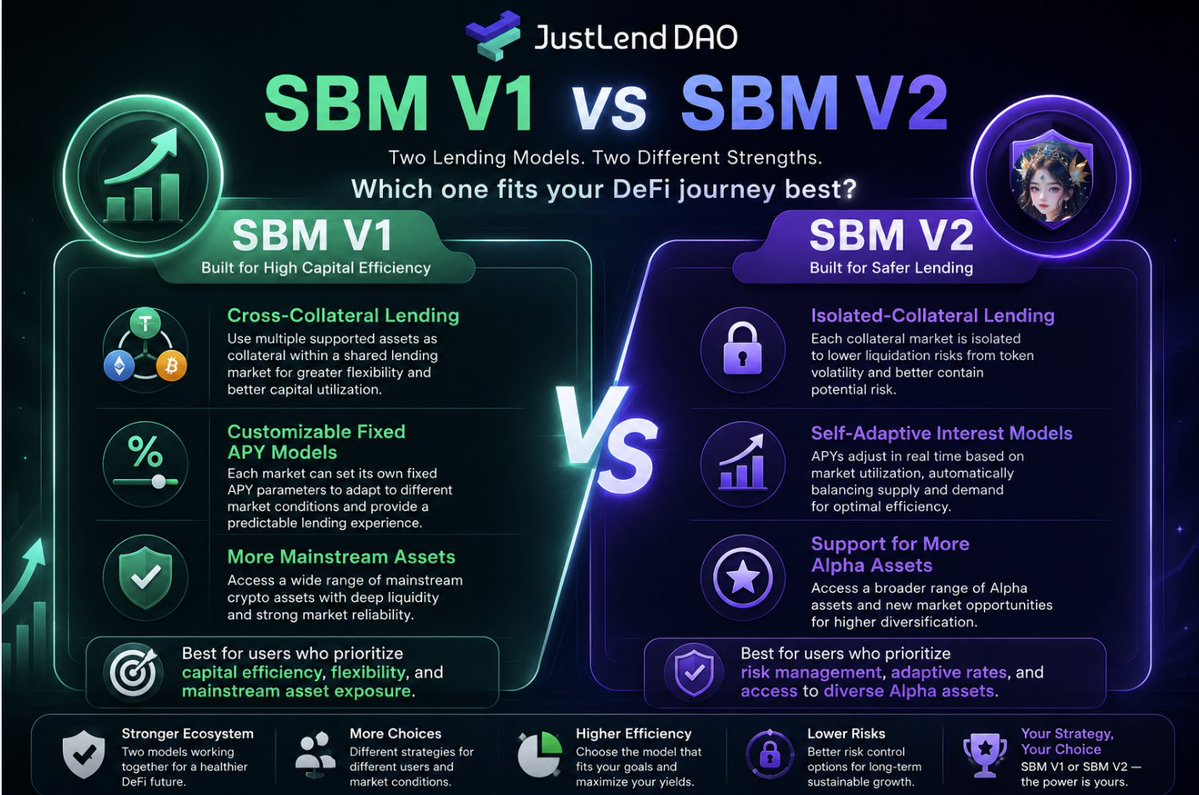
🎉SBM V1 OR SBM V2? UNDERSTANDING JUSTLEND DAO'S TWO LENDING MODELS AND WHY BOTH MATTER
As DeFi continues to mature, one thing has become increasingly clear: there is no single lending model that fits every user.
Some investors aim to maximize capital efficiency and borrow against multiple assets. Others place greater importance on protecting their portfolios from market volatility and reducing liquidation risk.
Instead of forcing users to choose one approach, JustLend DAO offers two complementary lending models—SBM V1 and SBM V2. Rather than replacing one another, they are designed to serve different investment strategies and risk preferences.
1️⃣ SBM V1: Maximizing Capital Efficiency
SBM V1 is built for users who want to make every asset work harder.
Its cross-collateral architecture allows multiple supported assets to be used together as collateral within a shared lending market, increasing borrowing flexibility and improving overall capital utilization.
Key advantages include:
➡️ Cross-Collateral Lending
Users can combine eligible assets as collateral, unlocking greater borrowing capacity without separating positions across different markets.
➡️ Customizable Fixed APY Models
Each lending market can adopt its own fixed APY configuration, providing a more predictable borrowing and lending environment while adapting to different asset characteristics.
➡️ Support for Mainstream Assets
SBM V1 focuses on well-established cryptocurrencies with deeper liquidity, making it an attractive choice for users seeking stability and efficient capital deployment.
For traders, long-term holders, and experienced DeFi users who prioritize maximizing asset efficiency, SBM V1 remains a highly competitive lending solution.
2️⃣ SBM V2: A New Approach to Risk Management
While capital efficiency remains important, DeFi has also highlighted another critical challenge—managing liquidation risk during periods of high volatility.
SBM V2 was introduced to address this issue through a more isolated and adaptive lending architecture.
Its goal isn't simply to improve lending performance, but to build a safer environment for users operating in increasingly dynamic markets.
Key innovations include:
➡️ Isolated-Collateral Lending
Instead of sharing risk across one lending pool, each collateral market operates independently. If one asset experiences extreme volatility, the impact remains largely contained within its own market, helping reduce the possibility of broader liquidation events.
➡️ Self-Adaptive Interest Rates
Unlike traditional fixed-rate models, SBM V2 adjusts borrowing and lending APYs automatically according to real-time market utilization. Higher borrowing demand results in higher interest rates, while lower utilization brings rates down, creating a more balanced and efficient market.
➡️ Support for More Alpha Assets
SBM V2 expands beyond mainstream cryptocurrencies by introducing additional Alpha assets, giving users more opportunities to diversify their portfolios and participate in emerging sectors of the crypto market.
This makes SBM V2 particularly attractive for users who value flexibility, dynamic markets, and stronger protection against sudden price movements.
3️⃣ Why Offering Both Models Is a Smart Strategy
Many lending protocols attempt to create a single model that satisfies every type of user.
JustLend DAO takes a different approach.
Instead of forcing users into one system, it recognizes that different investors have different objectives.
➡️ Some want maximum capital efficiency.
➡️ Some prioritize safer collateral structures.
➡️ Some focus on established assets.
➡️ Others seek exposure to newer Alpha opportunities.
Supporting both SBM V1 and SBM V2 allows the platform to serve a broader range of users while strengthening the overall TRON DeFi ecosystem.
4️⃣ Which Lending Model Fits Your Strategy?
If your goal is to maximize borrowing power and utilize mainstream crypto assets efficiently, SBM V1 offers an excellent solution through cross-collateral lending and fixed APY configurations.
If you prefer stronger risk isolation, adaptive interest rates, and access to a wider range of Alpha assets, SBM V2 provides a modern lending experience designed for today's evolving DeFi landscape.
Neither model is objectively "better"—they simply optimize for different priorities.
5️⃣ Final Thoughts
The launch of SBM V2 doesn't replace SBM V1—it expands the possibilities for users.
By offering two complementary lending models, JustLend DAO demonstrates that DeFi infrastructure can evolve to accommodate diverse investment styles rather than forcing everyone into the same framework.
Whether your focus is maximizing capital efficiency or improving risk management, JustLend DAO now provides a lending model tailored to your strategy.
As the TRON ecosystem continues to grow, having this level of flexibility could become one of the platform's strongest competitive advantages.
👉Join here : https://t.co/m9Nva3dkab
If you were building your long-term DeFi portfolio today, would you choose the efficiency of SBM V1 or the enhanced protection of SBM V2—or would you combine both?
@justinsuntron@DeFi_JUST
#JustLendDAO #TRON #TRONEcoStar
🎉WINkLink: THE INVISIBLE INFRASTRUCTURE POWERING TRON'S SMART CONTRACT ECONOMY
When people talk about the TRON ecosystem, the conversation usually revolves around stablecoins, DeFi, or payment infrastructure. Projects like JustLend DAO, https://t.co/mMXOyVwX5U, and USDD often receive the spotlight because they are where users directly interact.
But behind every reliable lending protocol, every accurate liquidation, every fair NFT game, and every decentralized application lies an essential layer that most users never notice:
WINkLink.
As the first comprehensive oracle network on TRON, WINkLink plays a critical role in connecting blockchain applications with trusted real-world data. While smart contracts are deterministic by design, they cannot independently access information outside the blockchain. WINkLink bridges this gap, enabling decentralized applications to operate securely, accurately, and at scale.
1️⃣ Why Smart Contracts Need an Oracle
A blockchain can verify transactions, balances, and on-chain events, but it cannot answer questions like:
➡️ What is the current price of BTC or TRX?
➡️ Has a sports match finished?
➡️ What is today's exchange rate?
➡️ Has a real-world event occurred?
Without reliable external data, many DeFi and Web3 applications simply cannot function.
This is where WINkLink becomes indispensable.
It acts as a decentralized bridge between off-chain information and on-chain smart contracts, ensuring that applications receive accurate, tamper-resistant, and timely data.
2️⃣ Delivering Verifiable Data
The first responsibility of an oracle is accuracy.
WINkLink aggregates information from multiple trusted data providers instead of relying on a single source.
This decentralized approach provides several advantages:
➡️ Higher data reliability.
➡️ Reduced dependence on centralized providers.
➡️ Greater resilience against outages.
➡️ Increased confidence for developers building financial applications.
For protocols handling millions or even billions of dollars, accurate price feeds are not optional—they are fundamental.
3️⃣ Preventing Data Manipulation
One of the greatest risks in decentralized finance is manipulated oracle data.
If attackers can alter price feeds, they may trigger false liquidations, exploit lending markets, or manipulate decentralized exchanges.
WINkLink minimizes these risks by using decentralized oracle mechanisms that verify information before it reaches smart contracts.
This creates a stronger layer of protection for:
➡️ Lending protocols.
➡️ Stablecoin systems.
➡️ Decentralized exchanges.
➡️ Prediction markets.
➡️ Gaming platforms.
Reliable data directly translates into stronger protocol security.
4️⃣ Maintaining Consistency at Scale
As the TRON ecosystem continues to grow, thousands of smart contracts may request the same data simultaneously.
WINkLink is designed to provide consistent and synchronized information across the network.
Instead of different applications receiving conflicting data, protocols can rely on standardized oracle feeds that maintain consistency even during periods of high activity.
This stability is essential for institutional-grade DeFi infrastructure.
5️⃣ Powering the Entire TRON Ecosystem
Although many users never interact with WINkLink directly, its services support a wide range of blockchain applications.
These include:
➡️ DeFi lending protocols requiring accurate collateral prices.
➡️ Stablecoin mechanisms maintaining healthy collateral ratios.
➡️ Decentralized exchanges that depend on market price feeds.
➡️ Blockchain games using verifiable randomness.
➡️ NFT platforms requiring trusted external data.
➡️ Wallets and financial products displaying real-time market information.
Rather than serving a single application, WINkLink functions as shared infrastructure for the broader TRON ecosystem.
6️⃣ More Than Just Price Feeds
Many people associate oracle networks only with cryptocurrency prices.
In reality, WINkLink offers much more.
Its infrastructure supports:
➡️ Real-world data integration.
➡️ Verifiable Random Function (VRF) for provably fair randomness.
➡️ Automation services for smart contract execution.
➡️ Secure off-chain computation.
➡️ Reliable data delivery across diverse Web3 applications.
These capabilities allow developers to build increasingly sophisticated decentralized applications without sacrificing security or transparency.
🚀 Final Thoughts
The most valuable infrastructure often operates quietly in the background.
Users may never see WINkLink during a transaction, yet its data helps determine whether lending markets remain solvent, liquidations occur fairly, stablecoins maintain their integrity, and decentralized applications function as intended.
As TRON continues expanding its DeFi, GameFi, AI, and Web3 ecosystems, the importance of secure and trustworthy oracle infrastructure will only continue to grow.
WINkLink isn't simply another project within the TRON ecosystem—it is one of the foundational layers that enables smart contracts to interact with the real world safely and reliably.
Without trusted data, decentralized applications cannot make informed decisions. With WINkLink, TRON gains the reliable data infrastructure needed to support the next generation of blockchain innovation.
✅Learn more : https://t.co/j5N2jLDGIn
What do you think will become the most important use case for oracle networks in the next wave of Web3 development—DeFi, AI, RWAs, or decentralized gaming?
@justinsuntron@trondao@WINkLink_Oracle
#WINkLink #TRONEcoStar
🔥 Put Your BTT to Work: Earn Up to 6.43% APY While Strengthening the BitTorrent Ecosystem @BitTorrent
Holding crypto is one strategy.
Putting your crypto to work is another.
Instead of letting your $BTT sit idle in a wallet, you can stake it to earn up to 6.43% APY while contributing to the infrastructure behind one of Web3's largest decentralized ecosystems.
Built on TRON, BitTorrent has evolved far beyond peer-to-peer file sharing. Today, it powers decentralized storage, bandwidth sharing, and Web3 services used by millions around the world.
And BTT staking is one of the simplest ways to become part of that ecosystem.
🚀 Why Stake $BTT?
Staking isn't just about earning rewards.
It's about transforming idle assets into productive capital.
When you stake BTT, you help support the BitTorrent ecosystem while receiving staking rewards in return.
Current staking rewards offer:
🔥 Up to 6.43% APY
Instead of relying only on market price appreciation, staking allows your holdings to continue growing over time.
💡 More Than Passive Income
BTT staking creates value on multiple levels.
✅ Earn additional BTT rewards over time
✅ Help strengthen decentralized network infrastructure
✅ Participate in the long-term growth of the BitTorrent ecosystem
✅ Keep your assets productive instead of sitting idle
For long-term holders, staking is a strategy that combines participation with potential yield.
Powered by TRON & BTTC
The BitTorrent ecosystem leverages the speed and efficiency of the TRON blockchain and BTTC to provide:
➠ Fast transactions
➠ Low transaction costs
➠ Decentralized infrastructure
➠Secure on-chain operations
This makes staking both accessible and efficient for users across the ecosystem.
📈 Why More Users Are Choosing to Stake
As Web3 continues to evolve, users are shifting from simply holding tokens to actively participating in decentralized networks.
Staking aligns with that vision by turning digital assets into productive resources that support the ecosystem while generating rewards.
Rather than leaving BTT unused, staking allows your tokens to contribute to the network's growth and resilience.
🚀 Getting Started
Starting is simple:
1️⃣ Hold $BTT in a TRON-compatible wallet.
2️⃣ Visit the official BTTC Staking platform.
3️⃣ Choose the amount you'd like to stake.
4️⃣ Confirm the transaction.
5️⃣ Begin earning rewards while supporting decentralized infrastructure.
👉 Stake now: https://t.co/3HPEX5ovxm
The future of Web3 isn't just about owning digital assets.
It's about making them work for you.
🔥 Stake your $BTT today and earn up to 6.43% APY while helping power the decentralized internet.
@justinsuntron@BitTorrent
#TRONEcoStar
📈 Great DeFi ecosystems don't just offer yield—they create sustainable opportunities.
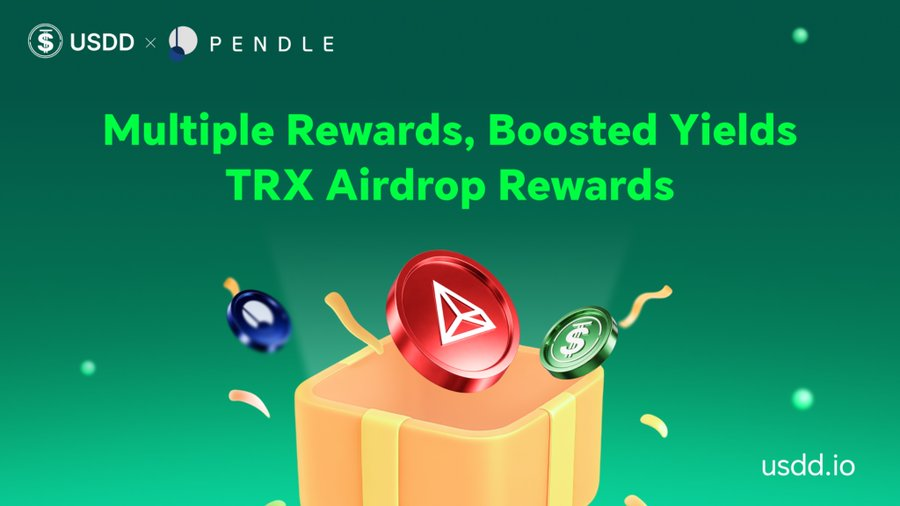
The latest incentive campaign brings exclusive TRX rewards to the sUSDD market on Pendle, giving users another compelling reason to participate in decentralized finance on TRON.
What makes this campaign stand out is the combination of multiple reward layers. Participants can benefit from USDD ecosystem incentives, additional TRX rewards, and Pendle's innovative yield marketplace, creating a more diversified earning experience. It's no surprise that the market quickly rose to #1 on Pendle's Hot Incentivized Markets, while Long Yield APY peaked at an impressive 1,667% during the incentive period.
Beyond the numbers, this reflects growing collaboration across the TRON ecosystem. By aligning stablecoin utility, yield innovation, and ecosystem incentives, USDD continues to build practical use cases that encourage broader DeFi participation and long-term ecosystem growth.
@usddio@justinsuntron #TRONEcoStar
🚀 安全没有终点,只有不断进步。
TRON 在 Nile Testnet 推出后量子签名功能,再次体现了其对于区块链长期安全发展的重视。
通过开放测试环境,开发者能够率先体验抗量子密码技术,并验证未来应用在新型加密体系下的运行表现。这不仅有助于提升开发能力,也为整个生态积累更多实践经验。
随着区块链不断发展,底层安全能力的重要性将持续提升。提前准备、持续优化,将帮助整个 Web3 生态更从容地面对未来技术变革。
TRON 正一步步构建更加安全、更加可靠、更加面向未来的区块链网络。
@trondao@justinsuntron #TRONEcoStar
💎 When strong infrastructure meets meaningful incentives, DeFi adoption accelerates.
USDD continues expanding opportunities for yield seekers by introducing multiple rounds of exclusive TRX incentives to the sUSDD market on Pendle. The initiative rewards users who participate in one of the fastest-growing yield markets within the TRON ecosystem.
The response from the community has been remarkable. The sUSDD market secured the #1 position on Pendle's Hot Incentivized Markets leaderboard, demonstrating growing confidence in the protocol. During the campaign, Long Yield APY climbed as high as 1,667%, creating an attractive opportunity for users exploring innovative yield strategies.
This collaboration showcases how ecosystem partnerships can generate real value. By combining Pendle's yield infrastructure with USDD's stable asset ecosystem and TRON's incentive support, participants gain access to diversified earning opportunities while contributing to deeper liquidity across DeFi.
As the ecosystem evolves, initiatives like these continue to strengthen the utility and adoption of decentralized financial products.
@usddio@justinsuntron #TRONEcoStar
🛡️ Security is a journey, not a destination.
TRON's decision to introduce post-quantum signatures on the Nile Testnet reflects a proactive mindset toward blockchain security. Instead of waiting for future challenges, the ecosystem is giving developers the tools to begin exploring tomorrow's cryptographic standards today.
By testing quantum-resistant technologies in a public environment, developers can better understand implementation strategies while contributing to stronger blockchain infrastructure.
Preparing for the future requires continuous collaboration, experimentation, and innovation. Every improvement made today strengthens the decentralized applications of tomorrow.
TRON continues to demonstrate that lasting blockchain success depends not only on adoption, but also on building security that evolves with technology.
@trondao@justinsuntron #TRONEcoStar
4/ 🎉 USDD Added Multiple Rounds of Exclusive TRX Incentives to the sUSDD Market on Pendle
USDD introduced multiple rounds of exclusive TRX incentives for the sUSDD market on @pendle_fi. The market also ranked #1 on Pendle's Hot Incentivized Markets leaderboard, with Long Yield APY reaching as high as 1,667%.
https://t.co/rtRIFrw1eu
https://t.co/4zH7NL8SXU
https://t.co/zuvntJdTCh
🚀 Yield opportunities continue to expand as USDD strengthens the sUSDD ecosystem on Pendle.
To reward long-term participation, USDD introduced multiple rounds of exclusive TRX incentives for the sUSDD market on Pendle, giving users even more reasons to explore yield strategies within the TRON DeFi ecosystem.
The momentum quickly became visible. The sUSDD market climbed to #1 on Pendle's Hot Incentivized Markets leaderboard, reflecting strong community interest and active participation. At its peak, the Long Yield APY reached an impressive 1,667%, highlighting the significant incentive program available during the campaign.
By combining USDD rewards, exclusive TRX incentives, and Pendle's innovative fixed-yield infrastructure, users have access to a more flexible way to manage yield opportunities while participating in a growing DeFi ecosystem.
As collaborations across the TRON ecosystem continue to deepen, initiatives like these demonstrate how strategic incentives can boost liquidity, strengthen adoption, and create greater utility for decentralized finance participants.
@usddio@justinsuntron #TRONEcoStar
4/ 🎉 USDD Added Multiple Rounds of Exclusive TRX Incentives to the sUSDD Market on Pendle
USDD introduced multiple rounds of exclusive TRX incentives for the sUSDD market on @pendle_fi. The market also ranked #1 on Pendle's Hot Incentivized Markets leaderboard, with Long Yield APY reaching as high as 1,667%.
https://t.co/rtRIFrw1eu
https://t.co/4zH7NL8SXU
https://t.co/zuvntJdTCh
🔬 Today's experiments shape tomorrow's blockchain standards.
The activation of post-quantum signatures on the TRON Nile Testnet creates a valuable environment where developers can experiment with advanced cryptographic technologies before they reach wider adoption.
Rather than viewing security as a one-time upgrade, TRON continues to treat it as an ongoing process of research, testing, and improvement. Introducing quantum-resistant signatures into a live testnet reflects a commitment to long-term ecosystem resilience.
Every successful blockchain prepares not only for current demand but also for future technological shifts. Giving developers early access to these tools encourages innovation while strengthening the overall network.
As Web3 continues evolving, investments in foundational security will become increasingly important—and TRON is already taking meaningful steps in that direction.
@trondao@justinsuntron #TRONEcoStar
🌐 Building resilient blockchain infrastructure means thinking decades ahead.
With NIST-standardized post-quantum signatures now available on the TRON Nile Testnet, developers can begin exploring cryptographic techniques designed to address future security challenges before they become mainstream.
Blockchain technology continues to mature, and long-term sustainability depends on proactive research rather than reactive upgrades. Testnet deployments like this provide valuable opportunities to validate implementation methods while encouraging community participation.
Strong ecosystems evolve through continuous innovation. Alongside improvements in scalability, interoperability, and user experience, advanced cryptographic research is becoming another essential pillar of blockchain development.
By embracing post-quantum security research today, TRON is helping lay the groundwork for a more resilient decentralized ecosystem capable of supporting the next generation of global Web3 applications.
@trondao@justinsuntron #TRONEcoStar
🚀 Innovation doesn't stop at faster transactions—it extends to stronger security.
TRON's latest Nile Testnet upgrade introduces post-quantum cryptographic signatures, giving the developer community access to one of the technologies expected to play an important role in blockchain's long-term evolution.
Quantum-resistant cryptography is designed to prepare decentralized networks for future computational advances. By making these capabilities available in a testing environment, TRON encourages experimentation while helping developers better understand emerging security models.
The blockchain industry evolves rapidly, and resilient infrastructure requires continuous improvement. Exploring advanced cryptography today allows protocols to adapt more efficiently as technology changes tomorrow.
Every successful ecosystem invests not only in current performance but also in long-term reliability. This latest milestone demonstrates TRON's commitment to building secure infrastructure that can continue supporting global Web3 adoption for years to come.
@trondao@justinsuntron #TRONEcoStar
🧩 Future-proofing blockchain starts long before the future arrives.
The introduction of post-quantum signatures on the TRON Nile Testnet reflects a forward-looking approach to blockchain development. Instead of waiting for quantum computing to become a practical threat, TRON is giving developers an opportunity to explore next-generation cryptographic standards today.
By integrating NIST-standardized quantum-resistant signatures into a public testing environment, developers can begin evaluating compatibility, performance, and implementation strategies for future decentralized applications.
Security has always been a moving target. Every generation of technology requires stronger foundations, and blockchain is no exception. Continuous research and experimentation help ensure that decentralized infrastructure remains resilient as computing capabilities evolve.
Preparing for tomorrow's security challenges is just as important as solving today's scalability needs. With every technical milestone, TRON continues to reinforce its commitment to building a blockchain ecosystem designed to stand the test of time.
@trondao@justinsuntron #TRONEcoStar