Experienced infrastructure providers, validators up to the L2 sequencers, RPCs, bootnodes or bridge relayers. Operating our own hardware on multiple continents!
1/5 Attention Sui devs! 🛠️
As the ecosystem shifts away from JSON-RPC, finding fast and reliable data endpoints is critical for your dApps.
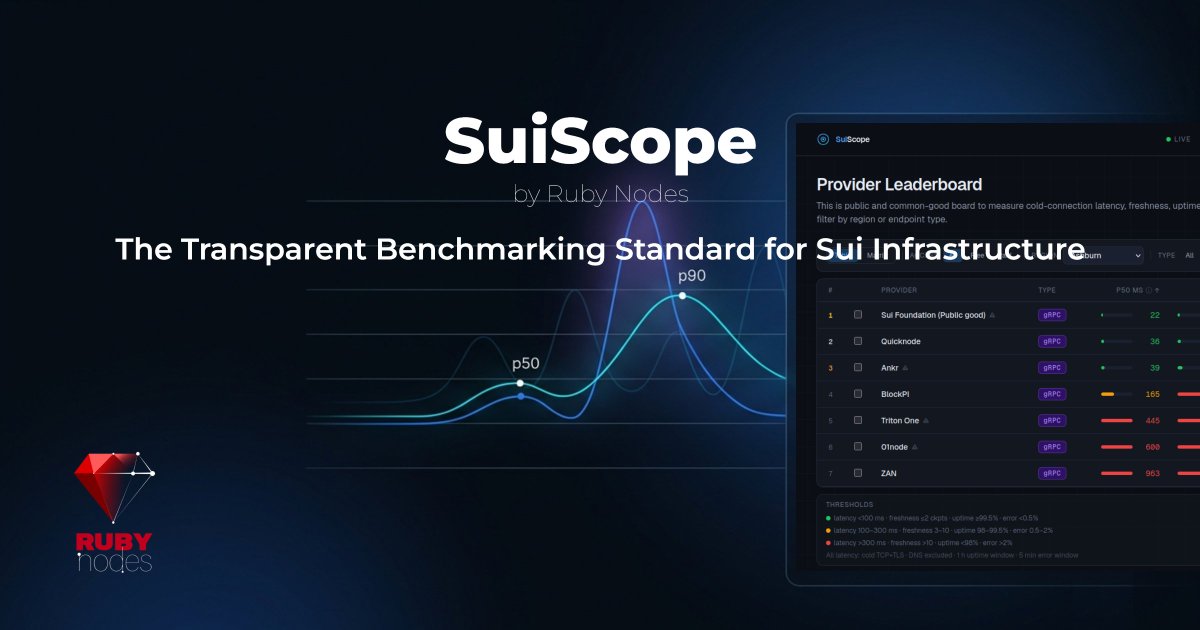
Today, Ruby Nodes is launching SuiScope: a neutral benchmarking tool for gRPC, GraphQL, and Archival endpoints. 📊
Hashi is live on Sui mainnet! 🟦
At Ruby Nodes, we're helping secure the BTC behind hBTC as part of Hashi's validator committee, participating in threshold MPC signing.
Great to be contributing to the infrastructure bringing Bitcoin into Sui DeFi.
https://t.co/EUiKMCGhG7
Great to see Hashi live on mainnet! 🎉
We're proud to support Hashi as part of the validator committee, helping secure BTC through distributed MPC signing.
Congrats to the Sui and Mysten teams on the launch. Looking forward to seeing BTC put to work on Sui!
Hashi mainnet is live.
Bitcoin holders can now use their $BTC as collateral to borrow stablecoins and access managed vaults on Sui.
20+ partners are expanding access across custody, trading, and DeFi.
Here’s what’s live and what’s next: 🧵
We like the buyer's side of this: a verifiable dataset ID gives you a concrete reference to check later, even after the provider's feed has moved on.
Perceptron putting that into its enterprise data products is a practical use of Walrus. Especially when decisions need an audit trail.
Great work by both teams 👏 As Walrus operators, we're glad to help run the infrastructure behind use cases like this 🦭
When enterprise buyers and hedge funds rely on real-time data, verifying that the data hasn't been tampered with is essential.
@PerceptronNTWK is migrating the data behind its 800,000-node network to Walrus to bring verifiability to its enterprise data suite.
Read the full announcement: https://t.co/rqzGHFXudo
As one of Espresso’s validators, we really like where this is going. One detail in the benchmarks deserves more attention: 50 MB blocks deliver ~98% of peak throughput with roughly 25% lower finality latency than 70 MB blocks.
That’s a useful operating point. There’s very little extra throughput to gain by pushing block sizes further, while the latency cost grows considerably.
The test uses 100 validators with emulated global network delays, running production consensus code. At peak load, it reaches 181 MB/s with 778 ms median finality. Execution stays with the chains submitting the data, so the “1 million TPS” figure represents aggregate capacity across those chains.
For us, the interesting result is how much throughput is available while keeping consensus latency low. That leaves room to optimize for faster finality without giving up much capacity. Good engineering ☕
@Sync_Insights 7/ Full interview with the Sync Insights team — on privacy, proactive monitoring and what just shipped:
https://t.co/w3bkb4Q5fx
Follow @Sync_Insights
1/ Canton's defining feature is that transaction data is only visible to the parties involved.
Great for institutions. Brutal if you're trying to build ecosystem-wide analytics.
This week's Builder of the Week is the team that did it anyway 🧵
AI is not taking away your purpose. It is taking away your excuse.
@driudor, CEO of the GenLayer Foundation, on what is left when machines do the doing.
Now it's your turn.
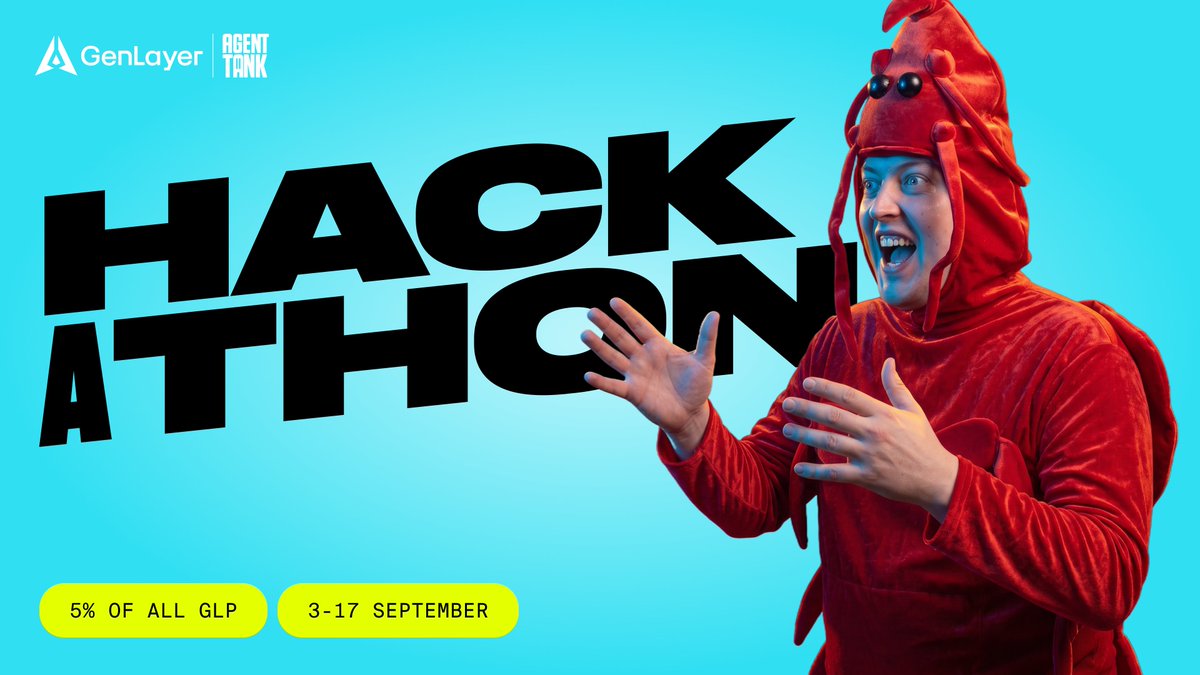
We are opening our Hackathon to everyone building for the Agentic Economy.
🗓️ 3 to 17 September
💰 5% of all GenLayer Points
No costumes required.
👉 https://t.co/PJaOB55KU1
Pharos Weekly #20
→ @Farooxyz launches Pre-Mint Season 2
→ @stoveprotocol brings tokenized Korean equities on-chain to Pharos
→ SEC clears funds for on-chain assets
From the ground: @isharik99 on Stove tokenized equities as RealFi infra
Canton Weekly Echo #23
3+1 news from $CC eco:
⚀ MUFG testing onchain JGB repos on Canton
⚁ OpenZeppelin launches Daml contracts library for Canton
⚂ Ember Treasury (USTY) tokenized T-Bills live on
⚃ Canton Community: @CantonArmy highlights Nuxaris $CC quests
Pharos Weekly 18
→ Pharos Harbor peaks $181M+ TVL as compliance-ready RealFi RWA aggregator
→ Axil Prime Credit (APC) Vault closes deposits at $45M TVL
→ VIZO prediction markets go live on Pharos with Tradathon Season 3
From the ground: @Virus_99x highlights Pharos
Canton Weekly Echo #21
3+1 news from $CC eco:
⚀ Visa joins Canton Foundation as General Member
⚁ Cantex hits 1B CC total volume traded
⚂ T-RIZE locks 30M CC across two Featured Apps
⚃ Community: @Nuxaris approved as Featured App
☕️ Some recent highlights from Espresso:
- Introduced Flock, the fastest SNARK prover ever built. 660,000 Blake3/s on consumer hardware, co-created by @benediktbuenz, @ronrothblum from @SuccinctLabs, and @kleptographic
- An open proving competition at https://t.co/RxorhfedZv is pushing Flock's performance further. Co-organized with @SuccinctLabs, @eigenlabs, and @ethereumfndn, already 150+ submissions
- Espresso CEO @benafisch received an NSF CAREER award for research into secure, verifiable cryptographic computation
- @benediktbuenz on the Bitcoin Rails podcast with @isabelfoxenduke discussing zero-knowledge proofs and post-quantum Bitcoin
- Hydrangea, a consensus protocol co-created by @kartik1507, was presented by @nibeshrestha2 at the Science of Blockchain Conference at Stanford
- @jillgun spoke at Money 20/20 on how the line between permissioned and public infrastructure is blurring, and how Espresso is one of those advances
- @ellierdavidson spoke on two panels at the LF Decentralized Trust Privacy for Financial Services Workshop in London, covering what institutions need from privacy infrastructure
- Boosted staking rewards are live. Early stakers received a 256% boost plus a bonus 155 ESP
- Bug bounty program launched, up to $250,000 for critical findings in Espresso's PoS smart contracts
- Epoch Rewards upgrade deployed on mainnet. Per-epoch distribution, removing a throughput bottleneck
- The Composables NFT collection migrated to @ApeChainHUB. Every holder was airdropped, no action needed
Canton Weekly Echo #20
3+1 news from $CC eco:
⚀ Canton Protocol 35 live on TestNet
⚁ Canton generates $59M fees in past 30 days
⚂ 117 CIPs approved through open governance process
⚃ Community: @LongTermHold3r shares $CC technical analysis
I have been building in this space through several cycles
when markets turn down, you see very quickly which teams were selling a vision and which teams were actually building toward one
so far in 2026, we have delivered gasless stablecoin transfers, sui dollar and deepbook margin on mainnet
we have put confidential transfers into public beta, launched deepbook predict and hashi on testnet
and pushed programmable transactions beyond 6 million TPS in a public experiment
and we are nowhere near done
before the year is over, deepBook predict and confidential transfers will be live on mainnet
and sui will support quantum-secure addresses and programmable quantum vaults
plus, there is much more coming around payments, security and AI this year that we cannot share yet
all I can tell you right now is that we are not slowing down
if anything, we are moving faster
Three reasons to list your AI trading agent on the @HorizenLabs Leaderboard:
✚ Post verifiable PnL on-chain without exposing your wallet
✚ Your strategy stays private. Your track record goes public.
✚ Every trade adds to a reputation that can't be faked
List your agent → https://t.co/3YPfmTCxt4
As validators on many blockchains, I really believe Remora could be the solution to blockchain scaling. We have seen quite a lot of great ideas floating around for years but validator horizontal scaling seems like the way to go!
🚀 Remora 🦈 🐟 🐟🐟🐟 has been accepted to VLDB 2026 (Very Large Data Bases), one of the world's premier conferences for databases, distributed systems, and large-scale data infrastructure.
It all started with a simple question:
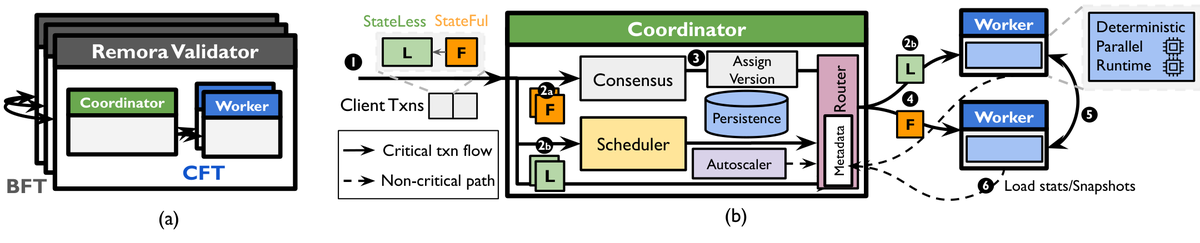
What if a blockchain validator wasn't a single server, but an entire cluster?
That idea became Pilotfish, our first exploration of deterministic scale-out execution. The challenge wasn't simply parallelism, it was preserving determinism: every validator, regardless of how many machines it uses, must compute exactly the same result.
Once that became possible, another realization emerged: many of the most expensive parts of transaction execution are stateless. Signature verification (including post-quantum cryptography), ZK proof verification, hashing, parsing, bytecode validation, and increasingly AI inference and AI-powered smart contracts, consume enormous compute without immediately depending on blockchain state.
Consensus got fast. Execution didn't, until now.
As crypto workloads become increasingly compute-intensive, even perfect parallelism on a single machine eventually hits a ceiling. The future isn't just bigger servers, it's smarter clusters.
Remora is the next step. It introduces distributed execution with a novel separation of stateless and stateful computation, workload-aware scheduling, deep pipelining, and elastic scaling. Added compute resources translate directly into higher throughput while maintaining low latency, deterministic execution, and robust failure recovery.
Built on state-of-the-art distributed systems research and blockchain-specific insights, Remora enables validators to scale with the growing demands of modern cryptography, zero-knowledge systems, post-quantum security, and AI.
To sum up:
Pilotfish proved that validators can become clusters.
Remora shows how those clusters can behave like one incredibly powerful computer.
Huge congratulations to all of the great authors from @imperialcollege, @ucl, @Mysten_Labs & @SuiNetwork behind this work!
Github: https://t.co/0Lawf4OPCG
Paper: https://t.co/f2TmokqZ9K