SECRETARY OF HEALTH ROBERT F. KENNEDY JR. VISITS NAVAJO NATION
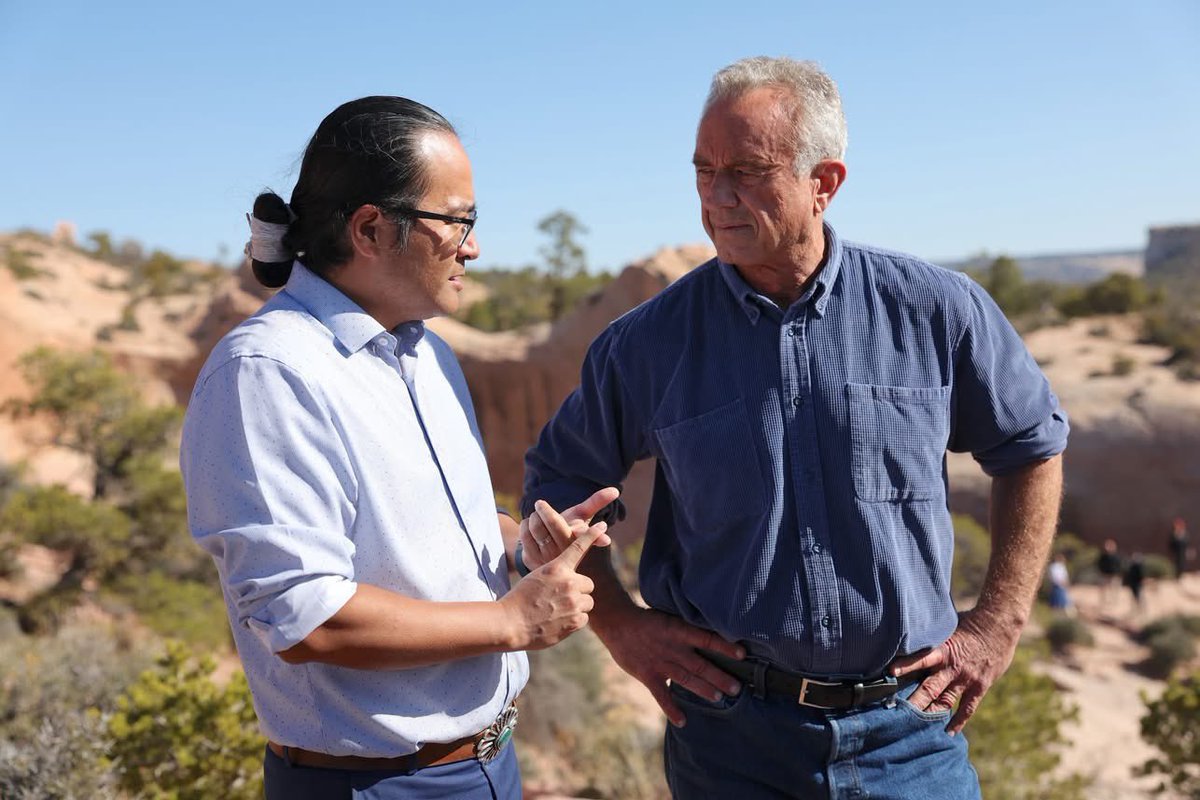
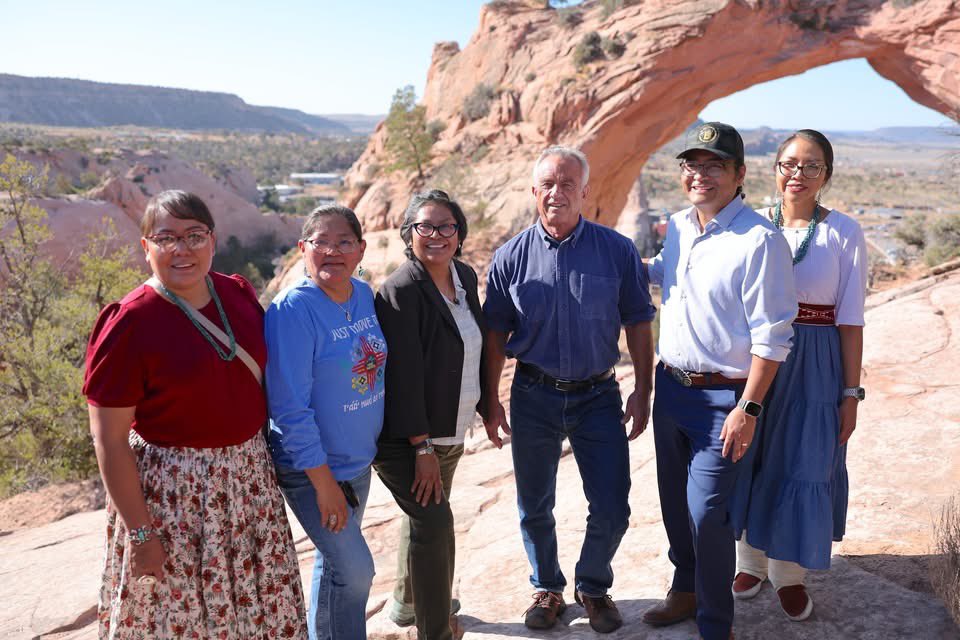
WINDOW ROCK, Ariz. — Against the backdrop of the iconic Window Rock arch, Navajo Nation President Buu Nygren sat on a sandstone cliff with U.S. Secretary of Health and Human Services Robert F. Kennedy Jr. and Council Delegate Germaine Simonson to discuss critical healthcare access issues facing the Navajo people—and the solutions rooted in sovereignty, tradition, and self-reliance.
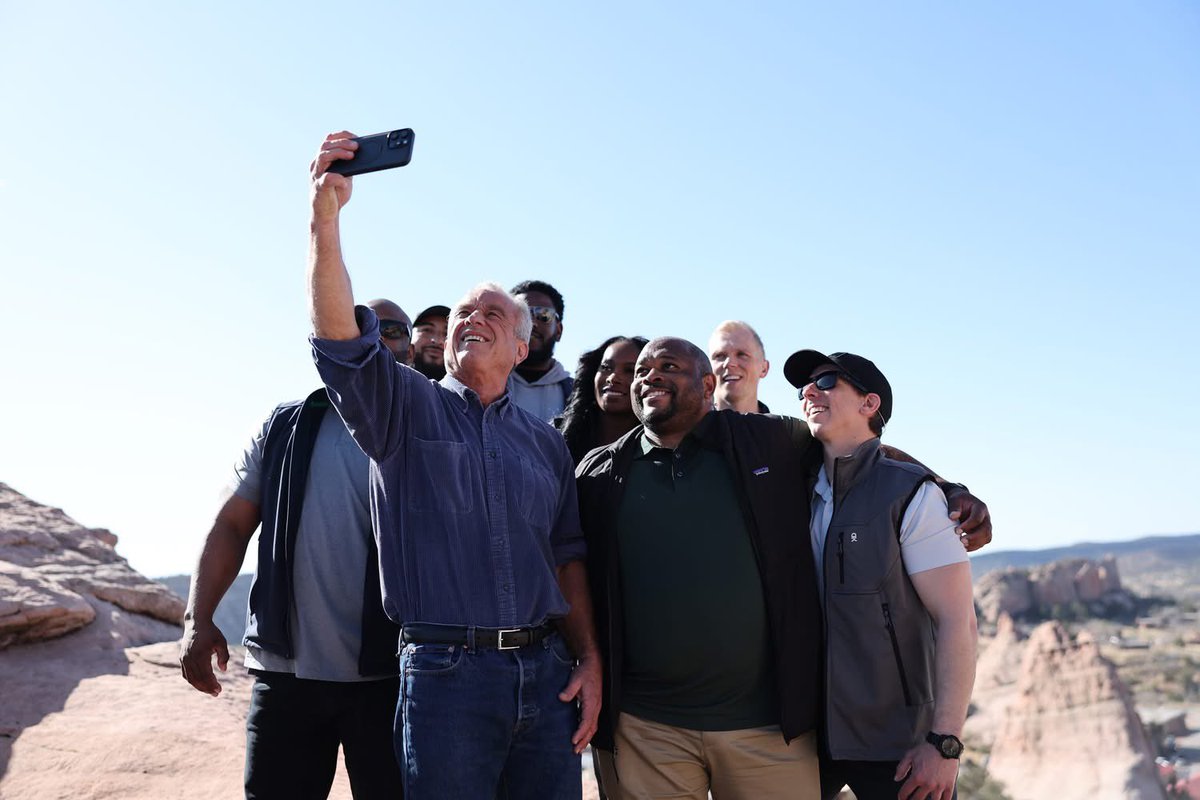
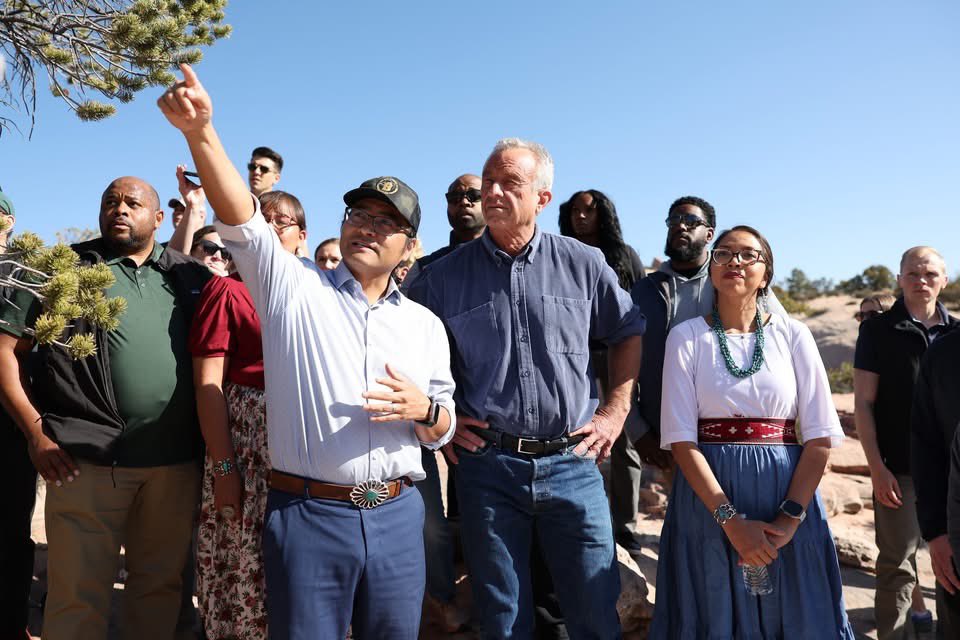
Secretary Kennedy, on a national tour, made a significant stop on the Navajo Nation to meet with tribal leaders including President Nygren, First Lady Jasmine Blackwater-Nygren, Speaker Crystalyne Curley, members of the 25th Navajo Nation Council, and officials from the Navajo Department of Health. The purpose of the visit was to better understand how Navajo programs are maximizing federal resources to serve thousands of Navajo people across the Nation.
"I know that you're no stranger to Navajo," President Nygren told Secretary Kennedy. "With your support and help, we will build the Gallup Indian Medical Center because it is in such, such need. It will expand to where we do not have to go to Albuquerque or Phoenix and our people will have a world-class facility."
The visit was deeply personal for Secretary Kennedy, who last set foot on the Navajo Nation 60 years ago alongside his father. His return began with a sunrise hike with tribal leaders from the base of the tribal capital to Window Rock. They were met with sacred prayer, traditional songs by a medicine healer, and ceremonial dances performed by the Dinétah Dancers at the Navajo Veterans Memorial Park.
President Nygren provided additional context about the urgent health disparities on the Nation and the strain caused by the Indian Health Service’s 30 percent vacancy rate.
“As President, I want to emphasize the importance of protecting and maintaining tribal sovereignty among food and healthcare for the Navajo Nation,” President Nygren said.
Secretary Kennedy expressed strong support, making a clear commitment to address staffing shortages and cuts in the Indian Health Service.
“By lifting the IHS hiring freeze and rescinding the hundreds of employee terminations,” Secretary Kennedy said, “it will not happen.”
Secretary Kennedy emphasized that the federal government must go further to empower Native communities.
"Today we learned many things that HHS could be doing to improve the condition of Navajo health...,” he said, adding that securing water will allow the Navajo people to build homes and become self-sustaining again.
A focal point of Secretary Kennedy’s visit was the Navajo Nation’s pioneering of the junk food tax, formally known as the Healthy Diné Nation Act. Passed in 2014 through grassroots mobilization by the Diné Community Advocacy Alliance, the law promotes healthy lifestyles and combats rising rates of diabetes and obesity.
The Indian Health Service reports that one in five Navajo Nation residents lives with diabetes, and approximately 75,000 individuals are prediabetic.
Revenues from the junk food tax have been redirected to support community wellness projects through the Navajo Division of Community Development, according to the Office of the Navajo Tax Commission.
President Nygren also emphasized the need for formal tribal consultations to ensure that the trust and treaty responsibilities are upheld, especially as recent changes at the federal level have impacted social services.
“We strive to live for 102 years as Navajo people, and also with your help and assistance, we look forward to reestablishing and protecting some of the services that your department provides,” President Nygren told Secretary Kennedy.
President Nygren added, “Secretary Kennedy’s visit today shows that our voices are being heard at the highest levels. We’re not asking for charity, we’re reaffirming equity, and we’re building solutions grounded in sovereignty…the Navajo Nation is ready to lead.”
@Useful_Idiot02@chris_opfer@libsoftiktok The company that created the product had a target market and I was simply answering your question(s) with information from the box I saw. I’m not part of their target market and would not buy one, nor would I recommend those in their target market to buy one.
@Useful_Idiot02@chris_opfer@libsoftiktok I guess the appeal would supposedly be for younger children so that they’re not holding a screen with games on it? Kinda like an Alexa device for questions, audio entertainment, and video calls? When I saw the box, I asked myself if it could serve for security or surveillance.
@sumofagum@60Minutes Mexico’s 1857 Article 10 was closest to the 2nd Amendment:
‘Every man has the right to keep and to carry arms for his security and legitimate defense. The law will indicate which arms are prohibited and the penalty for those who would carry them.’
Their right was infringed.
My nine year old granddaughter said something profound recently. First she said I was funny. When you get my sense of humor, you have my attention.
Then she said that I wasn’t like other grandparents. They say everything you say or do is just too wonderful for words. Everything is great, stupendous (I translated that word from 9 year old patois). You don’t do that. You do praise things I do, but you’re honest and tell me when it’s not good enough. You even sometimes say it’s crap. (That generally applies to things she likes such as butt jokes or cheesy comics.)
She is a very bright child, and I am a firm believer in encouraging and affirming everyone, but particularly children. But I also want to be honest, and I want everyone to work on improving what they do, even me. I was astonished at her insight, I now realize I have to tell her that. But there’s a bigger point here. We need to have standards.
There was a recent story in Baltimore where a child was promoted through four years of high school and was in the top half of his class. But he had only passed three classes, and he was now told he had to repeat Grade 9. The story didn’t give us all the details, but he was essentially lied to for four years. I obviously can’t comment on the quality of the teaching, but they failed that child. (No pun intended)
We fail our children if we don’t praise them (even when they are fully grown). But we also fail them if we can’t say you can and should do better. If you don’t know how, point them to where that help is available. Tell them it doesn’t always come easy. Encourage them that they can accomplish much if they’re willing to work at it. Warn them that they may not be good at everything. And most importantly, in the midst of all the effort, let them be children.
I do not like butt jokes or goofy comics. She does for now. I let her enjoy them. But you would be shocked at some of the things she also enjoys and is interested in. Her talents, insight, and interests are not all my doing, though I confess my guilt on some subjects. Great credit goes to her Mom and Dad, and to her Aunts and Uncle, and my Wife. That could be a key asset in this whole growing up thing, the support of an extended family.
If you don’t have children or grandchildren, there are probably some around who don’t have a supportive extended family, or even a family. They could use your time and your encouragement. The rewards may go way beyond being told you’re funny.
@MJJohnsonauthor We need more people to have a merit-based rather than participation-based perspective when it comes to how we view children. Respecting their dignity means honest feedback, which it appears she has gifted you in return.
@Nevyn05217348 Seems realistic… the 80/20 rule. Was that the ratio for who in the public was willing to violate the rights of others in 2020 and beyond? It would seem easier to prepare for the worst but hope for the best regardless of title or profession.
@Nevyn05217348 This reminds me. Lately I’ve been looking into what’s not being discussed when it comes to health issues (like diabetes and neurodivergence) and I’m starting to feel like cortisol disregulation and dopamine disregulation need to be talked about more.
@AlphaRichard@CashmereRebel1@lacroicsz Such a statement here mirrors the very behavior it intends to criticize, without necessarily implicating the post it responds to. To be clear, disagreeing about what constitutes appropriate medical care for trans-identifying youth does not inherently equate to bigotry.