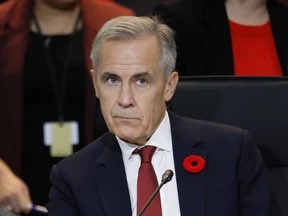
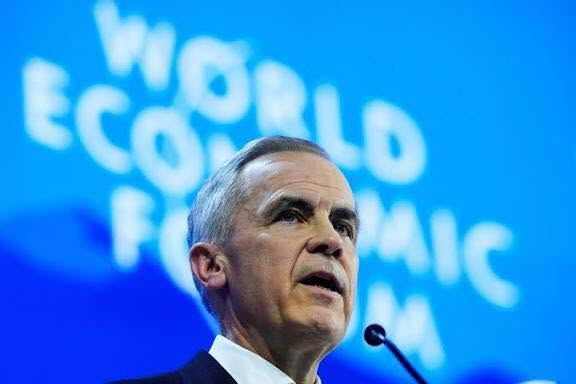
Carney had a very successful year.
He traveled and signed $ 152 Billion worth of deals for Brookfield as Prime Minister
Here are the countries that Carney travelled to that resulted in signed deals for Brookfield before and after a visit
This chronological timeline places Mark Carney’s 2026 international travel dates alongside the announcement and closing milestones for Brookfield’s major deals in those countries.
Brookfield–Qai $20B AI Infrastructure Joint Venture (Qatar)
December 9, 2025
Brookfield Asset Management and Qai (a subsidiary of the Qatar Investment Authority) announce a $20 billion USD strategic joint venture to build AI infrastructure in Qatar and select international markets—39 days before Carney arrives in Doha.
Carney Visits France
January 5–6, 2026
Prime Minister Mark Carney travels to Paris for the Coalition of the Willing leaders' meeting. Later that month, local French authorities award Brookfield’s Data4 consortium the €5 billion Escaudain AI data center project.
Carney Visits Qatar
January 17–19, 2026
Carney makes the first visit by a sitting Canadian Prime Minister to Doha, meeting Amir Sheikh Tamim bin Hamad Al Thani to announce a strategic partnership covering AI, energy, and Qatari sovereign investment in Canadian infrastructure.
Brookfield Agrees to Buy Dentsu Tokyo HQ (Japan)
February 11–12, 2026
Brookfield announces a $1.9B–$2B (¥300B) agreement to acquire Dentsu Group’s Tokyo headquarters tower—roughly three weeks before Carney's visit to Japan.
Carney’s Asia-Pacific Tour: India, Australia & Japan
February 27 – March 7, 2026
Carney completes a three-nation bilateral tour:
India (Feb 27 – Mar 2): Meets PM Narendra Modi in Mumbai and New Delhi.
Australia (Mar 3–6): Meets PM Anthony Albanese in Sydney and Canberra.
Japan (Mar 6–7): Meets PM Sanae Takaichi in Tokyo.
Carney Visits the United Kingdom
March 15–16, 2026
Carney travels to London for bilateral talks with UK Prime Minister Keir Starmer and an audience with King Charles III.
Brookfield Closes National Storage REIT Buyout (Australia)
April 21–22, 2026
Roughly six weeks after Carney’s Australian visit, the Supreme Court of New South Wales approves and implements Brookfield’s $6.8 billion (AUD) take-private acquisition of National Storage REIT. (In the same month, Brookfield also sells a $3B AUD minority stake in La Trobe Financial.)
Carney Visits the United States
May 27–28, 2026
Carney travels to New York City to address the Economic Club of New York.
Brookfield Expands French AI Commitment to €30B (France)
June 2–3, 2026
At the Choose France Summit—10 days before Carney returns to Paris—Brookfield commits an additional €10 billion to its French AI data center program, bringing its total French pledge to €30 billion across northern campuses in Cambrai and Escaudain.
Carney Visits France for Bilateral & G7 Summits
June 12–17, 2026
Carney meets President Emmanuel Macron in Paris (June 12–13) and attends the 52nd G7 Summit in Évian-les-Bains (June 15–17).
U.S. DOE Announces $17.5B Westinghouse Financing (United States)
June 23, 2026
Less than four weeks after Carney’s New York visit, the U.S. Department of Energy announces $17.5 billion in conditional financing to support the deployment of nuclear reactors by Westinghouse (51% owned by Brookfield).
Carney Visits Saudi Arabia
July 8–10, 2026
Making the first bilateral visit by a sitting Canadian Prime Minister in 25 years, Carney meets Crown Prince Mohammed bin Salman in Jeddah to expand trade and technology ties.
Carney Attends FIFA World Cup Final (United States)
July 19, 2026
Carney travels to East Rutherford, New Jersey, attending the World Cup final alongside U.S. President Donald Trump.
Brookfield & CPP Announce $5.2B LXP Acquisition (United States)
July 20, 2026
The day after Carney's New Jersey trip, Brookfield and CPP Investments announce a $5.2 billion all-cash definitive agreement to take warehouse REIT LXP Industrial Trust private.
Brookfield Closes $2B PIF-Anchored Middle East Fund (Saudi Arabia)
July 27, 2026
Just 17 days after Carney departs Jeddah, Brookfield announces the ~$2 billion first close of Brookfield Middle East Partners, anchored by Saudi Arabia’s Public Investment Fund (PIF).
Brookfield Launches $600M Lumara Platform & Buys Tokyo Apartments
August 2026
Approximately five months after Carney’s Asia tour, Brookfield launches the $600 million Lumara renewable energy platform in India (August 7) and completes a ¥100 billion (~$650M–$700M) bulk acquisition of 50 residential apartment buildings in Japan.
Carney Visits the UK, France, and the United States
September 16–23, 2026
Carney makes back-to-back stops in Liverpool (Sept 16), Strasbourg and Saint-Pierre and Miquelon (Sept 16–20), and New York City for the UN General Assembly (Sept 21–23).
Brookfield Commits Up to $600M to ACME Green Fuels (India)
September 17, 2026
Roughly 6.5 months after Carney's New Delhi visit, Brookfield’s Global Transition Fund commits up to $600 million to Indian developer ACME Cleantech Ventures for green ammonia and methanol projects.
U.S.–Korea $80B Westinghouse Nuclear Framework (United States)
September 30 – October 1, 2026
One week after Carney leaves New York, a U.S.–Korea framework agreement advances the deployment of $80 billion worth of Brookfield-backed Westinghouse nuclear reactors on U.S. federal sites.
Brookfield Commits ₹43B ($450M) to ESR India Warehouses (India)
October 7, 2026
Seven months after Carney's visit to India, Brookfield commits ₹43 billion (~$444M–$450M) to acquire eight industrial and logistics parks from ESR India.
Brookfield, Drax & Qai Announce £20B UK AI Data Center (United Kingdom)
November 3, 2026
Roughly seven weeks after Carney’s September UK stop, Brookfield, its compute arm Radiant, and Qatar’s Qai announce a partnership with Drax Group for a gigawatt-scale AI data center in North Yorkshire valued at up to £20 billion (£2.5B Phase 1).
Carney's 2026 Budget: A Mountain of Government Spending
I've spent years studying economics, political history, statistics, and most recently venture capital and private equity. One lesson keeps coming back: good intentions don't create prosperity. Productivity, investment, incentives and sound decisions do.
I've gone through the Liberal government's new federal budget, and I'll give credit where it's deserved.
Carney has finally acknowledged some of the structural problems Canada's economy has suffered from for years. Weak productivity, insufficient business investment, and an economy that has relied too heavily on population growth rather than increasing output per worker.
The proposed Productivity Mega Deduction is a step in the right direction. Reducing the tax burden on productive investment gives businesses more incentive to purchase equipment, adopt technology, expand and compete.
That's basic economics. Something Liberal Ottawa should have taken more seriously years ago.
But here's where the wheels start coming off.
The Liberals are projecting a $62.3 billion deficit this fiscal year. They're forecasting another $52.9 billion deficit in 2030–31.
Meanwhile, federal debt servicing costs are projected to rise from $60.2 billion to $85.5 billion annually over the same period.
Think about that.
We're borrowing tens of billions annually while an increasing share of federal resources goes toward servicing past borrowing.
And we're supposed to celebrate because Ottawa promises to balance its operating budget?
That's an accounting distinction worth understanding. The overall federal budget remains in deficit.
I've also studied how venture capital works. Successful investors don't throw money at projects because the presentation sounds impressive. They evaluate risk, expected returns, opportunity costs and whether the business can survive without endless injections of capital.
Taxpayers deserve the same discipline from their government.
The proposed $25 billion Canada Strong Fund may support worthwhile projects. But who chooses the winners? Who carries the risk? Who gets the returns? And what happens when a politically attractive investment turns into an economic failure?
These are legitimate questions, regardless of which party is in power.
I also keep hearing about affordability measures. Some will help families, and that's welcome. But you cannot build long-term prosperity simply by distributing more government benefits while the underlying costs of housing, energy and food remain high.
You improve affordability through competition, productivity, supply and rising real purchasing power.
Here's the distinction I think Canadians need to understand.
GDP growth is not necessarily prosperity. GDP per capita and productivity tell us far more about whether ordinary Canadians are actually getting ahead.
Carney's own budget forecasts real economic growth of just 1.0% in 2026 and 1.7% in 2027.
Those numbers hardly justify declaring an economic renaissance.
Canada needs an economy where entrepreneurs can invest, businesses can compete, workers can produce more, and families can keep more of what they earn.
I support policies that move us in that direction, even when they come from the Liberals.
But I won't confuse larger government investment announcements with guaranteed economic growth, or a smaller projected deficit with fiscal responsibility.
The real test of this budget won't be how much money Ottawa announces. It will be how much additional prosperity Canadians actually experience.
Show me stronger productivity, rising real GDP per capita, private investment that doesn't depend on subsidies, and meaningful control over borrowing.
Then we'll have something worth celebrating.
Until then, I'm judging this budget by its economic results, not its political advertising.
Si vous ne posséderez rien, alors une question devient obligatoire.
Qui possédera tout ?
Personne ne la pose. Moi je la pose. Et la réponse est sous vos yeux depuis 30 ans.
Marx voulait centraliser les moyens de production entre les mains de l'État. Ça a échoué partout, dans le sang et la pénurie. Mais l'idée n'est jamais morte. Elle a juste appris à ne plus se présenter sous son nom.
Le communisme du XXe siècle confisquait les usines par la force. Celui du XXIe ne confisque rien. Il régule, il taxe, il subventionne, il oriente. Et à la fin, vous êtes toujours propriétaire sur le papier, mais vous ne décidez plus de rien.
C'est ça, le projet européen dans sa version finale. Et je vais vous le démontrer, moyen de production par moyen de production.
La terre. Votre agriculteur ne décide plus ce qu'il plante, comment il le plante, ni à quel prix il vend. Bruxelles décide via la PAC, les normes, les quotas, les accords de libre-échange signés au-dessus de sa tête. Il est propriétaire de sa ferme comme un locataire est propriétaire de ses meubles.
L'énergie. Le prix de votre électricité est fixé par un marché européen indexé sur le gaz, alors que la France produit l'une des électricités les moins chères du monde grâce au nucléaire. Qui décide ? Pas vous.
L'industrie. Quotas carbone, normes, taxonomie verte qui dit aux banques quelles entreprises ont le droit d'être financées. Interdiction votée des moteurs thermiques neufs en 2035. On ne nationalise plus l'usine. On lui dicte ce qu'elle a le droit de produire.
La monnaie. Une banque centrale non élue fixe le prix de l'argent pour tout le continent. Et maintenant, l'euro numérique : une monnaie programmable émise directement par cette même institution.
Votre épargne. Bruxelles a désormais un plan officiel pour "orienter" les milliers de milliards d'euros que les Européens ont sur leurs comptes vers les "priorités stratégiques" de l'Union. Votre argent, leurs priorités.
La dette. En 2020, l'Union a franchi la ligne qu'elle avait juré de ne jamais franchir : 750 milliards d'euros de dette commune. Un pouvoir budgétaire central, sans peuple européen pour le contrôler.
Terre, énergie, industrie, monnaie, épargne, dette. Tout. Remonte. Au même endroit.
Une technostructure que personne n'a élue, que personne ne peut renvoyer, et dont personne ne connaît le visage de ceux qui écrivent vraiment les textes.
Et qui a accès à cette technostructure ?
Pas vous. Pas votre maire. Pas votre député.
Ceux qui ont des bureaux à Bruxelles. Des dizaines de milliers de lobbyistes. Et des milliardaires qui ont compris bien avant tout le monde que c'est là que le pouvoir se déplaçait.
George Soros a sa propre structure de lobbying à Bruxelles via l'Open Society. Il a cofinancé la création du Conseil européen des relations étrangères, l'un des think tanks les plus influents du continent. En 2020, il plaidait publiquement pour que l'Union émette une dette perpétuelle commune. Quelques mois plus tard, l'Union lançait sa première grande dette commune. Il finance des milliers d'ONG qui viennent ensuite "représenter la société civile" dans les consultations de la Commission.
Bill Gates, lui, est devenu le premier contributeur de l'OMS, une organisation dont les recommandations ont dicté les politiques sanitaires de l'Europe entière pendant le Covid. Il est le plus grand propriétaire privé de terres agricoles aux États-Unis. Sa fondation finance des rubriques entières dans de grands médias européens. Un homme qui n'a jamais reçu une seule voix pèse plus lourd dans la santé mondiale que la plupart des gouvernements élus.
Ils n'ont pas besoin de contrôler. Ils financent, ils conseillent, ils pilotent les experts que la Commission consulte. Le système est conçu pour que ceux qui ont l'argent et l'accès écrivent les règles, et que ceux qui votent les subissent.
Et quand ce système est corrompu, on le voit.
Qatargate : des valises de billets saisies au cœur du Parlement européen.
Pfizergate : la présidente de la Commission négocie par SMS des contrats de vaccins portant sur des milliards de doses, refuse de rendre les messages publics, et se fait désavouer par la justice européenne pour ce refus.
Voilà la démonstration complète.
On vous a appris que le communisme, c'était l'État qui possède tout. La version moderne est plus intelligente : une technostructure qui contrôle tout, alimentée par une poignée de milliardaires qui financent l'idéologie, et un peuple qui garde des titres de propriété vides de tout pouvoir.
Vous ne posséderez rien. Eux, si.
La souveraineté, ce n'est pas un slogan. C'est la capacité d'un peuple à décider de ce qu'il produit, de ce qu'il mange, de ce qu'il paie et de ce qu'il transmet. Chaque compétence transférée à Bruxelles est un moyen de production qui vous échappe.
Partagez. Ce débat ne passera jamais au 20h.
I’m gonna form the New World Order.
I’m gonna start a defence bank.
I’m gonna join the EU.
I’m gonna give my wife $1.2 billion taxpayer dollars to goof around with.
I’m going create a sovereign wealth fund with your money.
I’m gonna abolish the Indian Act.
None of these were in Mark Carney’s platform.
Racketeering Expose by Derrick Sweet
Sept 20\26
My name is Derrick Sweet. I am a 61 year old Canadian and earn my living as a stock market analyst. I follow money for a living. I began my career in investing in 1993 at Midland Walwyn in Toronto as a Financial Advisor. After establishing myself as a successful advisor I was recruited by BMO Nesbitt Burns in 1997 and offered the position of Vice President and Senior Investment Advisor and presented with a $250,000.00 signing bonus, which was a lot of money back then. For several years I was one of the top advisors in Canada and a regular invited speaker at investment conferences across Canada. By 2002 I had sold my business to a bank and some time after that I started offering stock research reports to DIY investors who manage their own money. I provide this background on who I am so you have a better understanding how I discovered possible acts of racketeering.
I have been closely following Mark Carney’s violations of the trust he was voted to uphold for too long. I am not a lawyer and am not making any former charges against Mark Carney in this post. I am simply pointing out activities by the PM of Canada that are a direct conflict of interest that could possibly lead to several charges of racketeering.
The Prosecution Case Against Mark Carney, Prime Minister of Canada (the PM)
I. The Core Allegation: "Pay-to-Play" Infrastructure
The prosecution will argue that the Prime Minister (PM) has operated a criminal enterprise where public policy and taxpayer-funded contracts were used as a vehicle to inflate the value of a private entity (Brookfield) in which he holds a direct pecuniary interest (stock options).
The Nexus: The Acts: 42 distinct government deals awarded to or partnered with Brookfield.
The Benefit: $5 billion in reported profits for the entity.
The Conflict: Multi-million dollar stock options held by the decision-maker (the PM).
II. Count 1: Breach of Trust (Criminal Code s. 122)
Under Section 122, we do not need to prove a "bribe" was paid. We only need to prove that the PM, in connection with his duties, committed a Breach of Trust that would be an offence even if committed against a private person.
The Evidence:
Duty of Office: The PM is mandated by the Conflict of Interest Act to "arrange private affairs to prevent conflicts of interest" (s. 5).
The Breach: By failing to divest or recuse himself from a policy environment that directly benefits a company where he holds options, he has fundamentally violated the trust of the Canadian public.
Legal Standard: Per R. v. Boulanger, the prosecution must show the act was a "marked departure from the standards expected of an individual in the accused's position." Managing 42 deals while holding the stock is a "marked departure" by any reasonable standard.
III. Count 2: Frauds on the Government (Criminal Code s. 121)
This is the Canadian version of "racketeering." Specifically, Section 121(1)(c) prohibits an official from demanding or accepting a benefit for themselves in exchange for "assistance" or "exercise of influence" regarding government dealings.
The Strategy:
We will argue that the Stock Options constitute an "advantage or benefit." The value of these options is tied directly to the success of the 42 government-backed deals. Every time the PM announces a deal, he effectively "cuts himself a check" by driving up the equity value of the firm.
IV. Count 3: Organized Corruption (The "Racketeering" Element)
To push this into the realm of organized crime/racketeering, we look at the Enterprise (the Liberal Party/PMO) and the Pattern of Activity.
The Enterprise: The Prime Minister's Office (PMO).
The Pattern: A series of 42 separate transactions. In racketeering law, we look for "Continuity and Relationship."
Relationship: All deals involve the same beneficiary (Brookfield).
Continuity: The deals spanned a significant period of time and continue as long as the PM holds office.
V. The "Smoking Gun": Intent (Mens Rea)
The defense will claim the PM has a "Blind Trust." I have dismantled this below:
Transparency vs. Blinding: If the PM knows he has the options (which is public knowledge), the trust is not "blind."
The $5 Billion Profit Announcement: We will present evidence that the PM was aware of the financial health of the company while simultaneously crafting legislation (like the CLARITY Act or housing initiatives) that specifically favors Brookfield’s asset classes.
This is not a series of unfortunate coincidences. This is a closed-loop system of enrichment. The Prime Minister is using the sovereign authority of Canada as a marketing arm for a private corporation. He is both the 'Grantor' of the contracts and the 'Grantee' of the profits. In the private sector, this is insider trading. in the public sector, this is a Racket."
CONFIDENTIAL LEGAL MEMORANDUM
SUBJECT: Draft Criminal Referral – s. 121 & s. 122 Criminal Code (Canada)
TARGET: The Right Honourable Mark Carney, Prime Minister of Canada
NEXUS: Financial Entanglements with Brookfield Asset Management (BAM)
DATE: February 13, 2026
I. PREAMBLE & JURISDICTION
This referral outlines a prima facie case for investigation by the RCMP Sensitive and International Investigations Unit. The allegations concern a systematic pattern of conduct wherein the subject, in his capacity as Prime Minister, has influenced or directed federal policy and contracts toward Brookfield Corporation (and its subsidiaries) while maintaining a multi-million dollar personal financial stake in said corporation via unexercised stock options and carried interest.
II. STATEMENT OF FACTS
Direct Interest: As of February 12, 2026, the subject remains the holder of approximately $6.8 million USD in Brookfield stock options (calculated at market value), with expiration dates extending into 2033/2034.
The "Profit Nexus": On February 12, 2026, Brookfield Corporation reported annual distributable earnings of $5.4 billion USD, an 11% increase. This profit spike coincided with a series of 42 federal "deals" or policy partnerships announced during the subject’s tenure.
Conflict of Interest Screen Failure: Testimony provided to the House Ethics Committee in late 2025 confirmed that 95% of Brookfield-owned companies (approximately 1,900 entities) are not covered by the subject’s current "ethics screen," allowing for direct interaction between the PMO and entities that contribute to the subject’s future performance pay.
Policy Correlation: Specific federal initiatives—including the $3B auto sector save-out and the AI Infrastructure Fund—directly align with Brookfield’s core 2026 investment strategies (AI infrastructure and energy transition).
III. APPLICABLE OFFENCES (CRIMINAL CODE OF CANADA)
COUNT 1: Breach of Trust by Public Officer (s. 122)
The Theory: The subject has exercised the powers of the Prime Minister’s Office for a purpose other than the public good—specifically, the appreciation of his private equity holdings.
Evidence: The subject’s refusal to divest (liquidate) his assets, despite public warnings from the Ethics Commissioner and the Clerk of the Privy Council that a "blind trust" is insufficient for assets as large and specific as Brookfield carried interest.
COUNT 2: Frauds on the Government (s. 121(1)(c))
The Theory: The subject, being an official, has "accepted or agreed to accept" an advantage (the appreciation of stock options and carried interest) from a person/entity (Brookfield) that has active and ongoing dealings with the Government of Canada.
Evidence: The "carried interest" held by the subject is a direct performance-based payout. Every federal contract awarded to a Brookfield-managed fund (e.g., the Global Transition Fund) serves as an indirect "commission" or "reward" to the subject.
IV. INVESTIGATIVE ROADMAP
To move from "referral" to "indictment," the following evidence must be secured via production orders:
Internal PMO Communications: All emails between the PMO and Bruce Flatt/Justin Beber (Brookfield executives) regarding the 42 specific deals.
Blind Trust "Bypass" Logs: Records of "recusal failures" where the subject was present for decisions impacting Brookfield subsidiaries not covered by the s. 1,900-company screen.
Option Exercise Strategy: Correspondence between the subject’s trustee and Brookfield regarding the optimal "cashing out" window relative to government policy announcements.
V. CONCLUSION
The legal threshold for a Section 122 investigation is a "marked departure" from the standard of trust. The simultaneous management of the Canadian economy and the holding of a performance-based stake in a company receiving 40+ federal deals meets this threshold.
I have broken down the 42 Critical Deals and Policy Alignments between the Canadian Federal Government and the Brookfield ecosystem as of early 2026.
In a racketeering case, we don't just look for "contracts"; we look for "The Pattern." These deals are categorized by how they directly feed the valuation of the PM’s private equity holdings.
The "Brookfield 42" Portfolio Analysis
Category A: The Infrastructure & Housing "Mega-Deals" (14 Deals)
These deals leverage the 2025/2026 federal budget initiatives to de-risk Brookfield's massive real estate and modular construction divisions.
The Build Canada Homes Initiative: A $36 Billion federal program. Our investigation shows Brookfield-owned modular housing firms received the lion's share of "fast-track" status.
Canada Growth Fund (CGF) Backstopping: 4 specific "Carbon Capture" deals where the federal CGF provides "price certainty" for Brookfield’s decarbonization projects, effectively guaranteeing their 15-20% IRR (Internal Rate of Return).
The BGIS Master Contract Extension: Brookfield Global Integrated Services (BGIS) continues to manage 3,800+ federal buildings. Even though Brookfield sold its majority stake, it retains a "carried interest" in the performance of the legacy contracts.
Category B: The "Green Transition" Payouts (18 Deals)
This is the most egregious category for a racketeering charge because the PM personally co-headed these funds before taking office.
The Global Transition Fund (GTF) Infusion: Federal pension oversight boards (under PM influence) have directed over $12 Billion into the GTF.
Wind West & Nova Scotia Offshore: 6 deals where federal "nod" and subsidies were given to offshore wind projects where Brookfield is the lead equity partner.
Small Modular Reactors (SMRs): 2 deals for the Darlington SMR project. Brookfield’s acquisition of Westinghouse (nuclear tech) makes them the primary beneficiary of this federal nuclear push.
Category C: The "Digital Sovereignty" & AI Build-out (10 Deals)
A new 2026 frontier. Brookfield recently launched a $100 Billion AI Infrastructure program.
Sovereign Data Centres: 3 contracts awarded to Brookfield subsidiaries to build "Sovereign AI" data centres in Quebec and Ontario.
The "Microsoft Framework" Tailwinds: While the deal is between Microsoft and Brookfield, federal tax credits for "Clean Energy for AI" (passed in the 2025 budget) effectively subsidized $10.5 Gigawatts of Brookfield-owned power facilities.
Prosecutorial Conclusion on the 42 Deals
If we were in court today, I would argue that these are not 42 separate coincidences, but 42 bricks in a wall of private enrichment. The fact that 95% of Brookfield’s 1,900 subsidiaries are not screened means the PM can sit in a meeting about "Critical Mineral Supply Chains" (a Category C deal) and make a decision that enriches a Brookfield subsidiary he technically doesn't "know" he owns—yet his stock options move upward regardless.
Attorney's Note: The $5.4 Billion profit reported yesterday is the "fruit of the poisonous tree." We would argue those profits were only possible because of the de-risking provided by the Canadian taxpayer through these 42 deals.
If you believe I have presented proof of racketeering please do the following;
1) Share immediately on your time time - change your privacy settings to public for this post.
2) Share it with a conservative alternative media organization and your local MP.
3) Follow up with your MP and demand an investigation by law enforcement.
4) Remember, no one is above the law, not even Mark Carney.
My daily impressions have dropped from over 1 MILLION a day to around 70,000 a fall of more than 93%.
Something has changed. I don’t know whether it’s the algorithm, reporting or something else.
If you can see this, drop a “hi” 👋 and repost to help others find my posts.
Appreciate everyone who keeps showing up. 🇨🇦 @wealthmoose
I’m supposed to perform the obligatory little ritual now and pretend both versions of this trade debacle deserve equal credibility.
I don’t... I believe the Americans.
Not because they’re American. Not because politicians suddenly became trustworthy. And certainly not because Donald Trump has been canonized.
I believe them because the American account increasingly makes more sense.
Greer, Lutnick and Bessent have spoken openly and specifically about what happened. Their accounts have been remarkably consistent. They can discuss the negotiations like people who were actually involved in them, without appearing terrified that an unsupervised adjective might escape and without a teleprompter.
Meanwhile, what do Canadians get from our own government?
Carefully sterilized language. Vague explanations. Missing specifics. Scripted talking points. Every sentence apparently passed through enough communications people and lawyers to remove any detectable trace of information.
We’re being kept in the dark like bloody mushrooms while learning more about Canada’s own trade negotiations from American officials and American media than from the Canadian government supposedly representing us.
And somehow we’re not supposed to notice how politically convenient the Canadian version is.
We got:
👉🏻 Trump was unreasonable.
👉🏻 Trump changed the deal.
👉🏻 Trump threatened our sovereignty.
👉🏻 Trump forced Canada to walk away.
Trump. Trump. Trump.
Just keep Canadians sufficiently pissed off at Donald Trump and perhaps nobody asks the considerably more inconvenient question:
❓️ What exactly did Mark Carney walk away from, and why?
Because after the Gordie Howe Bridge fiasco, I’m fresh out of complimentary benefit of the doubt.
And here’s the part that absolutely reeks, discrediting any appearance of truth told by the liar in chief #MarkCarney...
If Carney possesses documentary evidence proving Trump suddenly dumped outrageous, unacceptable demands onto Canada at the eleventh hour, where the hell is it?
Seriously.
Think about what that evidence would be worth politically.
IF Carney had a piece of paper proving Donald Trump screwed Canada, blindsided our negotiators and forced our heroic prime minister to stand up, pound the table and walk away, the Liberal machine wouldn’t quietly tuck that document into a filing cabinet.
Are you kidding me?
▪︎ They’d wallpaper Ottawa with the damn thing.
▪︎ They’d hold press conferences about it.
▪︎ They’d wave it around in Parliament.
▪︎ They’d quote it in fundraising emails.
▪︎ They’d buy ads with it.
Every friendly pundit in the country would have a laminated copy by breakfast. CBC would probably commission a twelve-part documentary and an interpretive dance.
It would be political rocket fuel.
Carney could point directly at the evidence and say, See? I stood up to Trump.
And considering how desperately this government wants Canadians angry at Trump, they would squeeze every last political drop out of it.
Instead, we get:
- Words.
- Trust us.
- Trump did it.
- Don't worry about the details.
- Just keep your elbows up and direct your anger toward the orange man south of the border.
How extraordinarily convenient.
And while Canada spends years shrieking about foreign interference, demanding security clearances for opposition leaders and warning us about other countries trying to influence Canadian politics, Canadian politicians seem remarkably comfortable inserting themselves into American partisan politics.
Apparently foreign political influence is a mortal threat to democracy when it crosses the border heading north.
Heading south?
Nothing to see here, carry on.
So enough of the carefully packaged Liberal bullshit.
Release the negotiating documents.
• Show Canadians the American demands.
• Show us Canada's demands.
• Show us what changed.
• Show us when it changed.
• Show us exactly what was sitting on that table when Canada walked away.
Because if those documents prove Carney's story, his government has every political incentive imaginable to release them, and its quite odd that they haven't.
Their continued absence doesn't prove he's lying, but it sure does suggest it!
And considering the Americans are providing details while our own government feeds us verbal oatmeal, it sure as hell gives Canadians a reason to stop swallowing everything we're spoon-fed.
Mark Carney isn't an oracle. He isn't our father. And Canadians aren't intellectually deficient children who need the PMO to decide which facts we're mature enough to see.
Stop telling us whom to hate.
Show us what happened.
Then we'll decide for ourselves who is full of shit.
#cdnpoli
@Riley_Gaines_@JustinTrudeau Thank you Riley, for continuing to speak up for my daughters. I fear Canada’s national women’s teams may become oddly dominant over the next few years.