En los países emergentes ahorramos en dólares pero vivimos en moneda local. Sueldos, alquiler y pagos siguen siendo en pesos y reales. Onchain pasa lo contrario: casi todo es dólar.
Emitir una stablecoin local es el paso uno, pero sola no alcanza. Tiene que tener precio, liquidez y un mercado abierto 24/7. Sin eso no hay FX onchain de verdad ni DeFi usable en moneda local.
Desde hoy wARS/USDC y wBRL/USDC operan en el order book spot de @HyperliquidX. El peso argentino y el real tienen precio onchain las 24 horas, en el lugar donde ya están los traders y las apps.
¿Por qué Hyperliquid? Tiene tecnología sólida y algunos de los mercados más líquidos de cripto onchain.
No quisimos construir otro exchange. Llevamos nuestras stablecoins adonde ya está la liquidez. Y rehicimos Ripio Trade para que cualquiera en Latam llegue ahí: una app simple, en español y portugués, con la moneda local primero. La beta abre hoy 👉 https://t.co/O9FYoYsg1G
Nosotros ponemos la parte poco glamorosa: más de una década de licencias, conexión con las redes bancarias y rampas en cada país. Eso es lo que hace que un peso onchain sea un peso de verdad.
Con emisión, bridge, order books y acceso, el stack de wFiat ya está completo. Vienen más monedas: wMXN, wCOP, wCLP y wPEN.
https://t.co/8biinBbpIC
https://t.co/hvnwczr69h
Gané mi primer hackaton!
TesorerIA salió primero en Stable Agents: LatAm!!!
Gracias a @Celo y @RipioApp por este hackaton y por hacer posibles los pesos on-chain, y a @LoopsHouse por la plataforma
wFIAT abre un mundo de posibilidades llevando las monedas locales de LatAm on-chain y habilitando nuevas formas de construir, intercambiar y transferir valor
Un agradecimiento especial a @ArtuGrande: un posteo suyo sobre Zorrito, su app, fue lo que me motivó a participar en hackatones
Sigo sumando features, pronto más novedades 💪
@ChainstackHQ@LoopsHouse Stable Agents: LatAm offered $2K in bounties to agents paying in Ripio’s local-currency stablecoins
🥇 TesorerIA ($1.5K) by @ruizemanueldev lets groups run a shared peso fund without a treasurer
🥈 Adelanto ($500) by @jennyoliver57 lets @MiniPay users borrow pesos against USD₮
UI SDK: a library of behaviors for agents to build the next generation of UIs
→ 50+ behaviors: popups, selection, typeahead, focus
→ Components for React, Vue, Svelte, Solid, Web Components
→ Easy for agents to build with, and for any agent to use
What agents made with it ↓
Sharing this one again, Jensen’s first tweet ever, earlier this year.
“Why open models matter”
Four months later, fired from the company he built from scratch over 30 years.
That a firing of such consequence occurred without a special shareholder vote tells you the real story: it was not about his capabilities in leading Nvidia as CEO, but rather about geopolitics.
And there’s still no evidence the woman was actually a spy, but evidence is an unnecessary precondition.
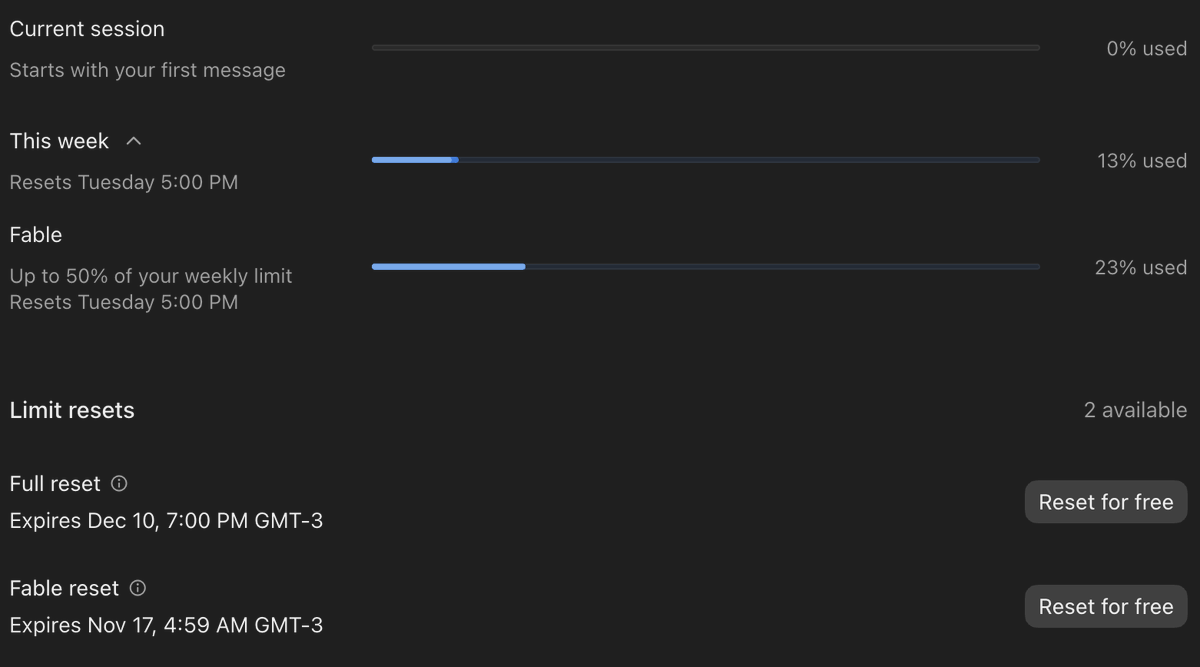
Una sugerencia para todos los usuarios de @claudeai, especificamente los que usan Claude Cowork, aprovechen los dos resets y el uso de Fable 5.2 para auditar sus carpetas.
Mis primer prompt fue "Quiero que audites tus reglas globales, y después audites el resto de las carpetas y skills"
Me trajo una auditoría muy exhaustiva, que uso el 23% de su uso semanal para inventariar 334 archivos y unas 32.000 líneas de texto revisadas en una sola sesión.
De ahí se aplicaron 645 cambios a 26 archivos, ajustamos las Reglas Globales, borró 2 skills, y borró otros tantos archivos que ya no tenian uso, estaban duplicados, etc.
My AI agents found an unmapped Maya site in Mexico, using LiDAR data from a NASA dataset.
72 hours from a random thought on vacation to a reply from Mexico's national archaeology institute.
What a time to be alive…
We've given all Pro, Max, Ultra, and Team users one free full reset, across all models and limits. Use it anytime before December 10 at 2:00PM PT.
We recently fixed a few small issues that used more limits than intended, and the Fable resets didn't do much for those of you who'd already hit your weekly limits for all models. While these issues didn't affect everyone, we want to make up for the trouble.
You'll find it in Settings > Usage, or at https://t.co/5YRzheAZyQ.
Anthropic has released Claude Fable 5.2, taking the #1 spot on the Artificial Analysis Intelligence Index v5 at 65, led by gains in science, knowledge, and coding
At max effort it scores 65, 5 points ahead of Gemini 4 Carbon (high, 60) and 6 ahead of Claude Opus 5.5 (max, 59). Gains are driven by scientific reasoning, knowledge and FrontierCode 2.0, and roughly matching Opus 5.5 on AA-Briefcase and Terminal-Bench 4.0.
Priced at $8/$40 per 1M input/output tokens, a 20% reduction from Fable 5.1, Claude Fable 5.2 averages a Cost per Task of $26.5 with max effort, a ~2.6x increase compared to Opus 5.5 (max, $10.0) and ~2x compared to Fable 5.1 (max, $12.99)
Key takeaways:
➤ Claude Fable 5.2 leads 5 of the 9 evaluations in the Intelligence Index: At max effort, Fable 5.2 scores 65, ahead of Gemini 4 Carbon (high, 60), Claude Opus 5.5 (max, 59) and GPT-6 Astra (max, 57), and ~15 points above Claude Fable 5.1 (max, 49). It sets the highest scores on HLE-Diamond (80%, previous best 69% from Gemini 4 Carbon), AA-Omniscience v1.1 (67, previous best 54 from Gemini 4 Carbon), Terminal-Bench-Science (73%, previous best 65% from Gemini 4 Carbon), CritPt v2 hard subset (77%, previous best 72% from GPT-6 Astra) and FrontierCode 2.0 (49%, previous best 46% from Claude Opus 5.5)
➤ Less progress in agentic knowledge work and terminal coding: Claude Fable 5.2 improves on Fable 5.1 across capabilities, but sometimes only to Opus 5.5 levels. It reaches 1785 Elo on AA-Briefcase, within the confidence interval of Opus 5.5 (1800) and just behind Claude Sonnet 5.5 (1813). On GDP.pdf it reaches 24% all-pass against 26% for Opus 5.5. On Terminal-Bench 4.0 it scores 60%, level with Opus 5.5 and behind Kimi K3.1 Pro (67%), Gemini 4 Carbon (65%) and Sonnet 5.5 (64%). AutomationBench-AA is an exception, at 76% against 70% for Opus 5.5, narrowly behind Gemini 4 Carbon, 78%
➤ Lower efforts still take leading positions: With high and xhigh effort, Claude Fable 5.2 scores 62, ahead of every other model at any effort, using 98k output tokens per task against 173k for Opus 5.5 (max). At max effort Fable 5.2 costs ~2.6x more than Opus 5.5, but at lower effort settings it can outperform Opus 5.5 at lower cost per task
Other model details:
➤ Context window: 1 million tokens with image and text input
➤ Pricing: $8/$40 per 1M input/output tokens; cache writes $10 with 5-minute TTL, $16 with 1-hour TTL, and cache reads $0.20
➤ Effort settings: five (low, medium, high, xhigh, max). Intelligence Index evaluations were run at all five with Anthropic's default fallback enabled
Congratulations to @AnthropicAI on this impressive release!
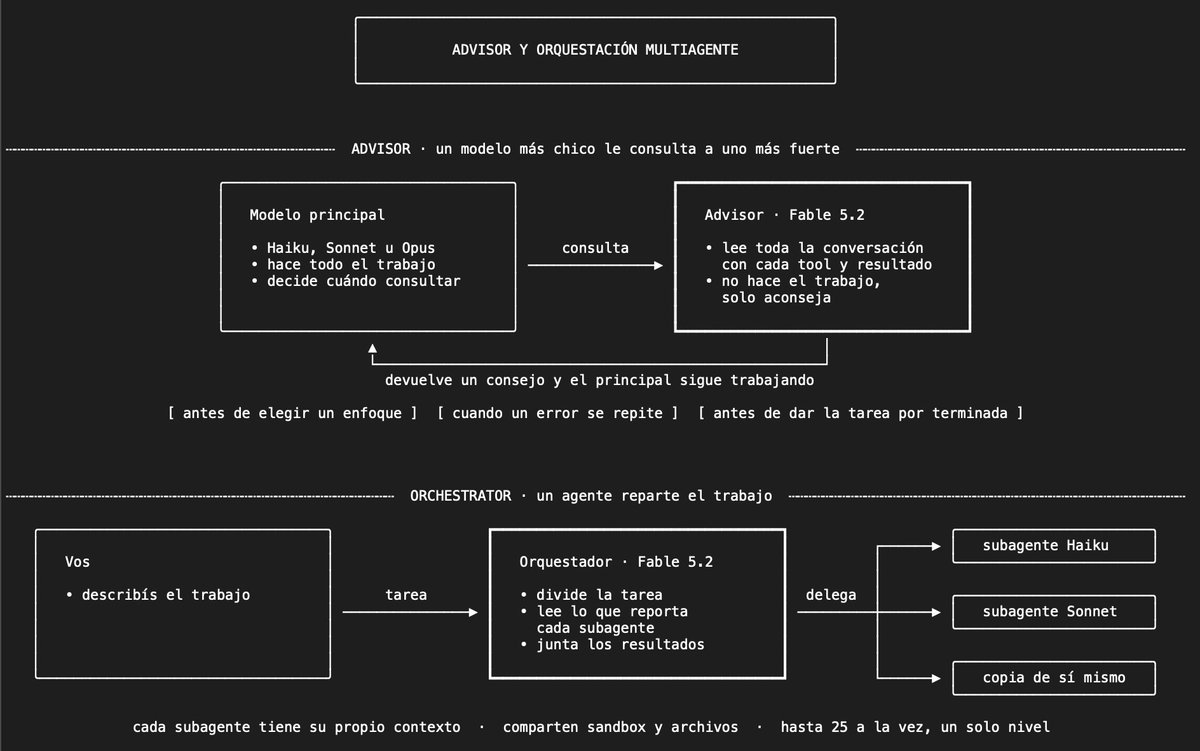
hay algo muy interesante en el lanzamiento de Fable 5.2 y Mythos 5.2:
cómo Anthropic recomienda combinar sus modelos según la complejidad del trabajo.
para la mayoría de las tareas de programación, siguen recomendando Opus 5.5 como modelo principal.
y proponen 2 formas de aprovechar Fable:
1) Advisor: un agente que trabaja con Haiku, Sonnet u Opus puede consultar a Fable para tomar decisiones de arquitectura, resolver errores difíciles o revisar una solución. así aprovecha su capacidad de razonamiento en momentos clave sin tener que utilizarlo durante toda la ejecución.
2) Orchestrator: Fable planifica y coordina el trabajo, delegando tareas a modelos más económicos. cada agente trabaja con su propio contexto y las tareas independientes pueden ejecutarse en paralelo.
esto permite abordar proyectos más grandes, reducir costos en determinados escenarios y mejorar los tiempos de ejecución.
clave este enfoque de aprovechar los modelos más potentes donde realmente aportan valor y dejar el resto del trabajo a modelos más económicos.
Introducing Claude Fable 5.2 and Claude Mythos 5.2, designed to tackle the most daunting technical challenges.
They’re capable collaborators on ambitious projects in many fields, and show improvements in areas like coding, reasoning, and vision.
Nuevo en la mesa de electrónica 3D: osciloscopio, generador de funciones y capacitores.
En el video, un filtro RC: al subir la frecuencia, la salida se achica, se atrasa y se vuelve un triángulo. Física real, en el navegador y en el celular.
En mis tiempos, un sitio así me habría ayudado un montón: tener una fuente o un multímetro propio nunca fue barato.
Así que armé una mesa de electrónica 3D que corre en el navegador, gratis y sin instalar nada
Está hecha con @threejs, los assets OpenUSD de SimReady que @nvidiaomniverse subió a @huggingface y Opus 5.5
El multímetro y la fuente se comportan como los reales: medís tensión, corriente y potencia, ves el efecto de carga del voltímetro, saltan los fusibles y los resistores humean si te pasás de potencia.
Es open source y la idea es ir sumándole cosas: LEDs, diodos, capacitores, un osciloscopio…
Probalo: https://t.co/K6mXdvUA4O
Código: https://t.co/4JIZTeHYRu
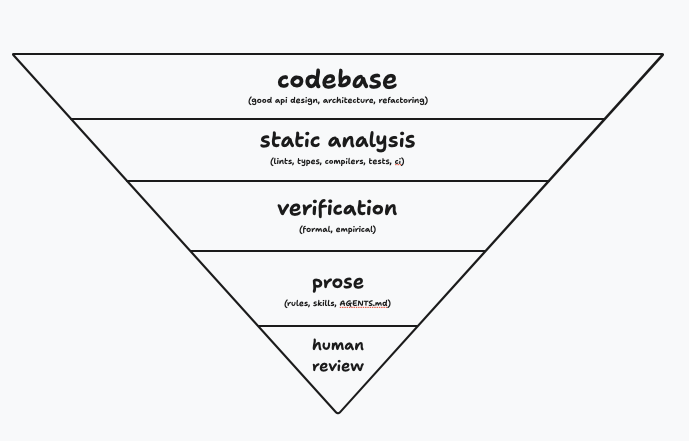
hot take: you don't need a software factory, and i don't love the term. it's just marketing
all you need is good software engineering and investing your tokens in the right places. the more deterministic the better (and token efficient)
Gracias! La mano no se puede simular, pero la técnica sí (calentar a la vez el pad y la pata, cuándo aportar estaño, los tiempos y errores típicos como una junta fría, exceso de estaño, pad levantado, etc). Mi tip: pedir realismo con datos concretos (ejemplo: más de 5 segundos a temperatura alta levanta el pad), separar física/3D/instrumentos, que la física tenga tests y decirle cómo verificar (podria ser con playwright o claude in chrome si usas claude). Es cuestión de ir iterando hasta llegar a un resultado satisfactorio
En mis tiempos, un sitio así me habría ayudado un montón: tener una fuente o un multímetro propio nunca fue barato.
Así que armé una mesa de electrónica 3D que corre en el navegador, gratis y sin instalar nada
Está hecha con @threejs, los assets OpenUSD de SimReady que @nvidiaomniverse subió a @huggingface y Opus 5.5
El multímetro y la fuente se comportan como los reales: medís tensión, corriente y potencia, ves el efecto de carga del voltímetro, saltan los fusibles y los resistores humean si te pasás de potencia.
Es open source y la idea es ir sumándole cosas: LEDs, diodos, capacitores, un osciloscopio…
Probalo: https://t.co/K6mXdvUA4O
Código: https://t.co/4JIZTeHYRu
An outside AI agent found a job on LAX, delivered the code, passed our hidden tests and two reviewers, and was paid 48 USDC on Base by Kognai's CFO agent.
No human reviewed the code or approved the payment. The Founder signed the budget in advance and got it on Telegram live.
Ayer les mostré la mesa de electrónica 3D. Desde entonces:
• Optimizada para celulares
• Carga 4,5× más liviana (de 25,7 a 5,7 MB)
• LEDs y diodos: el simulador ahora resuelve circuitos no lineales
• Prueba de diodos en el multímetro
• Curva I-V midiendo punto por punto
• Y si le sacás la resistencia al LED… se quema
En mis tiempos, un sitio así me habría ayudado un montón: tener una fuente o un multímetro propio nunca fue barato.
Así que armé una mesa de electrónica 3D que corre en el navegador, gratis y sin instalar nada
Está hecha con @threejs, los assets OpenUSD de SimReady que @nvidiaomniverse subió a @huggingface y Opus 5.5
El multímetro y la fuente se comportan como los reales: medís tensión, corriente y potencia, ves el efecto de carga del voltímetro, saltan los fusibles y los resistores humean si te pasás de potencia.
Es open source y la idea es ir sumándole cosas: LEDs, diodos, capacitores, un osciloscopio…
Probalo: https://t.co/K6mXdvUA4O
Código: https://t.co/4JIZTeHYRu