With the recent wave of vulnerability disclosures, it’s a good time to take a closer look at your own code.
Turn your coding agent into a team of security auditors with the open-source skill that seeded Cloudflare’s vulnerability discovery harness.
The 6 phase approach:
1. Map the codebase
2. Hunt for vulnerabilities
3. Challenge each candidate
4. Record the findings
5. Verify the findings
6. Report what’s confirmed, rejected, or still needs validation
Start your hunt here:
https://t.co/kL5PvcoAYY
💸 Update: My total biz expenses have now dropped to just ~$300/mo!
This is to run all my websites/apps serving per year:
- 20,000 paying customers
- 252 million visitors
- 2.4 billion requests
- 2.4 petabyte (PB) in bandwidth
(~$8,000/mo if you add the $7,000/mo GPU bill and $800/mo R2 storage I pay for Photo AI, I exclude it above because it's one project that's so much more expensive in size than all the other sites together, but included in the chart below)
Claude Code helped me to find smart ways to save more money, AI is just really really really good at finding cost savings by itself, which is not so great for the economy short-term, but long term it trims all the fat and opens up spending for better investments I think
Anyway here's what it saved me in money, almost $34,000/mo:
- $29,000/mo - switched to better and cheaper video models on Photo AI, video was very expensive and since I didn't update it ever it stayed expensive, also routed some image jobs to Google Cloud where I have some Google Cloud Credits, and also routed some jobs to Sume which sells AI models at market cost, very cool! This made my GPU bill go from $36,000/mo to $7,000/mo
- $3,000/mo - consolidated my servers, cancelled Digital Ocean and Linode and moved everything to Hetzner saving about $3,000/mo
- $1100/mo - analyzed my Backblaze B2 server backups, I had infinite versioning and lifecycle policies, that's reduced now to 30 days, this literally pushed the bill from $1,200/mo to $26/mo, about 50x cheaper! I had essentially versions of files for all my servers for over a decade, crazy!
- $400/mo - similarly added Lifecycle Policies to my Cloudflare R2 bucket for Photo AI, pics are automatically put in cheaper Infrequent Access after 90 days, there was years of photos in there so this reduced the R2 bill from $1,200/mo to $800/mo
- $118/mo - Claude analyzed all my Cloudflare Domain registrations, lots of domains I didn't use and didn't make sense to keep paying for, lots of things that also don't really make sense anymore in a post-AGI world, renewals for .io TLD are now $50/year which adds up fast!
- $100/mo - Claude also analyzed my Claude subscription (yes!) and discovered I don't even use the Max 20x plan limits, so I downgraded from $200/mo to $100/mo
Even including Photo AI, I have now cut my costs by 90% from last year, getting me close to my biz expenses amount from a decade ago when I started building things
Costs slowly creep up over the years and you don't realize all the things you're spending on but AI is nice to help you figure all that out (also in your personal life!)
ChatGPT and Codex are helping engineers build for the physical world.
We’re sharing our progress across mechanical design, electrical engineering, and simulation—from helping our hardware teams iterate faster to testing new workflows with industry collaborators.
NVIDIA just dropped an open source Apache-2.0 licensed CAD kernel HAHAHAHAHAHAHAHAHAHAHA
i honestly feel bad for the prop CAD bros. this week has been nonstop L's and it isn't getting better from here
https://t.co/O7hxkbTuGH
I resigned from Anthropic today. I spent the last three years doing pretraining research at both OpenAI and Anthropic. Neither company is acting responsibly. They are racing straight to self-improving superintelligence and gambling with our lives. More thoughts below.
We’re sharing a solution to the Navier-Stokes Millennium Prize Problem, one of the deepest problems at the frontier of mathematics.
The proof was produced by a group of agents, using an OpenAI next-generation model significantly more capable than GPT-6 Astra.
The problem concerns whether the description of smooth three-dimensional fluid motion modeled by the Navier-Stokes equations can break down. It has remained unresolved for roughly 90 years.
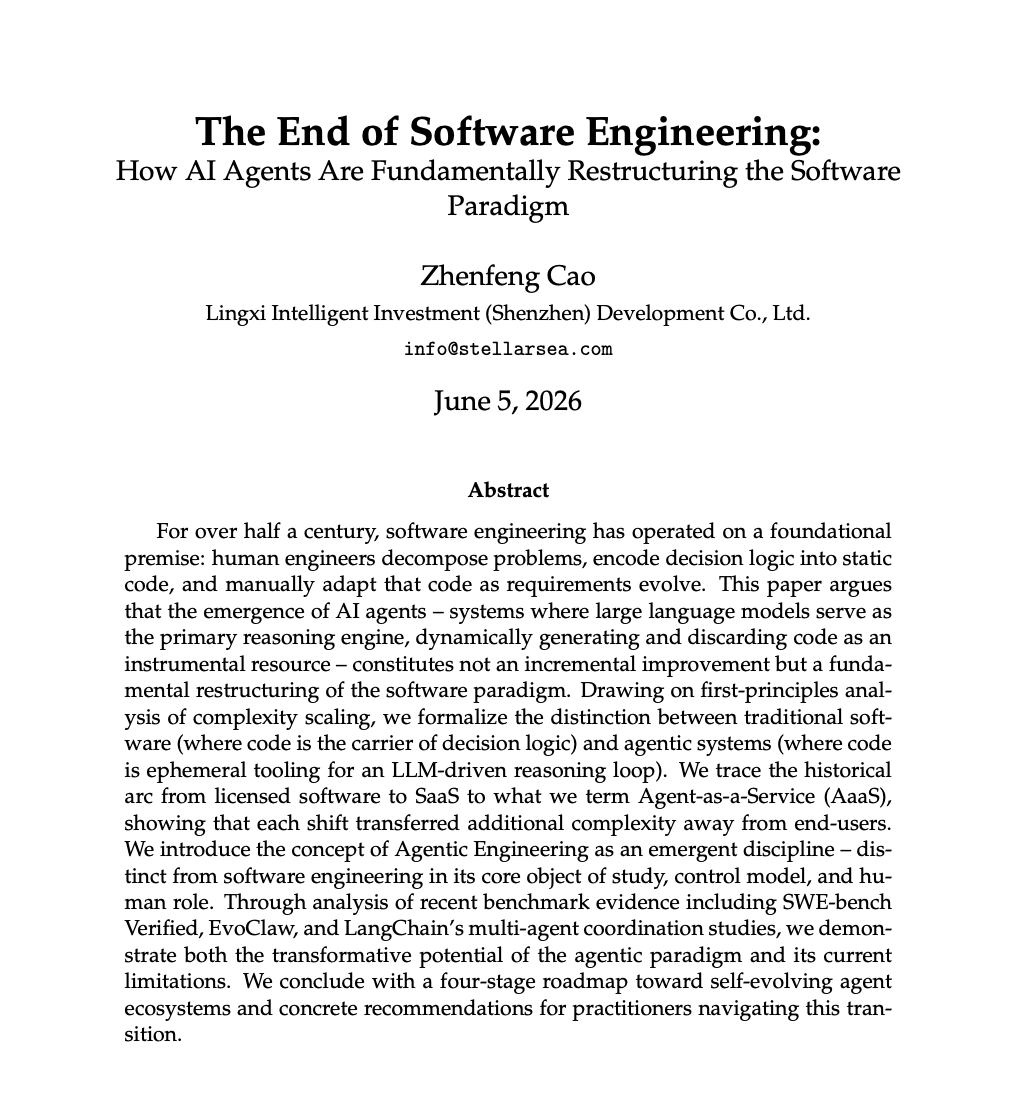
Chinese researchers published a paper with a devastating title: "The End of Software Engineering”
it argues software engineering is finished.
In traditional software, code is the carrier of pre-written human logic.
In agentic software, the AI agent is the software.
Code is no longer a permanent monument built by human hands. It is completely ephemeral, dynamically generated, executed, and discarded on the fly by an LLM-driven reasoning loop.
Think about how software delivery has evolved:
• Era 1: On-premise licensed software (you installed it locally)
• Era 2: SaaS (hosted in the cloud, managed by vendors)
• Era 3: Agent-as-a-Service (AaaS)
Each historical shift transferred complexity away from the user. But this latest shift transfers something entirely different.
It transfers decision-making complexity itself.
The paper argues that traditional engineering is hitting a hard complexity wall. Human brains can only hold so much state, manage so many dependencies, and debug so many lines at once.
LLM-based agents scale non-linearly.
They don't just write functions faster. They navigate architectural complexity by outsourcing reasoning to models that improve every single month.
Which means the role of the developer is permanently changing.
You are no longer a code author typing syntax line by line.
You are an intent architect.
Your job is no longer writing the implementation. It is specifying goals, designing multi-agent coordination loops, and auditing outcomes.