the hardest part of building solo isn't the code.
it's deciding what NOT to build. public boards, marketplace — all parked until retention proves itself.
focus is a feature you ship to yourself.
note to self while drafting the fleets pricing page: this is the most-audited page i never audit.
visitors read it harder than any blog post. clarity here converts better than any exit-intent popup ever will.
stop telling your agent to 'improve the seo.'
paste it the audit instead: broken canonicals, missing meta, slow routes — ranked, with fixes.
vague prompt, vague site. specific input is the whole trick.
site problems are rarely one big thing.
it's 15 small things, each 'too minor to prioritize', compounding into invisible.
rank them, fix the top three, remeasure. that's the whole discipline.
most 'monitoring' is a graveyard of green checkmarks.
learned it the hard way running multiple sites: uptime isn't health. a site can be up, indexed, and quietly bleeding rankings for months.
watch the right signals, not the green lights.
60-second test: search your own product category in chatgpt.
are you in the answer?
that's the new page one, and almost nobody is optimizing for it yet.
the free tier isn't marketing. it's the product proving it deserves your money before asking for it.
if a tool can't earn trust at $0 it won't earn it at $49/mo.
things agents care about on your site: response codes, structured data, plain-language answers.
things they don't: your gradient, your testimonial carousel, your cookie banner theater.
cheap growth hack that isn't a hack: fix your title tags.
most sites still ship 'home | company name'. that's a coin flip on every search impression you already earn.
your agents can already write code.
mcp means they can now also check your traffic, spot the regression, and draft the fix.
the site that maintains itself is closer than you think.
google analytics answers 'what happened.'
nobody has time for what happened.
the question that pays rent is 'what do i fix today.'
most analytics never answer that one.
delete half your homepage. seriously.
every section you added 'just in case' is a toll gate between the visitor and the one thing you want them to do.
the section you're scared to cut is usually the one costing you the most.
you're shipping projects faster than ever. watching them is the part that doesn't scale.
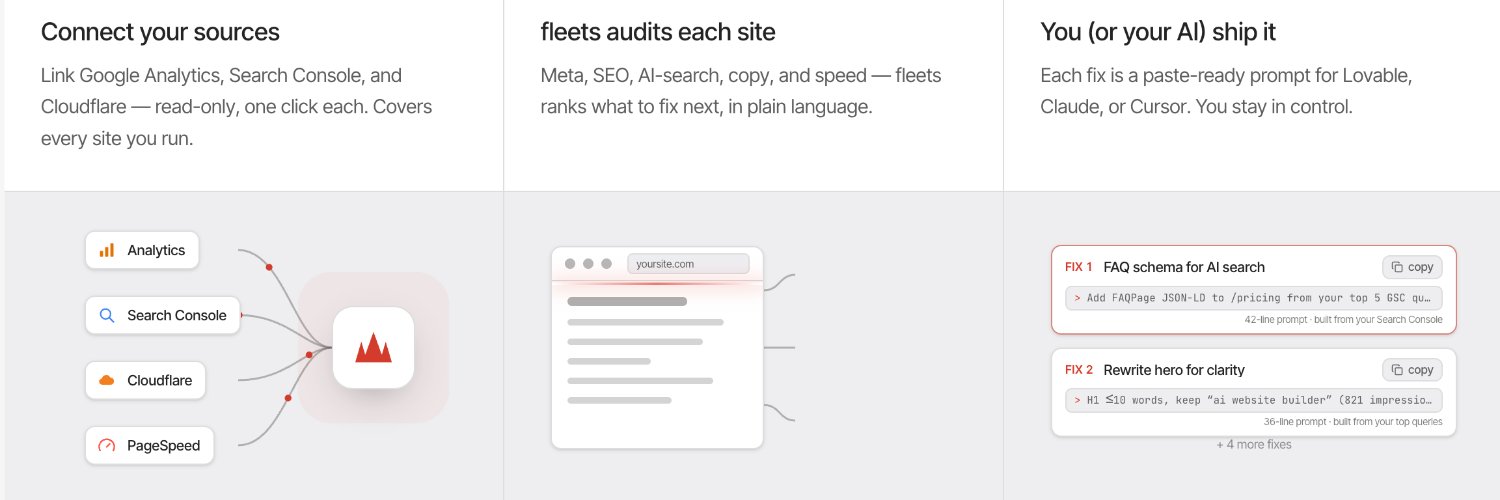
fleets puts every site in one view for free — traffic, uptime, what broke. when something's off, the audit hands you the exact fix to paste into your agent.
https://t.co/5OFw4AfkWP
the audit-to-prompt workflow:
run audit → get site-specific fixes as prompts → paste into your coding agent → done.
the report IS the implementation. this is how tooling should work now.