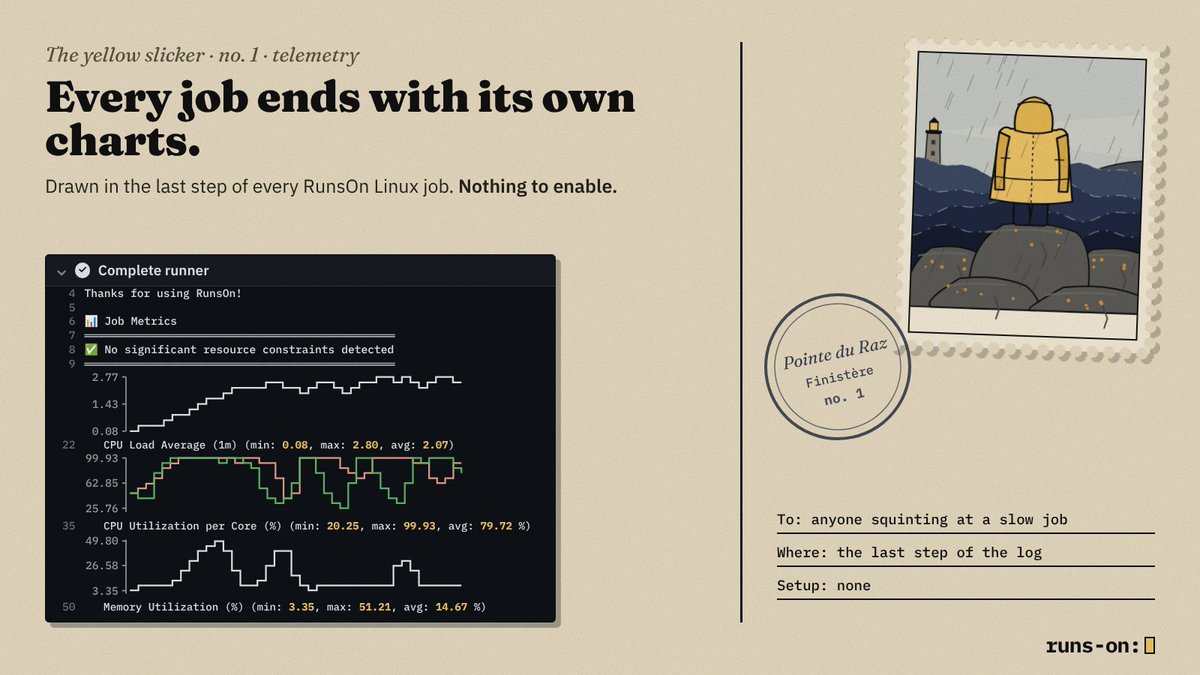
Every RunsOn job ends with its own charts: CPU load, CPU per core and memory, drawn in the last step of the log.
Nothing to enable.
https://t.co/KE6qwesef9
@Coveo ran its own GitHub Actions runner orchestrator for years. Then their Dev Tooling team replaced it with RunsOn.
PR checks: 3.3 → 1.5 min
Warm runner start: ~6 s
Feedback ~2 min sooner on every push
Orchestrator to maintain: none
https://t.co/06WHvOFGWX
RunsOn uses EC2 Spot capacity by default.
This makes it the cheapest way to run CI workloads on cloud compute by far.
But handling spot interruptions while keeping the CI green gets tricky when running thousands and thousands of jobs a day.
Here's how RunsOn does it:
Heavy GitHub Actions bill? Have a look at our state of actions report to identify what's costing you most. I'm deep into it every day and I still discovered a few stragglers
@pydantic Along the way, they built a RunsOn integration in Logfire: dashboards for queue times, Spot interruptions, cost per job, and runner CPU and memory.
A few lines of Terraform:
https://t.co/iyZik9ycMW
The @pydantic team switched Logfire's CI to RunsOn on Sept 1.
August, on GitHub, Depot and Ubicloud runners: $18.2k.
September, on RunsOn: $5.7k, license and every AWS cost included.
And they ran 31% more runner minutes in September. 🧵
@pydantic Same GitHub Actions, same workflows. Jobs now run on fresh EC2 instances in their own AWS account: mostly Graviton, Spot wherever a retry is cheap, on-demand for the merge queue and releases.
Bill Easton's write-up:
https://t.co/RtbZcN2XQR
Some CI data is too large or awkward for an archive cache. Linux Flex runners can mount a shared EFS filesystem directly at `/mnt/efs`.
https://t.co/hidelmHXvN
Disks? Where we're going, we don't need disks.
extras=tmpfs keeps a RunsOn runner's workspace and Docker data in RAM. PostHog's image build on 4 vCPU: 9m05s → 5m02s. GitHub's own runner takes 12m44s and costs 13 times as much.
https://t.co/6CWuZns0yc
Need a predictable egress IP for CI allow lists? RunsOn supports static egress through private subnets on Linux and Windows, with Flex and Fleet.
https://t.co/IUMaa2GBKu