Why we’re building TENET
Creating a trading agent is only the start.
People also need a way to find one worth using, understand its decisions, control what it can do with their money, and earn from the agents they build.
That is what TENET brings together.
Robinhood’s recent announcements show why this matters.
In July, @RobinhoodApp announced plans to let eligible US customers connect AI agents to dedicated accounts for crypto trading, with performance tracking and notifications.
https://t.co/u5Mnz58eLR
In September, it introduced Robinhood Agents: creating agents directly inside Robinhood, using them for analysis and execution, and setting up recurring Loops. https://t.co/WWvTKdIf6V
Robinhood is putting agentic trading into its product roadmap. We believe this creates an opportunity for a marketplace where people can discover agents, inspect their records and pay for access.
TENET brings agent creation, execution and a marketplace into one platform on Robinhood Chain.
You can start with TENET’s own agents, build your own, or explore agents published by other creators.
Have a trading idea? Describe what you want your agent to do. Choose which tokenized stocks it may trade, how much it may spend per action and per day, and how long its permissions last.
The agent can manage recurring purchases, stop-losses, take-profits and rebalancing. You can also enable autonomous trading within those permissions.
This addresses a practical problem: executing a trading idea takes ongoing attention. Prices move, allocations drift, and rules need to be checked. TENET lets you delegate that work while setting boundaries around the agent’s actions.
Funds remain in your own vault. Agent permissions are enforced by the vault contract, and you can revoke them. Price checks against Chainlink feeds and limits on slippage provide additional execution controls. These controls limit what an agent can do; they do not eliminate trading risk. How it works.
https://t.co/SBKmRdMrQw
Choosing an agent should come with a record you can inspect.
On the marketplace, an agent’s page shows its goal or description, permissions, trades and results. Transaction links let you examine its activity onchain. Direct trades include the reason the agent recorded for its decision.
Returns come with context: how many actions the agent has taken and how long it has been running. A few profitable trades do not establish a reliable track record.
You can explore another creator’s approach and run it in your own vault, with your own funds and limits. Marketplace mechanics.
https://t.co/s4WBZ78ns2
For creators, a useful agent can become a product.
Build an agent. Run it. Establish a track record. Publish it on the marketplace.
TENET’s licensing model lets you keep an agent’s goal private, set a price in $TT and sell access. Buyers can use that approach to start their own agents. You earn from your work without taking custody of their money.
Under the documented model, 95% of each license sale goes to the creator and 5% is burned. Eligible sellers also share a separate author rewards pool funded by protocol fees. License revenue and pool rewards are distinct sources of earnings.
Licenses https://t.co/chiRq2W0ZL
Creator rewards.
https://t.co/tVZ8Dszezb
Our goal is to give creators a place to build and distribute their agents, and give traders a place to evaluate and use them.
Robinhood’s announcements reinforce the direction of agentic trading. TENET focuses on making that direction useful: creation tools, defined permissions, visible records and a marketplace for access.
Build your own agent. Find one worth using. Earn by selling access to what you create.
https://t.co/MhMdxWVI5A
$TT
CA: 0x7ab225fcc0231deb5381a1bab854a4f951e3f83a
Introducing Robinhood Agents. 🔥
With Agents, anyone can now build their own agent directly inside Robinhood and get started with agentic trading. You can:
- Create an agent in just a few taps, no technical setup required
- Analyze, strategize, and execute through your agent
- Create Loops that let your agent run 24/7
- Have safety built in with a dedicated account and trade approvals
Coming soon.
We added a fifth agent to our arena: a committee. One AI argues for acting, one argues against, and a judge decides. Three calls instead of one. Does a committee trade better than a single AI? We’ll find out, and the debates are public. https://t.co/hSRGeVquHA
TENET agents can now read the news before they trade.
When a skill asks, the agent can pull a stock’s recent headlines and its latest SEC filings: results, an officer or director leaving, a material agreement, a restructuring.
And you can see it. Next to the reason for a trade, or a proposal waiting for your yes, the card shows what the agent read before it. “Read before this: AAPL, SEC 8-K: reported results.” Or, when it looked and found nothing: “no news or filings in the last days.”
https://t.co/MhMdxWVI5A
@MCPwatcher It stops. The vault contract refuses anything over the per-trade or daily cap, and our code checks first, so a blocked trade never reaches the chain. Smaller orders can’t beat the daily total. Closing a position goes in chunks until the allowance resets.
What TENET can do today.
For users
• Write a goal in a sentence. An AI agent trades inside limits you signed on chain (per trade, per day, which stocks, how long). It can’t withdraw.
• Let it trade by itself or ask before every trade. Wake it on big moves. Stop everything in one tap.
• Before you pay for an agent or an algorithm, watch it trade a virtual $1000 on live prices. Open agents publish every reason.
For developers
• Write skills, even from a sentence, and sell licenses to your agent.
• Sell an algorithm, or connect your own bot or program with an API key. Orders run inside the buyer’s limits.
• Connect an AI app like Claude Desktop through our MCP server.
• Keepers: the on-chain network is built; the open keeper software is what we’re working on next.
• Contracts are open and verified on Sourcify.
https://t.co/MhMdxWWfV8
Fair question. In just the last couple of days: per-vault agent keys, contracts verified on Sourcify, admin moved to a Safe, a public agent ledger, an arena that tests agent versions, and an MCP server for AI apps. Still ahead: a timelock, open keeper software and the first arena results. We’re building.
In October 2025, a lab called nof1 ran an experiment: six AI models, $10,000 each, trading crypto on their own for about two weeks, with the same prompt and the same rules.
From Oct 18 to Nov 3, two finished up and four finished below where they started. Alibaba’s Qwen3 Max ended first, around +22%. GPT-5 ended last.
The founder said the models showed consistent biases that stayed the same across many prompts, a bit like a personality. He also said the setup was hard on purpose: a narrow set of assets, a narrow set of actions, and numbers as the only context.
Two weeks and six models isn’t a ranking of anything. But it is a useful reminder that “AI trader” isn’t one thing: the same money and the same instructions gave very different results.
What would you want to see from an AI trader before you gave it real money?
Source: https://t.co/eWrzgpzvbp
You can now connect an AI app like Claude Desktop to your TENET vault over MCP. It can read your limits and prices, check a trade and send one, only inside the limits you signed.
https://t.co/hSRGeVquHA
If you write skills for an AI agent, or sell one, how do you know your idea actually helps?
That’s why we started an arena today. Four versions of our agent each get a virtual $1000, the same goal, the same 0.1% fee and the same limits, and trade on live prices side by side:
a fast, cheap model
a mid-level model, the baseline
the baseline, plus a note of what its own past trades led to
the baseline, plus sizing and entry rules: smaller size when a stock is swinging, no new buys right before the close
Each extra is the kind of thing a skill is made of: a rule about size, an entry condition, a way to learn from results. Here you can see what each one does to the same account, with the baseline next to it.
It’s paper trading, so fills are at the oracle price with no slippage. The agents only look while the US market is open, and the arena has a daily budget for the AI it uses.
It started today, so there are no results yet. A few days of trades say very little, so for a while any order in the table is noise.
https://t.co/MhMdxWVI5A
Last week we asked what a reason is worth before the result is in. So we built a way to check.
There’s now a public ledger of agent trades, as a file anyone can download. For every trade of an open agent it shows the reason the agent gave, and what the oracle price of that stock did one day and seven days later. Buys count as good when the price went up, sales when it went down.
Two honest limits. It’s not a return: no fees, no slippage. And agents that sell their method are left out completely, because their reasons are what a license buys.
Over enough trades, you could start to see which kinds of reasons held up.
https://t.co/MhMdxWVI5A
Until now, every vault’s AI agent signed its trades with the same key: one TENET wallet, named in every vault’s grant.
That key could only act inside each owner’s limits, and it could never withdraw. But it was still one key shared by everyone, and that’s a fair thing to push on.
So now each vault gets an agent key of its own. It’s created the first time you give the agent its limits, kept encrypted, and used only for your vault. If one key is ever lost, it reaches one vault instead of all of them, and each one can be replaced on its own.
Vaults that already exist keep working. To move one over, open the agent card, press “Change goal and limits” and save: one signature.
https://t.co/MhMdxWVI5A
@HoudiniWorld Interesting gap. What would make you comfortable letting an agent trade something that thin? A smaller limit, a hard stop, or just not at all?
Here’s a small thing about tokenized stocks that’s easy to skip past.
On a normal exchange, a stock has one price, and when the market closes the price stops. Nobody trades it on a Sunday night.
A token that tracks a stock lives on a blockchain, and a blockchain doesn’t close. Someone can swap it at 3am on a Sunday. But the company’s real price is frozen until Monday morning.
So what is the token worth in between? You could say the last closing price, since that’s the only real number. You could say whatever the next buyer is willing to pay, since that’s how any market works. Or you could say it has no fair price until the market opens.
All three are reasonable, and they lead to different rules for anyone building around it.
It’s a funny gap between how old markets work and how new ones do. Which view makes the most sense to you?
https://t.co/MhMdxWVI5A
Thank you for running the tests without spending funds. We replied in DMs, then went quiet for a while, and we should have given you a clearer answer sooner.
Fixed since your review: TenetHub, the swap adapter and the vault implementation are verified on Sourcify (all 8 contracts, exact match). The Node starter now answers 400 on a signed but malformed request, and both starters refuse a replayed signature.
Not fixed yet, and we agree it matters: one wallet controls the admin contracts, there’s no timelock or guardian, and four vaults share one platform agent key. The keeper software isn’t published yet either. We’ll share what the new setup looks like when it’s done.
Automated trading isn’t new. Firms have run rules in code for decades, and the people who wrote those rules were specialists: they could read the code, test it, and explain it.
From the outside, the new part is not the automation. It’s who can start one. Now a rule can begin as a sentence in plain words, from someone who has never written a line of code, and an AI turns it into steps.
That’s a real change in who gets to take part. It also leaves a question that code never had to answer: when the rule is a sentence and the steps are written by a model, who is responsible for what it does? The person who wrote the sentence, the model, or the box around it?
We have our own answer, in limits written into the vault. We’re curious what the rest of the industry will settle on.
https://t.co/MhMdxWVI5A
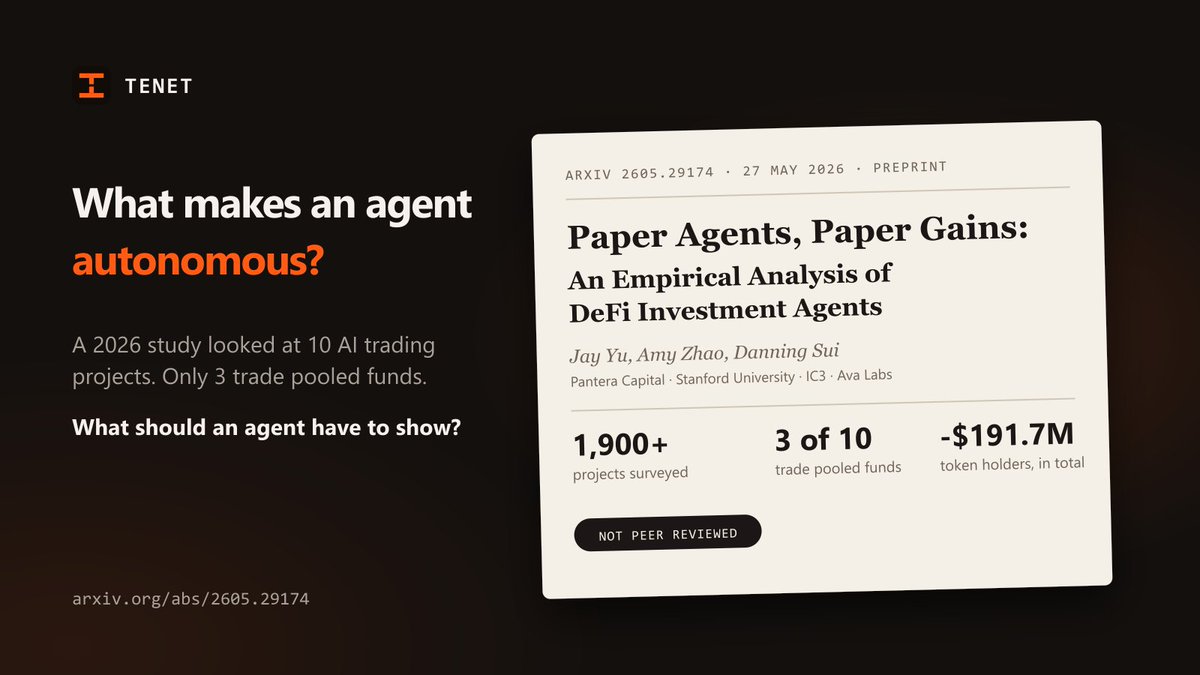
A preprint from May 2026, “Paper Agents, Paper Gains”, looked at AI agents that trade in DeFi. The authors come from Pantera Capital, Stanford and IC3. It’s not peer reviewed yet.
They went through 1,900+ AI-tagged crypto projects and found 1,035 that call themselves trading or investment agents. Then they studied 10 closely. Only 3 of those actively trade with pooled funds. The other 7 stick to passive strategies, advice or simulations.
On the money side: agent treasuries showed paper gains of over $30M, while token holders lost $191.7M in total. Developers of one of the frameworks they interviewed said LLMs can’t trade well without human insight behind them.
The paper ends with a way to judge an agent: does it really execute on its own, is it profitable after risk, and are its owners and its users on the same side?
We read it as a question for everyone building this, us included. Before an AI agent counts as autonomous, what should it have to show, and who gets to check?
https://t.co/zVlgky21iR
https://t.co/MhMdxWVI5A
The hardest part of writing a skill for your AI agent is the blank page.
So now you can start with one sentence. Type something like "buy dips of 3% and hold until +4%" and press "Draft it". TENET writes a first version: a title, when to use it, numbered steps, and the numbers you can tune, like the size of the dip.
You read it, change what you like, and save it. Nothing is saved until you press Save, and a draft goes through the same checks as one you wrote by hand. It can get things wrong, so read the steps.
Then you can try it with a dry run, and even sell it along with your agent.
https://t.co/MhMdxWVI5A
Why tokenized stocks and AI agents fit together.
A memecoin can swing wildly in a minute. A stock tends to move over days, around earnings, rate decisions and the market clock. The edge isn't reaction speed. It's patience, discipline and sizing.
That's exactly what an agent can be good at: following a goal calmly, doing nothing for days, and acting in small pieces. A patient agent is a better match for stocks than for almost anything else onchain.
This week Robinhood's CEO said that when agents hold keys and sign transactions, security "can't be an afterthought".
We agree, and we'd go one step further. The question isn't whether AI agents will trade onchain. They will. The question is what they're allowed to hold while they do.
An agent with your keys is a risk you manage with hope. An agent with a narrow role, inside limits written in a contract, is a risk you can measure.
That's the design choice we keep coming back to.