@MikeCunningham Love this! Was reading Show Your Work by @austinkleon this morning (mostly about creative process) and relating it to the process of coaching. And how I wish there was more open sharing about the messiness of the process sometimes!
Update on @reedfisch, the calf he has been nursing since the World Road Running Championships gave him some trouble and he has dropped from the race (update just provided to me by the elite athlete coordinator).
We knew this was a real possibility but he wanted to try. The Trials in February are number one.
Very grateful to @emilyepalmer & @people for telling our story. Christine has been such an inspiration to so many, perhaps me most of all. I’ll be trying to channel a small fraction of her strength and resilience on the course this weekend.
🚨Do you want to learn more about relative energy deficiency in sport?🙋♂️
Well you're in luck because it's #REDSmonthBJSM 🎉 🎊 ✅
📣 Kicking off the month with the NEW #IOC Consensus Statement on #REDs 📄
@margomountjoy and team 👏
Find out more ➡️ https://t.co/w48QZFjq5h
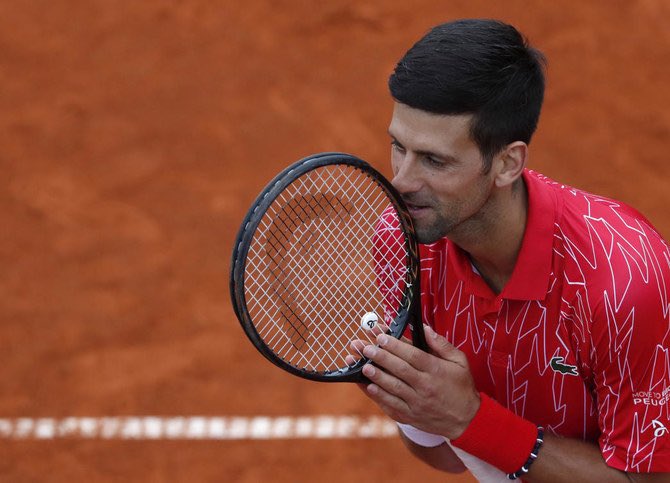
Days after a quarterfinals loss in the 2010 French Open, Novak Djokovic told his coach, Marián Vajda, that he had decided to quit playing tennis.
He was No. 3 in the world, a grand slam winner, and a favorite to win Wimbledon.
After Djokovic said he was quitting, Vajda asked,
“Why did you start playing this sport?”
Vajda immediately sensed what the problem was:
Djokovic was focusing too much on rankings, records, titles, and external expectations. As a result, Djokovic said, “I was mentally at one very messed up place.”
As Djokovic thought about Vajda’s question, he thought about how many of his earliest childhood memories include his “most beloved toy”—a mini tennis racket and a soft foam ball.
He started playing tennis, answering Vajda’s question, “because I just really loved holding that racket in my hand.”
“Do you still love holding a racket in your hand?” Vajda asked.
Djokovic thought about it for a few seconds, got excited, and said:
“I do. I still love holding a racket in my hand. Whether it’s a grand slam final on center court or just playing around on a public court, I like playing for the sake of playing.”
Vajda nodded, “Well that’s your source. That's what you need to tap into. Put aside rankings and what you want to achieve and what you think others are expecting of you.”
Vajda then suggested that Djokovic take a few weeks off.
Djokovic agreed that he would.
But when he woke up the next morning, Djokovic was dying to hit tennis balls. He went to the courts to play for the sake of playing. “And I never looked back ever since that moment.”
The following season, Djokovic enjoyed one of the greatest seasons in sports history. He won 43 straight matches. He won three Grand Slams, including his first Wimbledon title. And he finished the year as the number one player in the world.
“I started to play freely,” he says of that season. “I became the kid that I was when I started playing.”
Takeaway 1:
There's a word for being like the kid who does something for the sake of doing it:
Autotelic.
From the Greek "auto" (self) & "telos" (end)—an Autotelic is "someone or something that has a purpose in, and not apart from, itself."
As opposed to someone who focuses on rankings, records, titles, and external expectations—for an Autotelic...
”The work is the win,” as Ryan Holiday once told me.
Since you control the effort more than the outcome,
“Ultimately, you have to love doing it,” Ryan said. “You have to get to a place where doing the work is the win and everything else is extra.”
Takeaway 2:
When reading about Autotelics—people who describe their work as play, who simply seem to love what they do—a common mistake is to think that it’s all bliss all the time.
One of my favorite Autotelics is the legendary skateboarder Rodney Mullen, who is in his 50s and still skateboards every day.
“There are days,” Rodney said, “where you don’t want to go out. Or it hurts. Or you’re sore. Or you just suck—you're not making progress, and you feel defeated...But that's the nature of love—it's got hate in there, it's got pain in there. And that’s what draws you in, that's the magnetism.”
At one point during the recent Wimbledon final, Djokovic angrily smashed and shattered his racket. And after losing the match, he admitted that it will take him a while to get over the loss.
That’s the nature of love—it’s got hate in there, it’s got pain in there.
- - -
“I see people with talent, with all those things, but the one thing they don't have is just that love for doing it for the sake of it.” — Rodney Mullen
Follow @bpoppenheimer for more content like this!
Observations from many years of coaching:
90% of athletes will consistently upload their training files.
70% of athletes will consistently collect HRV data.
50% of athletes will consistently complete morning wellness survey.
20% of athletes will consistently give post session data/notes.
1% of athletes will consistently monitor/log nutrition!
IOW, there's massive improvement opportunity there for the vast majority!
Wow!
Among 12-21 year old females in the US, almost 40% are iron deficient.
Iron deficiency is associated with increased all-cause mortality... and mental disorders, too.
https://t.co/9ApjdlaMHg
@lwd69@Alan_Couzens I wonder about this as well! My VO2 max was measured at only 54 when I was 21 years old and a 2:11 800 and 4:32 1500 m runner. At age 59 I’m afraid to get tested haha
In today’s NYC Half, @tinmanelite’s @reedfisch wore a pink ribbon on his kit in support of his wife, Christine, who was recently diagnosed with breast cancer. 🙏
Despite a heavy and emotional last few months of training, he had a strong showing and finished 8th in 1:03:02.
What a weekend for @tinmanelite❗️
A healthy and fit @drewhunter00 wins the Dr. Sander mile in 3:55.57, an indoor PB. He closed his final 800m in 1:56 😤
Drew will be back at the Armory in a few short weeks for the @MillroseGames Wanamaker Mile.