1/11
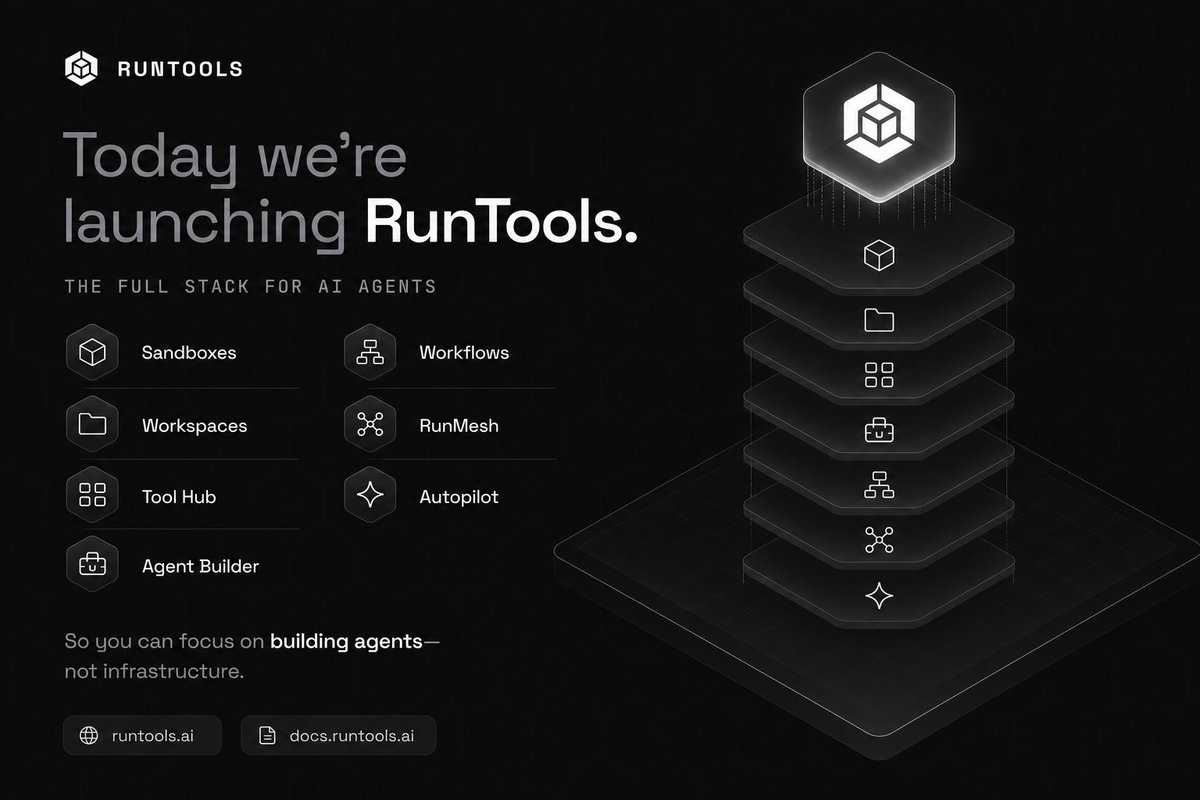
Today we’re launching RunTools.
The full stack for AI agents:
• Sandboxes
• Workspaces
• Tool Hub
• Agent Builder
• Workflows
• RunMesh
• Autopilot
So you can focus on building agents instead of spending months building and scaling infrastructure for execution, storage, tools, orchestration, and deployment.
https://t.co/0s5yTXZevI
Docs: https://t.co/CC723sCXxo
Chat-based AI made software easier to talk to.
Agentic AI will make software easier to delegate to.
That is a completely different category.
Conversation requires intelligence.
Delegation requires execution.
An agent that can take action needs more than a model. It needs tools, state, workflows, approvals, and an environment built to complete real work reliably.
This is why the next wave of AI innovation won't only happen at the model layer.
It will happen at the infrastructure layer.
At Runtools, we're building the foundation for production AI agents with secure sandboxes, persistent state, prebuilt tools, and orchestration that helps agents move from conversations to real workflows.
https://t.co/SC1cuOHJzo
#AIAgents #AIInfrastructure #ProductionAI #AgentInfrastructure
The AI conversation is moving beyond models.
Reasoning is improving across every frontier model. Now the focus is shifting to what happens after the model decides to act.
Where does the agent run?
How does it use tools?
How do workflows pause, resume, and continue?
How do teams deploy and operate agents in production?
Those aren't model questions. They are infrastructure questions.
As models become more capable, the platform around them becomes the bottleneck.
That is why we built Runtools. We provide the production grade agent infrastructure, including isolated sandboxes, persistent workspaces, and orchestration workflows, needed to run reliable agents at scale.
Learn more: https://t.co/Jm26VablvD
#AIAgents #AgentInfrastructure #ProductionAI #AIInfrastructure
Most AI infrastructure gives you a single piece of the puzzle.
A runtime.
A sandbox.
A workflow engine.
A tool framework.
Then you are left to connect everything yourself.
We built Runtools differently.
Agents.
Sandboxes.
Workflows.
Tool Hub.
Approvals.
Storage.
Everything working together on one platform.
Because building production AI agents shouldn't mean stitching together half a dozen services before your agent can do real work.
We believe the next generation of AI platforms will be defined by integration, not fragmentation.
That's what we are building at Runtools.
https://t.co/SC1cuOHJzo
#aiagents #AIInfrastructure #ProductionAI #agenticai
Isolation isn't optional for production AI agents.
As agents become more capable, they gain deeper access to your environment.
Files.
Tools.
APIs.
External systems.
That's why the runtime boundary matters.
At Runtools, every sandbox runs inside a Firecracker microVM, providing stronger isolation than traditional shared kernel approaches.
Because production agents shouldn't just execute reliably.
They should execute with clear security boundaries from the start.
Infrastructure decisions like these aren't implementation details.
They're the foundation for building AI agents you can trust.
https://t.co/SC1cuOHJzo
#AIAgents #AIInfrastructure #ProductionAI #AgentInfrastructure
Cold start latency isn't just a benchmark. It is a user experience problem.
Every time an AI agent wakes up to perform a task, that latency becomes visible to the user.
A few extra seconds of delay might not matter in a controlled demo. But they matter in production when an agent is responding to real-time events, handling API requests, or running hundreds of short-lived tasks throughout the day.
This is why Runtools sandboxes boot in under 50ms.
Less waiting. Faster execution.
We built our infrastructure to keep pace with the workflows agents are designed to automate, ensuring the execution layer remains seamless.
Production AI is not just about smarter models. It is about reliable, fast infrastructure.
Explore the platform at https://t.co/SC1cuOHJzo
#AIAgents #AIInfrastructure #AgentInfrastructure #ProductionAI
Most AI sandbox platforms stop at isolated execution.
Production agents need more than just a place to run. They need persistent state, prebuilt integrations, and structured workflows to move from experimentation to deployment without rebuilding the entire stack.
Runtools is built as a complete infrastructure layer for production agents:
- Sandboxes: Isolated microVMs with sub-50ms startup times.
- Workspaces: Persistent storage where files survive across runs.
- Tool Hub: Built-in integrations for search, email, browsers, and databases.
- Workflows & Agent Builder: Chain agents and configure system prompts easily.
- RunMesh: Run agents on local or private infrastructure with cloud sync.
The future of AI agents isn't just another runtime. It is integrated infrastructure.
https://t.co/Jm26VablvD
#AIAgents #AgentInfrastructure #ProductionAI #AIInfrastructure
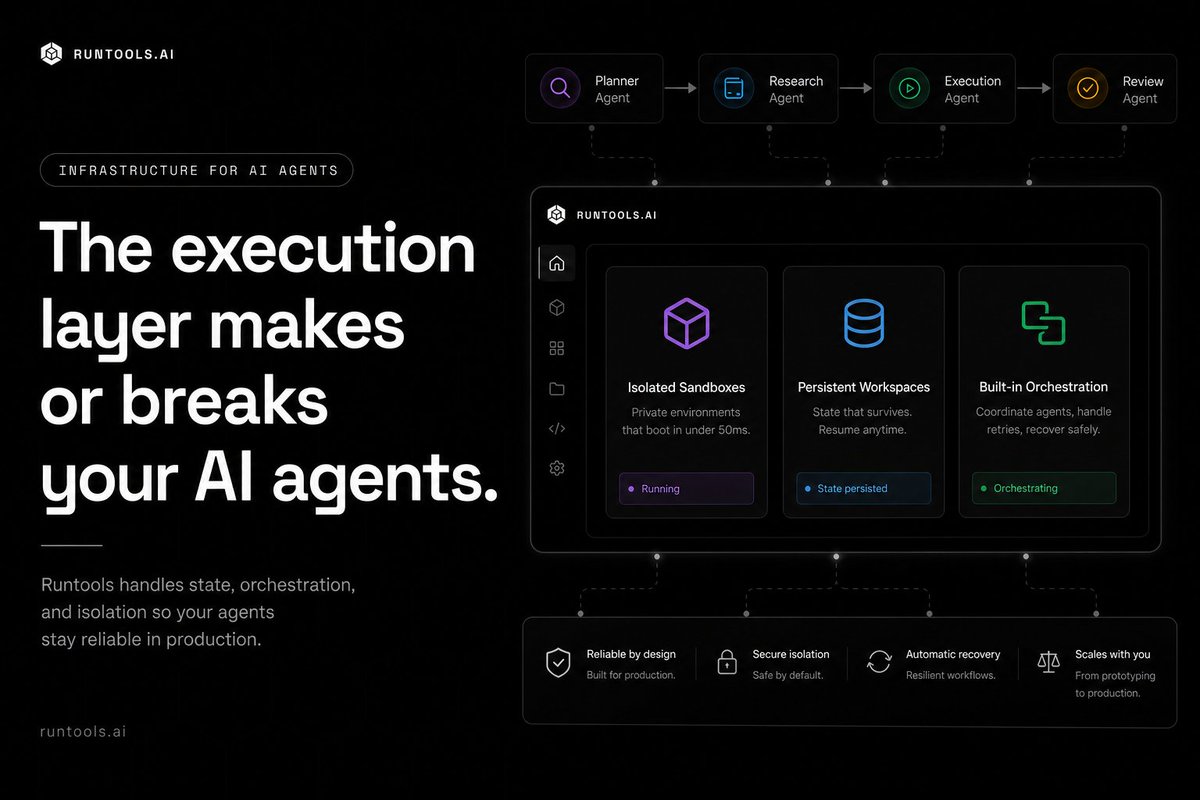
We started building multi-agent systems because the theory made perfect sense.
One AI agent plans.
One AI agent researches.
One AI agent executes.
One AI agent reviews.
It sounds like the ultimate assembly line. But when you move these systems from local testing to production, you quickly discover a different reality.
Adding more AI agents does not make a system more resilient. It introduces a compounding chain of failure points.
In production, you run into hard questions:
- How do you guarantee reliable state transfer between AI agents?
- Who owns the task when an intermediate step times out?
- How do you handle recovery when the research agent fails but the execution agent has already run?
The bottleneck is rarely the intelligence of the individual models. The real challenge of multi-agent systems is the execution layer.
Without persistent state, robust orchestration, and isolated environments, AI agent workflows break down under real-world edge cases.
This is where Runtools comes in.
We build the infrastructure layer for AI agents. With isolated Sandboxes, persistent Workspaces, and built-in orchestration, we handle the execution layer so you can focus on building the workflow.
Building reliable AI agents is an infrastructure problem, not a prompting problem.
https://t.co/SC1cuOHJzo
#AIAgents #AgentOrchestration #AgentInfrastructure
Responsible AI extends beyond the model.
As AI agents become more capable, the conversation has to include the infrastructure they operate on.
What can an agent access?
What actions can it take?
When should it pause for approval?
How does it recover when something goes wrong?
These questions are not answered by the model alone. They are answered by the environment the agent runs in.
Responsible AI is as much an infrastructure challenge as it is a model challenge.
At Runtools, we are building the execution layer for production AI agents, with secure sandboxes and the controls developers need to build reliable systems.
As agents move from assistants to autonomous workers, the infrastructure behind them becomes part of the safety conversation.
https://t.co/SC1cuOHJzo
#AIAgents #ResponsibleAI #AIInfrastructure #ProductionAI #AgentInfrastructure
OpenAI, Anthropic, and Meta have different strategies, but they all point in the same direction.
Models are becoming the base layer.
The next competition is not just who has the smartest model. It is who can turn model capability into reliable execution.
That means managing state, runtime, orchestration, integrations, and recovery in production.
Building agents is easy. Running them reliably at scale is the real challenge.
This is why we built Runtools. We provide the persistent storage, isolated sandboxes, and orchestration infrastructure to take agents from prototype to production.
Build reliable agents at https://t.co/SC1cuOHJzo
#AIAgents #AgentInfrastructure #AIInfrastructure #ProductionAI
Most AI agent demos work because the environment is clean.
Clean input. Short workflow. Simple state. No real failure cases.
That does not make the demo fake. It just means production is a different test.
A working demo proves the agent can act. Production proves the agent can be trusted.
In production, state management breaks down. Files disappear between runs. API calls fail. Long-running workflows lose context.
Building reliable agents requires shifting focus from the model to the execution environment.
https://t.co/SC1cuOHJzo
#AIAgents #ProductionAI #AgentWorkflows #AgentInfrastructure
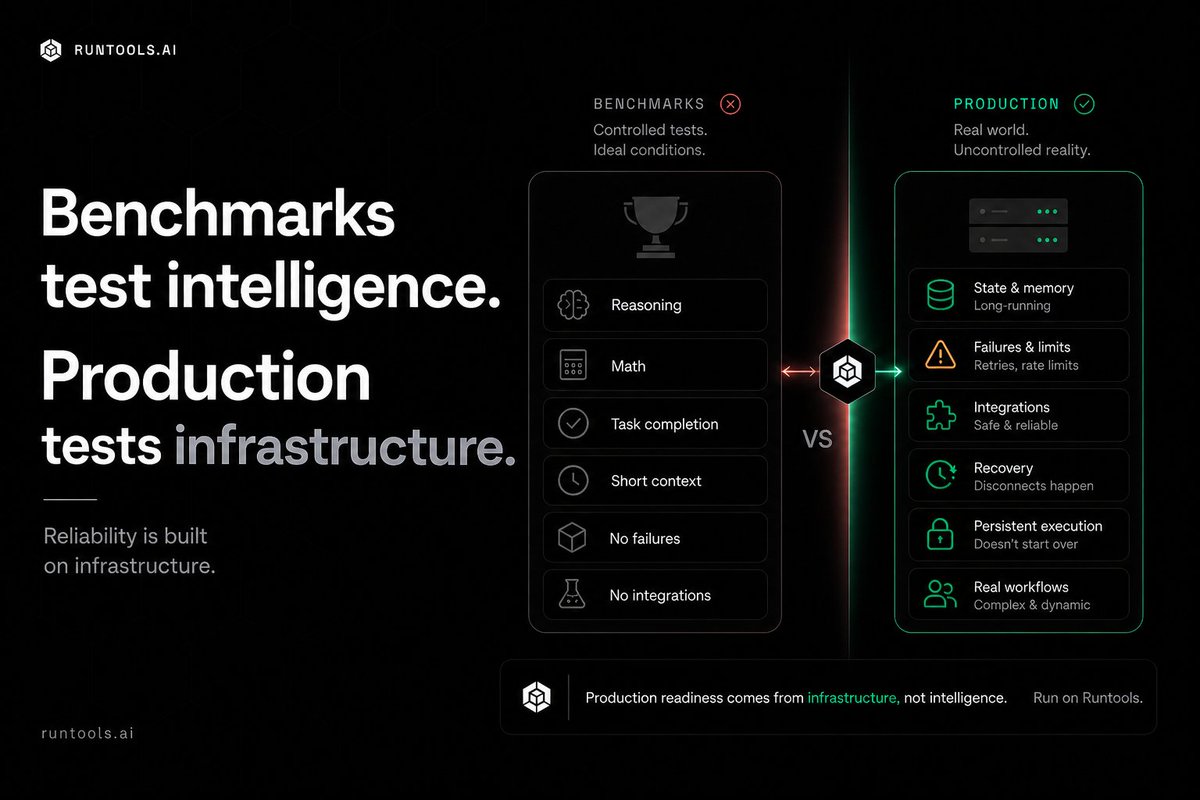
AI benchmarks are useful, but they do not measure production readiness.
Most benchmarks test reasoning, math, and controlled task completion in a vacuum. Production tests something else entirely.
In production, the challenges are infrastructural:
- Can the agent maintain state across long-running processes?
- Can it handle API failures and rate limits gracefully?
- Can it use integrations safely without breaking the workflow?
- Can it recover from a disconnected session without losing progress?
A smarter model does not automatically mean a more reliable agent. If the underlying runtime cannot manage state and execution safely, even the most capable model will fail in production.
Building reliable agents requires shifting focus from model intelligence to infrastructure stability.
https://t.co/SC1cuOHJzo
#AIAgents #AgentReliability #AgentInfrastructure #AIInfrastructure
The model gets the attention.
The runtime determines whether the agent succeeds.
A model can decide what to do next. But the agent still needs an environment where it can execute tasks, work with tools, preserve its state, and continue long-running workflows.
A powerful model running in the wrong environment is still a fragile agent.
As frontier models continue to improve, the real challenge is no longer intelligence. It's execution.
That is why we are building Runtools. Every production AI agent needs infrastructure it can depend on.
https://t.co/SC1cuOHJzo
#AIAgents #AgentInfrastructure #ProductionAI #AIInfrastructure
If every company has access to the exact same frontier models, the model itself is no longer a competitive advantage.
When GPT-4o, Claude 3.5 Sonnet, and Llama 3 are available to everyone via a simple API call, the playing field is completely level at the intelligence layer.
The real differentiator shifts from the model to the infrastructure supporting it.
In production, a model is just a engine. To build a valuable AI agent, you need the rest of the vehicle:
1. State Management
If an agent loses its place during a multi-hour task, it is useless. The advantage goes to systems that can persist state, survive network interruptions, and resume seamlessly.
2. Isolated Environments
Executing complex workflows requires sandboxing. Running untrusted code, processing files, and interacting with external systems safely requires secure, isolated runtimes.
3. Tool Integration
An agent is only as useful as what it can actually do. Reliable authentication, secure database access, and stable API integrations determine the ceiling of your agent's capability.
4. Persistent Storage
Agents need memory that outlives a single session. They need workspaces where files and context survive across runs.
Companies winning with AI agents aren't writing better prompts. They are building better infrastructure to handle execution, reliability, and state.
At Runtools, we build the persistent workspaces, sandboxes, and tool integrations that turn standard models into production-ready agents.
https://t.co/Jm26VablvD
#AIAgents #AgentInfrastructure #ProductionAI #AIInfrastructure
Adding more AI agents doesn't automatically make your system smarter.
It often makes it more fragile.
A single agent only needs to manage its own work. A team of agents needs to share context, coordinate tasks, access the right files, and recover when one of them fails.
The intelligence isn't the difficult part. The coordination is.
As more companies move toward multi-agent systems, the real challenge shifts from building capable agents to building infrastructure that keeps them working together reliably.
That's why we are building Runtools.
Whether you are running one agent or one hundred, they need secure environments, persistent state, and reliable orchestration to operate as a system instead of a collection of isolated tasks.
https://t.co/SC1cuOHJzo
#AIAgents #MultiAgentSystems #ProductionAI #AgentInfrastructure
Every frontier AI model supports agents now. So what actually differentiates AI companies?
OpenAI, Anthropic, Google, and Meta are all pushing toward the same goal: better reasoning, tool use, longer context, and more capable agents.
That means the competitive advantage is starting to shift.
Not every company can build a frontier model. But every company still needs to turn those models into products that actually work in production.
That's where infrastructure becomes the differentiator.
No matter which model you choose, your agents still need secure execution, persistent state, reliable orchestration, and the ability to recover when things go wrong.
That's why we're building Runtools.
The model provides the intelligence. Runtools provides the environment that helps it execute reliably.
As models continue to improve, we believe the platforms around them will matter even more.
https://t.co/SC1cuOHJzo
#AIAgents #AIInfrastructure #ProductionAI #AgentInfrastructure
Meta's Muse Spark 1.1 is another reminder that smarter models are no longer the biggest challenge in AI.
Long context, reasoning, tool use, and multi agent coordination are quickly becoming standard capabilities. Every frontier model is moving in the same direction.
The harder problem begins after the model makes a decision.
Can the agent execute safely? Can it preserve state across long running workflows? Can it recover from failures? Can it coordinate reliably with other agents?
Those aren't model problems. They're infrastructure problems.
As models continue to improve, we believe the biggest competitive advantage will come from the platforms that make AI reliable in production.
That's why we're building Runtools. Secure sandboxes, persistent workspaces, and the execution layer that helps AI agents move beyond demos and into production.
Do you think the next AI leader will be defined by better models or better infrastructure?
https://t.co/SC1cuOHJzo
#AIAgents #AIInfrastructure #ProductionAI #AgentInfrastructure
Who owns the AI stack?
Right now, the industry is hyper-focused on the model layer. LLMs are treated as the entire stack. But as we transition from chatbots to production AI agents, the value is shifting.
Models are becoming commoditized. Intelligence is getting cheaper, faster, and more accessible.
But intelligence alone cannot execute a workflow.
To do real work, an agent needs more than a model. It needs:
- Persistent state to remember context across days or weeks
- Isolated sandboxes to execute tasks safely
- Reliable tool integration to interact with databases, APIs, and browsers
- Orchestration to manage complex, multi-agent workflows
The companies that own the AI stack won't just build the smartest models. They will build the infrastructure that makes those models useful, reliable, and secure in production.
Without the execution layer, an agent is just a chatbot waiting for instructions.
https://t.co/SC1cuOHJzo
#AIAgents #AgentInfrastructure #AIInfrastructure #ProductionAI
The AI model is becoming the least defensible part of an AI company.
Every few months, a new frontier model raises the bar. What was once a competitive advantage quickly becomes accessible to everyone.
The real challenge isn't getting access to intelligence. It's turning that intelligence into a product people can rely on.
That's why the conversation is shifting from "which model should we use" to "how do we build AI systems that actually work in production."
When building autonomous AI agents, the bottlenecks are infrastructure problems, not model problems:
- Maintaining persistent state across long-running sessions
- Executing tasks in secure, isolated environments
- Managing tool orchestration and integrations
- Handling workflow failures reliably
The companies that win the next phase of AI won't just have great models. They will have the infrastructure that makes those models dependable at scale.
We built Runtools to provide the execution layer for production AI agents. While the models commoditize, the environment they operate in remains the differentiator.
https://t.co/SC1cuOHJzo
#AIAgents #AgentInfrastructure #ProductionAI #AIInfrastructure