My book is an attempt to stop people from going to jail for speaking. But if you are going to jail, you might need to read a few books. I highly recommend you buy my book immediately. It will be a great read in jail 😬😬😬
https://t.co/W7MMwnBg4q
This isn't a trained trick, this is a wild transaction. Sea Otters carry "favorite rocks" in their armpits to crack open clams. This otter realized that humans value "things," so he offered his prized possession, a perfect white stone, in exchange for a high-value item, a fish.
He literally invented currency on the spot.
How cool and adorable is that? ❤️
@sebkrier I just recalled that housing shortage is also the same. You can't regulate your way out of it; you have to build. That means keeping the private sector engaged, not scared off.
Very interesting. We'll see much more of this. Theory is useful for external validity, but particular functional forms we fit to get analytic tractability involve many assumptions that go beyond theoretical restrictions (cue Chuck Manski!). Methods like this are a solution.
I work with multiple companies where nearly all code is AI generated now. However, the productivity probably has only increased 20-30%. Why?
I suspect because writing code is really running code. Changes are the result of a business learnings. Or an operational learnings. For mature companies, the majority of PRs are sub 10 lines codifying these learnings.
AI clearly helps here (e.g. debugging, running tests, building tools) but less so. Operations and business learnings are workload and company specific.
Until AI can perfectly predict what the market needs, or how a system will be used this bottleneck will exist.
@sebkrier And we can wire into them the human-collaboration needed (where they don’t think of humans as a bottleneck but find the right avenues where human wisdom can be best used. That will be a true upgrade in human dignity.)
@sebkrier A simple not-too-techological solution to an evolving problem would be competing AI agents (instead of one God-like-AI) are bound to evolve with time. RSI is in fashion these days -- this could be a non-fancy version of SI but won't be as appealing
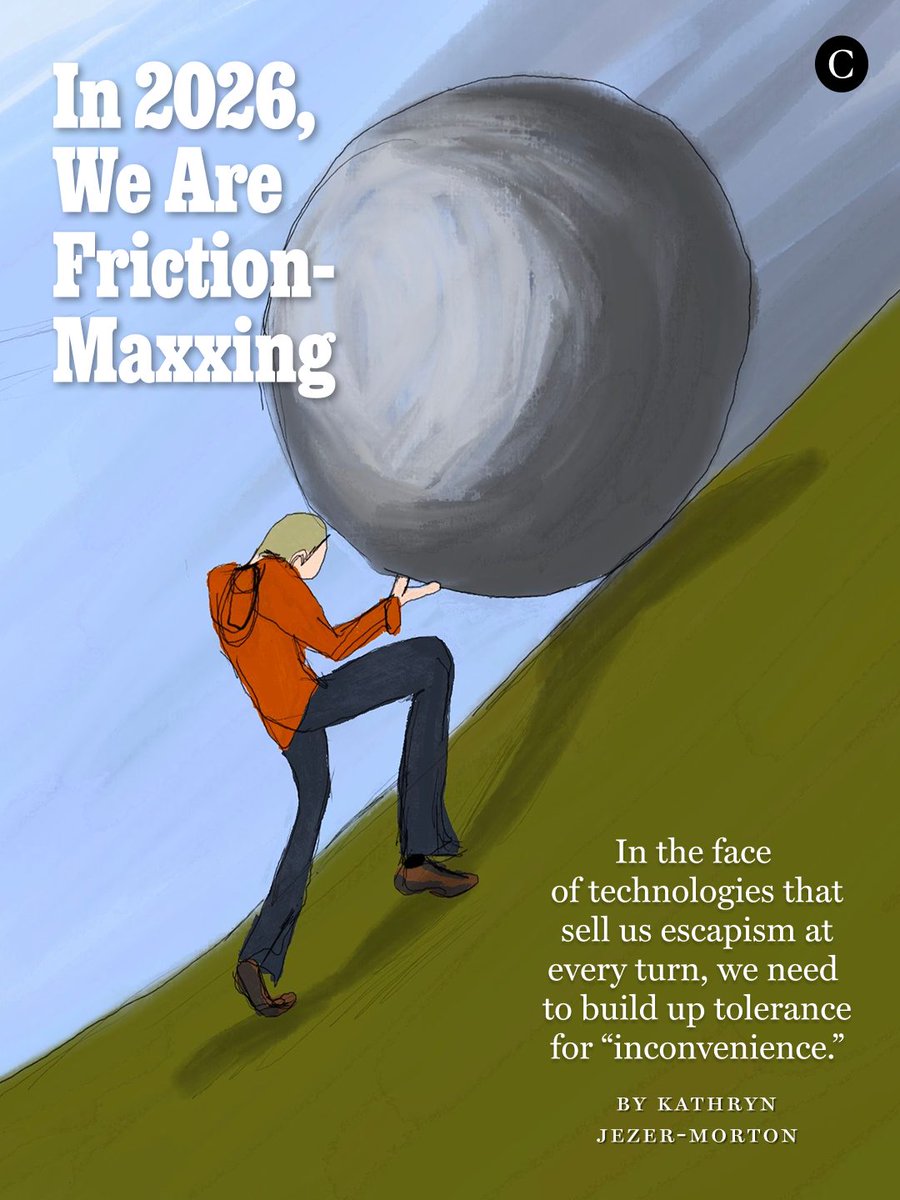
Tech companies are succeeding in making us think of life itself as inconvenient and something to be continuously escaping from, into digital padded rooms of predictive algorithms and single-tap commands: Reading is boring; talking is awkward; moving is tiring; leaving the house is daunting. These are all frictions that we can now eliminate, easily, and we do.
Once we’ve adopted a habit of escaping from something, whether it’s Uber-ing dinner five nights a week or using AI for replying to texts, the act of return, which is how we might describe no longer using a tool of escape, feels full of irritating friction. In these moments, we become exactly like toddlers in the five minutes after the iPad is taken away: The dullness and labor of embodied existence is unbearable.
“This is why I have resolved to commit to make 2026 a year of friction-maxxing, as an individual but more importantly as a parent,” Kathryn Jezer-Morton writes.
There are some obvious places to begin your friction-maxxing journey. Stop sharing your location with your kids and your partner. Stop using ChatGPT completely. No, it does not have good ideas for meal planning. Buy a cookbook. Text your friends for advice. Go to Trader Joe’s. Invite people over to your house without cleaning it all the way up.
Friction-maxxing is not simply a matter of reducing your screen time, it’s the process of building up tolerance for “inconvenience” — and then reaching even toward enjoyment. And then, it’s modeling this tolerance, followed by enjoyment and humor, for our kids.
Read Jezer-Morton’s full column: https://t.co/AnrXfBWrIz
Will AI prove Piketty right? Will labor share → zero? Will we need capital taxation?
@pawtrammell and @dwarkesh_sp wrote an important essay arguing AI vindicates Piketty's fears. I replied to some of it already but it was heavy on the math. How do we understand their model?
I went back to the basics: supply and demand for capital. What assumptions actually need to hold?
Getting labor share to zero—not 30%, approximately ZERO—requires either perfect substitutability (no task where humans have comparative advantage) or capital growing without bound forever.
For unbounded growth, it's not just about a high substitutability. Returns must always exceed depreciation + impatience. Not just now. Forever. At every capital level.
Yes, fast AI progress flattens the demand curve (easier substitution), but it also raises depreciation through obsolescence. Your GPU depreciates because next year's model is better. It's not about it necessarily breaking.
Could capital returns always be that high? Maybe. Anything is possible through Christ.
But a lot needs to change and a lot more than people realize.
For policy, while we aren't at the knife edge, I show that the same features that make capital accumulation explosive are exactly the features that make capital taxation ineffective.
Easy substitution + mobile capital = their inequality story.
Easy substitution + mobile capital = capital flees when taxed, workers pay.
https://t.co/ZNzIqEWo6Z
The most successful people I know don't actually think about discipline at all. Instead, they align their purpose with their pursuits. They find something that feels effortless to them and looks tedious to others. Because then, doing the work itself is the reward. You have to get them to stop working, not start working.
@sebkrier Govt. can shittify the things that used to work and run enterprises to the ground. Good intention ain't good enough. They can just stick to law and order and audits and enforcement and NatSec and gathering the needs of its people and make it easy for better people to solve gaps
@sebkrier States manage, audit, enforce contracts, etc etc. but the real material solutions come from the similar companies / ecosystem that safety people villianize. Governments are shit at innovations (DARPA like entities are outliers, but they too have private industry collabs).
I wrote this note earlier this year and it's so nice to see Richard Sutton make these points so eloquently. Somewhat comforting to know that my intuitions aren't completely off.