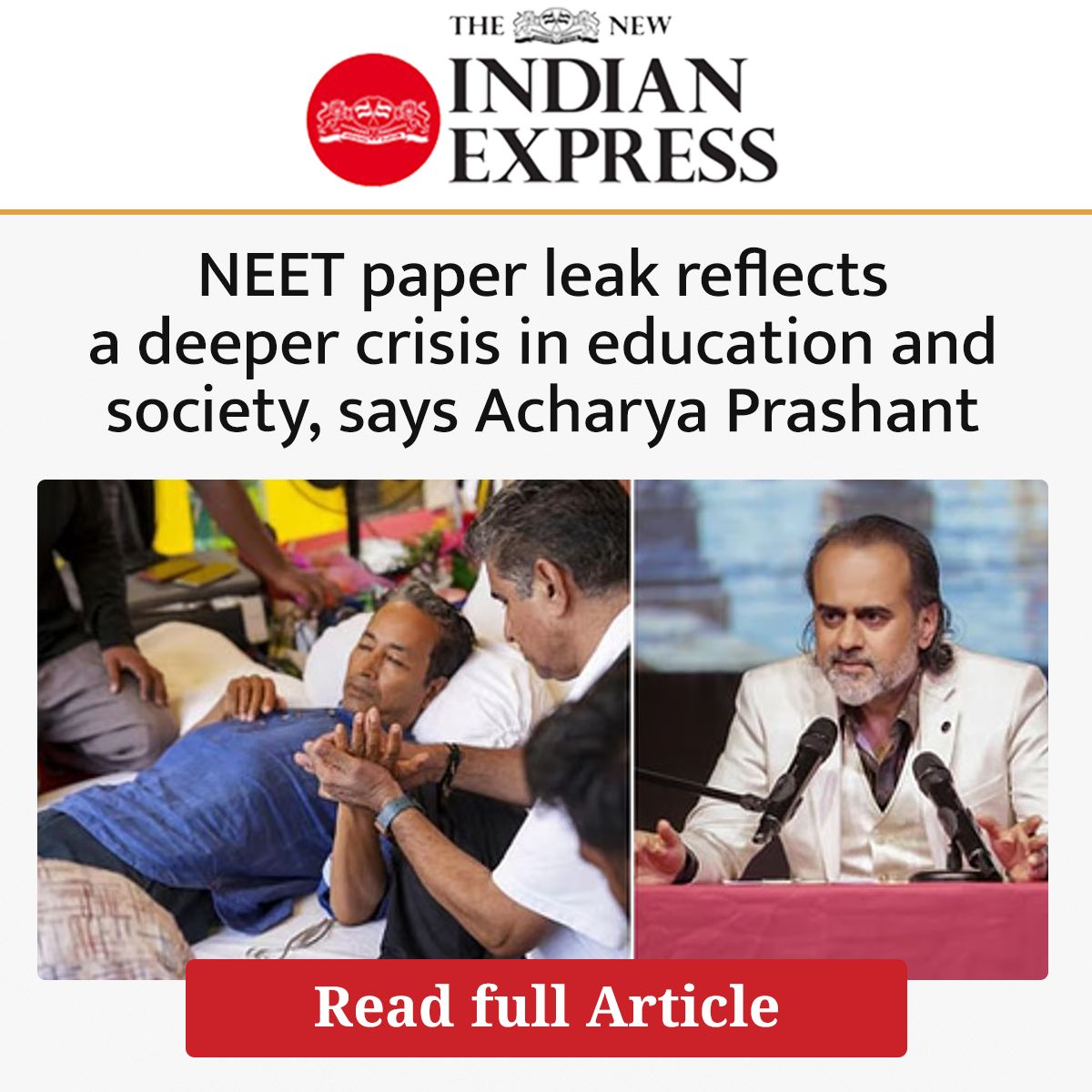
NEET paper leak reflects a deeper crisis in education and society, says Acharya Prashant ~ The New Indian Express coverage
"(Acharya Prashant) accepted the need for external reform but called it incomplete. ‘By all means fight the wrongdoing in the system; that is your right. But if awareness does not awaken within, then however many changes you bring outside, things will remain just as they were, having only changed their names and forms.’"
Read full article: https://t.co/ShDSZG0B6m
Other media coverage :-
◼️Dainik Bhaskar: https://t.co/xRXEkAifmR
◼️ Deshbandhu: https://t.co/z3Pw46Duv5
◼️ IANS: https://t.co/uf41yOwKrz
◼️ The Hawk: https://t.co/S1p1xk11TX
◼️ Yes Punjab: https://t.co/ggfAlWq7mq
◼️ Assam Tribune: https://t.co/iH28OqMOBH
Acharya Prashant on NEET crisis: A system can't be honest if its builders aren't
Acharya Prashant calls the NEET paper leak a symptom of deep societal dishonesty, urges Sonam Wangchuk to end his 18-day fast, and demands government dialogue.
https://t.co/ayD2oct2Zz
South Goa: Philosopher and author Acharya Prashant Appeals to Sonam Wanchuk, Message to Countrymen
Acharya Prashant says, "...There was a NEET paper. We are talking about 22 lakh applicants, 22 lakh families. This is not just an incident of a paper being leaked on one day. These students spent two, four, or even five years preparing. They gave up playgrounds, their childhood, the normal rhythm of life, festivals and celebrations... Paper leaks have happened, and we are speaking as if it is an external incident, as if some broker sitting in the system leaked the paper. Papers do not leak like that. Understand this: paper leaks happen when someone is willing to leak it and someone willing to buy it, not just willing, but ready to pay huge amounts... I want to ask: why have we forced our lakhs of children to go in only one direction? Where does this compulsion come from? When a paper becomes such a big deal, the law of economics applies: demand creates supply. It could have been that even if someone leaked the paper, there might not have been enough buyers, and this scandal would not have become so big. But today, if you see, the narrative that a student's life depends on one result, this narrative is being promoted by coaching centers, teachers, parents, students themselves, corrupt officials, and brokers. Everyone is saying the same thing..."
Meet Ashish Tani Purty.
If the name doesn't ring a bell, you're not alone.
This 𝘆𝗼𝘂𝗻𝗴 𝗵𝗼𝗰𝗸𝗲𝘆 𝗽𝗹𝗮𝘆𝗲𝗿 has just led India to gold at the U-18 Hockey Asia Cup 2026, defeating hosts 𝗝𝗮𝗽𝗮𝗻 on their home turf.
He was named 𝗣𝗹𝗮𝘆𝗲𝗿 𝗼𝗳 𝘁𝗵𝗲 𝗠𝗮𝘁𝗰𝗵 and finished as the tournament's 𝘁𝗼𝗽 𝘀𝗰𝗼𝗿𝗲𝗿 with 13 goals.
Think about that for a moment.
An Indian athlete dominates an international tournament.
Wins gold for the country.
Finishes as the top scorer.
And yet, most Indians are 𝗵𝗲𝗮𝗿𝗶𝗻𝗴 𝗵𝗶𝘀 𝗻𝗮𝗺𝗲 𝗳𝗼𝗿 𝘁𝗵𝗲 𝗳𝗶𝗿𝘀𝘁 𝘁𝗶𝗺𝗲 𝘁𝗼𝗱𝗮𝘆.
What's even more striking?
The final took place just 𝟲 𝗱𝗮𝘆𝘀 𝗮𝗳𝘁𝗲𝗿 𝘁𝗵𝗲 𝗜𝗣𝗟 𝗳𝗶𝗻𝗮𝗹, an event that dominated every screen, every headline, and every conversation across the country.
This is a reminder of the power our attention has in shaping sporting culture.
The sports we watch 𝗿𝗲𝗰𝗲𝗶𝘃𝗲 𝘀𝗽𝗼𝗻𝘀𝗼𝗿𝘀𝗵𝗶𝗽𝘀.
The athletes we celebrate 𝗴𝗮𝗶𝗻 𝘃𝗶𝘀𝗶𝗯𝗶𝗹𝗶𝘁𝘆.
The games we follow 𝗮𝘁𝘁𝗿𝗮𝗰𝘁 𝗶𝗻𝘃𝗲𝘀𝘁𝗺𝗲𝗻𝘁.
If India is to become a genuine sporting nation, the responsibility can't rest solely with athletes, federations, or governments.
It rests with us too.
---------------------------
This is precisely why 𝗔𝗰𝗵𝗮𝗿𝘆𝗮 𝗣𝗿𝗮𝘀𝗵𝗮𝗻𝘁 identified 𝗖𝘂𝗹𝘁𝘂𝗿𝗲 as one of the key reasons India struggles to become a true sporting nation.
Culture is ultimately a reflection of the individual.
An individual who has not understood himself remains driven by conditioning, conformity, and the need for social approval. And when millions live this way, it shapes the culture of an entire nation.
That is why Acharya Prashant repeatedly emphasizes the 𝗻𝗲𝗲𝗱 𝗳𝗼𝗿 𝗺𝗮𝘀𝘀 𝗲𝗱𝘂𝗰𝗮𝘁𝗶𝗼𝗻 𝗼𝗳 𝘁𝗵𝗲 𝘀𝗲𝗹𝗳.
Only a society of freer and more conscious individuals can truly recognize, support, and celebrate excellence wherever it appears.
#AcharyaPrashant
आचार्य प्रशांत का ब्रिटेन की ऑक्सफोर्ड यूनिवर्सिटी में सत्र~ दैनिक भास्कर कवरेज✨
"ऑक्सफ़ोर्ड में एक भारतीय द्वारा वेदांत पढ़ाए जाने को आचार्य प्रशांत ने एक सार्थक संयोग बताया। उन्होंने कहा कि वेदांत का ज्ञान कभी गुप्त नहीं रहा; जो भी सीखना चाहे, सीख सकता है, और पात्रता का आधार जन्म, जाति या वर्ण नहीं, बल्कि साधन चतुष्टय में वर्णित योग्यताएँ हैं, जो पूर्णतः गुण-आधारित हैं। उन्होंने कहा कि जिस पश्चिमी परंपरा ने कभी इस ज्ञान को बाहर से, एक अध्येय वस्तु के रूप में देखा था, वहाँ आज वही ज्ञान उसकी जीवित परंपरा के भीतर से प्रस्तुत हो रहा है।"
पूरा लेख पढ़ें: https://t.co/Z3APzuZqis
A century and a half on, the Ishavasya Upanishad returns to Oxford, this time in Acharya Prashant's voice
•In 1879, Professor Max Muller carried the Ishavasya Upanishad to the West, publishing its first English translation through Oxford University Press as the opening volume of the ‘Sacred Books of the East’. Nearly a century and a half later, an Indian philosopher has arrived at the same university to return the text to its living meaning
🔗https://t.co/umSpFmrcP5
Imagine if every citizen protected public spaces the way she did.
A 𝟳𝟯-𝘆𝗲𝗮𝗿-𝗼𝗹𝗱 𝘄𝗼𝗺𝗮𝗻 from Kozhikode, Kerala, went viral after she stopped a scooter rider from 𝗺𝗶𝘀𝘂𝘀𝗶𝗻𝗴 𝗮 𝗳𝗼𝗼𝘁𝗽𝗮𝘁𝗵.
Despite resistance, she stood her ground, and the rider eventually turned back.
Her name is Prabhavathi.
She was 𝗹𝗮𝘁𝗲𝗿 𝗵𝗼𝗻𝗼𝘂𝗿𝗲𝗱 𝗯𝘆 𝗼𝗳𝗳𝗶𝗰𝗶𝗮𝗹𝘀 of the Motor Vehicles Department after the video sparked widespread discussion on pedestrian safety.
This is precisely what 𝗔𝗰𝗵𝗮𝗿𝘆𝗮 𝗣𝗿𝗮𝘀𝗵𝗮𝗻𝘁 repeatedly reminds us:
Real change does not begin in systems.
It begins in the individual.
He often says:
“If there is something wrong right now, 𝘀𝗲𝗲 𝘄𝗵𝗮𝘁 𝘆𝗼𝘂 𝗮𝗿𝗲 𝗱𝗼𝗶𝗻𝗴 𝗿𝗶𝗴𝗵𝘁 𝗻𝗼𝘄.
The power to respond, the power to choose, is always available.
Don’t give up your power.
Whatever the situation, even if it is very bad, 𝗮𝗹𝘄𝗮𝘆𝘀 𝗲𝘅𝗲𝗿𝗰𝗶𝘀𝗲 𝘆𝗼𝘂𝗿 𝗽𝗼𝘄𝗲𝗿 𝘁𝗼 𝗰𝗵𝗼𝗼𝘀𝗲.”
Societies change, and systems change, only when ordinary people stop cooperating with everyday wrong.