I strongly believe there are entire companies right now under heavy AI psychosis and its impossible to have rational conversations about it with them. I can't name any specific people because they include personal friends I deeply respect, but I worry about how this plays out.
I lived through the great MTBF vs MTTR (mean-time-between-failure vs. mean-time-to-recovery) reckoning of infrastructure during the transition to cloud and cloud automation. All those arguments are rearing their ugly heads again but now its... the whole software development industry (maybe the whole world, really).
It's frightening, because the psychosis folks operate under an almost absolute "MTTR is all you need" mentality: "its fine to ship bugs because the agents will fix them so quickly and at a scale humans can't do!" We learned in infrastructure that MTTR is great but you can't yeet resilient systems entirely.
The main issue is I don't even know how to bring this up to people I know personally, because bringing this topic up leads to immediately dismissals like "no no, it has full test coverage" or "bug reports are going down" or something, which just don't paint the whole picture.
We already learned this lesson once in infrastructure: you can automate yourself into a very resilient catastrophe machine. Systems can appear healthy by local metrics while globally becoming incomprehensible. Bug reports can go down while latent risk explodes. Test coverage can rise while semantic understanding falls. Changes happens so fast that nobody notices the underlying architecture decaying.
I worry.
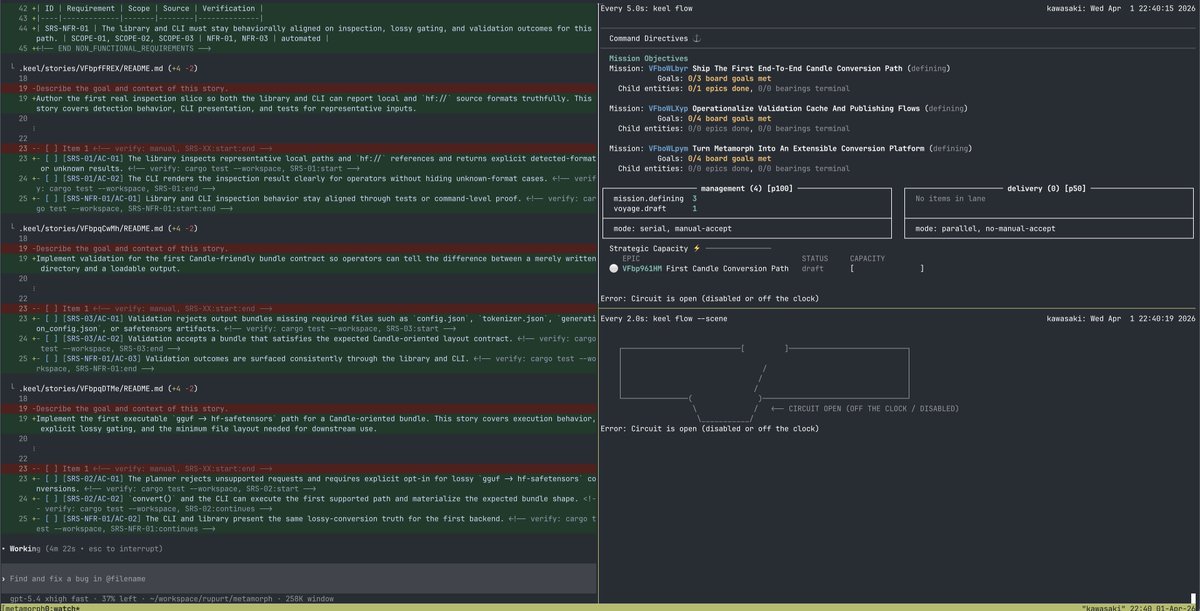
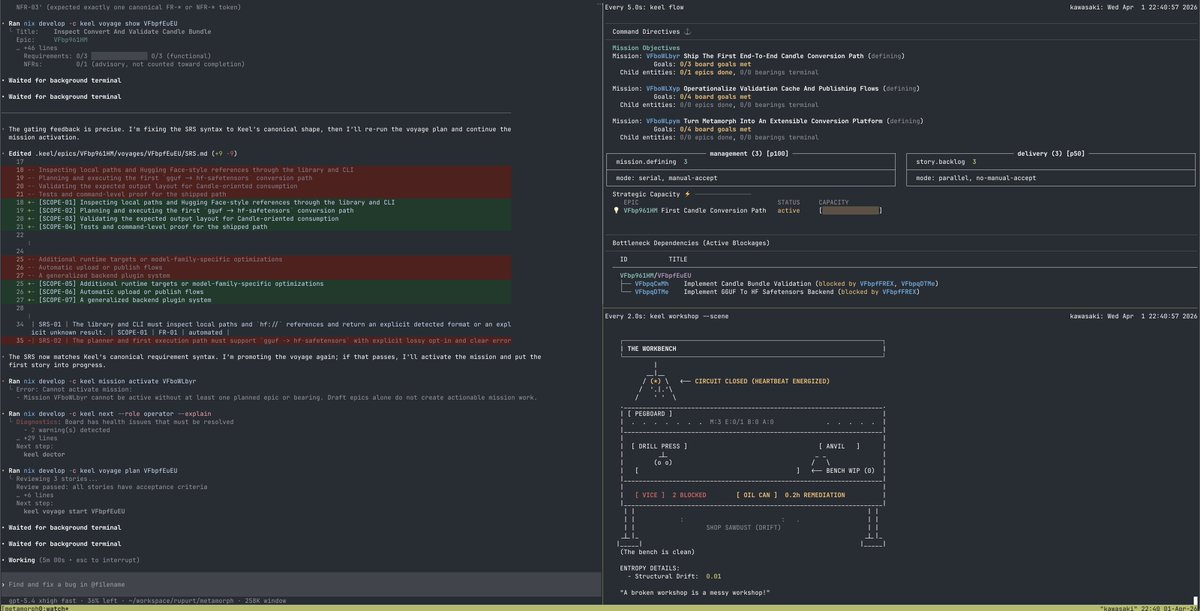
@nbaschez Would love to compare notes. I've been building keel for this exact pain. AI-authored planning markdown gets treated as enforceable state (vision → epic → story), with a doctor command that catches drift before review.
https://t.co/JkiRJ1CI5B
@boardyai https://t.co/qZAhYBvq0V It's a turn-based board engine for human/AI delivery teams. It allows software teams to move much faster by having agents participate in the SDLC process.
Custom local model/remote API harness Paddles (https://t.co/ukW0wMk9UO). Recursive context management with a different take on compaction using pressure heuristics with state space actions decided by the model first.
Kimi 2.5 in the screenshot
Adding support for the exciting new @PrismML 1-bit model released today!
Come play my text based adventure work games. Soon questing will never be so fun...
OpenAI's 2x limits come to a close tomorrow. Forever grateful of the progress it allowed me to make. I'm maxing out 2 Pro accounts, 1x Claude Max, 1x Gemini Ultra and a 1x Kimi Allegretto.
If you want help setting up your own software factory or just want to talk shop about AI engineering hit me up.
https://t.co/XuE5aQ6Xfi
Custom local model/remote API harness Paddles (https://t.co/ukW0wMk9UO). Recursive context management with a different take on compaction using pressure heuristics with state space actions decided by the model first.
Kimi 2.5 in the screenshot
Adding support for the exciting new @PrismML 1-bit model released today!
@AnthropicAI Have you tried giving project management tools to the harness? I’ve had great success with a custom CLI tool that manages missions/epics/stories. Getting creative with verification is where I spend most of my time now
The 12-slot rule: constraint is the feature, not the bug.
The heart can't overcommit. Diesel engines are governed below their ceiling. A watch face only has 12 positions.
Remove the constraint and you don't get more throughput — you get shorter engine life and invisible critical paths.
New post on constraint-driven prioritization → https://t.co/EngtDpC3QK
Unix is the IDE. Especially now, in the agentic era.
Every modern agent harness is just a formalized Unix control loop: command in, output out, parse, verify, repeat.
The text stream was always the protocol.
https://t.co/rdtikJMRad