I've been explaining the "head-foot" body plan like this for years, finally got around to drawing it 😁
(Part II only exists because I got so many questions after Part I 🙈)
So this happened today... I survived 4 hours of teaching BFAR personnel how to identify whole, carcass, and dried CITES-listed #sharks and rays! They had already spent the past 2 days learning about #CITES sea cucumbers, shells, and cetaceans. #ConservePHSharks#PatingKaBa
⚠️ rgdal, rgeos, and maptools won’t be available on CRAN after October 2023. ⚠️
What are the consequences of this change? What do you need to do as a user and as a developer?
Read my blog post at https://t.co/SW7hfT6l9T
#rstats#rspatial#gischat#geocompx
📣 #NewPaperAlert out now in @TPJF_NFRDI
We provide a comprehensive checklist of #sharks, rays, and chimaeras from Palawan waters using historical data from museums and publications, validated sightings from market surveys, and DNA barcoding. ✅️ 67 species confirmed! 🦈
What is Causal Inference?
Causal Inference is a new science of causation. This field is nothing less than a revolution in how scientists understand data. Read on to learn more.
This is the first post in a series based on the Book of Why by Judea Pearl. I will be reading the book and sharing the big insights with my followers.
When I first started learning causal inference, I didn't have a clear idea of the problems that casual inference was trying to solve. My misconceptions made it harder to understand the material than it would have been otherwise.
So, before we get into the ideas of the book, I want to help you avoid these common misconceptions.
1. Causal Inference is NOT just regular science
All sciences strive to infer causes within their domain of expertise. Therefore, it might not be obvious to you what makes casual inference any different. This is the reason why I sometimes call this new field mathematical causal inference. This term emphasizes that what sets causal inference apart is the mathematical framework it uses to describe causation.
2. Causal Inference is NOT directly about inferring causes
Based on the name, new learners often think causal inference is solving the following problem:
Given a list of candidate variables, how can we select the ones that have a real causal effect on our outcome of interest?
This is not what causal inference does. Causal inference is solving a different problem:
Assuming our beliefs about the causal relationships between all the variables is accurate, what is the best estimate of the causal relationship between a particular candidate variable and the outcome of interest?
Very roughly speaking, causal inference tells us whether based on our causal beliefs, the association between two variables is bigger or smaller than their true casual relationship.
3. The Example of Alice and Bob
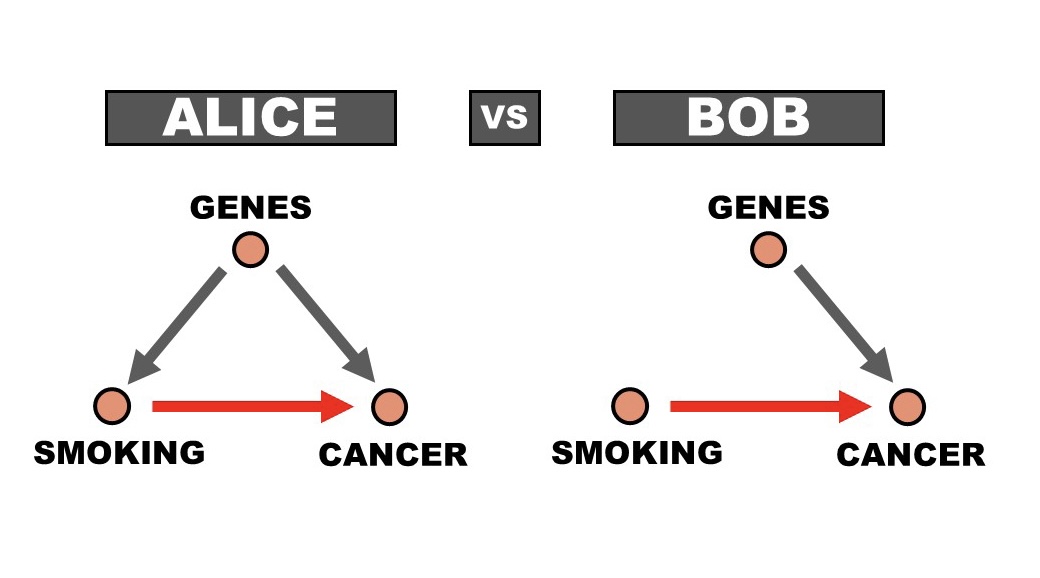
Alice thinks genes strongly affect addictive behaviors like smoking. She also thinks genes have an effect on who gets cancer. Bob agrees that genes very likely have an effect on cancer, but Bob thinks complicated social behaviors like addiction are completely due to social factors, not genes.
Causal inference allows us to evaluate the same data according to both Alice's and Bob's beliefs about the underlying causal relationships. This allows for various outcomes:
1. Avoiding unnecessary arguments. If Alice and Bob get very similar estimates for the causal relationship between genes and cancer, this implies that the disagreement about the relationship between genes and behavior is not that important. This allows scientists to move forward by focusing on the factors that really matter.
2. Agreeing to disagree. If the difference in estimates of the casual relationship between genes and cancer is large, causal inference allows both Alice and Bob to continue to explore the same data according to their very different assumptions about the causal relationships. This gives scientists and policy makers autonomy to pursue different interpretations of the same data.
4. Casual Inference builds doesn't replace statistics. It makes it more powerful.
Causal inference allows us to adjust our statistical estimates of the strength of particular casual relationships based on our beliefs about the casual relationships between the variables. This is why some experts in causal inference (like the epidemiologist @epiellie) prefer to use the term causal effect estimation to refer to the field causal inference.
That's it for now. My next post (coming soon!) will explore how causal inference creates a mathematical model of causation and what makes this approach so special. (You can find these posts using the hashtag #KareemReads)
Follow me (@kareem_carr) for more content like this. If you want to show support, like and retweet the thread.
Sleepy Dissertating Potato - "How does one become a night owl?"
Wise Turtle Whisperer @rushanicus - "Farida, one becomes a night owl by first becoming the night, then assuming the form of an owl."
Use a for loop! Or any of the apply family of functions. Reduces the chance of parsley error and you reduce the number of lines in your code. Cleaner and way faster :)
💛🐧yesterday, palmerpenguins reached 1 million CRAN downloads! The adoption & love this little data package has received over the past 3 years has been truly overwhelming. Here are some of my favorite (and maybe lesser known) moments from palmerpenguins’ history. 🧵1/11
Is Bisaya a language? No. It is a language family consisting of languages spoken in the Visayas and northern Mindanao. Bisayan languages include Cebuano, Hiligaynon, Waray, Karay-a, and Surigaonon, among others. Cebuano is colloquially known as 'Bisaya.'