So many traders are scared of gaps
BUT
If you know how to trade these correctly, you can make millions...
My favorite way to enter on a gap up:
1. Find the right stock
-Identify a stock gapping out of a big daily base with VOLUME
-Ideally some big company changing news
2. Wait for the gap up
-After the stock gaps up, patiently wait for a morning flush
-You are looking for a low to be established and price to start reversing
3. Enter on Vwap reclaim
-Once the stock reclaims the Vwap.. enter
-Stop loss goes to the days low
Incredible risk to reward with a stop at the lows... and you don't get shaken out in the morning
This is how I bought $TEM today
2. $IREN
NeoCloud focussing on LPS.
Owns massive amounts of land, already secured 5 GW of power.
Builds and operates data-centers themselves, to rent out capacity, for example to $MSFT.
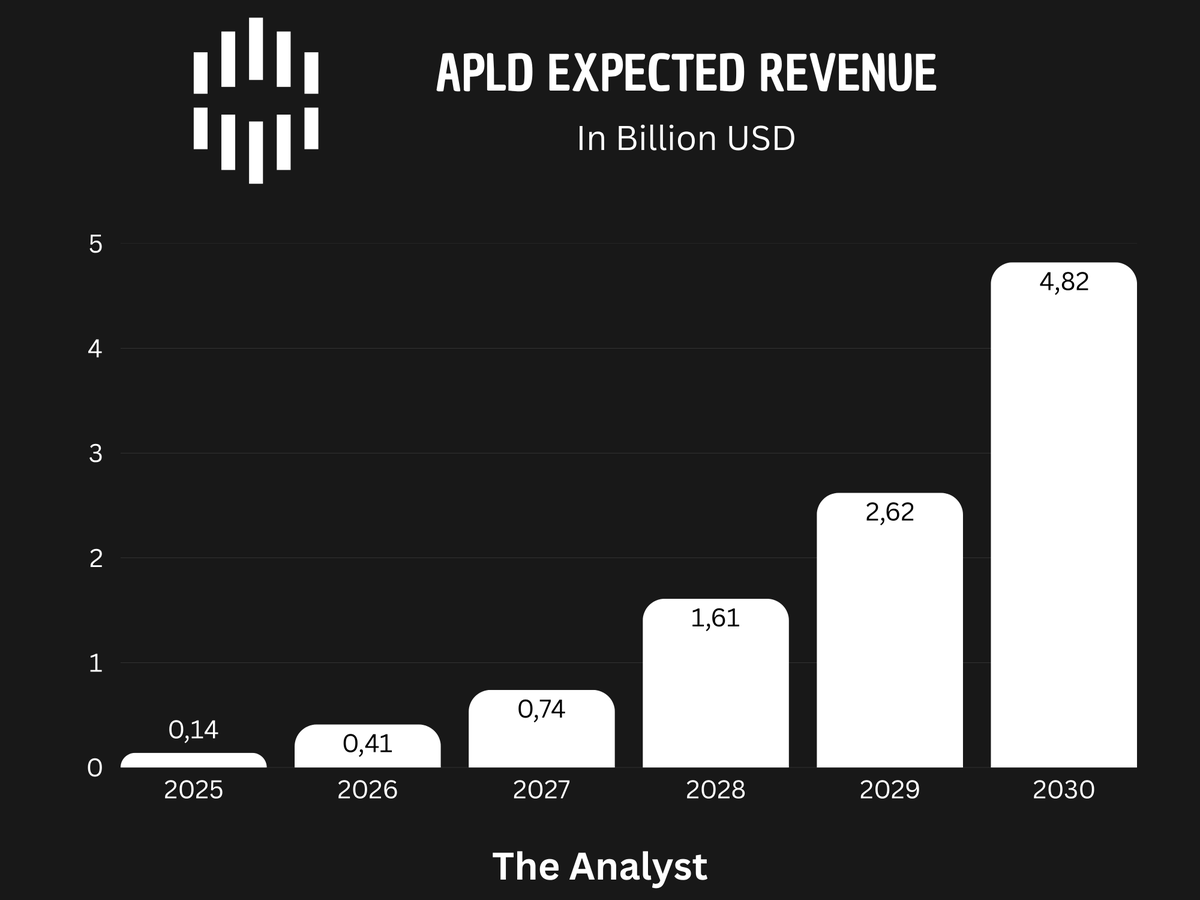
1. $APLD
Builds and operates AI-ready Powered Shells und Data-Center-Campuses.
Long-term deals with $CRWV and other hyperscalers renting these sites.
Pureplay on Land, Power and Shell. with a masive revenue ramp into 2030.
Stanley Druckenmiller initiated a new $IREN position buying 87,100 shares worth ~$4M.
Druckenmiller is widely considered one of the greatest investors ever after compounding at ~30% annually for nearly three decades.
WHAT I DO EVERY WEEKEND THAT HELPED ME MAKE MY FIRST $1,000,000 TRADING.
I’m doing it again right now trying to set up another $25,000 week.
Before Monday, I scan the money flows:
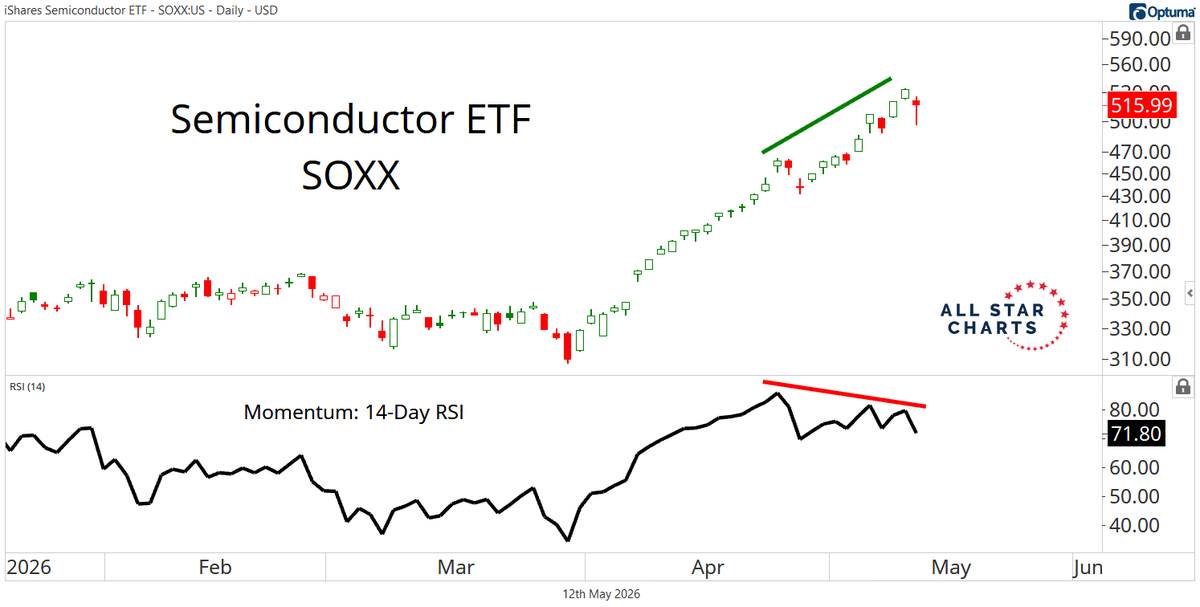
$SMH - Semiconductors
$DRAM - Memory
$EUV - Photonics
$IGV - Software
$CIBR - Cybersecurity
$WGMI - HPC
$DTCR - Data Centers
$BOTZ - Robotics
$ARKX - Space
$NLR - Nuclear
$QTUM - Quantum
$XLF - Financials
$XLV - Healthcare
$XLE - Energy
$IWM - Small Caps
Then I ask:
What is making new highs?
What is holding the 8/21 trend?
What is outperforming $SPY and $QQQ?
Where is money quietly rotating?
Then I find the strongest stocks inside the strongest ETFs.
I don’t wake up Monday searching for random trades.
I already know exactly where I’m looking.
Do this before Monday.
$HIMS capitulated down to $14
$ASTS capitulated down to $52
$OSCR capitulated down to $10
$AMD capitulated down to $84
$SE capitulated down to $75
$UNH capitulated down to $237
$BABA capitulated down to $60
$SOFI capitulated down to $7
$PLTR capitulated down to $7
What did they all have in common?
They all rebounded aggressively and we added.
Peter Lynch had a simple way to spot opportunity:
“A quick way to tell if a stock is overpriced is to compare the price line to the earnings line... the chances are you’d do pretty well.”
Well, let's try that.
1. Microsoft - $MSFT In 12 months...
Price line: -23.5%
Earnings line: +29.8%
SpaceX is now valued at $1.75 trillion. Still private. Still pre-IPO.
For the same money, you could buy the entire publicly-traded aerospace industry. All of it.
GE Aerospace. RTX. Boeing. Airbus. Safran. Honeywell. Rolls-Royce. Lockheed Martin. TransDigm. Northrop Grumman. BAE Systems. Howmet.
Twelve of the most dominant aerospace and defense businesses on the planet. Summed market cap: $1.74 trillion.
SpaceX alone: $1.75 trillion.
One private company. No disclosed earnings. No public track record. No IPO base. And a tech-IPO history that says a 50%+ drawdown in year one is the norm, not the exception.
Versus twelve proven, cash-generating, oligopolistic machines. Decades of recurring aftermarket revenue. Real dividends. Moats so deep there hasn't been a new commercial engine entrant in 50 years.
I know which side of that trade I'm on.
SpaceX is a genuinely remarkable company. The reusable rockets are real. The launch dominance is real. But "remarkable company" and "good investment at $1.75 trillion before it has even priced its IPO" are completely different statements.
Meanwhile the boring side of aerospace keeps quietly compounding:
– GE Aerospace: the engine aftermarket annuity, decades of service revenue per engine
– Safran: #1 worldwide in narrowbody engines, landing gear, and interiors
– TransDigm: the proprietary-parts compounder run like a private equity machine
– HEICO: the family-run FAA-parts business, roughly 22% a year for 35 years
– And in three weeks, the Honeywell Aerospace spin-off lands: $17 billion in revenue, an installed base on virtually every commercial and defense platform on earth, finally trading as a pure-play
The market is offering a clean choice.
One spectacular story about the future. Or the entire proven present that already prints cash, at the same price.
The future is thrilling.
The present pays you to wait.
US stock valuations have never been higher in 125 years.
Trailing P/E, Forward P/E, CAPE, P/B, P/S, EV/EBITDA, Q Ratio, Market Cap to GDP – every single metric is sitting in the 95th percentile.
Higher than 2000. Higher than 1929.
Don't forget though.
The US market has returned around 10% per year for the last 200 years. Some years are great, some are terrible. On average, 10%. That means your money roughly doubles every 7 years.
High valuations don't change that long-term math.
But they do change what happens in between. Today almost every large-cap stock is "long duration" and tech-adjacent, all moving with the same cycle. That sets up corrections that aren't 20% – they're 40 to 50%.
Long term, it doesn't matter. The 10% holds.
But you need to be able to survive the in-between. Mentally and financially.
Investors with a savings plan benefit from these drawdowns. They buy cheap shares during the panic and ride the recovery up.
Investors with too much leverage or too much FOMO never see the 10% again.
The market doesn't reward the one who knows the most.
It rewards the one who stays the longest.
$NOW can easily triple from $125 by Jan 2027.
Remember, token use is expected to 2800% in 5 years says $GS.
So these 24 stocks can still 10x-20x:
(COMPUTE / GPU)
1. $NVDA — Every token touches a GPU. 24x tokens = 24x chip demand, full stop.
2. $AMD — MI300X gaining enterprise traction. Second GPU source as hyperscalers diversify suppliers.
3. $INTC — Gaudi AI accelerators + x86 CPUs running inference at the edge and enterprise.
(NETWORKING)
4. $ANET — AI clusters need ultra-low latency switching. 24x tokens = 24x network traffic routed.
5.$AVGO — Custom AI ASICs for hyperscalers. Token volume drives ASIC and switching orders higher.
6. $CSCO — Data center fabric and ethernet switching. Every agent call crosses Cisco infrastructure.
7. $CIEN — Optical networking backbone connecting AI data centers. Bandwidth demand scales with tokens.
(MEMORY / STORAGE)
8. $MU — HBM3E stacked on NVDA GPUs. More inference = direct memory bandwidth demand explosion.
9. $WDC — Flash storage holds model weights and KV caches. Agent scale drives NAND demand structurally.
10. $STX — Hard drives store cold AI training data. Data center storage TAM expands with every model.
(POWER / COOLING)
11. $VRT — More tokens = more heat. Liquid cooling demand explodes alongside data center power density.
12. $ETN — Electrical infrastructure for AI data centers. Power management is the #1 buildout bottleneck.
13. $GEV — Gas turbines and grid solutions powering new data center campuses requiring gigawatt-scale energy.
14. $VST — Power generator selling directly to hyperscalers. AI energy contracts already locked in long-term.
(CLOUD PLATFORM)
15. $MSFT — Azure hosts majority of enterprise agents. Token spend flows straight through its cloud margin.
16. $AMZN — AWS Bedrock is the enterprise agent backbone. More agents, more API calls, more revenue.
17. $GOOGL — TPU infrastructure + Gemini API. Every token processed on Google Cloud prints margin.
(ENTERPRISE AGENT LAYER)
18. $NOW — Enterprise agents run on its platform. Every workflow automated burns more tokens daily.
19. $CRM — Agentforce deploys AI agents across sales, service, and marketing. Per-action token billing scales.
20. $PLTR — AIP platform runs AI agents on enterprise and government data. Token volume is its revenue driver.
(AI INFRASTRUCTURE)
21. $NBIS — Pure-play AI infrastructure at ground level. Token supercycle lifts the entire compute ecosystem.
22. $SMCI — Builds GPU server racks for data centers. Every NVDA chip needs a SMCI chassis to run.
23. $DELL — AI server sales to enterprises exploding. Token growth drives hardware refresh cycles faster.
24. $ARM — Chip architecture inside every mobile and edge AI device. Royalties scale with token proliferation.
$NOW is the most undervalued right now. This is why Jensen Huang says the market has made a mistake on it.
♻️ RESHARE this post and write 1 comment, I'll DM you the best $NOW contract to buy and hold.
The next 5-10 years will RETIRE you.
MILLIONAIRES will be made from the AI super cycle build out.
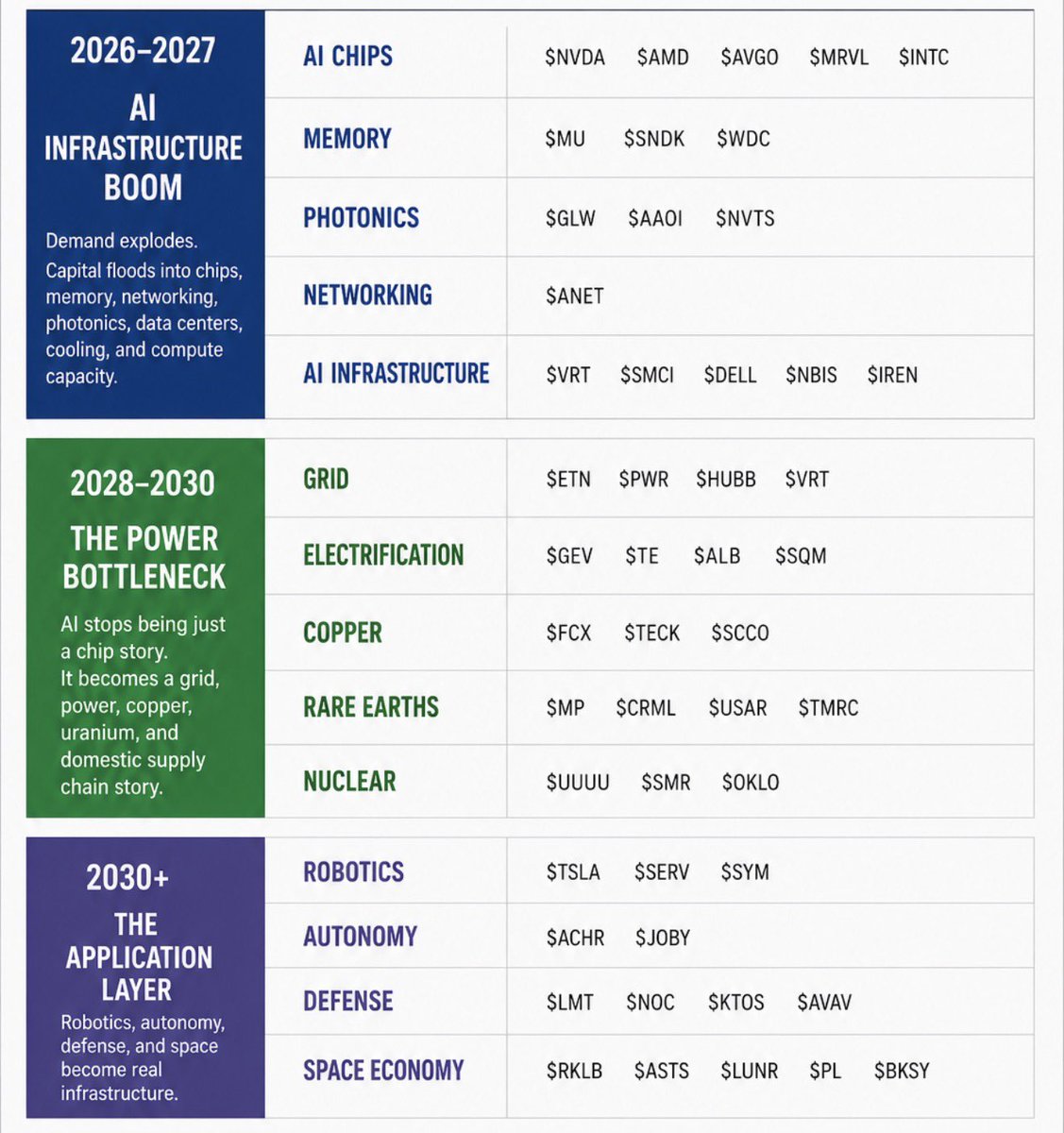
Here’s how I and those following me will position:
2026–2027: AI Infrastructure Boom
Money floods into chips, memory, networking, photonics, data centers, cooling, and compute capacity.
AI Chips: $NVDA $AMD $AVGO $MRVL $INTC
Memory: $MU $SNDK $WDC
Photonics: $GLW $AAOI $NVTS
AI Infrastructure: $VRT $SMCI $DELL $NBIS $IREN
2028–2030: The Power Bottleneck
It becomes a grid, power, copper, uranium, and domestic supply chain story.
Grid: $ETN $PWR $HUBB $VRT
Electrification: $GEV $TE $ALB $SQM
Copper: $FCX $TECK $SCCO
Rare Earths: $MP $CRML $USAR $TMRC
Nuclear: $UUUU $SMR $OKLO
2030+: The Application Layer
Robotics: $TSLA $SERV $SYM
Autonomy: $ACHR $JOBY
Defense: $LMT $PLTR $KTOS $AVAV
Space: $RKLB $ASTS $LUNR $PL $BKSY
I’m trying to help you position and become a MILLIONAIRE. I will make sure it happens.
Breaking: T1 Energy continues to surge due to The "Aschenbrenner Effect"
Leopold Aschenbrenner disclosed a ~$44,000,000 position in his 2026 Q1 filings
He disclosed his $TE position at ~$7/share a week ago
My girlfriend says she'll buy and hold $SPCX like marriage when it IPO on June 12.
She'd have $40,000,000 if she held $NVDA since its IPO with $10,000.
There's 10 stocks with direct SPACEX partnerships:
1. $SATS — EchoStar
The most direct SpaceX proxy. Sold spectrum licenses to SpaceX in a $19.6B deal and received an $8.4B SpaceX equity stake in return. Buying SATS = buying pre-IPO SpaceX exposure with a public ticker.
2. $TMUS — T-Mobile
SpaceX partnership delivers Starlink Direct-to-Cell coverage across 500K+ square miles of dead zones no special hardware needed. Guides $77B in service revenue and $37–37.5B EBITDA for 2026. Most financially dominant carrier riding the Starlink wave.
3. $FLTCF — Filtronic (OTC / AIM: FTC.L)
Pure-play SpaceX hardware supplier. Five-year supply agreement with SpaceX; revenue more than doubled to £56.3M in FY2025 with £13.4M operating profit. Landmark £47.3M contract to supply next-gen GaN E-band amplifiers for Starlink cumulative SpaceX contracts now exceed $115M. Biggest hidden gem on this list.
4. $GOOGL — Alphabet
Owns ~7.5% of SpaceX worth tens of billions at SpaceX's $1.75T IPO valuation. When SpaceX lists, Alphabet's balance sheet gets a massive mark-up. Sleeping SpaceX exposure inside a mega-cap.
5. $LUNR — Intuitive Machines
Guiding 2026 revenue of $900M–$1B nearly 5x trailing revenue from NASA lunar contracts that rely on SpaceX Falcon 9 as the launch vehicle. Every LUNR mission = a SpaceX launch. Growth is structurally tied to SpaceX cadence.
6. $RKLB — Rocket Lab
NASA formally partnered Rocket Lab alongside SpaceX for test flights and reusability research. FY2025: $602M revenue, 44.3% non-GAAP gross margins, $1.85B backlog. Also benefits directly from any SpaceX IPO-driven capital surge into the sector.
7. $FLY — Firefly Aerospace
Q1 2026 revenue $80.9M (+40% QoQ), full-year guidance $420M–$450M. Blue Ghost lunar lander launches on SpaceX rockets. Both compete together on Golden Dome contracts operationally intertwined.
8. $TSLA — Tesla
SpaceX and xAI bought ~$650M in Tesla goods in 2025, including $506M in Megapack battery systems. Tesla is effectively a major SpaceX supplier. The Musk ecosystem cross-transaction flows are now publicly disclosed and massive.
9. $WKEY — WISeKey (parent of $LAES)
WISeSat has launched multiple satellites aboard SpaceX Falcon 9 Transporter missions, with the latest embedding SEALSQ's QS7001 post-quantum chip into LEO. SpaceX is their exclusive launch partner — every new satellite = another SpaceX contract.
10. $RDW — Redwire
Q1 2026: $97M revenue (+57.9% YoY), record $498M backlog, 1.92 book-to-bill ratio. Builds in-space hardware that rides aboard SpaceX launches for defense and commercial customers. Winning large IDIQ defense contracts alongside SpaceX.
♻️ RESHARE this post and make 1 comment for my list of 1000% movers like $ASTS and $IONQ.
There's a company in Wyoming that will sell you a fully formed 12-year-old American business overnight for $3,500
It has an EIN, a state filing, a clean history, and a verifiable business credit profile from before you bought it
The bank treats you like you've been running this business since 2013
This is a real legitimate product. It's called an aged shelf company
A shelf company is a legal business entity (usually an LLC or corporation) that was formed years ago and "sat on the shelf" with no activity, no debt, no revenue, just a clean state filing and an active EIN. Specialized companies form these entities in bulk in business-friendly states (Wyoming, Delaware, Nevada, New Mexico) and hold them until someone buys
When you buy a shelf company, you're buying:
The business name (can be changed at registration)
The state filing (officially shows formation date 5-15 years ago)
The EIN (the IRS-issued business tax ID that's been on record since formation)
Sometimes: pre-established business credit accounts (Dun & Bradstreet listing, business credit cards in good standing, vendor accounts)
The legal continuity of being a "seasoned" entity
What this changes for funding:
Most business credit applications ask "years in business" on the application. A 5-day-old LLC scores low. A 12-year-old LLC scores high. Same human, same FICO, different perceived risk
Bank underwriting models heavily weight business age because longer-operating businesses default less. A 720 FICO with a 12-year-old LLC scores meaningfully higher on most issuers' business card underwriting than the same FICO with a 30-day-old LLC. The difference can be 20-40% higher approval limits and access to products that won't approve startups
Shelf companies with pre-existing business credit profiles (Dun & Bradstreet PayDex score, established tradeline history) score even higher. A shelf company with a 75+ PayDex and 8-10 established tradelines qualifies for business credit products that brand-new LLCs categorically can't access
The pricing market:
Basic 5-year-old shelf LLC, no credit history: $1,200-$2,500
10-year-old shelf LLC, no credit history: $2,800-$4,500
15-year-old shelf LLC with PayDex 75+ and 8+ tradelines: $7,500-$15,000
20-year-old shelf corp with full business credit profile: $15,000-$35,000
Where to buy: WholesaleShelfCorporations, Wyoming Corporate Services, Corporate Direct, Northwest Registered Agent (some of these companies, Google verifies the rest)
The play:
Step 1: buy a 10-12 year old shelf LLC for $3,500-$5,000. Get the operating agreement transferred. File a name amendment if you want a custom business name. Update the registered agent to you or your service
Step 2: open business checking under the shelf LLC name with the existing EIN. Walk into Chase, Bank of America, or US Bank. The bank sees "[Business Name] LLC, formed 2013." 12 years of legitimate operating history on paper. Deposit $500 to open
Step 3: 30 days after opening business checking, apply for business credit cards. Application asks "years in business." You truthfully type 12. The underwriter pulls public records, sees the 2013 state filing, sees the active EIN, sees an established checking relationship. Approves at the higher tier
Average approval lift versus a 30-day-old LLC: 25-60% higher limits on the same FICO
Same person. Same credit. Same income. The only thing that changed is the formation date on the paperwork
Important caveats (zero hedging on this part, just truth):
This is legal. Buying and operating a shelf company is fully legal in every state. The IRS doesn't care. State business registrars don't care. The banks don't have a problem with you buying a shelf company
What IS illegal under 18 U.S.C. § 1014: lying about the business's operating history or revenue on a credit application. If you bought a shelf company and tell the bank you've been operating it for 12 years generating $300K/yr in revenue, that's fraud. If you tell them you bought the entity recently and now operate it as a new business with [actual revenue], that's legal
Banks have also gotten smarter about shelf companies since 2018. Some issuers (notably Chase and Amex on certain products) now verify operations independently for newly-purchased shelf LLCs by requiring bank statement uploads or revenue documentation. The shelf company advantage is bigger than it was 10 years ago but smaller than it was 5 years ago
Best use case in 2026: shelf company combined with real business operations. You buy a 12-year-old LLC, transfer it to your name, start operating an actual business through it, and 60-90 days later apply for business credit. You get the formation-date advantage on the application while having real operational substance behind it
A friend in Phoenix bought a 14-year-old shelf corp last year for $4,200. Transferred ownership. Opened business checking. Used it to operate a marketing agency he was launching. 90 days later applied for Chase Ink Business Preferred. Approved for $58K at 0% APR. Same week applied for Amex Business Platinum. Approved for "no preset spending limit" (which functions as $50K-$100K usable)
The same human applying with a brand new LLC formed last month would have gotten roughly half those limits. The $4,200 paid for itself in week one of the business
The richest small business owners in America have stables of aged shelf companies sitting at their attorney's office. They activate them on demand whenever they want to look established to a new bank. The product has existed since the 1970s. It's only "obscure" because nobody talks about it
dm me "funding" and i'll show you how you can qualify for up to 250k in 0% APR funding (if you have a 700+)
SpaceX is about to be the largest IPO in human history.
But here’s the catch…
It’s also going to be the trade most retail investors REGRET for the next 5 years.
Here’s why, and the 4 space stocks I’m actually paying attention to instead:
On June 12, SpaceX will list on Nasdaq under the ticker SPCX.
The expected valuation is around $1.75 trillion.
That’s more than twice the previous record IPO, and more than the GDP of all but a handful of countries on earth.
But even if SpaceX doubles from there, your return is 100%.
In the same window, a small cap space stock with the right setup can do 5x or 10x.
The math simply does not work for retail investors hoping for asymmetric returns from a trillion dollar IPO.
You are buying a fully priced, fully discovered, fully institutional name on day one.
The real money in space is not SpaceX.
It’s in the smaller, less-followed public names that will get revalued the moment SpaceX trades.
Here are the 4 I am watching:
VELO Velo3D
3D prints metal parts inside SpaceX's Raptor engines. SpaceX backed them early and was their first customer. The cleanest direct supplier name on the public market.
RDW Redwire Space
The picks and shovels of space infrastructure. Solar arrays, deployable structures, microgravity manufacturing. The stuff every satellite and spacecraft needs.
BKSY BlackSky
Real-time earth observation satellites with major defense and intelligence customer base. Sub-billion-dollar market cap with a Pentagon backlog.
GHM Graham Corporation
Rocket turbopumps through its Barber-Nichols subsidiary. Already supplies multiple US launch players. Nobody is pricing the space exposure inside this name.
Most of these sit between $1 billion and $4 billion market cap.
Meaning even if they 5x to 10x from here, they would still be relatively small businesses.
That’s the power of an asymmetric bet. Either it goes to zero, or it does 5x to 10x over the next few years.
At The Assembly, we are a team of 8 with one goal: help you find the right stocks early.
Turn notifications on so you don’t miss our alerts. This is EXTREMELY important.
If you are not following us yet, you will understand later why that was a mistake.
BREAKING: Druckenmiller has updated its portfolio.
There is full exit from Alphabet after boosting the position 277% last quarter at $287, along with a complete sale of XLF, previously a top-three holding.
New buys include STM, Roku, Broadcom, CRH, Caris Life Sciences, United Airlines, Wabtec, Southern Copper, Linde, Cleveland-Cliffs and Intel.