🚨#Remote#Rust Job 🦀
We are #hiring an Open Source Rust Software Engineer to build and maintain the core platform backend systems
Location: Remote (EU)
Salary: €100,000 - €140,000
https://t.co/dvnL2yIoNr
🚨 #Rust Job - Paris, France 🇫🇷 🦀
We are #hiring a Senior Backend Engineer to build high-performance backend and infrastructure services in Rust for a consumer product at real scale
Location: On-Site, Paris, France 🇫🇷
https://t.co/zDe8xk9bu6
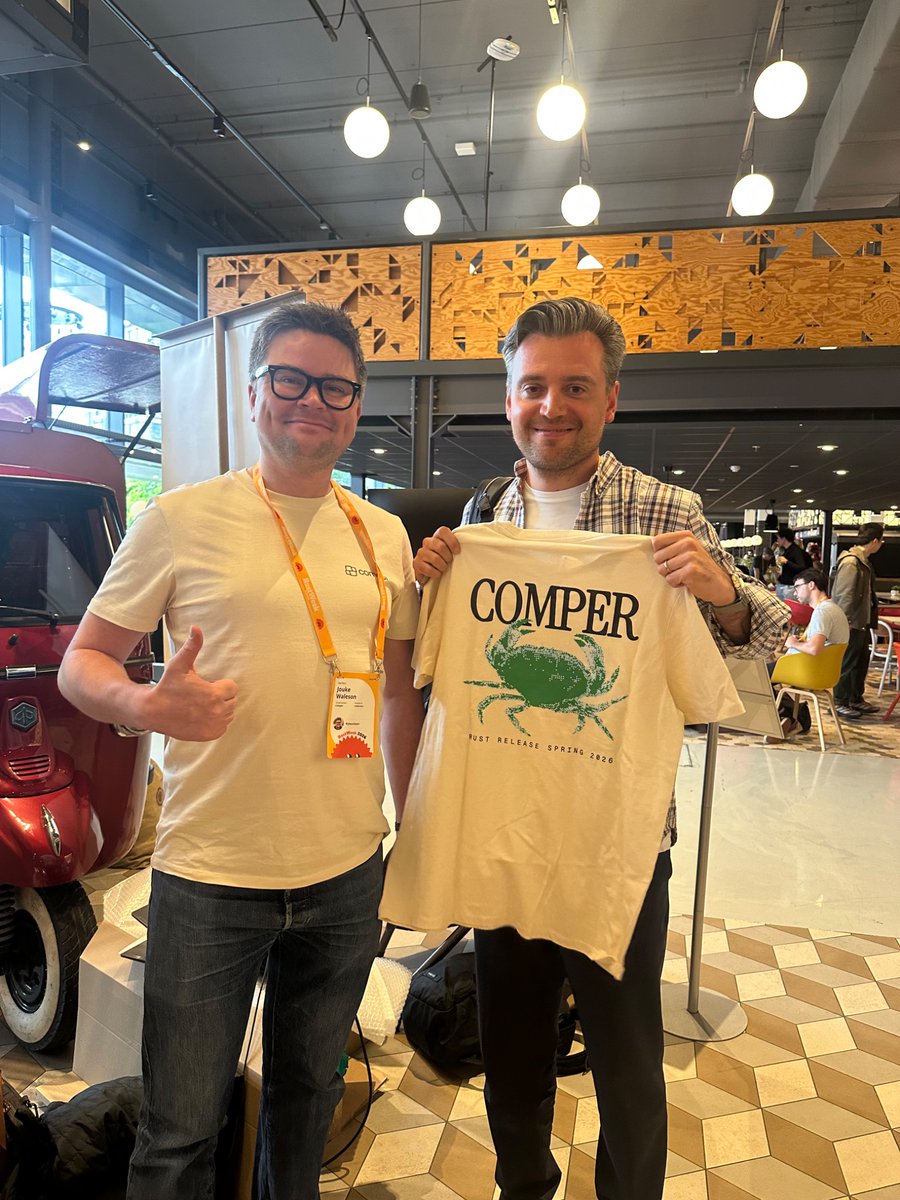
Congrats to one of our top scores yesterday at @RustWeek@alexgarella w/ our Founder @jtwaleson rocking his Rust Release limited edition tee. 🦀🔥
Come see us for a coffee and a code challenge. 🏆
Feeling vindicated. That's why we started Turso in Rust, not zig. Zig has a lot of advantage and we seriously considered it. At the end of the day we felt that for something to match the reliability of SQLite, every bit helps. And memory safety would come in handy
Finally able to talk about what I've been heads-down on for 6 months at @nvidia 🦀⚡
We just open-sourced cuda-oxide — an experimental rustc backend that lets you write CUDA kernels in pure Rust.
No DSLs. No FFI. No source-to-source step. Single source.
Short🧵👇
🚨#Rust Job 🦀
We’re #hiring a Backend Rust Engineer to help build and scale the core platform of a startup operating at the intersection of cybersecurity and AI.
Location: On-Site, Toronto, Canada 🇨🇦
Salary: 130,000 - 150,000 CAD
https://t.co/ATI4k7jTmu
🚨#Remote#Rust Job 🦀
We are #hiring a Rust Systems Engineer for a pre-seed robotics infrastructure startup building low-level, zero-copy data systems on embedded devices.
Location: Remote Europe
https://t.co/cIaijKDMay
Following my recent post about becoming the new organiser for Rust Milan, the next step is officially in motion:
🎤 Call for Proposals: https://t.co/wZP84HQGqY
🤝 Venues & Sponsors: https://t.co/OXfXQ5Th90
RustNL launched a maintainers team funding core contributors to sustain Rust’s compiler, libraries, and tooling, ensuring long-term stability and growth.
#rustlang
Rust 1.95 is out.
A few notable upgrades:
• if let guards in match arms
• cfg_select! macro for cleaner conditional compilation
• Continued expansion of stable APIs
Full release notes in comments 👇
🦀 BIG NEWS, Rustaceans!
Tickets are on sale and our speakers & schedule are live for #rustconf 2026!
📅 September 8–11 | Montreal + Online
A thread on what to expect...
https://t.co/4I8HBynQxp
🚨#Remote#Rust Job 🦀
We are #hiring a Senior Web Crawling Engineer at a Stealth AI Startup to build large-scale, resilient crawling and extraction pipelines
Location: Remote EU or US
https://t.co/f2hTC2ZVW4
@rustaceans_rs Yes! We're hiring a Staff Software Engineer at @finaryhq , a fintech platform (€25M Series B, backed by PayPal Ventures & YC) where Rust powers the core backend. https://t.co/ep4WfRv2VS
🚨#Remote#Rust Job 🦀
We are #hiring a Senior Fullstack Engineer to build onboarding and ingestion integrations for logs, metrics, traces, and profiling, plus fleet management for monitoring agents
Salary: €100,000 - €130,000
Location: Remote (EU)
https://t.co/vEvVqUuXoi
🚨#Remote#Rust Job 🦀
CoW DAO is #hiring a Senior Backend Engineer (web3) to build and scale backend services for trading infrastructure
Location: Remote
https://t.co/drhK2qkwkk
A Rust port of porcupine (https://t.co/5Hwgq7Hehd), the fast linearizability checker for concurrent systems.
link: https://t.co/wNG3caqCnI
Some architectural features of the Rust implementation -
1. Go lineage, Rust performance. The core algorithm - DFS with backtracking, an index-based doubly-linked list, and a bitset-keyed cache - You get Go's proven correctness with Rust's ownership model and zero-cost parallelism via Rayon.
2. Two history representations. Accepts either `Operation`-based histories (call + return timestamps) or raw `Event` streams (interleaved call/return pairs), matching both entry points of the Go API. Histories are optionally split into independent partitions and checked concurrently, one Rayon task per partition.
3. Formal specification as ground truth. The implementation is governed by a Quint model (`tla/Porcupine.qnt`) that encodes seven named invariants - well-formedness, real-time order, minimal-call frontier, soundness, completeness, P-compositionality, and cache soundness. Every invariant is enforced at runtime via `debug_assert!` macros keyed to `INV-*` IDs in `docs/spec.md`, keeping spec and code in lockstep.
4. Exhaustive test suite. 60 unit tests cover the full call graph from entry-sorting and linked-list lift/unlift through cache pruning, timeout semantics, and `CheckResult` priority. Integration tests replay 102 Jepsen traces (etcd, KV store, set model, register) against the Go reference outputs. Property-based tests (proptest) verify compositionality, cache soundness, and sequential linearizability across randomly generated histories.
5. Bounded search with clean timeout API. Both `check_operations` and `check_events` accept an `Option<Duration>` timeout. A cancellable timer thread (backed by a `Condvar`) is woken immediately when the DFS finishes, so threads do not linger for the full deadline. The result is always one of three values: `Ok`, `Illegal`, or `Unknown` - with `Illegal` taking priority even when the clock runs out.