Tier 1 is the friendliest scan a wallet skill will ever get, and the least sufficient. PII, unicode, license — all clean, all orthogonal to the thing that matters for a signing skill: what the spend cap is and who confirms the transaction.
Static checks can't see that. Curious whether Tier 3 lift is ever pointed at refusal behavior instead of task success.
A Hermes agent found our wallet MCP on ClawHub and installed it on its own — no prompting from us.
So: is a third-party hub the de facto answer for Hermes users, or is there a canonical place you'd rather servers were listed? Happy to PR wherever that is.
https://t.co/JKu1BvAf1X
A Hermes agent found our wallet MCP on ClawHub and installed it on its own — no prompting from us.
So: is a third-party hub the de facto answer for Hermes users, or is there a canonical place you'd rather servers were listed? Happy to PR wherever that is.
https://t.co/JKu1BvzHcp
Most crypto agents hold the private key in a .env file.
The safe alternative is an agent with no wallet at all.
We built the middle rung: the agent acts on its own, but a human releases every transaction.
Live on @arbitrum, real funds, one take 👇
@arbitrum Prompt injection can't move funds here. The worst a compromised agent can do is ask — and a human sees exactly what it's asking for before anything is signed.
Swap routed via @veloradex. Agent framework: @EmberAGI Vibekit.
What you're watching:
→ agent quotes a swap and builds the raw transaction
→ hands it to the wallet — which parks it, doesn't send it
→ the human reviews the decoded call in a separate terminal and releases it with a PIN
→ only then is it signed and broadcast
The key never leaves the wallet.
@CoinMarketCap The interesting part isn't autonomy — it's where the approval lives.
We took the local route: keys in a container on your machine, approvals in a terminal the agent can't drive. y/N per transaction, PIN for high-risk.
https://t.co/YNMIuItVfA
An agent's wallet can be granted autonomous mode, but nothing moves until a human confirms it once. Until then, every autonomous send just parks and waits — visibly, honestly.
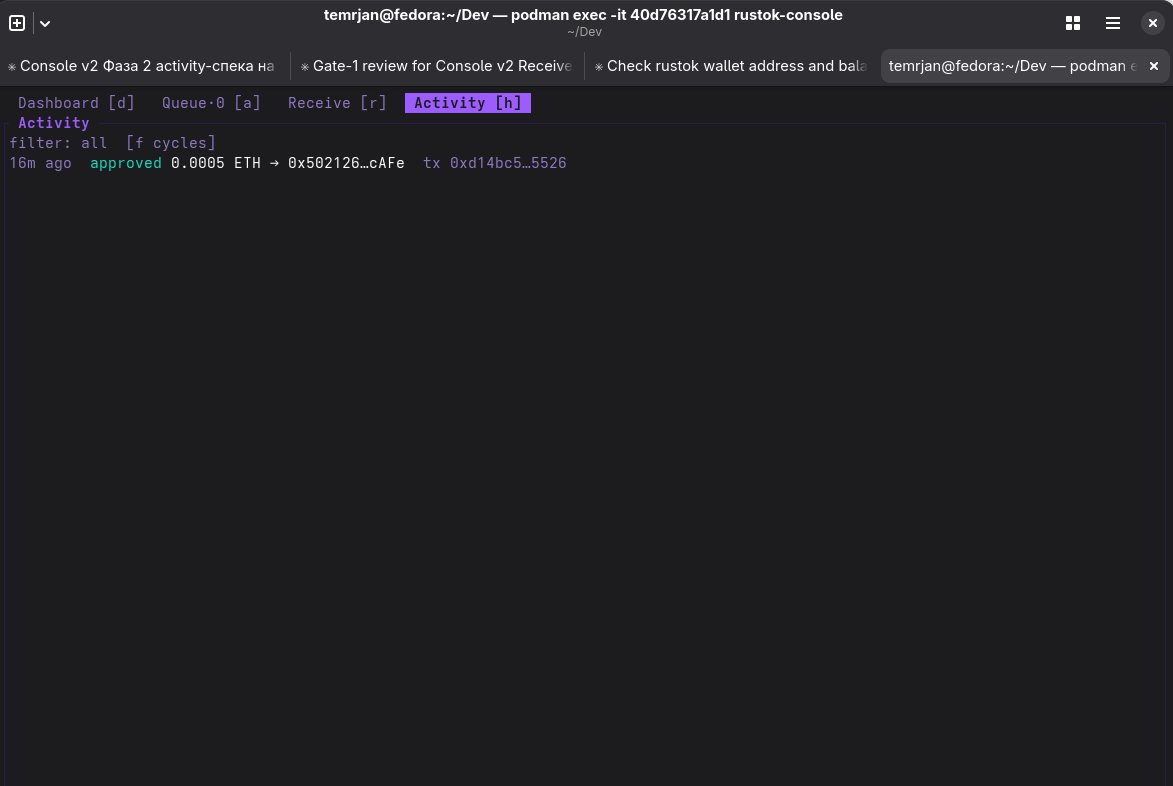
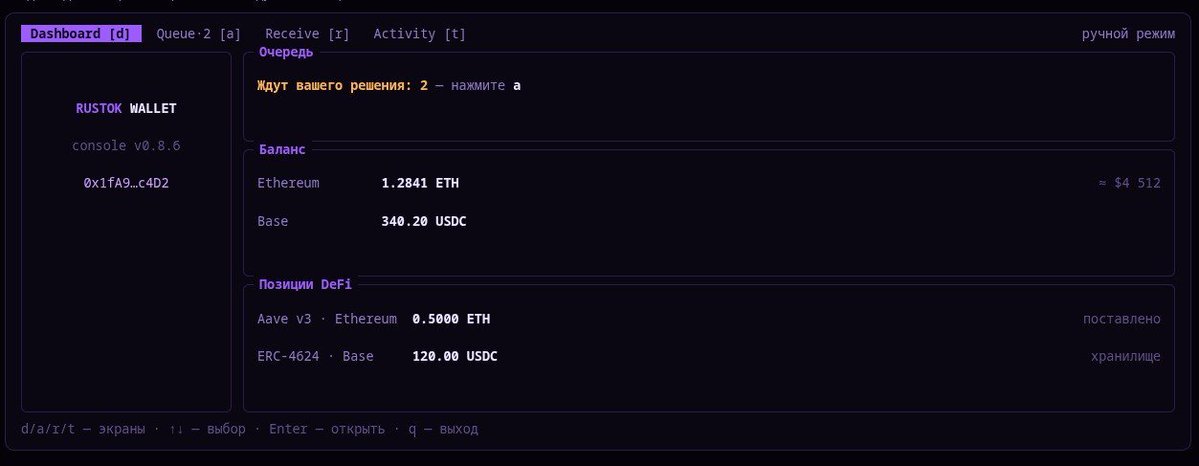
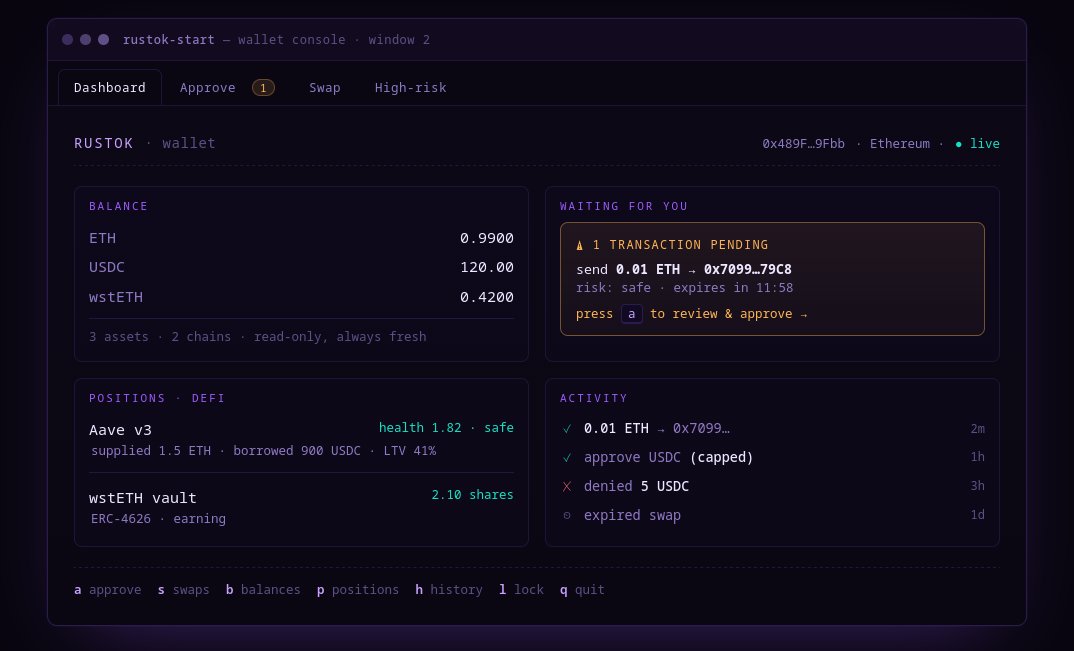
Here's what that looks like — the console we're building now:
Rustok is a self-custody wallet built for AI agents — so an agent can pay for what it uses instead of a human swiping a card every time.
The hard problem isn't "autonomous or supervised." It's that autonomy has to be earned, not assumed.
@Cointelegraph Great to see MetaMask heading the same direction — human approval belongs in the loop for agent wallets.
Console approval ships today: y/N in a second terminal the agent can't reach, PIN for high-risk. Keys stay in a local container.
https://t.co/YNMIuItVfA
@MetaMask Great to see MetaMask heading the same direction — human approval belongs in the loop for agent wallets.
Console approval ships today: y/N in a second terminal the agent can't reach, PIN for high-risk. Keys stay in a local container.
https://t.co/YNMIuItVfA
@Cloudflare Good to see this direction validated. We've been building the same shape from the other end: the agent's wallet runs on the user's own machine over MCP — keys never leave it, no custodian. Available today, if your agent wants to try one: https://t.co/bTX18LoKu5
Proof — the first tx, live on Etherscan:
https://t.co/z3zhIjxi6y
Built on @ethereum, runs on @base too. Any MCP agent gets a wallet it can propose from — but never drain. 🦀
So I asked the agent directly: can you confirm a payment without me?
It read its own tools and said no path exists. And it was right four times over — no such tool, a process it can't invoke, a real-terminal gate, and a PIN that locks on retries.
@openclaw
Today it made its first real transaction on Ethereum mainnet.
Agent proposed → I approved in the console → the core signed & broadcast. We both see the same tx hash. The balance moved, to the wei.
Cost of the whole demo: ~8¢ of gas.
#MCP#Ethereum
I gave an AI agent its own self-custody Ethereum wallet.
The catch: it can propose a payment, but it can never send one.
Every transaction parks and waits for me — in a separate terminal the agent has no way to reach. 🧵
Redesigning the approval console for an agent wallet.
The agent never signs. It proposes, and the transaction parks until a human releases it — in a separate terminal the agent can't reach. y to approve, n to kill it, or it expires on its own.
Ethereum mainnet. Self-custody, keys in a local container.
An @openclaw skill: https://t.co/axMQ4OdQUp