🚨𝐁𝐑𝐄𝐀𝐊𝐈𝐍𝐆🚨
https://t.co/INtB1X52ty just raised $300M to launch an industry-first 1000x leverage platform.
Stocks, crypto & commodities in one place, with some of the lowest fees in the industry.
@getonmoon
𝐓𝐇𝐄 𝐓𝐆𝐄 𝐈𝐒 𝐋𝐈𝐕𝐄 — 𝐁𝐔𝐓 𝐓𝐇𝐄 𝐑𝐄𝐀𝐋 𝐒𝐓𝐎𝐑𝐘 𝐈𝐒 𝐉𝐔𝐒𝐓 𝐒𝐓𝐀𝐑𝐓𝐈𝐍𝐆
A token launch can easily become the headline.
But for me, the more interesting part is everything that had to happen before the launch.
@KiiChainio has been building around Onchain FX, stablecoin infrastructure, cross-border payments, 24/7 settlement, emerging-market liquidity and the KiiChain App.
Now $KII is live.
𝐒𝐨 𝐈 𝐬𝐞𝐞 𝐭𝐡𝐢𝐬 𝐥𝐞𝐬𝐬 𝐚𝐬 𝐚𝐧 𝐞𝐧𝐝𝐢𝐧𝐠 𝐚𝐧𝐝 𝐦𝐨𝐫𝐞 𝐚𝐬 𝐚 𝐭𝐫𝐚𝐧𝐬𝐢𝐭𝐢𝐨𝐧:
Building ➠ Launching ➠ Scaling
The community that tested, farmed ORO, used the products and kept showing up has now reached a new chapter with the ecosystem.
And to be sincere, that is the part I’m watching most closely.
$KII is live. Learn more about the launch and follow the official KiiChain channels for what comes next.
𝔻𝕒𝕪 𝟙𝟙/𝟙𝟘𝟘.
Have you ever tried sending crypto to an exchange and noticed they gave you both a wallet address and a memo/tag?
That extra line is not there for decoration.
In today's video, I break down what a memo/tag actually does using a simple real life example, and why you shouldn't ignore it when making certain deposits.
Day 14/100.
You can send someone crypto without knowing their name, phone number, or bank details.
All you need is their blockchain address.
But what exactly is an address, and why can you share it while your private key must stay secret?
Let’s break it down.
𝐈𝐅 𝐈 𝐂𝐎𝐔𝐋𝐃 𝐎𝐍𝐋𝐘 𝐏𝐈𝐂𝐊 𝟓 𝐒𝐓𝐎𝐂𝐊𝐒…
@MEXC just turned stock picking into a little challenge.
I had to choose only 5 US stocks for my cart, so I went with:
☞ MCD
☞ NKE
☞ SHOP
☞ BABA
☞ KO
I explained why I picked each one and built my cart in the video.
Now I’m curious…What would your 5 be?
Build your own #MEXC0808 and let’s see whose cart looks better over the week.
What I like about @feeldotcash is that it is not trying to make launching a coin feel like some complicated technical process.
You have an idea ➠ launch it ➠ let people discover it ➠ let the market decide.
That simplicity could be a big deal on @base.
And with the team already having experience shipping products at scale, I’m curious to see how far https://t.co/Yl9XbTVpXN can actually push the launchpad category.
Feels like the competition is only getting started.
𝐖𝐇𝐘 𝐁𝐈𝐍𝐀𝐍𝐂𝐄 𝐂𝐇𝐎𝐒𝐄 𝐓𝐇𝐄 𝐇𝐀𝐑𝐃𝐄𝐑 𝐏𝐑𝐎𝐃𝐔𝐂𝐓
One thing that stood out to me from the first episode of 𝙄𝙣𝙨𝙞𝙙𝙚 𝘽𝙞𝙣𝙖𝙣𝙘𝙚 was how DG explained the thinking behind Binance’s product decisions.
The easiest option is not always the one worth building.
Take tokenized stocks.
@binance could have simply created a product that gives users synthetic exposure to stock prices. That would probably be much easier to build.
Instead, the team chose the harder route: building toward a product where users can actually redeem into real shares.
And I think that distinction matters.
If the goal is to bring traditional equity investors into the tokenized world, giving them something that feels familiar and actually connects to real shares makes a lot more sense than simply recreating price exposure onchain.
This is one of the parts of the conversation I found interesting because it shows the thinking behind the product, not just the product itself.
Watch the clip and let me know what you think.
https://t.co/t7CFXHXVFg
Can @savefefer and $FEFER become the meme people associate with @Stable?
There is already a story, a recognizable character, a community and now a new team trying to rebuild it properly.
I broke down why I think the opportunity is interesting in the video. 🎙️
What do you think?
𝐓𝐇𝐈𝐒 𝐖𝐄𝐄𝐊, 𝐓𝐇𝐄 𝐆𝐀𝐌𝐄 𝐂𝐇𝐀𝐍𝐆𝐄𝐒.
There is always that period before something launches where nobody really knows what to expect.
A few people are paying attention.
A few are testing things quietly.
And everyone else is waiting for the timeline to start screaming about it.
I think @ActionModelAI is going to be one of those launches. Because it takes a very simple idea and turns it into a much bigger loop:
Platforms need users.
Users want rewards.
AI needs training data.
ActionFi connects all three.
A platform creates a bounty for something it actually wants users to do.
You complete the task, and Action Model extension verifies the action, then you earn points. And the action becomes useful training data for the Large Action Model.
That is a much more interesting loop than:
𝙁𝙤𝙡𝙡𝙤𝙬 𝙪𝙨 𝙖𝙣𝙙 𝙢𝙖𝙮𝙗𝙚 𝙬𝙚’𝙡𝙡 𝙖𝙞𝙧𝙙𝙧𝙤𝙥 𝙨𝙤𝙢𝙚𝙩𝙝𝙞𝙣𝙜 𝙡𝙖𝙩𝙚𝙧.
And with multipliers reaching as high as 73x, the platform you choose matters just as much as the task you complete.
So before ActionFi goes live, don’t just ask:
How do I earn?
Ask:
Which actions are actually worth my time?
Because next week, the answer starts getting very interesting. 🔥
ActionFi is coming.
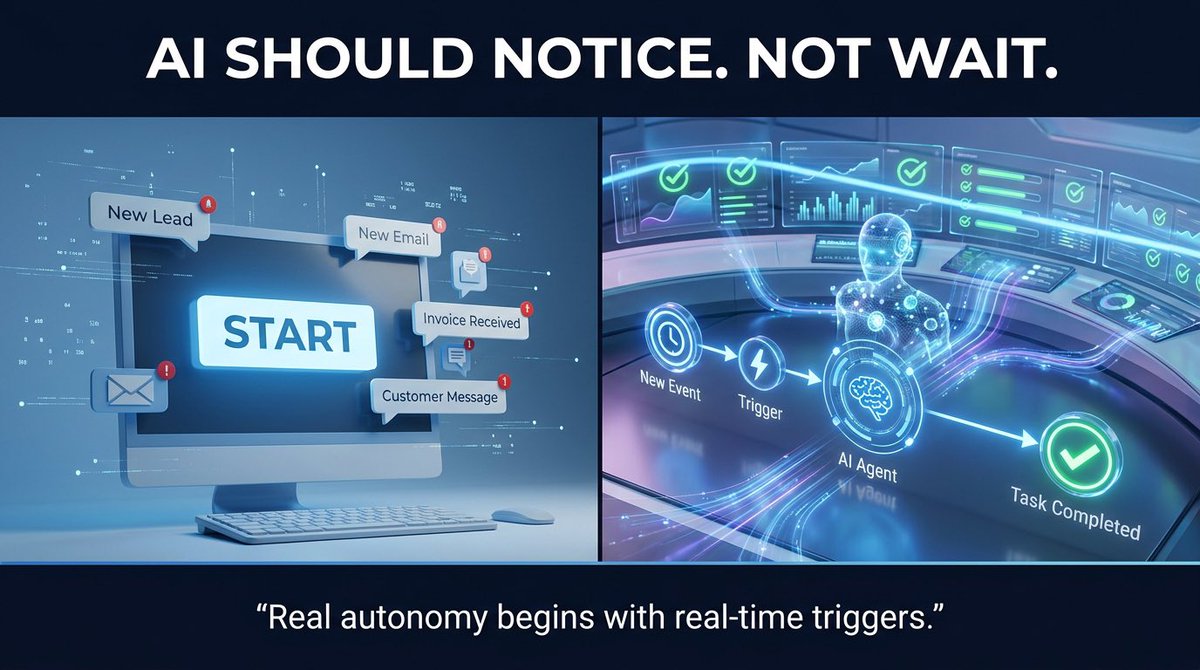
For decades, software has had one frustrating habit.
It waits.
It waits for you to click the button. It waits for you to open the app. It waits for you to notice the email. It waits for you to remember the deadline. No matter how powerful the software becomes, nothing happens until a human starts the process.
That is how we have always interacted with computers.
But people don’t work like that.
Good employees don’t wait for someone to remind them every five minutes. They notice when something changes and respond.
A new customer signs up? They send a welcome email.
A payment fails? They follow up.
A meeting ends? They send the summary. The event itself becomes the instruction.
That is exactly why @ActionModelAI Actionist triggers matter.
Instead of asking your AI agent to run manually every single time, you define what should happen when a specific event occurs. A new lead enters your CRM. A Slack message arrives. A form is submitted. A webhook fires. The trigger activates, and your agent immediately begins working without anyone touching a mouse or keyboard.
That may sound like a small feature.
It is actually one of the biggest differences between automation and autonomy.
Automation follows schedules.
Autonomy responds to reality.
The future of AI is not software that waits to be used. It is software that is already paying attention.
𝐓𝐇𝐄 𝐑𝐄𝐀𝐋 𝐕𝐀𝐋𝐔𝐄 𝐎𝐅 𝐑𝐄𝐅𝐄𝐑𝐑𝐀𝐋𝐒
A few years ago, referrals mostly meant inviting friends to an app and hoping for a small reward. (Majorly during the app mining era and testnet)
Now I’m starting to see systems where referrals are tied to actual value creation instead of just signups.
Most referral systems reward growth, @ActionModelAI rewards contribution.
That is the difference.
When someone joins through your referral link, they are not entering a system built around speculation.
They are entering an ecosystem where users complete real tasks, generate real training data, and help build a community owned AI model.
Every verified action strengthens the network.
Every completed task creates value.
Every new participant helps expand the training data that powers the Large Action Model.
And because @ActionModelAI connects rewards to actual platform usage, referrals become more than marketing, they become network expansion.
With Epoch 6 starting, new users still have an opportunity to lock in better earning conditions than future participants.
The earlier the network grows, the stronger the community owned AI economy becomes.
That is what makes the referral system interesting.
It is not about inviting people for clicks, It is about bringing contributors into an ecosystem where actions have value.
Train it.
Earn it.
Own it.