I’m in a WhatsApp gc with 23 CMOs of 8-fig biz. Last week this CMO texted that Claude recommends his product in 9 out of 10 prompts.
Site traffic’s up. LLM traffic CVR is higher than ever.
This guy is 25 years old and knows more about Claude / ChatGPT naming your brand on search than anyone else I know.
I asked him to give a masterclass for my team.
We’re 90 days in, with similar outcomes:
+% of traffic with high intent to buy. 4x meetings from AI literally saying GrowthAssistant.
I asked him to share everything you’d need to know about the first 3 months of starting a GEO program. He sent me this guide that breaks down his entire process:
– High visibility channels + how to play on each one
– Tool suites he trusts and what metrics he lives by
– The easy wins to amplify any size brand in search
Comment “GEO” and I’ll DM this playbook with you.
This Chinese guy built a Second Brain in Obsidian and every morning gets 3 trading ideas that brought him $180,000 in 6 months.
Inside he runs a pipeline of 6 workflows on N8N that automatically pulls every read article, listened podcast, and voice note into a shared Obsidian vault, and a neural network analyst every morning at 6:00 finds connections between the fresh and the old and puts the 3 strongest trading ideas for the day into the inbox.
No analytics desk, no Bloomberg terminal, no Telegram chats with traders. Just a Mac Mini by the wall, an iPhone in the pocket, and 1 local Obsidian vault.
And traditional quant funds keep entire teams of 8 people on salary for the same flow of insights, while his expenses are only subscriptions to Readwise, Whisper API, and N8N hosting.
6 pipelines process about 200 sources a day and close the monthly API bill at about $120.
The Mac Mini itself stores the entire vault and keeps the neural network analyst running 24/7, and from the iPhone the owner drops any idea he hears on the go into a Telegram bot, and it lands in the vault inbox in just 30 seconds.
The starting instruction that sits in the VAULT.md file at the root of his vault looks like this:
"you are the AI analyst of a solo trader. you read his vault every morning at 6:00, find connections between fresh and old notes, and deliver 3 trading ideas he can verify in the hour before the market opens.
pipelines:
// Reader (pulls every article and highlight from Readwise, Twitter bookmarks, and Kindle into /notes)
// Listener (transcribes podcasts through Airr and voice notes through Whisper, puts them in /notes)
// Catcher (accepts any message from the Telegram bot and writes it to /inbox with a timestamp)
// Connector (every night reads across the entire vault and updates the connection graph between 4,000 notes)
// Briefer (at 6:00 AM writes a brief: 3 trading ideas for today plus the emerging thesis of the week, puts it in /inbox)
// Mobile (lives in the iPhone, answers any question about the vault by voice, and confirms alerts while the owner is on the go).
you wake the owner with a push notification only when a fresh note contradicts his active thesis or when 1 of the 3 morning ideas has a confidence score above 90%."
This instruction immediately sets the role for the system and the limits of its autonomy.
It knows it is supposed to connect new with old on its own.
It knows it is supposed to prepare 3 trading ideas every morning on its own.
It knows it connects the live trader only when a thesis is contradicted or an ultra-confident idea appears.
→ Reader pulls about 80 articles and highlights a day from Readwise, Twitter, and Kindle
→ Listener transcribes 4 to 6 podcasts a week through Airr and Whisper
→ Catcher intercepts all voice and text ideas through the Telegram bot, averaging 15 to 20 a day
→ Connector updates the connection graph between 4,000 notes every night, adding 25 to 30 new edges
→ Briefer puts a fresh brief with 3 trading ideas and the emerging thesis into the inbox at exactly 6:00
→ Mobile answers any question about the vault by voice and confirms alerts right from the iPhone
And only when a new note contradicts his active thesis or 1 of the ideas breaks 90% confidence does the orchestrator raise the owner with a push notification.
And when the trader at that moment is driving to the gym or eating breakfast, the Mobile agent in his iPhone answers any quick question about the vault by voice: what he wrote about this ticker last week, which 3 sources support the idea of long NVDA, and what counter-thesis already sits in his notes.
The trader makes the decision and sends the order before New York opens.
The fresh brief from last Monday looks like this:
"reader: 78 materials added over the weekend, 11 of them about semiconductors, 4 about energy, 3 about biotech. passing to connector."
"connector: 27 new connections found between fresh materials and the vault, the strongest one is that the Goldman report from Wednesday matches the NVDA thesis you wrote 3 weeks ago."
"briefer: 3 trading ideas for today: long NVDA (confidence 0.84), short Tesla at the close of the quarterly report (0.71), watch URI (0.62). emerging thesis of the week: the market is underpricing capex on data centers."
"alert: your fresh note about long-term risk in semis contradicts the NVDA thesis. sending for review."
In his work setup there is no cloud server, no team of analysts, and not even a Bloomberg subscription.
At home sits a Mac Mini with a local Obsidian vault, on top run 6 N8N pipelines and a neural network analyst, and the same vault mirrors to a secure terminal on the iPhone.
Out of everything I have seen this year, this is the cleanest solo trading setup on a second brain: $120 a month on the API, about $30,000 a month into the account, and between them 6 pipelines, 4,000 connected notes, and 1 iPhone in the pocket.
> most use Claude Code like autocomplete
> they don't know repos exist
> 100 of the best. all links.
> skills. agents. memory. MCP.
> Mac Mini. Claude Code. one month.
> install just 5-10 of these
> already ahead of 95% of users
> paying for the same Claude as you
this Adaptive agent uses GPT's new image model to run your entire creative + marketing team, on autopilot.
here's how any business can replace their whole marketing op with it:
- generates fresh on-brand creatives for every platform, daily
- writes and schedules the content across every channel
- replies to every comment the second it drops
- DMs every lead and turns cold interest into booked clients
- boosts paid ads from your best-performing organic posts
- doubles down on the creatives that win, kills the ones that don't
- tracks performance + adjusts strategy automatically, 24/7
every step from brand → booked client is fully automated.
reply "AGENT" + RT and I'll send you the full guide so you can set it up too
i genuinely should be gatekeeping this but f*ck it:
FULL breakdown of the exact manus ai prompts i use to build high-converting ecom landing pages in MINUTES
for 24h, i'm sending it to EVERYONE who likes + comments "PAGES"
(must be following + RT for priority access)
Here's how to go from "looks AI-generated" to "who designed this?":
Step 1: Screenshot sites you admire
Drop them into Claude.
Say "extrapolate the key design elements and create a design system."
Step 2: Save that style guide
Every future component references it.
That's how you get consistency.
Step 3: Use existing component libraries as reference
Tools like Tailarc Pro give you polished blocks and illustrations to build on top of.
Step 4: Refine in Figma/paper first
Try different layouts visually before touching code.
The secret isn't better prompting.
It's giving the AI a design system to follow, just like a real developer would get from a designer.
That's how you go from "looks AI-generated" to "wait, this was vibe-coded?"
CURSO COMPLETO de CLAUDE AI en 5 HORAS
Guarda esta página antes de que se te pase.
Crea herramientas útiles.
Automatiza tareas repetitivas.
Aprende cómo la gente diseña bots y sistemas.
550 UGC ads/day at $1 each. Creative bottlenecks = gone.
- Claude + MakeUGC = AI creative strategist
- Finds winning angles + predicts fatigue
- Tells you exactly what to make next
- Auto-produces high-quality UGC
- Scripts, pacing, variations included
No creators. No delays. Just scale.
Comment “UGC” for the workflow
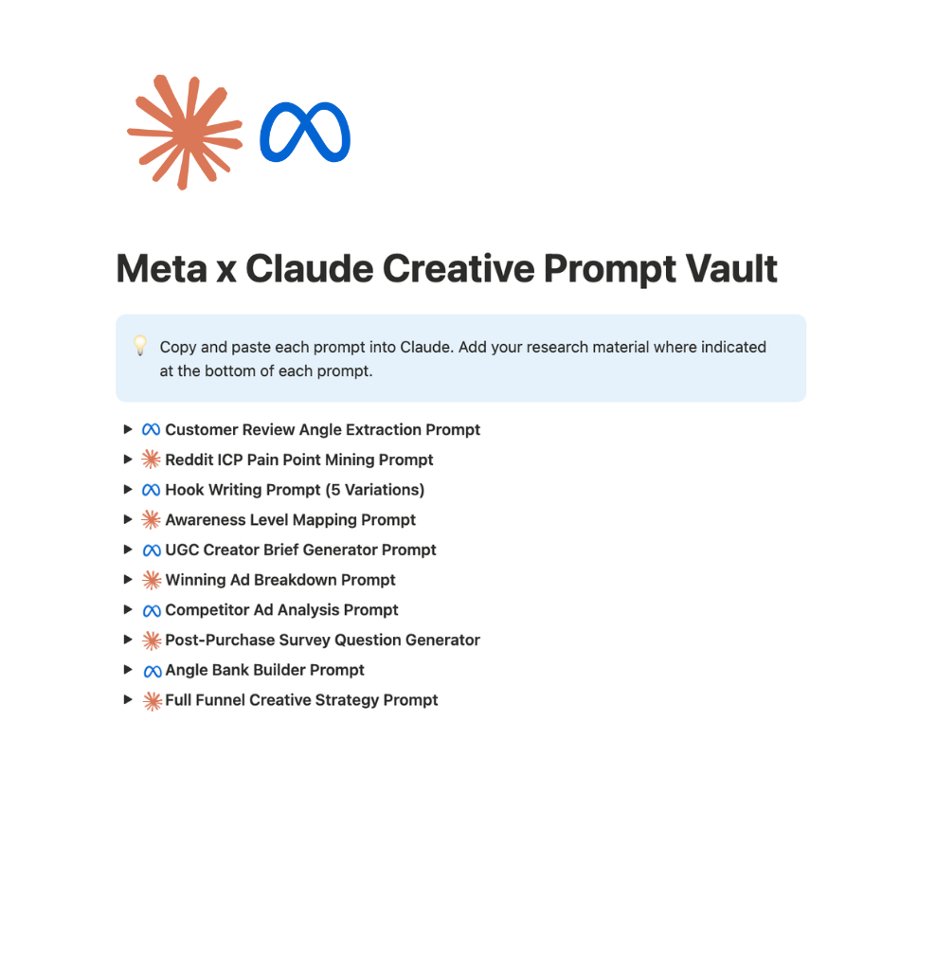
I use Claude to build winning Meta ad creative from scratch.
I put together my Meta Creative Research Vault (below)
Claude is BY FAR the best tool for extracting angles, writing hooks, and briefing creators.
I use my customer data combined with my prompts to go from zero to a full creative brief in under an hour.
My prompts replace an entire research team.
I compiled ALL my Claude prompts into one vault:
● Customer Review Angle Extraction Prompt
● Reddit ICP Pain Point Mining Prompt
● Hook Writing Prompt (5 variations from one angle)
● Awareness Level Mapping Prompt
● UGC Creator Brief Generator Prompt
● Winning Ad Breakdown Prompt
● Competitor Ad Analysis Prompt
● Post-Purchase Survey Question Generator
● Angle Bank Builder Prompt
● Full Funnel Creative Strategy Prompt
Want access?
→ Comment "Meta"
→ Follow me and I'll DM you the vault
In under a year, IM8 Health crossed a $100M+ annualised run-rate and the underlying metrics actually improved as they grew.
With Danny Yeung joining us on the podcast tomorrow, it felt like the right time to reshare our funnel breakdown to show what’s actually driving the numbers:
A few numbers worth paying attention to:
- $100M+ ARR pace in ~11 months
- 76% QoQ growth in the latest quarter
- 80%+ of first-time buyers convert to subscription
- $150 AOV, up materially post product expansion
- EBITDA losses now ~$2M per quarter, with breakeven in sight
We mapped IM8’s entire growth system end-to-end in a teardown a few months back, covering:
- Performance media across Meta + Google
- High-converting lander architecture
- Subscription-first funnel design
- Email + retention doing real revenue work
- Ambassador-led distribution
- Strong organic + owned community
- Bundled offers that lift AOV
- Clear, science-backed positioning (without killing brand)
If you want the full breakdown:
1️⃣ Retweet this the post
2️⃣ Comment “IM8”
3️⃣ Make sure you're following so I can send it over